Group Insolvency Under IBC: Coordination, Consolidation and Case Law
Group insolvency under IBC is a phrase candidates often assume has its own chapter in the statute. It does not. When a lending consortium finances a corporate group with a parent company and several subsidiaries, each entity that defaults still goes through a separate Corporate Insolvency Resolution Process under the existing Code. There is no standalone group provision. What exists instead is a Working Group report, formed under IBBI with MCA support, that recommends a phased path forward. Tribunals have filled the gap case by case. This article separates settled law from recommendation, and shows what a consortium banker needs to track.
📚 Why the IBC Has No Group Insolvency Framework
The Insolvency and Bankruptcy Code, 2016 was built around one idea: one corporate debtor, one resolution process. Sections 7, 9 and 10 all frame admission around a single applicant and a single defaulting company. You can trace this design in the Structure of the IBC chapter, where the Code's architecture is laid out layer by layer.
Real corporate groups do not behave like isolated units. A parent company routinely guarantees a subsidiary's loans. Subsidiaries lend to each other. Directors sit on multiple group boards. Cash gets pooled centrally and moved between entities. None of this is unusual, and none of it is addressed by a dedicated provision in the Code.
So when one group entity defaults, lenders cannot simply file one application covering the whole group. Each corporate debtor is legally distinct, and each needs its own admission, its own resolution professional, and its own committee of creditors, at least under the law as it stands today. This gap became visible early, when large, debt-heavy business groups went through simultaneous defaults across several linked companies, and tribunals had no statutory toolkit built for that scenario.
💡 Exam Tip: If a question asks whether the IBC has a "group insolvency chapter," the answer is no. Anchor your answer in Sections 7, 9 and 10, which apply to one corporate debtor at a time.
🔍 The Working Group's Phased Roadmap
To close this gap, a Working Group on Group Insolvency was constituted under IBBI, with the Ministry of Corporate Affairs steering policy direction. The group studied how other jurisdictions handle linked corporate defaults and looked closely at the UNCITRAL model on enterprise groups. Its core conclusion was cautious: do not attempt one big-bang group insolvency law. Move in phases instead.
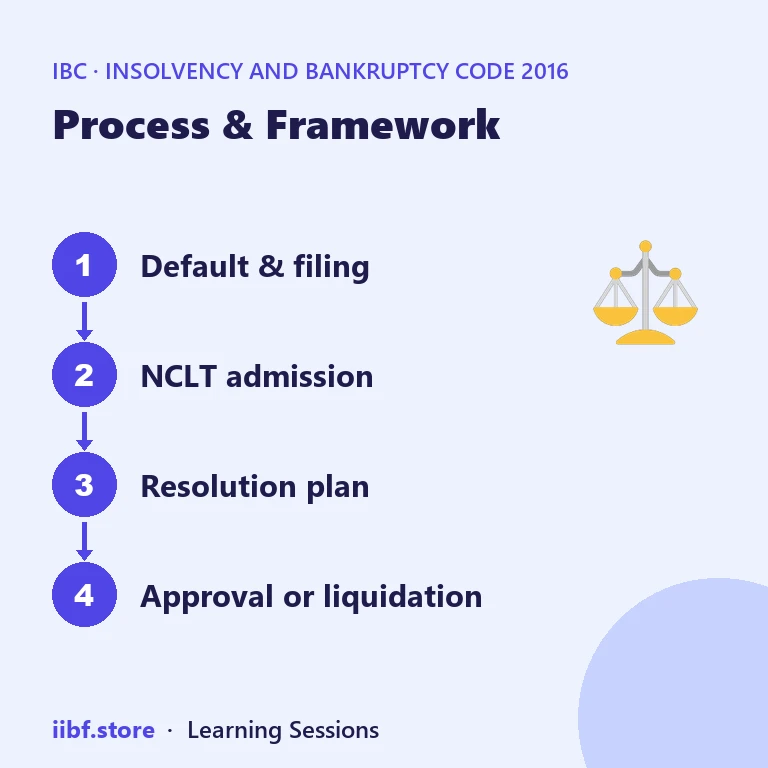
The first phase it recommended is enabling framework for procedural coordination. This means group companies undergoing CIRP at the same time could have their cases heard together, share information, and follow synchronised timelines, without disturbing the separate legal identity of each entity. Nothing here merges assets or creditors across companies.
A second, more demanding phase was flagged for later: substantive consolidation, reserved for rare, tightly entangled group structures where separating assets and liabilities is practically impossible. The Working Group was clear that this step needs strong safeguards and should not become the default response to every group default.
As of August 2026, none of this has been enacted as amendments to the Code. It remains a recommendation, not law. You can check current insolvency rules and regulator updates directly on the IBBI website before quoting any reform proposal in an exam answer. Candidates should also revisit how the Evolution of Insolvency and Bankruptcy Code chapter frames these committee-driven reform proposals, and how IBBI as insolvency regulator commissions and studies such expert inputs before any rule change.
⚖️ Procedural Coordination vs Substantive Consolidation
These two terms get mixed up constantly in exam answers, so keep the distinction sharp. Procedural coordination leaves every group company as a fully separate legal person. Each still gets its own Corporate Insolvency Resolution Process, its own committee of creditors under IBC, and its own resolution professional. What changes is logistics: a common bench may hear connected matters together, timelines may be aligned, and information may be shared between processes.
Substantive consolidation goes much further. It pools the assets and liabilities of multiple group companies into one estate and treats their creditors as one combined class. The separate identity of each company is effectively set aside for insolvency purposes only. This is powerful, but it can also hurt creditors of a healthier group company who suddenly share a pool with a much weaker one. That is exactly why the Working Group treated it as an exceptional, later-phase tool rather than a general rule.
Claims teams should note that even under procedural coordination, claims verification under IBC still runs separately for each corporate debtor. Coordination speeds up communication; it does not merge claim registers.
| Feature | Procedural Coordination | Substantive Consolidation |
|---|---|---|
| Legal identity of group companies | ✅ Stays separate | ❌ Set aside for insolvency purposes |
| Number of CIRPs | One per defaulting entity | Merged into a single process |
| Committee of creditors | Separate per entity | Single combined creditor class |
| Asset and liability pool | ❌ Not pooled | ✅ Pooled across entities |
| Codified in IBC (Aug 2026) | ❌ Recommendation only | ❌ Recommendation only |
| Working Group's intended use | Default, near-term step | Rare, exceptional, later phase |
⚠️ Common Mistake: Do not write that substantive consolidation is "the group insolvency rule under the IBC." It is a Working Group recommendation, not an enacted provision, as of August 2026.
🏛️ How Tribunals Have Handled Group Cases So Far
In the absence of a codified framework, NCLT and NCLAT have relied on their general and inherent powers to manage connected group cases sensibly. This has typically meant clubbing hearings of related company petitions before the same bench, encouraging a common resolution professional where creditors agree, and coordinating timelines informally between linked CIRPs.
Well-known large group defaults over the past several years, involving multiple linked companies under one promoter umbrella, pushed tribunals toward exactly this kind of case-by-case coordination. None of these outcomes rested on a standalone "group insolvency" section of the Code. They rested on tribunal discretion, applied within the existing text that governs Commencement of CIRP for each debtor.
This matters for exam answers: judicial practice is not the same as codified law. A tribunal can coordinate hearings today; it cannot legislate a new substantive-consolidation right into existence. Candidates should also revisit how Roles and Duties of IRP and RP are defined per entity, because even coordinated group cases still need a resolution professional appointed, and functioning, separately for each corporate debtor unless creditors specifically consent to a common appointment.
Compared with jurisdictions that have codified enterprise-group insolvency chapters, India's approach today is judge-led and reactive rather than rule-based. That gap is precisely what the Working Group's phased roadmap is meant to close over time.
📌 Remember: Tribunal coordination of group cases is current practice. A codified group insolvency chapter in the IBC is not yet in force.
💼 What This Means for a Lending Consortium
For a consortium banker, the practical checklist starts with filings. If two or more group companies default together, each defaulting corporate debtor needs its own Section 7 application. There is no shortcut that lets one filing capture the whole group. Review your exposure structure against the Credit Recovery Laws for Banks chapter before assuming otherwise.
Second, do not assume a common resolution professional will be appointed automatically. Coordination across group cases is something creditors and the bench arrange deliberately; it is not a statutory default. Your consortium should raise this early with the interim resolution professional and other creditors if a coordinated process is preferred.
Third, remember that group structures often extend beyond companies into promoter-linked partnership firms and Hindu Undivided Family entities, which sit outside CIRP altogether since the Code's CIRP chapters apply to corporate debtors. Recovery against such linked partnership or HUF exposures follows separate legal routes, which is exactly why a banker's understanding of banking with partnership firms and HUF accounts matters just as much as IBC mechanics when a group borrower unwinds.
Finally, budget for slower recoveries. Multiple parallel CIRPs, even when coordinated, take longer to resolve than a single clean process, and asset values inside a distressed group can erode further while separate timelines run.
🎯 Getting Exam-Ready on Group Insolvency
To sum up: group insolvency under IBC has no dedicated chapter today. What you have is a phased recommendation from the Working Group, starting with procedural coordination and reserving substantive consolidation for rare cases, plus a body of tribunal practice built on general powers rather than a specific statute. Keep those three layers distinct in your answers: what is law, what is tribunal practice, and what is only proposed.
For more IBC topics mapped to your syllabus, browse the Insolvency and Bankruptcy Code tag hub. Then test what you have learned with chapter-wise mocks at iibf.store/tests before your next attempt.
🧠 Practice MCQs: Group Insolvency Under IBC
Q1. Under the IBC as it stands today, Corporate Insolvency Resolution Process is triggered against: (a) an entire corporate group at once (b) each corporate debtor individually (c) only the parent company of a group (d) the promoter personally
Answer: (b) — Sections 7, 9 and 10 frame admission around one corporate debtor at a time; there is no group-wide trigger in the Code.
Q2. The Working Group on Group Insolvency was constituted under: (a) SEBI (b) RBI (c) IBBI, with MCA involvement (d) NCLAT
Answer: (c) — The Working Group was set up under IBBI, with the Ministry of Corporate Affairs guiding the reform process.
Q3. Which statement best describes "procedural coordination" as recommended by the Working Group? (a) Merging assets and liabilities of all group companies into one estate (b) Coordinating timelines, hearings and information sharing while keeping entities legally separate (c) Automatically appointing one resolution professional for the whole group by law (d) Treating all group creditors as one pari passu class
Answer: (b) — Procedural coordination keeps each entity separate; it only aligns process logistics, not assets or creditor classes.
Q4. As of August 2026, substantive consolidation of group companies under the IBC is: (a) codified directly in Section 7 (b) a Working Group recommendation, not enacted law (c) mandatory whenever two group companies default (d) restricted to listed companies only
Answer: (b) — Substantive consolidation remains a proposed, phased tool. It has not been written into the Code as enacted law.
Q5. When a lending consortium faces simultaneous defaults across a corporate group's entities, current law requires: (a) one consolidated CIRP application for the whole group (b) separate CIRP applications against each defaulting corporate debtor (c) a single common committee of creditors by default (d) prior approval from the Working Group
Answer: (b) — Each defaulting corporate debtor needs its own application; the Code does not provide a single group-wide filing.
Want chapter-wise mock tests with 100+ MCQs? Start practising free →
Does the IBC have a codified group insolvency framework?
No. As of August 2026, the Code has no dedicated group insolvency chapter. Each group company is resolved through its own separate CIRP.
What did the Working Group on Group Insolvency recommend?
It recommended a phased approach: enabling procedural coordination first, with substantive consolidation reserved for rare, tightly entangled group cases later.
What is the difference between procedural coordination and substantive consolidation?
Procedural coordination aligns hearings and timelines while entities stay legally separate. Substantive consolidation pools assets, liabilities and creditors of multiple companies into one estate.
Can NCLT coordinate group company cases without a codified group insolvency law?
Yes. Tribunals have used their general and inherent powers to club related hearings and encourage coordination, even though no dedicated statute exists yet.
Quick quiz on this topic
5 exam-style questions from our free test bank — check yourself before you move on.
Practice this topic
Take a free mock test, download chapter PDFs, or watch a video class — all included on iibf.store.