Climate Stress Testing for Banks: Scenarios, Data and Disclosure (CAIIB Risk Management)
Indian banks are being pushed to treat climate change as a core financial risk, not a corporate-social-responsibility footnote. Climate stress testing for banks is the discipline that translates rising temperatures, shifting monsoon patterns and the shift away from fossil fuels into numbers a credit or risk manager can actually use — probability of default, loss given default, capital buffers and liquidity cushions. For CAIIB Risk Management candidates, this topic sits at the intersection of scenario analysis, credit risk and prudential reporting, and examiners increasingly test it as a standalone theme rather than a footnote inside ICAAP. This article walks through the two risk channels regulators care about, why climate scenarios behave differently from an ordinary macro stress test, how banks heat-map their loan book by sector, the data problems every bank runs into, and how all of this eventually lands on the board's desk as a disclosure.
🌡️ Physical Risk vs Transition Risk: The Two Channels
Every climate stress test starts by separating two distinct transmission channels. Physical risk covers the direct damage that weather and climate patterns inflict on borrowers and collateral — a cyclone-hit MSME unit in a coastal district, a drought-affected agricultural loan book, or a warehouse that floods every monsoon. These losses show up as damaged collateral values, disrupted cash flows and, in acute cases, sudden jumps in non-performing assets concentrated in specific pin codes or river basins.
Transition risk is different in character. It arises from the economy's shift away from carbon-intensive activity — tighter emission norms, carbon pricing, changing consumer preference, and stranded-asset risk in thermal power, coal mining and old-technology manufacturing. A bank's exposure to a thermal power generator or a diesel-vehicle component maker can lose value not because of a flood, but because policy and market sentiment move against the sector faster than the loan tenor assumed. Both channels ultimately hit the same balance sheet levers examiners expect you to know: credit risk (through PD and LGD), market risk (through asset repricing), and liquidity risk (through sudden withdrawal of financing to affected sectors, a theme that connects directly to liquidity risk management). Banks with concentrated exposure to coastal agriculture, coal-dependent power, or export units facing carbon border taxes carry both channels simultaneously, which is why regulators ask for a combined physical-plus-transition view rather than treating them as separate silos.
📅 Why Climate Scenarios Differ From an Ordinary Stress Test
A standard macro stress test under ICAAP typically runs a one-to-three-year horizon: a GDP shock, an interest rate spike, a credit-cycle downturn. Climate stress testing stretches that horizon out to decades, because the physical effects of warming and the transition to a low-carbon economy unfold over 10, 20 or even 30 years. This mismatch matters practically — most retail and even many corporate loans mature well before the worst-case climate scenario plays out, so banks must decide how much of a 2050 pathway to compress into a shorter risk-assessment window without losing the signal.
The second difference is uncertainty. A normal stress scenario draws on decades of historical credit-loss data. Climate scenarios instead borrow from bodies like the Network for Greening the Financial System (NGFS), which publishes orderly-transition, disorderly-transition and hot-house-world pathways built on climate science and macroeconomic modelling rather than historical bank loss experience. There is no equivalent of a 2008-style back-test for a warmer world, so results carry much wider confidence bands and are meant to be read as directional exposure indicators, not precise capital numbers. This is also why climate stress testing is exploratory in most jurisdictions, including India, rather than a hard Pillar 1 capital add-on — it feeds risk appetite, sector limits and the risk management framework, rather than mechanically inflating RWAs the way a standard credit stress test might.
| Risk Channel | Nature | Typical Horizon | Captured in Standard Stress Test? |
|---|---|---|---|
| Physical Risk | Acute events (floods, cyclones) and chronic shifts (heat, water stress) damaging collateral and disrupting borrower cash flows | Medium to long term (acute events can hit within one credit cycle; chronic shifts run 10-30+ years) | ❌ |
| Transition Risk | Policy, technology and market shifts as the economy decarbonises, repricing carbon-intensive assets and stranding exposures | Long term (out to 2050 net-zero pathways) | ❌ |
| Standard Macro Stress | Interest rate, credit-cycle and liquidity shocks used in RBI/ICAAP scenarios | Short term (1-3 years) | ✅ |
🗺️ Sector Heat-Mapping the Loan Book
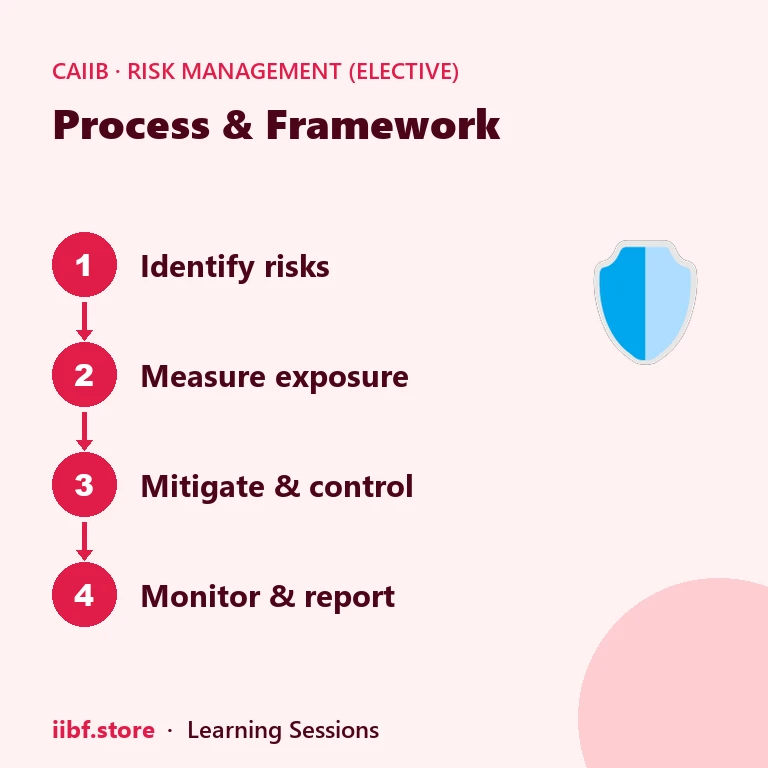
Before running any scenario, banks build a heat map of the loan book against climate sensitivity — typically a matrix scoring each sector or sub-sector on physical risk exposure (flood zones, water stress, cyclone tracks) and transition risk exposure (emission intensity, ease of switching technology, policy dependence). Thermal power, cement, steel, coal mining and commercial real estate in flood-prone cities usually land in the "high" bucket on one or both axes; IT services and diversified retail lending typically score low.
Heat-mapping is deliberately coarse at first pass — it is a screening tool, not a pricing model. Once sectors are ranked, banks drill into geography (a coastal branch's mortgage book versus an inland one), tenor (a 15-year infrastructure loan carries more transition risk than a 2-year working-capital facility), and counterparty transition readiness (whether the borrower has a credible decarbonisation plan). This layered view feeds directly into limit-setting and sector caps, and increasingly into loan pricing — a borrower with weak transition readiness in a high-carbon sector may see wider spreads, echoing the logic already used in risk based pricing of loans. For CAIIB purposes, remember that heat-mapping is the diagnostic step that precedes scenario translation — you cannot run a meaningful PD/LGD shift exercise on a book you haven't first segmented by climate sensitivity.

📉 Translating Scenarios Into PD and LGD Shifts
The technical heart of climate stress testing is converting a scenario narrative into balance-sheet numbers. For physical risk, banks typically overlay hazard data (flood maps, cyclone tracks, water-stress indices) onto collateral location to estimate a haircut on loss given default — a mortgage on a flood-prone property gets a higher LGD than an identical loan on higher ground. For transition risk, banks map carbon price and demand-shift assumptions from the scenario onto borrower cash flow projections, which then feed a shifted probability of default, typically applied as an overlay on the same architecture used in standard credit risk models in banks, expressed as a multiplier or notch-equivalent adjustment over the base-case PD.
⚠️ Common Mistake: Treating the climate PD/LGD shift as a precise, audited number. It is a scenario-conditional estimate meant to rank sensitivity across the book, not a substitute for the bank's core credit risk models used in day-to-day provisioning.
Data is the recurring constraint. Indian banks rarely have geo-tagged collateral data going back decades, granular emissions data for MSME borrowers, or forward-looking capital-expenditure plans for transition readiness. In practice, banks lean on proxies: pin-code level hazard maps from government and reinsurance sources, sector-average emission intensities instead of borrower-specific figures, and qualitative questionnaires bundled into loan renewal to capture transition readiness. These proxies are acceptable starting points but must be clearly flagged as such — a scenario built entirely on sector averages will understate risk for outlier borrowers and overstate it for genuinely low-carbon ones within a "dirty" sector. Improving data quality here overlaps directly with the discipline covered under risk data aggregation and reporting, since climate risk data ultimately has to flow through the same aggregation pipes as any other risk data.
📋 Disclosure and Board Reporting Expectations
Once a bank has run its scenarios, the results are expected to travel upward, not stay buried in a risk team spreadsheet. The board and its risk management committee need periodic reporting on climate exposure concentrations, heat-map movements, and the direction of PD/LGD sensitivity under adverse scenarios — mirroring the governance banks already apply to interest-rate and liquidity risk through their asset liability management committee structure. The Reserve Bank of India has been building out a climate risk disclosure framework requiring banks to publish standardised, phased disclosures covering governance, strategy, risk management and metrics — a structure closely modelled on international climate disclosure practice.
Supervisors are also increasingly linking climate stress testing to broader financial-stability oversight, in the same spirit that payment systems oversight in India has matured into a distinct supervisory track over the past decade — climate risk is following a similar path from voluntary disclosure toward structured, board-accountable reporting. Candidates should note that India's approach so far remains disclosure-and-governance focused rather than a hard capital charge, but the direction of travel — more granular scenarios, mandatory disclosure timelines, and board sign-off on climate risk appetite — is consistent with global regulatory momentum.
📌 Remember: Climate stress testing outputs feed governance and disclosure first, and only influence formal capital requirements once supervisory frameworks mature further.
✅ Building Climate Stress Testing Into Your CAIIB Risk Management Toolkit
Climate stress testing for banks is no longer a niche specialist topic — it now sits alongside credit, market and liquidity risk as a mainstream item on the risk committee agenda, and CAIIB Risk Management examiners test it accordingly. Know the two channels (physical and transition), the horizon-and-uncertainty gap versus ordinary stress tests, the role of sector heat-mapping as a screening step, the mechanics of PD/LGD translation under data constraints, and the disclosure-first posture of current Indian regulation.
Reinforce this with practice questions that mix climate risk with the broader risk management syllabus — instruments like derivatives and risk management increasingly show up as hedging tools for transition exposure too. Take a free CAIIB Risk Management mock test to see how these concepts get framed in exam questions, or browse the full Risk Management Elective article hub for related topics.
🧠 Practice MCQs: Climate Stress Testing for Banks
Q1. Which of the following is an example of transition risk rather than physical risk in a bank's loan book? (a) A flood damaging collateral in a coastal branch (b) A drought reducing farm loan repayment capacity (c) A thermal power borrower losing value due to stricter carbon regulation (d) A cyclone disrupting a borrower's factory operations
Answer: (c) — transition risk arises from policy, technology and market shifts away from carbon-intensive activity, not direct weather damage.
Q2. Compared to a standard ICAAP macro stress test, climate stress test scenarios typically use: (a) A shorter horizon and lower uncertainty (b) A longer horizon and higher uncertainty (c) The same horizon but no scenario narrative (d) No horizon since climate risk is instantaneous
Answer: (b) — climate scenarios run out to decades and rely on modelled, not historical, loss data, so uncertainty bands are far wider.
Q3. The primary purpose of sector heat-mapping in climate stress testing is to: (a) Calculate exact capital charges for each borrower (b) Screen and rank the loan book by physical and transition risk sensitivity before deeper analysis (c) Replace the bank's core credit risk models entirely (d) Set the bank's interest rate on retail deposits
Answer: (b) — heat-mapping is a coarse screening step that identifies where to focus detailed scenario analysis, not a pricing or capital calculation.
Q4. When banks lack borrower-level emissions or hazard data, a common practical approach is to: (a) Exclude the exposure from stress testing entirely (b) Use sector-average or pin-code level proxy data, clearly flagged as approximations (c) Assume zero climate risk for all unmeasured exposures (d) Wait until perfect data is available before running any scenario
Answer: (b) — proxies such as sector-average emission intensity or geo-level hazard maps are acceptable interim substitutes if their limitations are documented.
Q5. Climate risk stress test outputs in India currently primarily feed into: (a) A mandatory Pillar 1 capital add-on (b) Governance, risk appetite, sector limits and disclosure reporting (c) Deposit insurance premium calculation (d) Statutory liquidity ratio computation
Answer: (b) — India's current approach is disclosure-and-governance focused rather than a formal Pillar 1 capital charge.
Want chapter-wise mock tests with 100+ MCQs? Start practising free →
What is climate stress testing for banks?
It is the process of translating physical and transition climate risk scenarios into quantified impacts on a bank's credit, market and liquidity risk metrics, such as PD, LGD and sector concentration limits.
What is the difference between physical risk and transition risk?
Physical risk covers direct damage from weather and climate events to borrowers and collateral, while transition risk covers losses from policy, technology and market shifts as the economy moves away from carbon-intensive activity.
Why do climate stress test scenarios use a longer horizon than ordinary stress tests?
Because physical climate impacts and the low-carbon transition unfold over decades, so scenarios typically extend out to 2050 rather than the 1-3 year horizon used in standard ICAAP stress tests.
Does climate stress testing currently affect a bank's regulatory capital in India?
Not directly as a formal Pillar 1 charge. Results currently feed board governance, risk appetite and disclosure reporting, though the direction of regulatory travel points toward deeper integration over time.
Practice this topic
Take a free mock test, download chapter PDFs, or watch a video class — all included on iibf.store.
Keep reading