Digital Rupee CBDC in India: CAIIB Central Banking Guide 2026
Every CAIIB Central Banking Elective candidate now needs a firm grip on the Digital Rupee CBDC in India — the Reserve Bank of India's own digital currency project, issued as e₹ and tested across wholesale and retail pilots since late 2022. This guide walks through what CBDC actually is, how the wholesale and retail versions differ, where the pilot stands in 2026, and the exam angles examiners love to test. Read it alongside the Functions of Central Banks chapter for full context on why central banks issue currency at all.
🏦 Digital Rupee CBDC in India: What e₹ Actually Is
The Central Bank Digital Currency (CBDC), branded e₹ by the RBI, is a digital form of the rupee that is a direct liability of the central bank — not of a commercial bank, and not a private token like a cryptocurrency. Legally it is issued under the RBI Act, 1934, whose definition of currency now recognises digital form alongside paper notes. This single design choice separates CBDC from every existing digital payment rail in India.
When you pay through UPI, NEFT, or a debit card, money moves between commercial bank ledgers; the RBI never touches that transaction directly. With CBDC, the rupee token itself sits in a digital wallet and is redeemable one-to-one against cash, carrying the same legal tender status as a currency note. The RBI launched the wholesale pilot (e₹-W) in November 2022 for interbank settlement of government securities, followed a month later by the retail pilot (e₹-R) for closed user groups of customers and merchants across select cities.
For exam purposes, remember that CBDC sits alongside — not instead of — physical cash and bank deposits. It is one more form of central bank money, designed to keep pace with the shift towards digital payments while preserving the RBI's direct control over currency issuance, something UPI-based systems cannot offer since they merely move claims on commercial banks.
💡 Exam Tip: If a question asks whose liability CBDC is, the answer is always the RBI (central bank), never the commercial bank — that one distinction settles most MCQs on this topic.
⚙️ Wholesale vs Retail CBDC: Design and Architecture
India's CBDC exists in two distinct tracks, and mixing them up is the single most common error candidates make. The Wholesale CBDC (e₹-W) is restricted to banks and select financial institutions; the RBI first used it to settle secondary market transactions in government securities, cutting settlement risk because the cash leg and the securities leg move on the same digital rail instead of separate systems. Since 2023 the RBI has also piloted e₹-W for call money market settlement.
The Retail CBDC (e₹-R) is the version ordinary customers see — a token-based digital wallet, distributed through partner banks, usable for person-to-person and person-to-merchant payments via QR codes. Unlike a bank deposit, which is account-based and shows up as a ledger entry, a token-based CBDC unit behaves more like a digital coin: possession of the token itself proves ownership, similar to how holding a currency note does.
The RBI deliberately chose a two-tier distribution model: it issues e₹ to banks, and banks distribute it onward to customers through their own apps, exactly as currency notes flow from the RBI through bank branches today. This keeps the existing banking relationship intact and avoids disintermediating banks from deposit-taking — a concern regulators worldwide have flagged with retail CBDC design. For the CAIIB paper, the wholesale-versus-retail split, and the token-versus-account distinction, are the two design contrasts most likely to appear.
📊 Pilot Rollout: Digital Rupee CBDC in India vs Other Payment Rails
The retail pilot began with four cities and four participating banks in December 2022 and has since widened to cover more than two dozen cities and over a dozen banks, including public sector, private, and payments banks. Circulation remains a tiny fraction of total currency in circulation, reflecting the RBI's deliberately cautious, phased approach rather than a mass rollout target.
The table below places CBDC against the two payment rails candidates most often confuse it with — UPI and physical cash — on the features examiners test most.
| Feature | CBDC (e₹) | UPI | Cash |
|---|---|---|---|
| Issuer / liability | RBI (central bank) | Commercial bank | RBI (central bank) |
| Legal tender status | ✓ Yes | ✗ No (a payment system) | ✓ Yes |
| Works fully offline | ✓ Piloted feature | ✗ No | ✓ Yes |
| Interest bearing | ✗ No | ✗ Not applicable | ✗ No |
| Fully traceable by design | ✓ Yes | ✓ Yes | ✗ No |
Notice that CBDC and cash share legal tender status and offline capability, while CBDC and UPI share full traceability — CBDC effectively sits between the two, which is exactly why the RBI positions it as a complement to both rather than a replacement for either.
🔐 Privacy, Programmability, and Offline Access
Two design questions dominate CBDC discussions and both come up regularly in CAIIB mocks: privacy and programmability. On privacy, the RBI has been explicit that retail CBDC transactions are not anonymous in the way cash is — every e₹ token movement is recorded, though the RBI has piloted limited-anonymity features for small-value offline transactions to balance privacy with anti-money-laundering needs.
On programmability, the RBI's public position draws a careful line: CBDC can support programmability for specific, pre-approved use cases — for example, a government department restricting a subsidy token to be spent only on fertiliser — but it will not build blanket expiry dates or blanket spending restrictions into ordinary retail e₹. This distinction between "programmable money" and "money with programmable features attached to specific use cases" is a favourite trap in objective questions.
Offline functionality is the third pillar. The RBI has piloted offline CBDC transactions using near-field communication and other proximity technologies so that payments can go through in areas with poor network connectivity — a feature cash has always had and UPI fundamentally lacks. This offline capability is one of the strongest arguments the RBI makes for CBDC's relevance in India's less-connected regions, and it directly supports the broader financial inclusion themes covered in the Constituents of Indian Financial System Structure chapter.
⚠️ Common Mistake: Students often assume CBDC transactions are as anonymous as cash. They are not — full anonymity was deliberately avoided; only limited privacy features exist for small offline transactions.
⚖️ CBDC, Monetary Policy, and Why It Matters for Central Banking
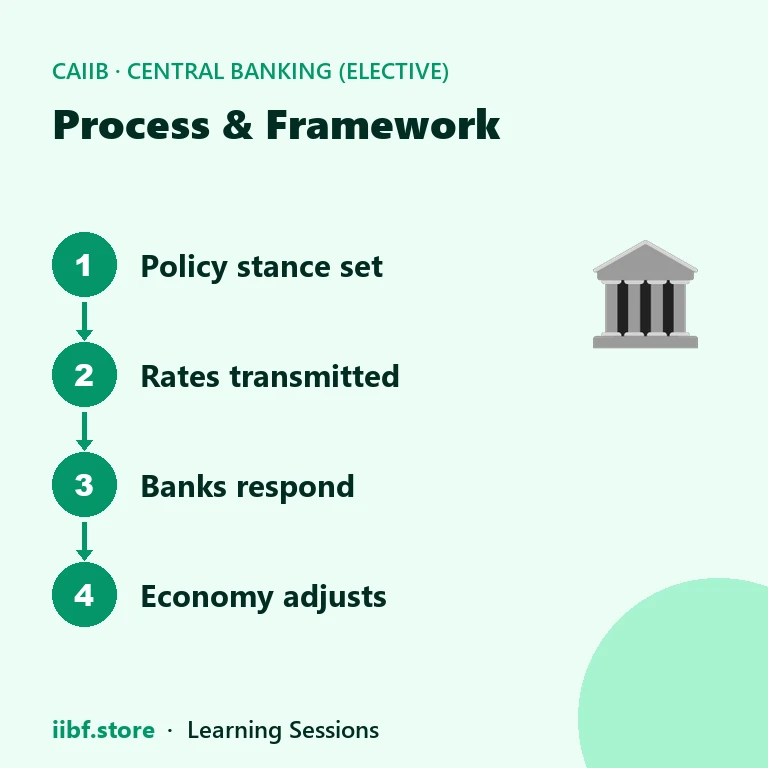
CBDC also has a monetary and financial stability dimension the CAIIB syllabus expects you to know. Because retail CBDC is a direct RBI liability, large-scale movement of bank deposits into e₹ wallets during stress could, in theory, accelerate a digital bank run — money leaving commercial banks faster than in a cash-based panic. This is one reason the RBI has kept the retail pilot deliberately small and closed-user-group based rather than opening it to the general public overnight.
CBDC adoption also interacts with the tools covered in our piece on the Standing Deposit Facility and liquidity corridor, since large shifts of banking-system liquidity into CBDC wallets would show up first in overnight liquidity management. It also ties back to the broader inflation targeting framework in India, because a well-functioning digital currency is meant to support — not disrupt — the RBI's ability to manage liquidity and monetary conditions.
For candidates studying Advanced Bank Management alongside Central Banking, the deposit-migration risk connects directly to balance sheet management in banks, where funding-mix stability is a core theme. It is also worth cross-referencing how the RBI tracks CBDC alongside money supply measures in India, since e₹ in circulation now feeds into currency-in-circulation data.
📌 Remember: CBDC is currency, not a bank deposit and not a cryptocurrency — it carries no interest, no volatility, and no counterparty risk beyond the RBI itself.
For the RBI's own publications and policy statements on CBDC, see the central bank's official site at rbi.org.in. You can browse more elective-subject explainers on the Central Banking Elective tag hub, revise related chapters like Contemporary Issues in Central Banking, or jump straight into a CAIIB course for structured prep.
🧠 Practice MCQs: Digital Rupee CBDC in India
Q1. Which entity is the direct issuer and legal liability holder of India's Central Bank Digital Currency (CBDC)? (a) The bank distributing the e₹ wallet (b) NPCI (c) The Reserve Bank of India (d) The Ministry of Finance
Answer: (c) — CBDC is a direct liability of the RBI, unlike bank deposits, which are liabilities of the commercial bank holding them.
Q2. What was the primary initial use case of the Wholesale CBDC (e₹-W) pilot launched in November 2022? (a) Retail QR code payments (b) Settlement of secondary market government securities transactions (c) Cross-border remittances (d) Replacing UPI
Answer: (b) — e₹-W was first used to settle secondary market transactions in government securities, cutting settlement risk between the cash and securities legs.
Q3. How does a token-based retail CBDC differ from a bank deposit? (a) It pays a fixed interest rate (b) It is an account-based ledger entry like a savings account (c) Possession of the token itself constitutes proof of ownership, similar to a currency note (d) It can only be held by banks
Answer: (c) — Retail e₹ is token-based; holding the token proves ownership, unlike a bank deposit which is an account-based ledger claim.
Q4. Which feature has the RBI piloted specifically to make retail CBDC usable in areas with poor internet connectivity? (a) Programmable expiry dates (b) Offline transactions via proximity technology such as NFC (c) Mandatory KYC-free accounts (d) Automatic currency conversion
Answer: (b) — The RBI has piloted offline CBDC transactions using near-field communication and similar proximity technology for low-connectivity areas.
Q5. Why has the RBI kept the retail CBDC pilot in a closed user group format rather than a full public launch? (a) Legal tender status has not yet been granted (b) To manage risks such as large-scale deposit migration from banks and to test technology gradually (c) Because CBDC is illegal outside metro cities (d) Because UPI already fulfils the same function
Answer: (b) — The phased, closed-user-group approach lets the RBI manage risks like accelerated deposit migration while testing the technology gradually.
Want chapter-wise mock tests with 100+ MCQs? Start practising free
Frequently Asked Questions
What is the difference between CBDC and UPI?
CBDC (e₹) is a direct digital liability of the RBI with legal tender status, while UPI is a payment system that moves money between existing commercial bank accounts; the RBI never directly issues the rupees moved via UPI.
Is the digital rupee legal tender in India?
Yes. Both wholesale and retail CBDC are issued under the RBI Act as a digital form of the rupee and carry the same legal tender status as physical currency notes.
Can the digital rupee be used without internet access?
The RBI has piloted offline CBDC transactions using near-field communication and other proximity technology so payments can go through even without live network connectivity, a feature designed for low-connectivity areas.
Does the digital rupee pay interest like a savings deposit?
No. CBDC functions like digital cash — it does not earn interest, mirroring the RBI's design choice to keep it comparable to physical currency rather than a competing deposit product.
🎯 Get Exam-Ready on Digital Rupee CBDC in India
The Digital Rupee CBDC in India is now a fixture in CAIIB Central Banking Elective papers, and the concepts — direct RBI liability, wholesale versus retail design, token-based distribution, limited programmability, and offline access — repeat across attempts every cycle. Lock in these distinctions with timed practice rather than re-reading notes alone. Take a free CAIIB Central Banking mock test on iibf.store and see exactly where your CBDC concepts still need work.
Quick quiz on this topic
5 exam-style questions from our free test bank — check yourself before you move on.
Practice this topic
Take a free mock test, download chapter PDFs, or watch a video class — all included on iibf.store.
Keep reading