CAIIB Central Banking: the inflation targeting framework in India explained

The inflation targeting framework in India rests on a statute, not on a policy preference — Sections 45ZA to 45ZN of the Reserve Bank of India Act, 1934, inserted by the Finance Act, 2016. For CAIIB Central Banking (Elective), that one sentence is worth underlining, because most questions from this area test the legal architecture rather than the economics.
Examiners repeatedly ask three things: who fixes the target, what exactly counts as a failure to maintain it, and what the Reserve Bank must do when it fails. This article walks through each, maps the statutory sections you are expected to quote, and separates the settled law from the contested economics.
🏛 Why India Moved to a Statutory Target
The inflation targeting framework in India was the fourth monetary policy regime since Independence, not the first. From the mid-1980s, following the Chakravarty Committee, the RBI ran monetary targeting with feedback, using broad money (M3) as the intermediate target. That approach depended on a stable relationship between money, output and prices — a relationship that financial liberalisation steadily broke.
By 1998 the RBI had shifted to the multiple indicator approach. Credit, interest rates, exchange rate, trade, capital flows, fiscal position and output data were all monitored together, with no single announced anchor. It gave the central bank flexibility, but it also made accountability diffuse: with no published target, nobody could say the RBI had missed anything.
The turning point was the Expert Committee to Revise and Strengthen the Monetary Policy Framework, chaired by Dr Urjit Patel, which reported in January 2014. It recommended headline CPI-Combined as the nominal anchor, a disinflationary glide path, and a committee — not an individual — to set the policy rate. A Monetary Policy Framework Agreement between the Government and the RBI followed on 20 February 2015, and the Finance Act, 2016 then gave the arrangement statutory force.
The chapter on Monetary Policy traces this evolution in full, while Central Banking: Indian Specific Issues explains why an emerging-market central bank with a large food-weighted price index adopted this route later than most advanced economies.
📜 Sections 45ZA to 45ZN: The Statutory Anatomy
The legal spine of the inflation targeting framework in India is a compact block of sections. Learn the numbers — they are directly examinable.
- Section 45ZA — the Central Government, in consultation with the Reserve Bank, determines the inflation target in terms of the Consumer Price Index, once every five years, and notifies it in the Official Gazette along with an upper and a lower tolerance level.
- Section 45ZB — constitutes the six-member Monetary Policy Committee, which determines the policy repo rate required to achieve the inflation target. Its decision is binding on the Bank.
- Sections 45ZC to 45ZH — eligibility, the Search-cum-Selection Committee, terms of appointment, removal and vacancies of external members.
- Section 45ZI — meetings: the MPC must meet at least four times a year, with a quorum of four members.
- Section 45ZL — minutes, including each member's vote and statement, published on the fourteenth day after the meeting.
- Section 45ZM — the Monetary Policy Report, published once every six months.
- Section 45ZN — failure to maintain the inflation target, and the report to the Central Government.
Note the division of labour precisely. The Government sets the number; the MPC chooses the instrument setting to reach it. That split is the heart of the design: goal independence sits with the sovereign, operational independence sits with the central bank — the theme developed further in our note on central bank independence.
Since the first Gazette notification in August 2016, the configuration has been a 4 per cent CPI target with a tolerance band of 2 per cent on either side — that is, 2 per cent to 6 per cent. That configuration was carried into the second five-year cycle and has remained the anchor of the framework; because the target is renotified every five years, always confirm the notification operative on your exam date from the RBI website.
💡 Exam Tip: The target is expressed in terms of headline CPI-Combined, not core inflation, not WPI, and not the GDP deflator. Options offering "core CPI" or "WPI" are the standard distractors.
🗳 Inside the Monetary Policy Committee
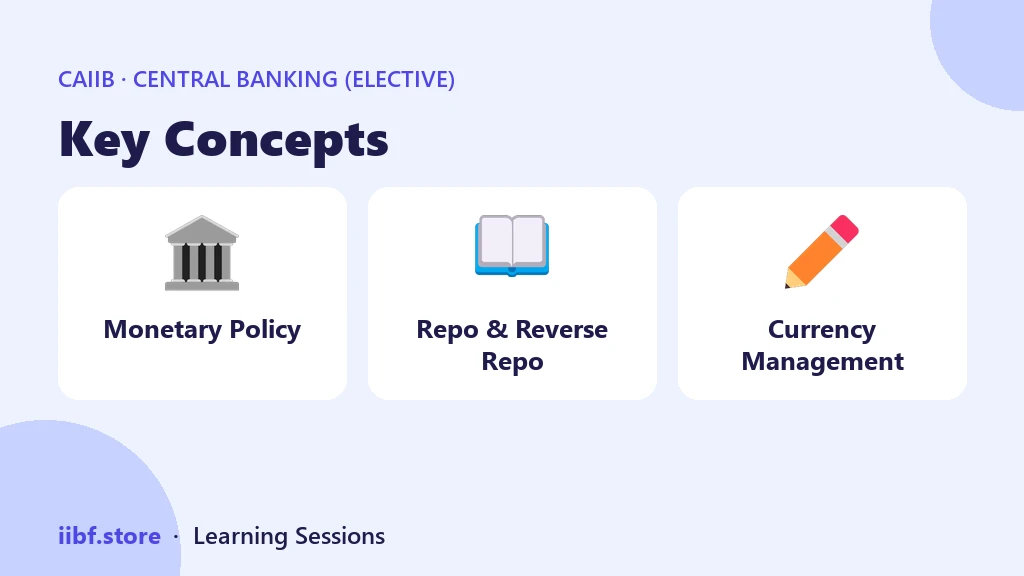
The decision-making organ of the inflation targeting framework in India is a six-member committee. Three members are from the Reserve Bank: the Governor (ex officio Chairperson), the Deputy Governor in charge of monetary policy, and one officer of the Bank nominated by the Central Board. The other three are external members appointed by the Central Government on the recommendation of a Search-cum-Selection Committee headed by the Cabinet Secretary.
Voting and quorum
Each member has one vote and the decision is by majority. In a tie, the Governor exercises a second, casting vote. The quorum is four members, of whom the Governor — or in his absence the Deputy Governor who is a member — must be present. External members serve a four-year term and are not eligible for re-appointment.
Transparency obligations
The resolution is published on the day of the decision. Every member must record a statement of the reasons for the vote, and the minutes carry the resolution, the vote of each member and those statements. This individual-accountability design is deliberate: it prevents the committee from hiding behind a collective voice.
Instrument and operating target
The MPC votes only on the policy repo rate and the stance. Everything downstream — the Standing Deposit Facility as the corridor floor, the Marginal Standing Facility as the ceiling, variable rate repo and reverse repo auctions, open market operations — is executed by the Reserve Bank to keep the weighted average call rate close to the repo rate. The chapter on the Liquidity Management Framework - LAF, OMO, MSS covers this plumbing, and the live corridor is on our RBI policy rates tracker.
⚠ What Counts as a Failure — and What Follows
This is the single most-tested definition in the inflation targeting framework in India. A failure to maintain the inflation target is deemed to have occurred when the average inflation is above the upper tolerance level for three consecutive quarters, or below the lower tolerance level for three consecutive quarters.
Two features trip candidates up. First, the test is on quarterly averages, not monthly prints — a single month at 6.5 per cent is not a failure. Second, the framework is symmetric: undershooting persistently is as much a failure as overshooting, because deflationary conditions damage output and debt dynamics just as surely.
When failure is established, Section 45ZN requires the Reserve Bank to send a report to the Central Government setting out three things:
- the reasons for the failure to achieve the target;
- the remedial actions proposed to be taken by the Bank; and
- an estimate of the time within which the target will be achieved, following the timely implementation of those actions.
The report goes to the Government, not to Parliament, and there is no statutory requirement to publish it. This has happened once so far: CPI inflation averaged above 6 per cent through the first three quarters of 2022, and the RBI transmitted its report in November 2022. Note also what does not follow — no member is removed, no penalty is levied, and the MPC is not dissolved. The sanction is reputational and political, not legal.
⚠ Common Mistake: Writing that a failure triggers the Governor's resignation or a report to Parliament. Neither is in the Act. The obligation is a written report to the Central Government under Section 45ZN, nothing more.
⚖ FIT Versus the Multiple Indicator Approach — and the Criticisms
The word "flexible" carries real weight. Section 45ZB requires the MPC to achieve the target "while keeping in mind the objective of growth", and the tolerance band exists precisely so that the Bank need not crush output to offset a transient supply shock.
| Feature | Multiple Indicator Approach (1998–2016) | Flexible Inflation Targeting (2016 onwards) |
|---|---|---|
| Statutory backing | ❌ Internal framework, no legal mandate | ✅ RBI Act Sections 45ZA–45ZN |
| Nominal anchor | No single announced anchor | Headline CPI-Combined, notified target |
| Who decides the rate | Governor, advised by a Technical Advisory Committee | Six-member MPC; decision binding on the Bank |
| Accountability for a miss | No defined failure, no report | Three-quarter rule; report under Section 45ZN |
| Transparency | Policy statement only | Resolution, individual votes, minutes on day 14, half-yearly MPR |
The critiques are equally examinable. Food and beverages carry close to 46 per cent of the weight in the CPI basket, so the index is dominated by supply-side items a policy rate cannot influence within the usual three-to-four-quarter transmission lag. Critics argue this forces the MPC to react to monsoon and global commodity shocks with an unsuitable instrument.
Second, one instrument cannot serve inflation, the exchange rate and financial stability at once — which is why liquidity operations and RBI intervention in the foreign exchange market sit outside the MPC's vote, and why money supply measures in India still matter analytically even though M3 is no longer a target. Third, emerging risks such as climate stress testing for banks show how physical and transition shocks now feed into both prices and financial stability without appearing anywhere in the CPI mandate. Fiscal dominance is the fourth standing objection: a large borrowing programme constrains how far the rate can move. The Constituents of Indian Financial System chapter puts these interlinkages in context.
📌 Remember: The band is 4 per cent ± 2 per cent, but the target is 4 per cent. The band is a tolerance for volatility, not a licence to settle anywhere between 2 and 6 per cent.
🧠 Practice MCQs: Inflation Targeting and the MPC
Q1. Under Section 45ZA of the RBI Act, 1934, who determines the inflation target and how often? (a) The RBI, every three years (b) The Central Government in consultation with the RBI, once every five years (c) The MPC, annually (d) Parliament, every five years
Answer: (b) — The Central Government, in consultation with the Reserve Bank, notifies the CPI-based target in the Official Gazette once every five years.
Q2. A failure to maintain the inflation target under the Act is deemed to have occurred when average inflation breaches a tolerance level for: (a) two consecutive months (b) six consecutive months (c) two consecutive quarters (d) three consecutive quarters
Answer: (d) — Average inflation above the upper tolerance level, or below the lower tolerance level, for three consecutive quarters constitutes a failure.
Q3. Which of the following is NOT required to be included in the report sent to the Central Government under Section 45ZN? (a) The names of MPC members who voted against the majority (b) The reasons for the failure (c) The remedial actions proposed (d) The estimated time to achieve the target
Answer: (a) — The report must state reasons, remedial actions and the estimated time to return to target; individual voting records belong to the minutes under Section 45ZL, not to the failure report.
Q4. In the six-member Monetary Policy Committee, a tie in voting is resolved by: (a) A fresh meeting within seven days (b) Reference to the Central Government (c) A second or casting vote exercised by the Governor (d) The stance being left unchanged by default
Answer: (c) — Each member has one vote; if the votes are equal, the Governor has a second, casting vote.
Q5. The price index used as the nominal anchor under India's flexible inflation targeting framework is: (a) Wholesale Price Index (b) Consumer Price Index (Combined), headline (c) Consumer Price Index for Industrial Workers (d) Core CPI excluding food and fuel
Answer: (b) — The statutory target is set in terms of headline CPI-Combined; core CPI is an analytical aid, not the target.
Want chapter-wise mock tests with 100+ MCQs? Start practising free →
❓ Frequently Asked Questions
Is the MPC's decision binding on the Reserve Bank?
Yes. Section 45ZB provides that the decision of the Monetary Policy Committee determining the policy repo rate is binding on the Bank. The Governor cannot override it, though the Governor does hold a casting vote in a tie.
Why is it called "flexible" inflation targeting rather than strict inflation targeting?
Because the mandate requires the MPC to achieve the target while keeping the objective of growth in mind, and because the tolerance band permits temporary deviations caused by supply shocks. Strict inflation targeting would require the central bank to ignore output entirely.
Has India ever failed to maintain the inflation target?
Yes, once. CPI inflation averaged above the upper tolerance level for three consecutive quarters in 2022, and the Reserve Bank sent the report required by Section 45ZN to the Central Government in November 2022.
How many times must the MPC meet in a year?
The Act prescribes a minimum of four meetings a year with a quorum of four members. In practice the RBI has followed a bi-monthly cycle of six scheduled meetings, plus off-cycle meetings when conditions demand.
The inflation targeting framework in India is examined as law first and economics second. If you can state who sets the target, what the three-quarter failure rule says, and what Section 45ZN obliges the Bank to report, you have covered the bulk of what this topic yields in the CAIIB paper. Read the rest of our CAIIB Central Banking (Elective) notes and articles, then test the recall — attempt the CAIIB course tests and mark every section number you cannot reproduce from memory.
Quick quiz on this topic
5 exam-style questions from our free test bank — check yourself before you move on.
Practice this topic
Take a free mock test, download chapter PDFs, or watch a video class — all included on iibf.store.
Keep reading