Economic Capital Allocation in Banks: Methods, RAROC and Limits

Economic Capital Allocation in Banks answers a question the regulator's minimum ratio never fully settles: how much capital does this bank actually need to stay solvent through a bad year, and which desk, product or borrower should carry the cost of holding it? For CAIIB and IIBF Risk Management candidates, economic capital allocation in banks is the bridge between risk measurement (PD, LGD, VaR, loss distributions) and business decisions (pricing, limits, performance pay). Examiners like this area because it forces you to separate three different meanings of the word "capital" and to reason about diversification instead of simply adding numbers up.
🏦 What Economic Capital Really Measures
Economic capital is the bank's own estimate of the buffer required to absorb unexpected losses over a defined horizon at a defined confidence level, so that the bank remains solvent and consistent with its target credit standing. It is an internal, risk-sensitive number produced by the bank's models and validated through its Internal Capital Adequacy Assessment Process (ICAAP) under Pillar 2.
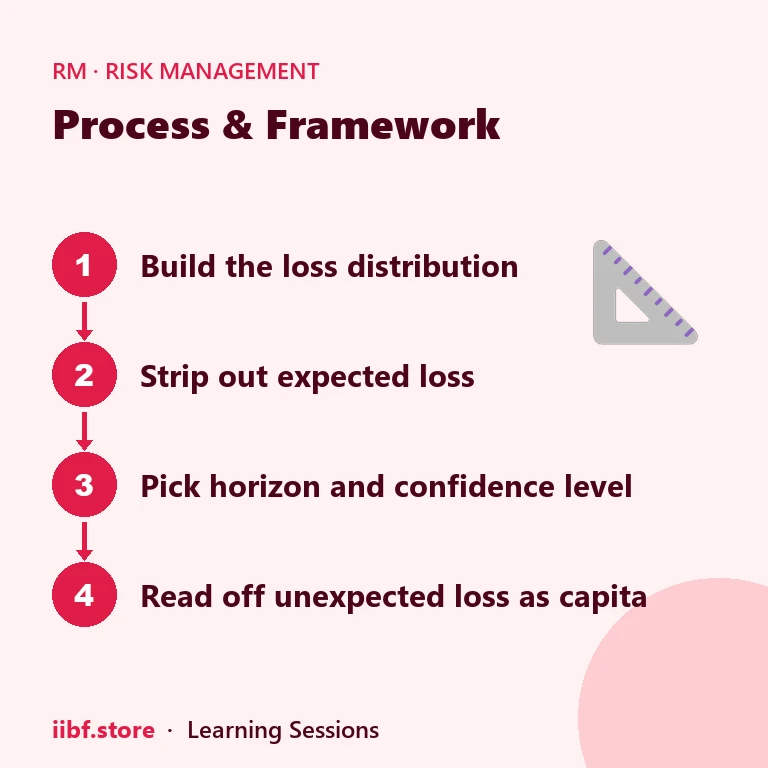
The starting point is the loss distribution of a portfolio. Split it into three zones. Expected loss (EL) is the average loss the bank anticipates over the horizon; for credit exposures it is conventionally PD × LGD × EAD. EL is a cost of doing business — it belongs in provisions and in the credit spread charged to the customer, not in capital. Unexpected loss (UL) is the deviation of actual losses above that average up to the chosen percentile of the distribution; this is what economic capital is sized to absorb. Losses beyond that percentile sit in the tail the bank has consciously decided not to hold capital against — that residual is the bank's chosen probability of default on its own obligations.
This framing matters in the exam. A question that says "provisions cover expected loss, capital covers unexpected loss" is testing exactly this split. It also explains why a portfolio of well-rated exposures can have low EL yet meaningful UL if the exposures are concentrated in one sector: concentration widens the distribution even when the average is flat. Studying the supervisory backdrop in why banks need regulation helps you see why supervisors accept internal estimates only when governance around them is strong.
💡 Exam Tip: Remember the one-line rule — price for expected loss, provide for expected loss, hold capital for unexpected loss. Most numerical traps in this chapter come from candidates adding EL into the capital number.
📊 Economic Capital vs Regulatory Capital vs Book Capital
Three capital concepts coexist in every bank and they rarely give the same answer. Regulatory capital is the minimum that supervisors demand — for Indian banks, the CRAR and buffer requirements laid down in RBI's Basel III capital regulations, computed with prescribed risk weights and a prescribed additive treatment of credit, market and operational risk. Book capital is the accounting equity actually on the balance sheet: paid-up capital, reserves and retained earnings. Economic capital is the internally modelled requirement described above. A bank is comfortable only when available book capital exceeds both the regulatory requirement and the economic estimate, with headroom for growth and stress.
| Dimension | Economic capital | Regulatory capital | Book capital |
|---|---|---|---|
| Who defines it | The bank's own models, approved by the Board and tested in ICAAP | RBI / Basel framework as adopted in India | Accounting standards and the balance sheet |
| Purpose | Solvency target, pricing, limits, performance measurement | Minimum prudential floor and supervisory comparability | Reporting owners' funds actually available |
| Risk coverage | All material risks, including concentration, interest rate risk in the banking book, business and reputational risk | Mainly Pillar 1 risks; other risks handled through Pillar 2 | None — it is a stock, not a risk measure |
| Diversification recognised? | ✅ Yes, through correlations across risk types and portfolios | ❌ Largely no — Pillar 1 charges are added up | ❌ Not applicable |
| Confidence level / horizon | Chosen by the bank, linked to its target rating, usually one year | Fixed by the framework (IRB credit risk is calibrated at 99.9% over one year) | None |
| Can it bind a business decision? | ✅ Yes, via RAROC hurdles and capital limits | ✅ Yes, as a hard floor | ✅ Yes, it caps how much risk can be funded |
The exact minimum CRAR, buffer percentages and the treatment of specific instruments have been revised more than once, so quote them from the current RBI Master Circular on Basel III Capital Regulations rather than from memory. The chapter on regulatory capital and capital adequacy sets out the prescribed structure in detail, and it pairs naturally with this topic.

🎯 Confidence Level, Time Horizon and Target Rating
Two parameters drive the size of any economic capital number, and both are policy choices rather than model outputs. The time horizon is normally one year, on the reasoning that a bank can raise fresh capital, de-risk or restructure within a year of identifying a problem. Trading portfolios are sometimes modelled over shorter liquidation horizons and then scaled, which is where inconsistencies creep into aggregate figures.
The confidence level is the percentile of the loss distribution up to which the bank wants to be protected. It is chosen to match a target solvency standard — a bank aiming at a high external rating implies a very low tolerable one-year default probability, and that implies a percentile in the region of 99.9% or above. The Basel IRB formula for credit risk is itself calibrated at a 99.9% one-year confidence level, which is a useful benchmark to quote in an answer. Raising the confidence level from 99% to 99.9% can increase required capital substantially because the credit loss distribution is heavily skewed with a long right tail.
Candidates often confuse this with Value at Risk conventions used for market risk, where much lower percentiles and one-day or ten-day horizons are standard. The parameters differ because the purpose differs: market risk VaR supports daily limit monitoring, whereas economic capital supports solvency. Any sensible framework also runs the chosen parameters through severe but plausible scenarios — the discipline covered in stress testing in banks — because a percentile drawn from historical data can understate a regime shift. Reading it alongside the wider enterprise risk management framework shows how the parameter choice is ratified by the Board rather than by the modelling team.
⚠️ Common Mistake: Treating the confidence level as a modelling assumption. It is a risk appetite decision — the Board picks the target solvency standard, and the model then reports the capital that standard costs.
🧮 Diversification Benefit and the Three Allocation Methods
Total economic capital for a bank is almost always less than the sum of the stand-alone requirements of its parts, because credit, market and operational losses, and losses across regions and sectors, are not perfectly correlated. That gap is the diversification benefit. Allocation is the exercise of distributing the diversified total back to business units, and the method chosen changes the answer materially.
Stand-alone allocation measures each unit as if it were a separate bank. It is simple and cannot be gamed, but it ignores diversification entirely, so the parts add up to more than the whole and every unit feels over-charged. Marginal or incremental allocation asks how much total capital falls if a unit is removed. It correctly rewards a unit that hedges the rest of the bank, but the marginal amounts sum to less than the total, leaving an unallocated residue that has to be spread by some arbitrary rule. Euler allocation — also called component or contributory capital — allocates each unit its share of the tail loss conditional on the portfolio being in distress. Its defining property is full allocation: the components add up exactly to the diversified total, which is why it dominates modern practice.
Whichever method is used, the result must be stable, explainable to business heads and reproducible. That is a model governance obligation as much as a mathematical one, and it links directly to operational risk practice — the same evidence trail you build when following collection of loss data standards, or when running the control self-assessment described in RCSA and key risk indicators. Where interest-rate or hedge mismatches distort a unit's measured contribution, revisit basis risk in banking before blaming the allocation method.
💰 Putting Allocated Capital to Work: RAROC, Pricing and Limits
Allocation is pointless unless the number changes behaviour. The main transmission channel is RAROC — risk-adjusted return on capital — computed as net revenue, less operating cost, less expected loss, plus a credit for the return earned on the capital itself, all divided by the economic capital allocated to that exposure or unit. The result is compared with a hurdle rate anchored on the bank's cost of equity. A deal that clears the hurdle creates shareholder value; one that does not must be repriced, restructured with better collateral or covenants, or declined.
Three practical uses follow. First, pricing: the loan spread must cover funding cost, operating cost, expected loss and a capital charge on allocated economic capital. Second, limits: capital-based limits on sectors, single borrowers and trading desks are far more meaningful than notional exposure caps, because they automatically tighten when volatility or correlation rises. Third, performance measurement: comparing a corporate desk with a retail book on profit alone rewards whoever took the most risk, whereas comparing them on RAROC or economic value added puts them on the same footing.
The framework has limits you should be able to state. Model risk is real, correlations move exactly when you need them to be stable, and allocated capital can be gamed if incentive pay depends on it. Non-financial exposures also need a place in the ICAAP narrative — the customer-facing exposures set out in conduct risk in financial services and the process failures covered in the operational risk and management framework chapter both consume capital even when no model produces a clean number for them.
📌 Remember: Economic capital sizes the buffer, allocation decides who pays for it, and RAROC decides whether the business earning that buffer is worth doing. All three must use the same confidence level and horizon or the comparison is meaningless.

📊 Conclusion and Revision Plan
For the exam, be able to define economic capital in one sentence, contrast it with regulatory and book capital, explain why the confidence level is a Board decision, name the three allocation methods with one advantage and one drawback each, and write the RAROC formula. Numerical questions usually test the EL/UL split or a simple RAROC comparison against a hurdle rate. Browse more revision notes on the risk management tag hub, then lock the concepts in with chapter-wise practice on the CAIIB course pages and timed attempts at iibf.store mock tests.
🧠 Practice MCQs: Economic Capital and Allocation
Q1. Economic capital is primarily held to absorb which component of the loss distribution? (a) Expected loss (b) Unexpected loss (c) Losses in the extreme tail beyond the chosen confidence level (d) Operating expenses
Answer: (b) — Expected loss is covered by provisions and pricing; losses beyond the confidence level are consciously not capitalised.
Q2. The Basel IRB approach for credit risk capital is calibrated at a one-year confidence level of approximately: (a) 95% (b) 99% (c) 99.5% (d) 99.9%
Answer: (d) — The IRB risk-weight functions use a 99.9% one-year solvency standard, a common benchmark for internal economic capital too.
Q3. Which allocation method distributes the diversified total so that the parts add up exactly to the whole? (a) Euler or component allocation (b) Stand-alone allocation (c) Incremental allocation (d) Pro-rata book capital allocation
Answer: (a) — Full allocation is the defining property of Euler allocation; stand-alone over-allocates and incremental under-allocates.
Q4. A proposed corporate loan shows RAROC below the bank's hurdle rate although the bank's CRAR is comfortable. The most appropriate response is to: (a) Approve it because the regulatory ratio has headroom (b) Approve it and exclude it from performance reporting (c) Reprice it, strengthen collateral or structure, or decline it (d) Raise the provision and approve at the same price
Answer: (c) — A comfortable CRAR does not make a value-destroying deal acceptable; the economics must be fixed or the deal refused.
Q5. The sum of stand-alone economic capital of a bank's business lines usually exceeds the bank's total economic capital because of: (a) Double counting of expected loss (b) Diversification across imperfectly correlated risks (c) Regulatory capital floors (d) Goodwill recognised in book capital
Answer: (b) — Losses across risk types and portfolios are not perfectly correlated, so the aggregate tail is smaller than the sum of the parts.
Want chapter-wise mock tests with 100+ MCQs? Start practising free →
❓ Frequently Asked Questions
Is economic capital always higher than regulatory capital?
No. It can be higher or lower. Economic capital captures risks that Pillar 1 ignores, such as concentration and interest rate risk in the banking book, which pushes it up, but it also recognises diversification, which pushes it down. Which effect dominates depends on the bank's portfolio mix, so both numbers must be monitored against available book capital.
Where does economic capital appear in ICAAP?
ICAAP is the Pillar 2 process in which a bank identifies all material risks, quantifies the capital needed for them, compares that with available capital under both base and stress conditions, and documents the governance behind the estimates. Economic capital models are the quantitative core of that document, and the supervisor reviews them under the supervisory review and evaluation process.
How is RAROC different from ROE?
Return on equity divides profit by accounting equity, which is not risk sensitive. RAROC divides risk-adjusted profit — revenue less costs less expected loss — by the economic capital allocated to the activity. Two units with identical ROE can have very different RAROC if one runs a much riskier book, which is exactly why capital allocation is needed.
Can allocated economic capital be used for incentive compensation?
It can, and many banks do link variable pay to risk-adjusted performance, but it needs safeguards. If bonuses depend on allocated capital, business units have an incentive to argue for lower allocations or to shift risk into categories the model measures poorly. Independent model validation, stable methodology and Board oversight of the allocation rules are the usual controls.
Source and further reading: Bank for International Settlements and the Indian Institute of Banking & Finance.
Practice this topic
Take a free mock test, download chapter PDFs, or watch a video class — all included on iibf.store.
Keep reading