Environmental Ethics in Banking: A Complete IIBF Guide
Environmental ethics in banking asks a simple but tough question: should a bank fund a project just because it is profitable, even if it damages the environment? For JAIIB and CAIIB Ethics module candidates, this is no longer a soft-skill footnote — it sits next to credit risk and compliance as a real banking decision. This guide breaks down what environmental ethics in banking means in practice, how it shows up in everyday lending calls, and where it overlaps with — and differs from — the governance and reporting rules you may have studied as separate topics.
🌱 What Is Environmental Ethics in Banking?
Environmental ethics in banking is the branch of banking ethics that asks whether a bank's decisions — lending, investing, procurement, even office operations — are fair to the natural environment and to the communities that depend on it. It is broader than any single regulation. A loan can clear every legal box and still be unethical if it finances a project that poisons a river or clears a forest without real assessment.
Banks touch the environment indirectly but powerfully. They rarely pollute a river themselves, but they finance the factory that might. This is why the Environmental Ethics chapter treats a bank's credit decisions as environmental decisions in disguise. Every appraisal note, every project loan, every trade finance limit carries an environmental footprint the credit officer either examines honestly or ignores for the sake of a target.
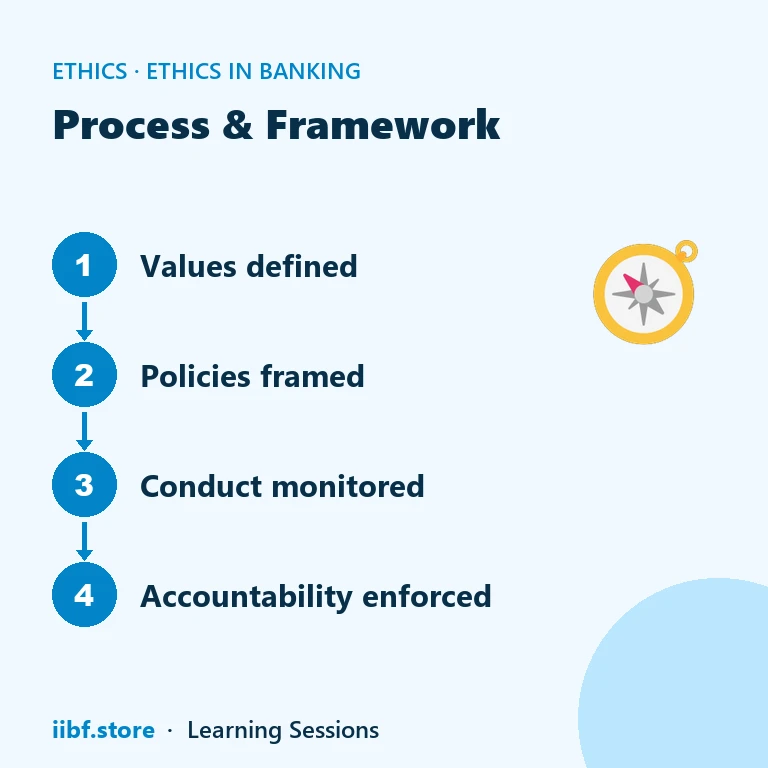
For exam purposes, remember that environmental ethics in banking rests on three ideas: stewardship (banks hold public deposits in trust and should not deploy them recklessly), inter-generational fairness (today's growth should not wreck tomorrow's resources), and accountability (a bank should be able to explain, not hide, the environmental logic behind a big-ticket loan). These three ideas repeat across IIBF's ethics syllabus in different wording, so learn the underlying logic rather than memorising one definition.
🏦 Environmental Ethics in Everyday Lending Decisions
Textbook ethics can feel abstract until you place it inside a real credit file. Consider a mid-size bank evaluating a loan for a tannery expansion. The project meets every financial ratio the bank asks for. Does that make it fine to fund? Environmental ethics in banking says no — the appraisal team must also weigh effluent treatment capacity, groundwater impact, and whether the promoter has a history of bypassing pollution norms to save cost.
This plays out in a few recurring situations that examiners like to test. First, project appraisal: banks increasingly build environmental risk screening into the same appraisal note used for financial and technical risk, not as a separate tick-box. Second, green and sustainable lending: preferential pricing or priority allocation for solar, wind, water-treatment, and clean-transport projects, which rewards ethical behaviour rather than just penalising bad behaviour. Third, exposure review: a banker who spots a client quietly diluting its environmental compliance year after year has an ethical duty to flag it during renewal, not wait for a regulator to catch it.
💡 Exam Tip: If a case study describes a bank chasing loan targets while ignoring an applicant's known pollution violations, the expected answer is almost always "conduct enhanced environmental due diligence before sanction," not "reject automatically" or "proceed since compliance is the promoter's problem."
The habit worth building for the exam and for the desk is simple: treat an environmental red flag the same way you would treat a financial red flag — worth a second look before disbursement, not after a complaint arrives.
⚖️ Environmental Ethics Compared to Related Banking Practices
Students often blur environmental ethics in banking together with sustainability reporting, greenwashing, and ordinary compliance. They overlap but are not the same thing, and the exam likes to test the distinction. Environmental ethics is the underlying value judgment — is this decision right or wrong for the environment. Reporting frameworks are the disclosure mechanism that communicates what a bank already did. Greenwashing is the failure mode where a bank talks the ethical talk in its reports without matching action in its lending book.
| Practice | What It Actually Does | Ethically Sound? |
|---|---|---|
| Screening a project loan for pollution and land-use risk before sanction | Genuine ex-ante environmental due diligence | ✅ |
| Publishing a glossy sustainability report while funding high-emission projects unchanged | Greenwashing — disclosure without behaviour change | ❌ |
| Offering priority pricing for verified green energy and clean-transport loans | Positive incentive aligned with environmental ethics | ✅ |
| Renewing a client's limits despite repeated known effluent violations, to protect fee income | Ethics subordinated to short-term revenue | ❌ |
⚠️ Common Mistake: Candidates often assume any bank that publishes an ESG or sustainability report is automatically acting ethically. The report only proves disclosure happened — it says nothing about whether lending decisions actually changed. Don't conflate the two in an answer.
This distinction also matters outside the exam hall. A banker who understands that reporting and ethics are separate layers is far less likely to be caught off guard when a regulator or auditor asks for evidence behind a disclosure claim. Reviewing how enforcement bodies treat this gap — covered in our note on RBI enforcement action on banks — helps connect the ethics chapter to real supervisory consequences.
🌍 Globalization, Organizational Culture and Environmental Responsibility
Environmental ethics in banking does not stop at a bank's home country. A bank financing a cross-border trade deal or an overseas subsidiary's project cannot claim the environmental damage "happened somewhere else." The Ethics and Globalization chapter is built around exactly this idea — global capital flows mean global environmental responsibility, and a bank's ethical obligations travel with its money across borders.
None of this works, though, unless it is built into the organization itself rather than left to individual conscience. A single well-meaning credit officer cannot hold the line if the bank's incentive structure rewards volume over diligence. This is where building an ethical organization becomes the practical bridge: clear escalation paths for environmental red flags, leadership that visibly backs a "no" decision on a profitable-but-risky deal, and training that starts on day one rather than during a crisis review. The same discipline expected on the trading floor and the KYC desk — covered in our guide to organizational ethics in banks — applies just as firmly to environmental decisions.
Everyday workplace habits matter here too. A junior officer who is comfortable raising an environmental concern in a morning credit meeting, without being labelled difficult, is a sign the culture is working the way the work ethics and the workplace chapter describes. Culture, not a single policy document, is what actually decides whether environmental ethics survives contact with a busy sanctioning calendar.
Environmental ethics in banking sits close to a cluster of related ethics topics that examiners like to test together, so it helps to know where the boundary lines fall. Sustainability disclosure standards tell a bank what to report and how often; our detailed walkthrough of BRSR sustainability reporting for banks is worth reading alongside this guide because the two topics reference each other constantly in mixed case studies. Separately, environmental corner-cutting often travels with financial corner-cutting — a promoter who under-reports pollution costs may also be under-reporting financial exposure, which is why our note on bribery and corruption in banking shares several red flags with environmental due diligence.
📌 Remember: In mixed case studies, environmental ethics, governance, and reporting questions are often stitched into one scenario. Answer each sub-part on its own terms — don't let a governance detail bleed into your environmental-ethics reasoning or vice versa.
Practically, a bank builds environmental ethics into daily operations through three habits: embedding environmental screening in the standard appraisal checklist rather than a separate optional form, rewarding relationship managers for flagging risk early rather than only for disbursement volume, and reviewing high-exposure environmental sectors — power, mining, chemicals, construction — on a fixed cycle instead of only when a complaint surfaces. None of these habits require new legislation; they require the organization to actually mean what its code of conduct says. For the full picture of how India's central bank frames environmentally responsible lending, the Reserve Bank of India publishes its priority-sector and green-finance guidance directly, and it is worth skimming once before your exam. You can browse more topics on our Ethics in Banking tag hub for related chapters and case studies.
🧠 Practice MCQs: Environmental Ethics in Banking
Q1. A bank's credit team discovers that a profitable project loan applicant has a documented history of bypassing pollution-control norms. What does environmental ethics in banking require the team to do? (a) Approve the loan since compliance is a legal, not a banking, matter (b) Reject the file automatically without further review (c) Conduct enhanced environmental due diligence before taking a sanction decision (d) Refer the matter only if a regulator specifically asks
Answer: (c) — Ethical lending means investigating known red flags before sanction, not ignoring them or reacting only to outside pressure.
Q2. Which statement best distinguishes environmental ethics from sustainability reporting in banking? (a) They are identical and interchangeable terms (b) Ethics is the underlying value judgment while reporting is the disclosure mechanism describing what was done (c) Reporting always proves ethical lending occurred (d) Ethics only applies after a report is published
Answer: (b) — A report communicates outcomes; it does not by itself prove the lending decisions behind it were ethically sound.
Q3. A bank publishes an impressive sustainability report while its actual lending book funds high-emission projects unchanged. This practice is best described as: (a) Effective ESG governance (b) Greenwashing (c) Priority-sector compliance (d) Environmental due diligence
Answer: (b) — Greenwashing is disclosure without a corresponding change in actual lending or operating behaviour.
Q4. Under the "ethics and globalization" perspective on environmental responsibility, a bank financing an overseas subsidiary's high-risk project: (a) Has no ethical obligation once funds cross the border (b) Retains ethical responsibility because global capital flows carry global environmental responsibility (c) Is only responsible if the host country has stricter laws than India (d) Can delegate all responsibility to the subsidiary's local management
Answer: (b) — Ethical obligations travel with the bank's money, regardless of where the project is physically located.
Q5. Which action best reflects "building an ethical organization" applied to environmental risk? (a) Relying on one senior officer's personal conscience to catch every case (b) Rewarding only disbursement volume in incentive structures (c) Creating clear escalation paths and leadership backing for declining profitable-but-risky deals (d) Reviewing environmental exposure only after a customer complaint
Answer: (c) — Ethical behaviour scales when the organization builds structural support for it, not when it depends on one individual's goodwill.
Want chapter-wise mock tests with 100+ MCQs? Start practising free →
Is environmental ethics in banking a legal requirement or a voluntary standard?
It is broader than any single law. Regulations set minimum compliance floors, but environmental ethics asks whether a decision is right even where no specific rule forces the bank's hand.
How is environmental ethics different from green banking products?
Green banking products, like solar or clean-transport loans, are one visible outcome of environmental ethics. The ethics itself is the broader value system that also governs ordinary, non-green lending decisions.
Why do JAIIB and CAIIB test environmental ethics separately from governance topics?
Because case studies frequently blend both, examiners test whether candidates can tell the difference between a value-judgment question and a disclosure or governance-process question within the same scenario.
Does environmental ethics apply only to large project finance loans?
No. It applies at every scale, from a small business loan for a polluting workshop to a large infrastructure project — the size of the loan does not change the underlying ethical obligation.
Environmental ethics in banking is not a side topic bolted onto the syllabus — it is a lens for reading almost every lending decision a bank makes, and examiners increasingly expect candidates to apply that lens to fresh case studies rather than recall a definition. Revisit the chapter links above, work through the comparison table until the distinctions feel automatic, and then test yourself under exam conditions. Practise more Ethics in Banking questions free →
Quick quiz on this topic
5 exam-style questions from our free test bank — check yourself before you move on.
Practice this topic
Take a free mock test, download chapter PDFs, or watch a video class — all included on iibf.store.