Exchange Rate Mechanism in India: A Treasury Manager Guide

Every trader, treasury officer, and bank branch dealing in foreign currency depends on one core idea: the exchange rate mechanism in India decides how many rupees a dollar, euro, or pound will fetch on any given day. For JAIIB and CAIIB candidates, and for working treasury staff, understanding this mechanism is not optional — it explains why the rupee moves, how the Reserve Bank of India steps in, and what risks a bank's treasury desk must manage every single day.
This article walks through how India moved from a fixed rate to a market-determined one, how RBI intervenes without formally pegging the rupee, and how treasury desks measure the resulting currency risk. We also compare the major exchange rate regimes side by side, so you can see exactly where India's system sits today.
💱 What Is the Exchange Rate Mechanism?
An exchange rate mechanism is simply the set of rules a country uses to decide the value of its currency against others. Broadly, three types exist: a fixed rate pegged to another currency or gold, a fully floating rate left to market demand and supply, and a managed float, where the central bank lets the market decide most of the time but steps in during sharp swings.
India's journey through the exchange rate mechanism in India is a good case study. Before 1992, the rupee was fixed to a basket of currencies. The Liberalised Exchange Rate Management System (LERMS) introduced a dual-rate transition in 1992, and by March 1993 India moved to a single, market-determined rate. Since then, the rupee has technically floated, but the Reserve Bank of India actively smooths volatility rather than letting the currency swing unchecked.
This entire topic sits inside the broader financial market framework that treasury professionals must know cold, since currency, money, and capital markets constantly influence one another.
💡 Exam Tip: Remember the sequence — fixed rate before 1992, LERMS dual rate in 1992, fully market-determined and officially floating from March 1993. Examiners love this timeline.
🏦 How RBI Manages the Exchange Rate
Even though the rupee floats, the exchange rate mechanism in India is not left entirely to chance. RBI intervenes by buying or selling US dollars in the spot and forward markets whenever it judges that the rupee is moving too fast in either direction. This is called a managed float, and it is the arrangement India actually follows today, whatever the textbook label says.
To judge whether the rupee is overvalued or undervalued, RBI and treasury economists track two index numbers: the Nominal Effective Exchange Rate (NEER), which compares the rupee to a basket of trading-partner currencies, and the Real Effective Exchange Rate (REER), which adjusts NEER for inflation differences. A rising REER usually signals the rupee is getting expensive relative to competitors, which can hurt exporters.
RBI also manages liquidity that indirectly feeds into currency markets, an area explained well in our guide to Treasury Bills in India. For the official, authoritative version of RBI's forex policy stance, always cross-check with the Reserve Bank of India's own website rather than relying on secondary sources. If you want the mechanics of spot, forward, and swap deals themselves, our detailed piece on foreign exchange market operations covers that ground.
📊 Exchange Rate Regimes at a Glance
Different countries pick different points on the fixed-to-floating spectrum. The table below compares the main regimes so you can quickly place India's current system in context — a comparison that shows up often in JAIIB and CAIIB objective questions.
| Regime | How the Rate Is Set | Active Central Bank Intervention | Example |
|---|---|---|---|
| Fixed / Pegged | Government fixes rate to another currency | ✅ | Pre-1992 India, Gulf currencies pegged to USD |
| Managed Float | Market sets rate, central bank smooths swings | ✅ | India (current system) |
| Free Float | Purely market demand and supply | ❌ | US dollar, euro, Japanese yen |
| Dual / Transitional Rate | Two rates run side by side during reform | ✅ | India under LERMS, 1992 |
| Currency Board | Domestic currency fully backed by a reserve currency | ❌ | Hong Kong dollar |
⚠️ Common Mistake: Candidates often call India's system a "free float." It is not — RBI intervenes regularly, which is why it is correctly termed a managed float.
🔄 Managing Currency Risk on the Treasury Desk
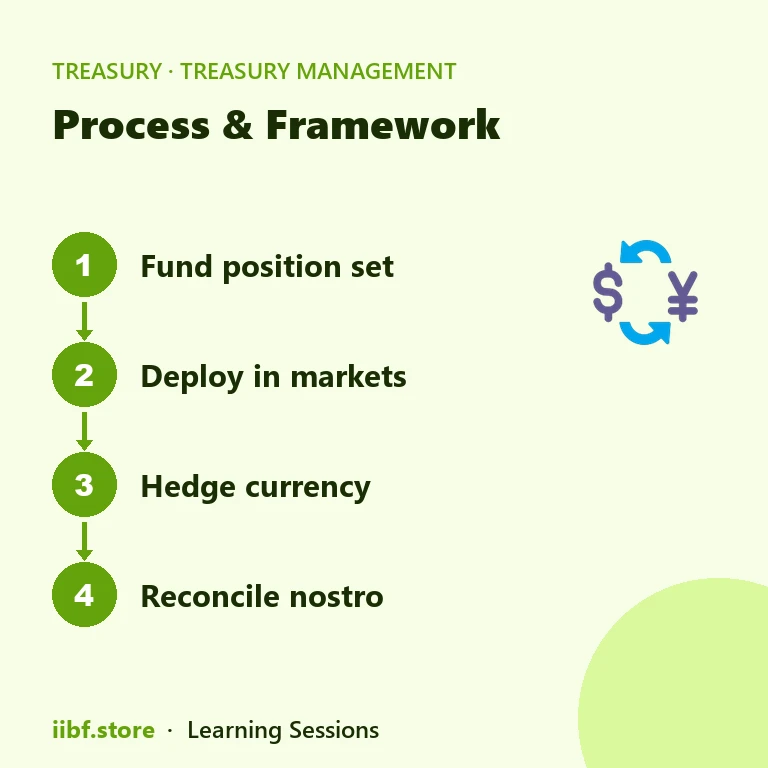
For a bank, the exchange rate mechanism in India is not just an academic topic — it creates real, daily profit-and-loss swings on every open foreign currency position. A treasury desk that holds unhedged dollar receivables or payables is exposed to loss the moment the rupee moves against it.
To control this, banks set intraday and overnight open position limits, use forward contracts and currency swaps to hedge, and revalue open positions at the day's closing rate. This exposure management is closely tied to the principles covered under risk analysis and control, which every treasury officer should study alongside currency mechanics.
The limits and daily reporting mentioned above are typically monitored under treasury middle office operations, a separate control function that sits between the dealing room and the back office and exists specifically to catch limit breaches early.
📌 Remember: Open position limits and stop-loss limits are set by the board, monitored by the middle office, and executed by the front-office dealers — three separate roles, never one person doing all three.
🧮 Exchange Rates and Capital Market Instruments
Currency movements do not stay confined to the forex desk. When the rupee weakens sharply, foreign investors holding Indian bonds and equities often reassess their returns in dollar terms, which can trigger outflows and push bond yields higher. This is why treasury dealers watching fixed income securities also track the currency market closely.
Bond prices react to yield changes through duration and convexity, a relationship explained in depth in our chapter on fixed income securities, duration and convexity. A longer-duration bond portfolio suffers more when yields rise following a currency shock than a short-duration one.
Banks that deploy surplus rupee liquidity into corporate paper must also respect corporate bond investment norms for banks, a topic covered under the separate TIRM certification but directly relevant to any treasury desk managing both currency and credit exposure together. Beyond bonds, treasuries also deal in other capital market instruments, many of which carry embedded currency risk when issued or listed offshore.

🔍 Auditing Exchange Rate Exposure
Because currency positions can swing a bank's profit and loss quickly, both internal and external auditors pay close attention to how the exchange rate mechanism in India is applied inside a bank's own treasury. Auditors check that open position limits were never breached without escalation, that revaluation was done at the correct closing rate, and that FEMA reporting requirements were met on time.
This audit function is formally covered under internal and external audit, a chapter that JAIIB and CAIIB candidates frequently underrate but that examiners test heavily, since compliance failures in treasury carry real regulatory consequences.
Practising bankers who want to track live reference rates alongside their study can bookmark our RBI rates resource for quick day-to-day checks.
🧠 Practice MCQs: Exchange Rate Mechanism
Q1. Under which system did India first move away from a single fixed exchange rate toward a market-linked rate? (a) Bretton Woods System (b) Liberalised Exchange Rate Management System (LERMS) (c) Basel Accord (d) Special Drawing Rights System
Answer: (b) — LERMS, introduced in 1992, created a dual exchange rate that transitioned India toward a fully market-determined rate by March 1993.
Q2. India's current exchange rate arrangement is best described as: (a) A free float with zero intervention (b) A fixed peg to the US dollar (c) A managed float (d) A currency board arrangement
Answer: (c) — The rupee is market-determined but RBI intervenes to smooth excessive volatility, which is the definition of a managed float.
Q3. What does REER stand for, and what does it primarily indicate? (a) Real Effective Exchange Rate; inflation-adjusted currency competitiveness (b) Reserve Exchange Equalisation Ratio; bank capital adequacy (c) Rupee Export Earnings Ratio; trade surplus (d) Regulated External Exposure Rate; foreign debt level
Answer: (a) — REER adjusts the Nominal Effective Exchange Rate for inflation differences, showing whether the rupee is over- or under-valued against a basket of currencies.
Q4. In a bank's treasury, who is primarily responsible for monitoring that open position limits are not breached? (a) The front-office dealer (b) The middle office (c) The branch manager (d) The external auditor alone
Answer: (b) — The middle office is the independent control function that monitors dealing-room limits, separate from the front office that executes trades.
Q5. A weakening rupee following a currency shock typically has what effect on a long-duration bond portfolio? (a) No effect at all (b) A smaller price impact than a short-duration portfolio (c) A larger price impact if yields rise in response (d) An automatic increase in credit rating
Answer: (c) — Longer-duration bonds are more sensitive to yield changes, so if a currency shock pushes yields up, long-duration portfolios lose more value.
Want chapter-wise mock tests with 100+ MCQs? Start practising free →
❓ Frequently Asked Questions
What is the exchange rate mechanism in India today?
India follows a managed float, meaning the rupee's value is largely set by market demand and supply, while the Reserve Bank of India intervenes in the spot and forward markets to prevent excessive volatility.
When did India stop using a fixed exchange rate?
India transitioned away from a fixed rate through the Liberalised Exchange Rate Management System in 1992, reaching a fully unified, market-determined rate by March 1993.
What is the difference between NEER and REER?
NEER (Nominal Effective Exchange Rate) compares the rupee to a basket of currencies without adjusting for inflation, while REER adjusts NEER for inflation differences to show real competitiveness.
Why does a bank's treasury desk care about the exchange rate mechanism?
Because open foreign currency positions create direct profit-and-loss risk, treasury desks must hedge, set position limits, and revalue exposures daily in line with how the rate is determined and managed.
Understanding the exchange rate mechanism in India is essential groundwork for any JAIIB or CAIIB candidate, and it directly affects how a real treasury desk hedges risk every working day. To build genuine exam confidence, work through structured mock tests and revise the linked chapters above rather than memorising isolated facts. Ready to test yourself further? Explore the full CAIIB course and browse more Treasury Management articles to keep building your foundation.
Prefer revising from a printed book?
Chapter-wise books with MCQs after every chapter — minimal pages, complete coverage, delivered anywhere in India. Every book has a free sample to read first.
































Practice this topic
Take a free mock test, download chapter PDFs, or watch a video class — all included on iibf.store.