Farmer Producer Organisation Financing: FPO Credit for CAIIB Rural Banking
Farmer Producer Organisation financing is the single biggest lever Indian banks now use to move smallholder agriculture from subsistence plots to aggregated, market-linked business. For CAIIB Rural Banking candidates, this topic sits at the intersection of priority sector lending, government promotion schemes, and credit appraisal — exactly the kind of cross-cutting area examiners like to test. This article walks through the scheme architecture, the appraisal framework bankers actually use, and the credit guarantee cover that makes FPO lending collateral-free within limits.
Before you go further, it helps to place FPOs in the wider rural economy context covered in Agriculture Economy — FPOs exist because fragmented landholding and weak market access are structural features of that economy, not a temporary gap.
🌾 What an FPO Is and Why Banks Care About It
A Farmer Producer Organisation is a collective of primary producers — mostly registered as a Producer Company under the Companies Act, though cooperative and society forms also exist — formed to aggregate produce, access inputs at scale, and negotiate better prices on behalf of its farmer-members. Unlike an individual farmer loan, FPO financing funds a business entity: working capital for procurement, term loans for processing or storage assets, and cash-credit lines against receivables from aggregated produce.
Banks care because an FPO converts hundreds of small, high-cost-to-service accounts into one bankable enterprise account with a business plan, a board, and audited books. That shift lowers transaction costs per rupee lent and improves recovery discipline, provided the FPO has genuine business volume behind it — not just a certificate of incorporation.
The membership base matters at appraisal stage. Promotion norms under the government's FPO schemes commonly cite a minimum of around 300 farmer-members in the plains and a lower threshold in hilly and North-Eastern regions, reflecting sparser populations there. A thin membership base with no real aggregation volume is one of the first red flags a credit officer should catch.
💰 Government Schemes Backing FPO Credit
The Central Sector Scheme for "Formation and Promotion of 10,000 FPOs," launched by the Ministry of Agriculture and Farmers Welfare, is the umbrella programme most bank-financed FPOs originate under. It works through implementing agencies — NABARD, SFAC (Small Farmers' Agribusiness Consortium), and NCDC — which appoint Producer Organisation Promoting Institutions (POPIs) to mobilise farmers, register the FPO, and hand-hold it through its first years of operation.
Two support instruments sit alongside the credit itself. First, a matching equity grant, administered through SFAC/NCDC channels, tops up the FPO's own paid-up capital so its net worth looks more credit-worthy to a bank. Second, handholding support funds professional management — a CEO and accounts staff — for a defined period, which materially improves the quality of the financials a bank has to appraise.
Loans to FPOs and Farmer Producer Companies for agriculture and allied activities are eligible for Priority Sector Lending classification under RBI's Master Directions on Priority Sector Lending, subject to a prescribed borrower-level ceiling. That PSL eligibility is what makes FPO financing commercially attractive to banks even at relatively thin margins — it counts toward the agriculture and weaker-section sub-targets many branches struggle to meet.
💡 Exam Tip: Remember the three-agency structure — NABARD, SFAC, NCDC — as implementing agencies of the 10,000-FPO scheme. Examiners frequently test which agency does what.
📋 Credit Appraisal Framework for FPO Loans
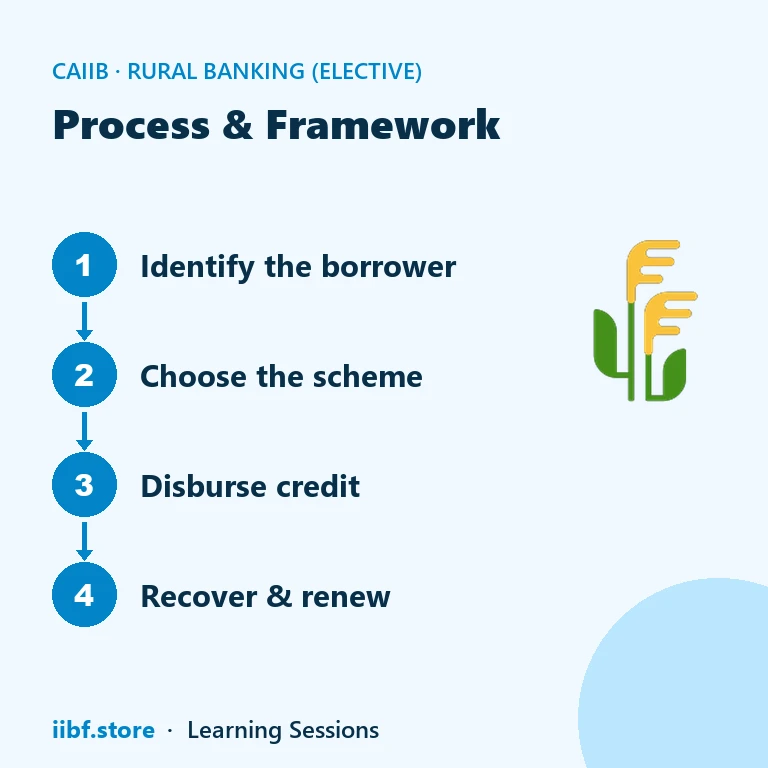
Appraising an FPO is closer to SME credit assessment than to a crop loan. A branch first checks the promoting institution's track record — a POPI that has successfully nurtured other FPOs is a positive signal in itself. Next comes the business plan: what commodity is being aggregated, what value addition (grading, cleaning, storage, primary processing) is planned, and whether the projected procurement volume matches the membership's actual production capacity.
Financial appraisal looks at paid-up capital plus any equity grant received, cash-flow projections built around the seasonal aggregation cycle rather than a flat monthly repayment, and governance quality — is the board meeting regularly, are audited financials current, is there a functioning CEO separate from the board of farmer-directors. Working capital requirement is usually sized against the procurement-to-sale cycle length, while term loans for infrastructure are assessed on asset utilisation and depreciation-adjusted cash flow.
Rural socio-economic context still matters at this stage. The broader issues covered in Issues Concerning Rural Areas — infrastructure gaps, market access, and seasonal income volatility — directly shape how conservative a bank should be on repayment scheduling for an FPO borrower.
| Support Instrument | Implementing Agency | Purpose | Collateral-Free |
|---|---|---|---|
| 10,000 FPO Scheme (formation) | NABARD / SFAC / NCDC | Registration, mobilisation, handholding | ❌ Not a loan |
| Matching Equity Grant | SFAC / NCDC | Strengthens FPO net worth and capital base | ❌ Not a loan |
| CGFS-FPO Guarantee | NABSanrakshan (NABARD subsidiary) | Covers bank credit risk on FPO loans | ✅ Yes, within cover |
| PSL Term/Working Capital Loan | Scheduled Commercial Banks | Procurement, processing, marketing finance | ✅ Yes, up to CGFS limit |
| NABARD Refinance | NABARD (via lending bank) | Refinance support to the financing bank | ❌ Not direct to FPO |
🛡️ Credit Guarantee Cover: CGFS-FPO
The Credit Guarantee Fund Scheme for Farmer Producer Companies (CGFS-FPO) is what lets banks extend collateral-free credit to FPOs despite these entities rarely owning mortgageable fixed assets. It is administered by NABSanrakshan Trustee Company, a NABARD subsidiary set up specifically to run guarantee schemes for the farm and allied sector.
Under CGFS-FPO, eligible loans up to a defined ceiling (commonly cited around Rs 2 crore) qualify for guarantee cover, with the guaranteed proportion of the credit facility tapering as the loan quantum rises. In effect, a smaller loan to a newly formed FPO gets a higher percentage of cover than a larger loan to a mature one — the scheme is deliberately tilted to de-risk the early, most fragile years of an FPO's borrowing relationship with a bank.
For the credit officer, this means the security section of the appraisal note shifts from asset-backed collateral to guarantee-backed exposure. The bank still underwrites based on business viability — the guarantee reduces loss-given-default, it does not substitute for a sound repayment assessment.
⚠️ Common Mistake: Treating CGFS-FPO cover as a substitute for cash-flow appraisal. The guarantee protects the bank's recovery, not the FPO's ability to repay — appraisal rigour cannot be relaxed.
⚠️ Risks and Monitoring After Disbursement
The risks in FPO financing cluster around three areas: governance dilution as founder-farmers lose interest once the initial mobilisation subsidy ends, price risk on the commodity being aggregated, and dependence on a single crop or season for cash flow. Banks typically monitor FPO accounts through periodic stock and receivable statements rather than relying solely on annual balance sheets, given the working-capital-heavy nature of aggregation business.
A related discipline candidates should connect here is how banks staff and train officers handling this specialised segment — a theme that overlaps with knowledge management in banks, since FPO credit officers need continuously updated scheme knowledge as guarantee ceilings and scheme guidelines get revised.
Diversification of the FPO's product basket, staggered disbursement linked to procurement milestones, and a functioning market-linkage tie-up (with an aggregator, processor, or e-NAM-linked buyer) are the practical mitigants examiners expect you to name in a case-study answer.
📌 Remember: Rural development context — covered in Rural Development Policies — frames why the government subsidises FPO formation even though the credit itself flows through commercial banks.
🔗 How FPO Financing Fits With Other Rural Credit Instruments
FPO financing rarely stands alone in a bank's rural portfolio. Aggregated produce from an FPO is often warehoused before sale, which is where warehouse receipt finance in India becomes relevant as a complementary instrument for the FPO or its member-farmers. Similarly, an FPO operating in a cooperative-heavy district needs to be understood alongside the cooperative credit structure in India, since FPOs and PACS often compete for the same farmer-members' loyalty and produce.
Crop-linked risk in an FPO's supply base also ties back to PMFBY crop insurance scheme coverage among member-farmers — an FPO whose members are well insured presents materially lower aggregate supply risk to its lending bank. CAIIB Rural Banking candidates should be able to draw these links rather than treating each topic in isolation.
🧠 Practice MCQs: Farmer Producer Organisation Financing
Q1. Under the Central Sector Scheme for Formation and Promotion of 10,000 FPOs, which three agencies act as implementing agencies? (a) RBI, SEBI, IRDAI (b) NABARD, SFAC, NCDC (c) SIDBI, EXIM Bank, MUDRA (d) FCI, CACP, APEDA
Answer: (b) — NABARD, SFAC and NCDC are the designated implementing agencies that appoint POPIs to form and support FPOs.
Q2. CGFS-FPO, the credit guarantee scheme for Farmer Producer Companies, is administered by which entity? (a) CGTMSE (b) NABSanrakshan Trustee Company (c) Deposit Insurance and Credit Guarantee Corporation (d) SFAC directly
Answer: (b) — NABSanrakshan Trustee Company, a NABARD subsidiary, administers the CGFS-FPO guarantee scheme.
Q3. Why do banks generally treat FPO loan appraisal as closer to SME credit assessment than to a standard crop loan? (a) FPOs are ineligible for PSL (b) FPOs are individual borrowers (c) FPO financing funds a business entity with cash flow from aggregation, not a single crop cycle (d) FPOs never require working capital
Answer: (c) — An FPO is a business entity aggregating produce from many members, so appraisal focuses on business viability, governance and cash flow like an SME loan.
Q4. Under CGFS-FPO, how does the guaranteed proportion of a loan typically behave as the loan amount increases toward the scheme ceiling? (a) It increases proportionally (b) It stays fixed regardless of loan size (c) It tapers, giving smaller loans relatively higher cover (d) Cover applies only above the ceiling
Answer: (c) — The guarantee cover tapers as loan size rises, giving newer/smaller FPO loans proportionally higher protection.
Q5. What is the primary role of the matching equity grant available to FPOs under government schemes? (a) It repays existing bank loans (b) It strengthens the FPO's net worth and capital base ahead of bank appraisal (c) It replaces the need for a business plan (d) It is disbursed directly to individual farmer-members as income support
Answer: (b) — The matching equity grant tops up the FPO's own capital, improving its net worth profile for bank credit appraisal.
Want chapter-wise mock tests with 100+ MCQs? Start practising free →
❓ FAQs on Farmer Producer Organisation Financing
What is Farmer Producer Organisation financing?
It is bank credit — working capital and term loans — extended to a registered FPO or Farmer Producer Company to fund aggregation, processing, storage and marketing of member-farmers' produce, distinct from an individual crop loan.
Can FPO loans be sanctioned without collateral?
Yes, within limits. The CGFS-FPO guarantee, administered by NABSanrakshan, allows banks to extend collateral-free credit up to a defined ceiling because the guarantee absorbs a large share of default risk.
Do FPO loans count toward Priority Sector Lending targets?
Loans to FPOs for agriculture and allied activities are eligible for PSL classification under RBI's Master Directions, subject to a prescribed borrower-level ceiling, making them attractive for meeting agriculture sub-targets.
Which agencies implement FPO promotion schemes in India?
NABARD, SFAC and NCDC are the implementing agencies under the Central Sector Scheme for Formation and Promotion of 10,000 FPOs, working through appointed Producer Organisation Promoting Institutions.
✅ Conclusion: Exam-Ready on FPO Credit
For CAIIB Rural Banking, Farmer Producer Organisation financing tests your ability to connect government promotion architecture, PSL eligibility, appraisal discipline and guarantee cover into one coherent lending story. Revisit the chapter material on Economic Features of rural India to ground the demand side of this topic, browse more chapter-linked reading on the Rural Banking Elective tag hub, and then lock in recall with a timed mock.
Ready to test yourself? Attempt a chapter-wise Rural Banking Elective mock now: start your CAIIB preparation →
Prefer revising from a printed book?
Chapter-wise books with MCQs after every chapter — minimal pages, complete coverage, delivered anywhere in India. Every book has a free sample to read first.




























Quick quiz on this topic
5 exam-style questions from our free test bank — check yourself before you move on.
Practice this topic
Take a free mock test, download chapter PDFs, or watch a video class — all included on iibf.store.