Fiduciary Duty of Bankers: Trust, Care and Disclosure (IIBF)
The fiduciary duty of bankers is one of the most misunderstood ideas in the IIBF Ethics syllabus, because the general banker–customer relationship is not a fiduciary one at all. A bank that accepts your deposit is a debtor; it owes you money, not your money back. Yet in a growing set of situations — safe custody, escrow and specific-purpose accounts, trusteeship, nomination, wealth advisory and the sale of third-party products — the same banker steps into a position of trust and confidence, and the law imposes a far stricter standard than ordinary contract. Knowing exactly where that line falls is what separates a scoring answer from a vague one.
⚖️ What the Fiduciary Duty of Bankers Means in Law
A fiduciary relationship arises whenever one party reposes trust and confidence in another, and the other accepts the resulting influence or discretion. The classic ingredients are three: duty of care (act with the skill a prudent professional would bring), duty of loyalty (put the beneficiary's interest ahead of your own), and duty of disclosure (reveal, rather than conceal, anything that could colour your advice). A contractual party may bargain hard and stay silent; a fiduciary may not.
Indian law does not house the fiduciary duty of bankers in a single statute. It is assembled from the Indian Trusts Act, 1882 — whose Section 88 requires anyone in a fiduciary character who gains an advantage from that position to hold it for the beneficiary — from the law of agency in the Indian Contract Act, 1872, from equity, and from regulatory codes issued by RBI, SEBI and IRDAI for specific activities. The Banking Regulation Act, 1949 permits banks to act as trustee, executor and administrator; the moment a bank accepts such a mandate, trust-law standards attach.
The contrast with the deposit relationship is deliberate. In Foley v. Hill (1848) the House of Lords held that money paid into a bank becomes the banker's money, to be used as it pleases, with only an obligation to repay an equivalent sum on demand. That single holding is why a depositor cannot trace "his" notes, why a bank may lend deposits, and why the Ethics paper keeps testing it. The evolution of duties beyond that bare contract is traced in the chapter on banking ethics and its changing dynamics, and the philosophical basis for treating loyalty as an obligation rather than a courtesy is set out in our note on ethical theories in business ethics.
📌 Remember: Debtor–creditor is the default. Fiduciary duty is the exception, and it must be triggered by a specific role — trustee, agent, adviser, custodian — not merely by the customer's faith in the bank.
🏦 When a Banker Is a Trustee and When Only a Debtor
Examiners love the "identify the relationship" question because the answer changes the remedy. If the bank is a debtor and it fails, the customer ranks as an unsecured creditor. If the bank holds money as trustee, that money never entered the bank's estate at all and the beneficiary can claim it in priority. The distinguishing test is appropriation to a specific purpose: money handed over for a named, identified use, kept identifiable, is trust money; money credited to a running account and mingled is not.
Custody functions push in the same direction. In safe deposit and safe custody of sealed articles the bank is a bailee, and in some formulations an agent — either way it owes a duty of reasonable care rather than a duty to repay. When a bank collects a cheque for a customer it acts as agent; when it discounts the same cheque it acts as owner. Under nomination provisions for deposits, articles in safe custody and locker contents, the nominee who receives payment does so as a trustee for the legal heirs, and the bank obtains a valid discharge. Those daily judgement calls are exactly what the chapter on work ethics and the workplace drills at branch level.
| Situation | Legal relationship | Fiduciary duty? | What the banker must do |
|---|---|---|---|
| Savings / current / term deposit | Debtor–creditor | ❌ | Repay on demand or on maturity; act in good faith |
| Money paid in for a named specific purpose | Trustee–beneficiary | ✅ | Keep identifiable; apply only to that purpose |
| Cheque sent for collection | Agent–principal | ✅ | Present with due diligence; account for proceeds |
| Sealed articles in safe custody | Bailee–bailor | ❌ (duty of care applies) | Take care a prudent owner would take |
| Escrow / trusteeship / executor mandate | Trustee | ✅ | Follow the deed; no self-dealing, no secret profit |
| Investment advice for a fee | Adviser–client | ✅ | Recommend what suits the client, disclose conflicts |
Note the middle column carefully: a bailee owes a high duty of care without being a fiduciary. Care and loyalty are separate obligations, and only loyalty is distinctively fiduciary.
💼 Fiduciary Duty in Wealth Advisory and Third-Party Products
The sharpest modern application of the fiduciary duty of bankers is the distribution counter. A bank selling mutual funds, insurance or structured products wears two hats: it earns commission from the manufacturer while advising a customer who believes the branch is on his side. The regulatory answer has been to separate the roles. Under the SEBI (Investment Advisers) Regulations, 2013, an entity giving investment advice must act in a fiduciary capacity towards its client and must keep advisory separate from distribution; a bank that merely executes or distributes is a distributor, remunerated by the producer, and must say so. Insurance distribution through the corporate agency and bancassurance route carries parallel conduct obligations under IRDAI norms.
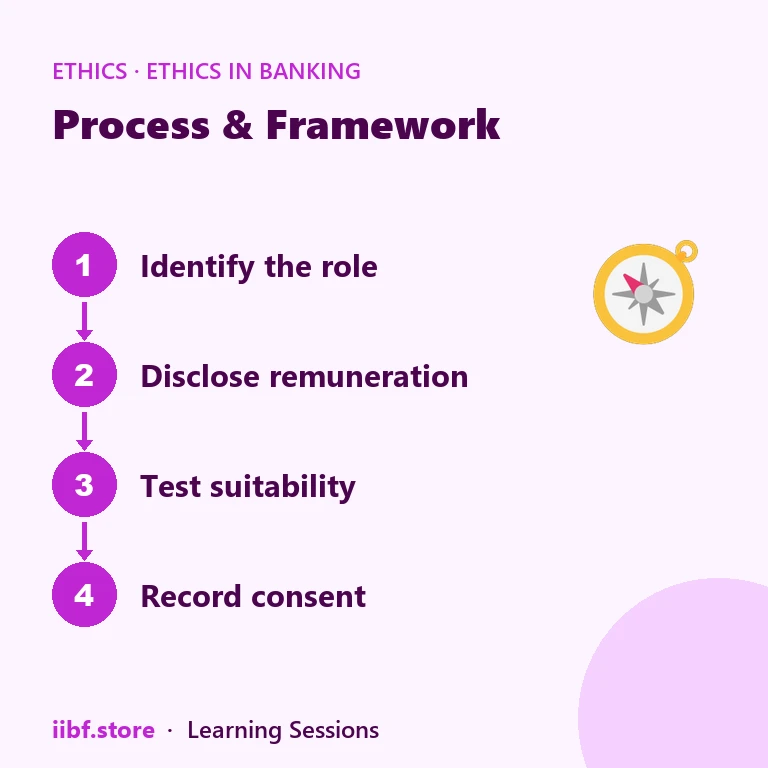
Three practical duties follow. First, disclosure of remuneration — the customer should know the bank is paid to place the product. Second, no unauthorised profit: any benefit obtained by reason of the fiduciary position, from soft-dollar arrangements to contest prizes, is the beneficiary's, which is the plain reading of Section 88 of the Trusts Act. Third, informed consent: where a conflict cannot be avoided, it must be disclosed and consented to, not buried. That grammar of disclose-avoid-manage is developed further in our guide to conflict of interest in banking.
Product governance is the upstream control. Before a single branch is allowed to sell, the product must clear a documented approval gate that fixes the target customer segment, the risk disclosures and the incentive design — the process examined in the compliance paper as new product approval compliance in banks. Where incentives reward volume alone, breach becomes systemic rather than individual, and the culture question moves to the board, as discussed under ethical leadership in banks.
⚠️ Common Mistake: Writing that "a bank always owes a fiduciary duty to its customer". It does not. Say instead that the duty attaches to particular roles — trustee, agent, custodian, adviser — and that outside those roles the bank owes contractual good faith and statutory conduct standards.
🎯 Suitability, Appropriateness and the Judicial View on Breach
Two words separate the advisory standard from the execution standard. Suitability asks whether this product fits this customer's objectives, risk tolerance, income and time horizon; it is the fiduciary test and it obliges the bank to know the customer before it recommends. Appropriateness asks only whether the customer has the knowledge and experience to understand the product's risks; it is the lower, execution-only test. A branch that files a risk-profiling form and then sells the highest-commission scheme regardless of the profile has satisfied appropriateness and failed suitability — and it is suitability that the fiduciary standard demands.
Indian courts and consumer forums have consistently held that where a bank assumes an advisory role, silence about material risk and about its own commission is actionable. The Supreme Court's insistence in banking matters that a fiduciary must not place itself in a position where interest and duty conflict is the settled equity principle, and it applies unchanged to a relationship manager pushing a target. Consequences of breach run on four tracks at once: civil (restitution, compensation, disgorgement of the profit made from the position), regulatory (supervisory action, penalties and business restrictions by RBI, SEBI or IRDAI), consumer (redress through the internal grievance machinery and the RBI Ombudsman framework, whose monetary limits and time windows were revised recently — quote the current scheme, not an old figure), and employment (staff accountability under service rules).
Reputational cost outlasts all four. Remediation, refunds and adverse press typically exceed the commission earned by a wide margin, which is why an ethical organisation designs the incentive out rather than policing the outcome — the theme of the chapter on building an ethical organisation. More Ethics revision material is collected on the ethics blog tag hub.
💡 Exam Tip: If a case study says the customer was "advised" or "recommended", answer on suitability and fiduciary duty. If it says the customer "instructed" or "requested" a specific product, answer on appropriateness and execution-only obligations.
🧠 Practice MCQs: Fiduciary Duty of Bankers
Q1. The general relationship between a bank and its deposit customer is best described as: (a) trustee and beneficiary (b) debtor and creditor (c) agent and principal (d) bailee and bailor
Answer: (b) — Following Foley v. Hill, deposited money becomes the bank's own money, leaving an obligation to repay an equivalent sum.
Q2. A customer pays money into the bank for a clearly identified specific purpose, and it is kept identifiable. If the bank fails, the customer's best position is that the bank held the money as: (a) unsecured borrower (b) bailee (c) guarantor (d) trustee
Answer: (d) — Appropriation to a specific purpose with identifiable funds creates a trust, so the money does not form part of the bank's general estate.
Q3. Which duty is the distinctive mark of a fiduciary, as opposed to a merely careful contracting party? (a) duty of loyalty (b) duty to repay (c) duty of confidentiality (d) duty to keep records
Answer: (a) — Loyalty, meaning the beneficiary's interest is placed above the fiduciary's own, is what distinguishes fiduciary status; care and confidentiality can exist without it.
Q4. A relationship manager recommends a scheme that pays the highest commission, although the customer's risk profile is conservative. The primary standard breached is: (a) appropriateness (b) know your customer for AML (c) suitability (d) fair disclosure of charges
Answer: (c) — Suitability requires the recommendation to fit the customer's objectives and risk tolerance; appropriateness is the lower, execution-only test.
Q5. Under the Indian Trusts Act, 1882, a person in a fiduciary character who gains an advantage from that position must: (a) share it equally with the beneficiary (b) hold it for the benefit of the beneficiary (c) disclose it and retain it (d) return only the excess above a reasonable fee
Answer: (b) — Section 88 requires the advantage so gained to be held for the benefit of the person whose interest the fiduciary was bound to protect.
Want chapter-wise mock tests with 100+ MCQs? Start practising free →

❓ Frequently Asked Questions
Is a bank a trustee for its ordinary savings account holders?
No. For ordinary deposits the bank is a debtor and the customer a creditor. Trusteeship arises only where money is appropriated to a specific identified purpose, or where the bank accepts an express trustee, escrow or executor mandate.
What is the difference between suitability and appropriateness?
Suitability asks whether the product fits this particular customer's objectives, risk appetite and horizon, and applies when the bank advises. Appropriateness asks only whether the customer can understand the risks, and applies to execution-only transactions.
Does a bank owe a fiduciary duty when it sells insurance or mutual funds?
It depends on the hat it wears. As a distributor paid by the manufacturer it must disclose that role and the remuneration. Where it gives advice for a fee, adviser regulations require it to act in a fiduciary capacity and to keep advisory separate from distribution.
What are the consequences of breaching the fiduciary duty of bankers?
Civil restitution and compensation, disgorgement of any profit made from the position, regulatory action by RBI, SEBI or IRDAI, customer redress through the grievance machinery and the RBI Ombudsman framework, and internal staff accountability — plus reputational damage that usually outweighs the income earned.
🚀 Conclusion and Next Step
Reduce the topic to one line for the exam hall: the bank is a debtor by default, a fiduciary by role. Identify the role in the question stem — depositor, bailor, principal, beneficiary or advisory client — and the duty, the standard and the remedy all follow from it. Then check the three fiduciary tests in order: was there care, was there loyalty, was there disclosure. Practise this with the full Ethics question bank and case studies in the CAIIB and certification course library, or take a timed chapter test now at iibf.store/tests and see how quickly you can classify the relationship before you answer.
Source and further reading: Reserve Bank of India and the Indian Institute of Banking & Finance.
Quick quiz on this topic
5 exam-style questions from our free test bank — check yourself before you move on.
Practice this topic
Take a free mock test, download chapter PDFs, or watch a video class — all included on iibf.store.