Ethical Theories in Business Ethics: A Banker's Guide
When a branch manager decides whether to press ahead with an aggressive recovery call or wait one more cycle, or when a relationship manager is tempted to push a high-commission investment product on an elderly depositor, the rulebook alone rarely settles the question. This is exactly where ethical theories in business ethics earn their place in the JAIIB and CAIIB syllabus: they are the reasoning tools examiners expect you to apply, not just define. Four classical lenses - consequences, duty, character and rights - can each defend a different action for the same branch dilemma, and knowing which lens is doing the work is what separates a mechanical answer from an exam-ready one.
This guide walks through each theory the way IIBF questions actually test it: with a real banking scenario attached, not an abstract philosophy lecture.
📊 Consequentialism and Utilitarianism: The Greatest-Good Test
Consequentialism judges an act purely by its outcomes. The best-known version, utilitarianism, asks a single question: does this action produce the greatest good for the greatest number? A branch manager reasoning this way about a stressed MSME account would weigh total welfare - jobs saved, recovery achieved, reputational cost avoided - against the harm of pushing the borrower into distress.
The test has real appeal in banking because regulators, boards and risk committees think in aggregate terms: net NPA ratios, portfolio health, shareholder value. But utilitarian reasoning has a well-known weak spot - it can justify sacrificing one stakeholder's rights if the arithmetic favours the majority. A recovery agent who harasses a single defaulter because it protects the bank's overall asset quality is using flawed utilitarian logic: the greatest-good test is meant to weigh everyone's welfare, not just the institution's.
💡 Exam Tip: If a question describes a decision justified purely by "the outcome benefits more people than it harms," it is testing utilitarianism - name the theory before you evaluate it.
⚖️ Deontology and Kant's Duty Ethics: The Categorical Imperative
Deontology flips the question. Instead of asking what outcome an act produces, it asks whether the act itself follows a duty or rule that holds regardless of consequences. Immanuel Kant's categorical imperative is the version IIBF candidates must know cold: act only according to a rule you could will to become a universal law, and never treat a person merely as a means to an end.
Applied to mis-selling, Kant's test is unforgiving. If every relationship manager quoted unsuitable investment products whenever it boosted commission, trust in the banking system would collapse - so the maxim fails the universalisability test outright, regardless of whether the particular sale "worked out" for that one customer. The categorical imperative also condemns using a customer purely as a means to hit a sales target, even if the product technically suits them on paper.
This is the theory that best explains why a bank's code of conduct reads like a set of firm duties - full disclosure, informed consent, no exploitation of trust - rather than a cost-benefit worksheet. The chapter on Work Ethics and the Workplace (Chapter 10) builds directly on this duty-based foundation.
🧭 Virtue Ethics, Rights, Justice - and the Limits of Relativism and Egoism
Virtue ethics asks a different question again: not "what should I do" but "what would a person of good character do here?" It centres traits - honesty, prudence, courage, fairness - rather than rules or outcomes. A banker with strong professional character does not need a checklist to know that backdating a document is wrong; the act simply conflicts with who they are trying to be.
Rights-based ethics starts from the premise that individuals hold certain entitlements - to privacy, to informed consent, to fair treatment - that no aggregate benefit can override. Justice-based approaches ask whether the distribution of benefits and burdens is fair: does the recovery process treat a small borrower the same way it treats a large corporate account?
Two theories deserve a caution flag because IIBF loves testing their limits. Ethical relativism holds that right and wrong are relative to culture or context - useful for explaining variation, but dangerous if stretched to excuse a branch-level violation of RBI norms as "just local practice." Ethical egoism holds that an act is right if it serves the actor's own self-interest - which collapses immediately in a fiduciary role, where the banker's job is to act in the customer's and the institution's interest, not their own.
⚠️ Common Mistake: Candidates confuse ethical relativism (right/wrong varies by context) with cultural sensitivity in customer service - they are not the same idea, and relativism cannot justify breaching a statutory duty.
These distinctions matter beyond the exam hall too - see Ethics: A Holistic Approach for how IIBF ties the theories together into one framework.
🏦 Same Facts, Different Verdicts: Recovery, Mis-selling and Whistleblowing
The reason IIBF tests multiple theories side by side is that they can genuinely disagree on the same facts. Take an aggressive recovery case: a consequentialist may approve firm follow-up if it protects the bank's asset quality and, by extension, other depositors' interests. A deontologist objects the moment the method itself violates a duty - harassment, threats, disclosure of the default to third parties - regardless of the recovery outcome. IIBF's own guidance on ethics in loan recovery practices is built on this duty-first reading.
Now take mis-selling an investment product, a scenario closely tied to third party product distribution in banks compliance. A teleological (outcomes-first) reading might excuse the sale if the customer's portfolio, on balance, still performs. A deontological reading rejects it outright the moment informed consent was incomplete - the act of concealment is the violation, independent of how the investment later performs.
Whistleblowing on a colleague splits the theories differently again. A consequentialist weighs the disruption of reporting against the harm of letting misconduct continue. A rights-based and duty-based reading treats the report as owed - to customers, to the institution, to the regulator - irrespective of the personal cost to the whistleblower. This is why the whistleblower policy in banks is framed as a protected duty rather than an optional courtesy.
A related fault line is the stakeholder view versus the shareholder view. The shareholder view (associated with Milton Friedman) holds that a company's primary ethical duty is to maximise returns for owners within the law. The stakeholder view widens that duty to employees, customers, regulators and the community. Indian banking, given its deposit-taking and public-trust character, leans firmly stakeholder - a position ethical leadership in banks is expected to model from the top.
| Theory | Core Question | Weighs Consequences | Weighs Duty/Rules | Typical Bank Example |
|---|---|---|---|---|
| Consequentialism / Utilitarianism | Does this maximise overall good? | ✅ | ❌ | Approving firm recovery to protect depositors' funds |
| Deontology (Kant) | Does the act itself follow a universal duty? | ❌ | ✅ | Full disclosure before selling an investment product |
| Virtue Ethics | What would a person of good character do? | ❌ | ❌ | Refusing to backdate a document even under pressure |
| Rights/Justice-based | Are entitlements and fair treatment respected? | ❌ | ✅ | Equal recovery process for small and large borrowers |
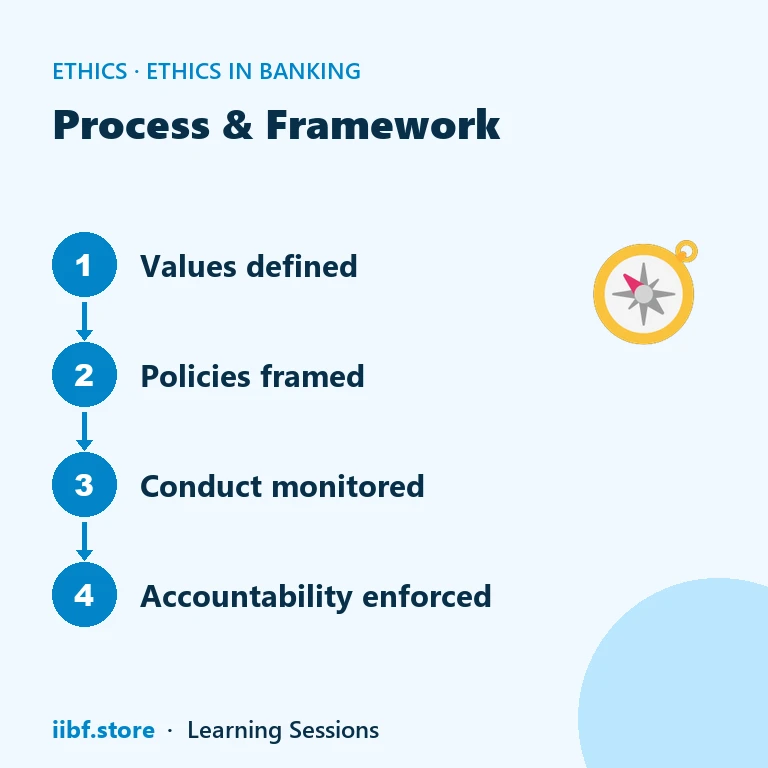
🛠️ A Step-by-Step Framework for Resolving a Branch-Level Dilemma
IIBF case-study questions usually want a structured resolution, not a philosophy essay. A workable sequence: first, identify the facts and every stakeholder affected - customer, bank, colleague, regulator. Second, check the rulebook - does a circular, the code of conduct or a statutory duty already settle it? If yes, the deontological answer generally wins; a duty cannot be overridden by a favourable outcome.
Third, if the rulebook is silent, run the utilitarian test - which option produces the least net harm across all stakeholders, not just the bank's balance sheet? Fourth, apply the virtue check - would a banker of good character be comfortable if this decision were made public? Fifth, confirm no individual's rights are being sacrificed purely because the aggregate outcome looks better - this is the safeguard against faulty utilitarian reasoning. Finally, document the reasoning; an auditable ethical decision, not just an auditable financial one, is what protects both the banker and the institution later.
📌 Remember: Where duty and outcome conflict, IIBF exam answers almost always favour the duty-based response - a good outcome never retroactively excuses a broken rule.
Building an ethical organization does not happen by accident; the framework above is the individual-level mirror of what IIBF's Building an Ethical Organization (Chapter 11) covers at the institutional level. For the regulatory backbone that these codes of conduct are ultimately anchored to, see RBI's regulatory framework.
✅ Conclusion: Turning Theory Into an Exam-Ready Answer
Every IIBF ethics question worth its marks is really asking you to pick the right lens and defend it. Consequentialism and utilitarianism look at outcomes; deontology and Kant's categorical imperative look at duty; virtue ethics looks at character; rights and justice-based approaches look at fairness and entitlement - and relativism and egoism are the two traps examiners set to see if you can spot flawed reasoning. Master the four core lenses, know where each one breaks down, and you can resolve almost any branch-level dilemma IIBF throws at you.
For the full topic map, browse the Ethics in Banking tag hub, then lock in the theory with chapter-wise practice on iibf.store/course/caiib.
🧠 Practice MCQs: Ethical Theories in Business Ethics
Q1. A branch manager approves a recovery action because it protects the interests of the majority of depositors, even though it causes hardship to one defaulting borrower. Which ethical theory is being applied? (a) Deontology (b) Virtue ethics (c) Utilitarianism (d) Ethical relativism
Answer: (c) — Utilitarianism judges an act by whether it produces the greatest good for the greatest number, which is exactly the majority-welfare reasoning described.
Q2. Kant's categorical imperative requires that an action be judged by which test? (a) Whether it maximises profit (b) Whether the actor would personally benefit (c) Whether the underlying rule could be willed as a universal law (d) Whether the local culture accepts it
Answer: (c) — The categorical imperative asks whether the maxim behind an act could consistently become a universal rule for everyone, independent of outcome or self-interest.
Q3. A bank employee refuses to falsify a document even though no one would ever find out, simply because it conflicts with their sense of integrity. This best illustrates which approach? (a) Ethical egoism (b) Virtue ethics (c) Shareholder view (d) Consequentialism
Answer: (b) — Virtue ethics centres on character traits like honesty and integrity guiding the decision, not on rules, outcomes, or self-interest.
Q4. Which theory holds that an act is ethical simply because it serves the decision-maker's own self-interest? (a) Ethical egoism (b) Deontology (c) Rights-based ethics (d) Stakeholder theory
Answer: (a) — Ethical egoism judges rightness by whether the act benefits the actor, which conflicts directly with a banker's fiduciary duty to customers.
Q5. The stakeholder view of business ethics differs from the shareholder view because it: (a) Focuses only on maximising owner returns (b) Ignores regulatory obligations (c) Extends ethical duty to employees, customers, regulators and the community (d) Applies only to listed companies
Answer: (c) — The stakeholder view widens ethical responsibility beyond owners to everyone affected by the bank's decisions, which fits the public-trust nature of Indian banking.
Want chapter-wise mock tests with 100+ MCQs? Start practising free →
❓ Frequently Asked Questions
What is the difference between teleological and deontological ethical theories?
Teleological theories, such as utilitarianism, judge an action by its outcomes or consequences. Deontological theories, such as Kant's duty ethics, judge an action by whether it follows a moral duty or rule, regardless of the outcome.
Why does IIBF test multiple ethical theories instead of just one code of conduct?
Because real branch dilemmas rarely have a single obvious answer. Testing consequentialism, deontology, virtue ethics and rights-based reasoning together checks whether a candidate can identify which lens applies and defend the reasoning, not just recall a rule.
Is ethical relativism an acceptable justification for bending a bank rule?
No. Ethical relativism explains why norms vary across cultures, but it cannot override a statutory duty or regulatory requirement - a branch cannot excuse a violation by calling it "local practice."
How should a banker resolve a conflict between doing what helps the most people and following a strict duty?
Check whether an existing rule, circular or statutory duty already covers the situation - if so, the duty generally takes priority. Where no rule applies, weigh the outcome for all stakeholders, not just the bank, before deciding.
Quick quiz on this topic
5 exam-style questions from our free test bank — check yourself before you move on.
Practice this topic
Take a free mock test, download chapter PDFs, or watch a video class — all included on iibf.store.