Guarantees and Finance to NBFCs: RBI Compliance Norms
Candidates preparing for the Banking Compliance Professional (BCP) certification face few areas as tricky as guarantees and finance to NBFCs. These topics mix operational detail with regulatory sensitivity. A bank guarantee looks like a simple non-fund facility on the surface. But the moment it is misclassified, wrongly sanctioned, or issued without Board-approved limits, it becomes a live compliance exposure. Bank credit to Non-Banking Financial Companies (NBFCs) works the same way. It sits under a dense web of RBI restrictions. A compliance officer must be able to recite these restrictions without hesitation. This article walks through both topics the way BCP examiners actually test them. It covers norms, ceilings, documentation, and the fine distinctions between guarantee types.
🏦 Guarantees and Co-Acceptances: The Compliance Basics
A bank guarantee is a contingent, non-fund based commitment. The bank undertakes to pay a specified sum if the applicant (the bank's customer) fails to fulfil an obligation. This obligation may be contractual or financial, owed to a third party (the beneficiary). Guarantees fall into two broad types. Financial guarantees cover repayment of money, such as advance payment guarantees or deferred payment guarantees. Performance guarantees cover satisfactory execution of a contract, such as bid bonds and performance bonds. Co-acceptance of bills is a related but distinct facility. Here the bank adds its acceptance to a bill of exchange drawn on its customer. This makes the bank liable to the holder if the drawee defaults. Because co-acceptance creates an unconditional payment obligation, RBI treats it with the same rigour as a financial guarantee for exposure and sanctioning purposes.
Compliance teams must distinguish a Deferred Payment Guarantee (DPG) from an ordinary performance guarantee. A DPG is typically issued for machinery or capital goods purchase on instalment terms. It carries credit risk comparable to term lending. RBI therefore requires banks to treat DPGs as funded exposures for capital adequacy and exposure-ceiling computation. This holds even though DPGs sit off the balance sheet, like any other guarantee. Getting this classification wrong is one of the most common findings in internal and RBI inspections. It is also a favourite BCP exam trap.
💡 Exam Tip: If a question describes a guarantee "for machinery purchased on deferred payment terms," think DPG. Remember: it is risk-weighted and exposure-capped like a term loan, not treated as a plain non-fund facility.
Sanctioning discipline matters as much as classification. Guarantees must be issued strictly within delegated sanctioning powers. They need a facility letter, and counter-guarantees or collateral where the bank's credit policy demands it. Compliance officers reviewing a bank's guarantee book should check one thing: are unsecured guarantees within the ceiling fixed by the bank's own Board-approved policy? RBI withdrew the earlier fixed percentage cap. Banks now govern this internally, subject to prudential norms on unsecured exposure. For a structured walkthrough of the broader family of non-fund facilities, the chapter on Guarantees, Acceptances and Finance to NBFCs is the primary reference. Candidates should work through it before attempting mock questions.
📜 RBI Restrictions on Bank Finance to NBFCs
The second half of this topic — bank finance to NBFCs — is where compliance risk multiplies. RBI permits banks to extend working capital, term loans, and other credit facilities to registered NBFCs. But it draws firm lines around the purpose of that finance. Banks cannot finance NBFCs for investment in land and building, other than for their own use. They also cannot finance investment in unquoted shares. The same goes for bridge loans against expected equity flows or capital/debenture issues. On-lending to group companies or promoters is also barred, if it works around exposure norms. NBFC-MFIs and NBFC-Investment and Credit Companies attract additional sector-specific conditions. Gold-loan NBFCs face loan-to-value monitoring before a bank can extend bulk credit lines to them.
These restrictions exist for a reason. NBFCs sit one layer removed from RBI's direct prudential supervision compared to banks. So bank funding of NBFCs is effectively an indirect channel of systemic credit. A compliance function that fails to screen the end-use of NBFC credit is, in RBI's eyes, failing to control a material contagion risk. That is exactly why this sits inside the Banking Compliance Professional syllabus, not only in credit or treasury training. This ties closely to the broader restrictions on lending covered in Loans and Advances Regulatory Restrictions. Candidates should read the two chapters together, not in isolation.
⚠️ Common Mistake: Students often assume "restrictions on bank finance to NBFCs" means banks cannot lend to NBFCs at all. In reality, RBI restricts only specific end-uses and structures. General working capital and refinancing of eligible NBFC business remains permissible within exposure limits.
📊 Exposure Ceilings That Apply to Guarantees and NBFC Credit
Both guarantees and NBFC finance ultimately feed into a bank's single-borrower and group-borrower exposure computation. A guarantee, once invoked, converts from a contingent liability into a funded exposure. So banks must include the guarantee's credit-equivalent amount while calculating exposure against the counter-party, not just the drawn credit limits. The same logic applies when a bank finances an NBFC that belongs to a corporate group. If that group already carries fund-based exposure with the bank, the two must be aggregated for group-exposure ceiling purposes. This is precisely where the chapter on Large Exposures and Exposure Norms intersects with guarantee and NBFC-finance compliance. BCP papers test this connection frequently through scenario-based questions.
| Facility Type | Nature | Treated as Funded Exposure? | Typical Compliance Check |
|---|---|---|---|
| Performance Guarantee | Non-fund, contract execution risk | ❌ No (until invoked) | Delegated sanctioning power, counter-guarantee |
| Financial / Advance Payment Guarantee | Non-fund, repayment risk | ❌ No (until invoked) | Unsecured guarantee ceiling per Board policy |
| Deferred Payment Guarantee (DPG) | Instalment-linked, term-loan-like risk | ✅ Yes, for exposure/capital purposes | Classified and risk-weighted like a term loan |
| Bill Co-acceptance | Unconditional payment undertaking | ✅ Treated akin to a guarantee | Aggregated with other exposures on the drawee |
| Term Credit to NBFCs | Fund-based | ✅ Yes | End-use screening against RBI-prohibited purposes |
✅ Building a Compliance Checklist for Guarantee and NBFC-Finance Files
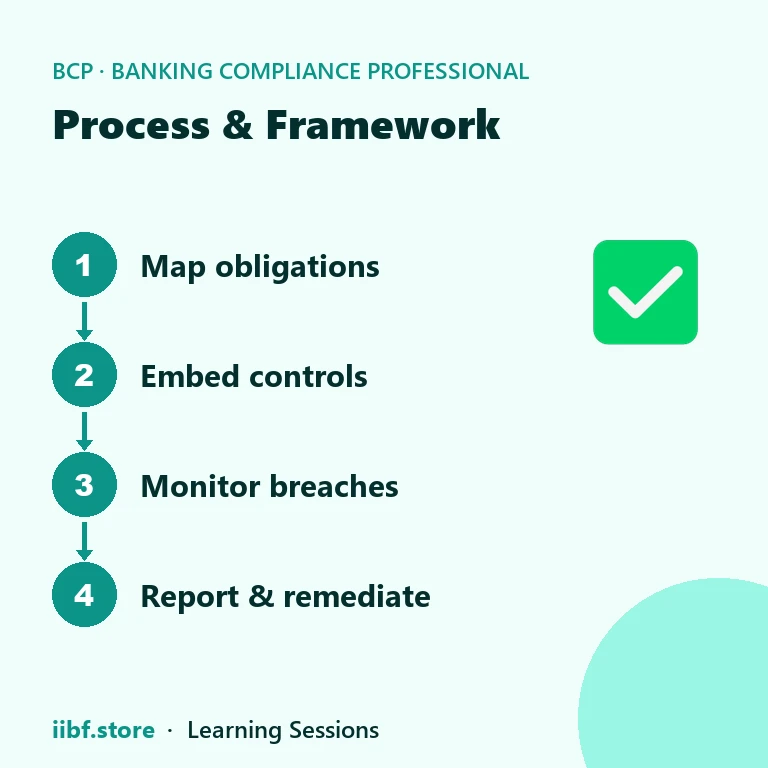
A compliance officer reviewing a branch's guarantee and NBFC-finance portfolio typically works through a fixed checklist. First, verify that every guarantee was sanctioned within the officer's delegated power. Also check that the facility letter and guarantee format match the model approved by the bank's legal department. Second, confirm that DPGs are flagged separately in the core banking system. This ensures they are picked up correctly during exposure and capital-adequacy computation — a system-classification error here is a recurring audit finding across banks. Third, for NBFC credit files, confirm documented end-use certification exists. Also confirm that disbursement has not been used, directly or indirectly, for a restricted purpose. Land purchase or bridge financing against a pending IPO are two common examples.
Fourth, check that group and single-borrower exposure aggregation actually includes outstanding guarantees and co-acceptances, not just fund-based limits. This is the single most common gap RBI inspection teams flag in mid-sized banks. Finally, ensure periodic renewal and review of guarantee limits and NBFC credit lines is evidenced in the credit file. Compliance sign-off should be recorded, not merely assumed. Many of these checklist items overlap with the wider disciplines tested under the chief compliance officer oversight structure. Guarantee and NBFC-finance sanctioning ultimately rolls up into the CCO's monitoring dashboard.
📌 Remember: A guarantee is contingent only until it is invoked. The moment it converts to a funded exposure, every exposure-ceiling and provisioning rule that applies to a loan applies to it too.
Compliance professionals should also track how supervisory frameworks pick up these exposures during examination cycles. RBI's evolving supervisory approach is discussed in detail under the RBI SPARC framework. It increasingly uses data-driven flags to identify banks where guarantee and NBFC-exposure aggregation appears inconsistent with reported single-borrower limits. This means these are no longer purely manual-audit risks. They also surface through automated supervisory analytics.
🏢 Where This Fits With Borrowing Powers Under Company Law
Guarantees and NBFC finance do not exist in a regulatory vacuum. They interact directly with a borrowing company's own legal capacity to create charges and avail credit. This applies to a bank sanctioning a guarantee-backed facility. It also applies to an NBFC receiving bank finance, if that NBFC is itself a company. Either way, charge and borrowing-power documentation must align with company law requirements. Compliance professionals studying this chapter should cross-reference Companies Act 2013 for bankers. This helps them understand how charge registration and borrowing-power resolutions interact with the guarantee and credit sanctioning process described above. This linkage appears in integrated BCP case-study questions more often than standalone theory questions.
Exam aspirants preparing for the CBCP certification will find that guarantee classification and NBFC-finance restrictions are tested alongside exam-structure basics. If you have not yet reviewed the certification's format, the guide on the CBCP exam pattern is a useful companion. Read it before diving deeper into scenario-based practice sets.
🧠 Practice MCQs: Guarantees and Finance to NBFCs
Q1. As per RBI's revised guidelines, the ceiling on unsecured guarantees combined with unsecured advances is now primarily governed by: (a) A fixed 15% cap prescribed by RBI (b) The bank's own Board-approved policy (c) IIBF's model guarantee policy (d) SEBI's exposure norms
Answer: (b) — RBI withdrew the earlier fixed percentage ceiling and now requires banks to fix and monitor unsecured exposure limits through a Board-approved policy.
Q2. Co-acceptance of a bill of exchange by a bank essentially amounts to: (a) An unconditional guarantee of payment by the accepting bank (b) A discounting arrangement carrying no bank liability (c) A facility used only for export bills (d) An activity restricted entirely under the Companies Act 2013
Answer: (a) — Once a bank co-accepts a bill, it becomes unconditionally liable to the holder if the drawee fails to pay, making it a contingent liability similar to a financial guarantee.
Q3. RBI guidelines specifically restrict banks from financing NBFCs for which of the following purposes? (a) Working capital for hire-purchase business (b) Discounting of genuine commercial bills (c) Investment in land, buildings and unquoted shares (d) Term funding for eligible asset-financing NBFCs
Answer: (c) — RBI prohibits bank credit to NBFCs being used for investment in land, buildings (other than for own use) or unquoted shares, to prevent indirect equity-style speculation funded through bank credit.
Q4. A guarantee issued to secure a buyer's advance payment made to a contractor is best classified as: (a) A performance guarantee (b) A bid bond guarantee (c) A deferred payment guarantee (d) A financial guarantee, specifically an advance payment guarantee
Answer: (d) — Guarantees covering repayment of money (like an advance payment) are financial guarantees, distinct from performance guarantees that cover execution of contractual obligations.
Q5. A Deferred Payment Guarantee (DPG) issued for machinery purchase is treated in a bank's exposure and capital computation as: (a) A funded credit facility akin to a term loan (b) An off-balance sheet item carrying no credit risk (c) A pure non-fund facility exempt from exposure norms (d) A demand guarantee with no risk weight
Answer: (a) — Because a DPG's repayment risk mirrors instalment credit, RBI requires it to be treated as a funded, term-loan-like exposure for capital adequacy and exposure-ceiling purposes.
Want chapter-wise mock tests with 100+ MCQs? Start practising free →
❓ Frequently Asked Questions
What is the difference between a performance guarantee and a financial guarantee?
A performance guarantee assures the beneficiary that a contract will be executed as agreed, while a financial guarantee assures repayment of a monetary obligation, such as an advance payment or deferred instalment.
Can a bank finance an NBFC's working capital requirements?
Yes, banks can extend working capital and term credit to registered NBFCs for eligible business activities, provided the funds are not diverted to RBI-restricted end-uses such as land purchase, unquoted share investment, or bridge financing against capital issues.
Why is a Deferred Payment Guarantee treated differently from other guarantees?
A DPG carries repayment risk similar to instalment credit, so RBI requires banks to treat it as a funded exposure for capital adequacy and exposure-ceiling computation, unlike a typical non-fund guarantee.
Where do guarantee and NBFC-finance exposures get aggregated for ceiling purposes?
They are aggregated within the bank's single-borrower and group-borrower exposure framework, alongside all other fund-based and converted non-fund exposures on the same counter-party or group.
🎯 Conclusion
Guarantees and finance to NBFCs sit at the intersection of credit operations and compliance oversight. That is exactly why the Banking Compliance Professional syllabus dedicates a full module to it. Master the classification of guarantee types, the specific RBI restrictions on NBFC end-use, and how both feed into exposure ceilings. Do this well, and you will be placed well for both the exam and real audit scenarios. Explore more topics from this subject on the Banking Compliance Professional tag hub. Verify the underlying norms directly at rbi.org.in. When you are ready to test your recall, take a full chapter-wise mock at iibf.store/tests.
Prefer revising from a printed book?
Chapter-wise books with MCQs after every chapter — minimal pages, complete coverage, delivered anywhere in India. Every book has a free sample to read first.
Learning Sessions · Ashish Sir
132 pages · 225 MCQs
Learning Sessions · Ashish Sir
188 pages · 435 MCQs
Learning Sessions · Ashish Sir
117 pages · 236 MCQs
Learning Sessions · Ashish Sir
Learning Sessions · Ashish Sir
118 pages · 299 MCQs
Learning Sessions · Ashish Sir
Learning Sessions · Ashish Sir
Learning Sessions · Ashish Sir
Learning Sessions · Ashish Sir
115 pages · 255 MCQs
Learning Sessions · Ashish Sir
Learning Sessions · Ashish Sir
334 pages · 936 MCQs
Learning Sessions · Ashish Sir
Learning Sessions · Ashish Sir
115 pages · 344 MCQs
Learning Sessions · Ashish Sir
107 pages · 240 MCQs
Learning Sessions · Ashish Sir
90 pages · 150 MCQs
Learning Sessions · Ashish Sir
131 pages · 672 MCQs
Learning Sessions · Ashish Sir
221 pages · 831 MCQs
Learning Sessions · Ashish Sir
128 pages · 524 MCQs
Learning Sessions · Ashish Sir
107 pages · 445 MCQs
Learning Sessions · Ashish Sir
148 pages · 478 MCQs
Learning Sessions · Ashish Sir
151 pages · 465 MCQs
Learning Sessions · Ashish Sir
148 pages · 375 MCQs
Learning Sessions · Ashish Sir
216 pages · 895 MCQs
Learning Sessions · Ashish Sir
109 pages · 300 MCQs
Learning Sessions · Ashish Sir
104 pages · 360 MCQs
Learning Sessions · Ashish Sir
82 pages · 297 MCQs
Learning Sessions · Ashish Sir
151 pages · 600 MCQs
Learning Sessions · Ashish Sir
98 pages · 282 MCQs
Learning Sessions · Ashish Sir
Practice this topic
Take a free mock test, download chapter PDFs, or watch a video class — all included on iibf.store.
Keep reading