FATCA and CRS Compliance for Banks: Form 61B Reporting Guide (2026)
Cross-border tax transparency has quietly become one of the heaviest recurring obligations on a bank's compliance desk, and FATCA and CRS compliance for banks sits at the centre of it. Every branch that opens an account, every relationship manager who onboards a Non-Resident, and every reporting team that files an annual return is touching this framework whether they realise it or not. For candidates sitting the IIBF Banking Compliance Professional exam, this is a high-yield area: it blends US law, OECD standards, Indian Income-tax Rules and RBI's customer-due-diligence expectations into a single reporting workflow. This guide walks through the origins, the Indian legal machinery, the due-diligence thresholds, the timelines and the penalties, so you can answer both the conceptual and the numeric questions with confidence.
🌍 What FATCA and CRS Actually Are
The Foreign Account Tax Compliance Act (FATCA) is a United States law enacted in 2010 to stop US persons hiding income in offshore accounts. It compels financial institutions worldwide to identify accounts held by US persons and report them to the US Internal Revenue Service (IRS). India did not adopt FATCA by copying US law; instead it signed an Inter-Governmental Agreement (IGA) — a Model 1 IGA — with the United States on 9 July 2015. Under Model 1, Indian banks report to the Indian tax authority (the CBDT), which then exchanges the data with the IRS.
The Common Reporting Standard (CRS) is the multilateral cousin, developed by the OECD in 2014 and built on the same architecture. Instead of one partner country, CRS creates automatic exchange of financial-account information among 100-plus participating jurisdictions through the Multilateral Competent Authority Agreement (MCAA). India was an early adopter, with its first CRS exchanges commencing in 2017. Because both regimes share due-diligence logic, Indian rules implement them together. A bank's obligation is therefore not "US-only" — it must identify tax residents of every reportable jurisdiction, which is why understanding the shared framework matters more than memorising either regime in isolation.
⚖️ The Indian Legal Framework
In India, the entire edifice rests on Section 285BA of the Income-tax Act, 1961, which obliges specified Reporting Financial Institutions (RFIs) to furnish a statement of financial transactions or reportable accounts. The operational detail lives in Rules 114F, 114G and 114H of the Income-tax Rules, 1962. Rule 114F carries the definitions — Reporting Financial Institution, Financial Account, Reportable Account and the crucial distinction between "US person" and "reportable person". Rule 114H sets out the due-diligence procedures, and Rule 114G specifies exactly what information must be reported and how.
The reporting vehicle is Form 61B, the Statement of Reportable Account, filed electronically with the Directorate of Income Tax (Intelligence and Criminal Investigation). Note the examiner's favourite trap: FATCA/CRS reporting goes to the CBDT, not to the RBI. RBI's role is indirect — its KYC Master Direction requires banks to obtain self-certification and comply with the Income-tax Rules as part of customer due diligence. For a compliance officer this dual-regulator reality is central; the same onboarding form feeds both a banking-regulator obligation and a tax-authority obligation. Understanding how this overlaps with the fundamentals and overview of FEMA helps you place cross-border reporting in its wider regulatory context.
📝 Exam Tip: If a question asks "to whom does a bank report FATCA/CRS data", the answer is the CBDT / Income-tax Department via Form 61B — never the RBI directly. RBI only mandates the self-certification and due-diligence discipline.
🔍 Due Diligence and Account Classification
The heart of operational compliance is classifying accounts and applying the right review procedure. Rule 114H splits accounts along two axes: pre-existing versus new, and individual versus entity. New accounts (opened after the cut-off date) require a valid self-certification at onboarding — the customer declares their country/countries of tax residence and Taxpayer Identification Number (TIN). Without a valid self-certification, a bank should not open the account. Pre-existing accounts are reviewed against monetary thresholds and electronic-record indicia such as a foreign address, foreign phone number or standing instruction to a foreign account.
The thresholds are where marks are won or lost. Study the side-by-side comparison below, which every candidate should be able to reproduce.
| Feature | FATCA (US IGA) | CRS (OECD) | De-minimis relief? |
|---|---|---|---|
| Legal origin | US law, 2010; IGA signed 9 Jul 2015 | OECD, 2014; MCAA (India live 2017) | — |
| Reportable persons | US persons | Tax residents of partner jurisdictions | — |
| Pre-existing individual de-minimis | Accounts ≤ USD 50,000 may be excluded | No de-minimis — all reviewed | FATCA ✔ / CRS ✘ |
| High-value individual threshold | Balance > USD 1,000,000 | Balance > USD 1,000,000 | ✘ |
| Pre-existing entity threshold | Aggregate > USD 250,000 | Aggregate > USD 250,000 | ✔ (below may be excluded) |
| Self-certification for new accounts | Mandatory | Mandatory | ✘ |
⚠️ Common Mistake: Assuming CRS has the same USD 50,000 de-minimis as FATCA. It does not — under CRS, all pre-existing individual accounts must be reviewed regardless of balance. Only FATCA offers the lower-value individual exemption.
📤 Reporting Obligations, Timelines and Penalties
Once accounts are identified, the RFI aggregates the reportable data — account holder name, address, jurisdiction of residence, TIN, account number, account balance or value at year-end, and gross interest, dividend or redemption amounts credited. This is filed in Form 61B for each calendar year. The statutory due date is 31 May of the year following the calendar year being reported. Crucially, where an institution has no reportable accounts, it must still file a Nil statement — a point examiners love, because many candidates assume "nothing to report" means "nothing to file". The discipline mirrors the wider return-filing culture covered in RBI regulatory reporting under CIMS, where timeliness and completeness of returns is itself the compliance test.
Penalties bite hard. Under Section 271FA, failure to furnish the statement attracts Rs 500 per day of default, rising to Rs 1,000 per day once a notice is served. Section 271FAA imposes a penalty of Rs 50,000 for furnishing inaccurate information — for example, where the RFI knew the details were wrong, failed to correct them, or did not obtain valid self-certification. Because these penalties accrue per day and per defect, a small process gap can compound quickly. Compliance teams therefore treat FATCA/CRS as a controlled annual project, not an afterthought. Reading this alongside reporting requirements related to FEMA shows how India layers multiple cross-border disclosure obligations on the same customer file.
🛡️ The Compliance Officer's Playbook
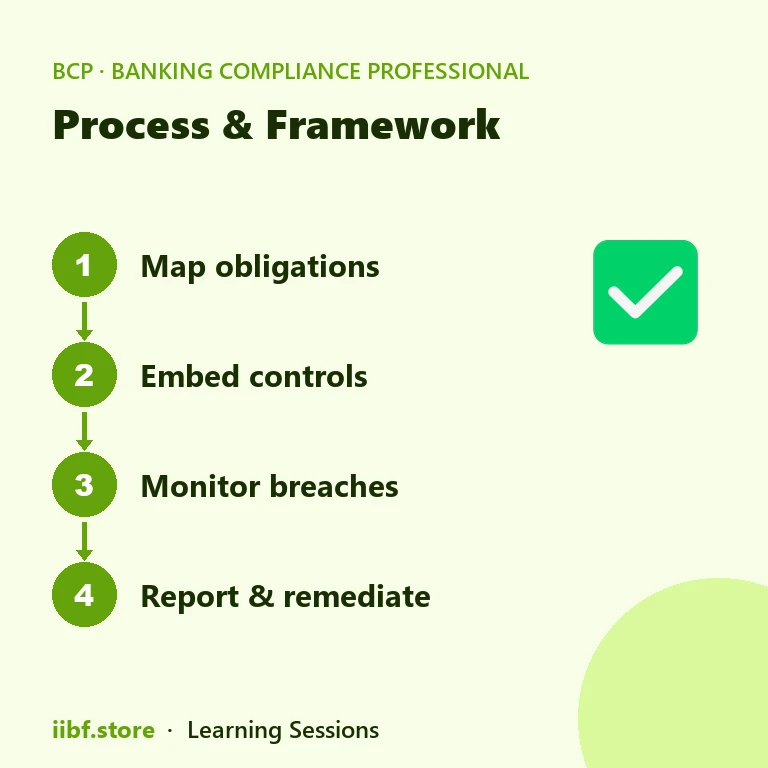
For a Banking Compliance Professional, FATCA/CRS is a governance problem as much as a data problem. Good practice starts at onboarding: build self-certification into the account-opening journey so it cannot be skipped, and validate the declared TIN format against the jurisdiction. Maintain a "change of circumstances" trigger — if a customer updates their address to a foreign country or adds a foreign phone number, the system should flag the account for re-review, because indicia can appear years after onboarding. Reconcile the population of reportable accounts before every 31 May filing, and retain due-diligence evidence for the statutory period.
Escalation and oversight matter too. The compliance function should test a sample of onboarded accounts each quarter to confirm self-certifications were obtained and correctly captured — a control that dovetails with identification of compliance issues and risks. Where breaches are found, the same governance chain that supports the CCO reporting line in banks ensures issues reach the board-level committee. Candidates preparing for the CBCP exam pattern and eligibility should note that examiners frame FATCA/CRS as a test of whether controls are preventive (self-certification at source) or merely detective (year-end reconciliation) — the preventive answer is always the stronger one.
💡 Remember: A valid self-certification obtained at onboarding is a preventive control; a year-end reconciliation is only detective. Exam questions on control design reward the preventive option.
Because default and recovery matters often surface the same cross-border account data, it pays to understand how enforcement channels such as the Debt Recovery Tribunal process for banks interact with a customer's overall risk profile. For more subject-wise revision material, browse the full Banking Compliance Professional article hub.
🧠 Practice MCQs: FATCA and CRS Compliance for Banks
Q1. Under which section of the Income-tax Act, 1961 must Reporting Financial Institutions furnish statements of reportable accounts? (a) 285BA (b) 271FA (c) 139AA (d) 206AA
Answer: (a) — Section 285BA is the enabling provision that obliges RFIs to furnish the statement; the rules 114F-114H flow from it.
Q2. Which form is used in India to file the Statement of Reportable Account under FATCA and CRS? (a) Form 15CA (b) Form 61A (c) Form 61B (d) Form 26AS
Answer: (c) — Form 61B is the Statement of Reportable Account; Form 61A is the separate Statement of Financial Transactions (SFT).
Q3. The de-minimis threshold below which a pre-existing individual account may be exempt from review under FATCA is: (a) USD 1 million (b) USD 50,000 (c) USD 250,000 (d) No threshold applies
Answer: (b) — FATCA allows exclusion of pre-existing individual accounts of USD 50,000 or less; CRS grants no such de-minimis.
Q4. By what date must Form 61B be furnished for a given calendar year? (a) 31 March (b) 30 April (c) 31 May (d) 30 June
Answer: (c) — The statement for a calendar year is due by 31 May of the following year, and a Nil statement is required even with no reportable accounts.
Q5. The penalty under Section 271FAA for furnishing inaccurate information in Form 61B is: (a) Rs 10,000 (b) Rs 50,000 (c) Rs 1,00,000 (d) Rs 500 per day
Answer: (b) — Section 271FAA prescribes a Rs 50,000 penalty for inaccurate information; the per-day penalties sit under Section 271FA for non-furnishing.
Want chapter-wise mock tests with 100+ MCQs? Start practising free
❓ Frequently Asked Questions
Authoritative reference: see the latest guidelines on the Reserve Bank of India website and the IIBF syllabus portal.
Do Indian banks report FATCA and CRS data directly to the US IRS?
No. Under India's Model 1 IGA, banks report to the CBDT (Income-tax Department) via Form 61B, and the CBDT exchanges the data with the IRS and other partner jurisdictions.
Is a Nil statement really required if there are no reportable accounts?
Yes. A Reporting Financial Institution must file a Nil statement in Form 61B even when it has identified no reportable accounts for the calendar year.
What happens if a customer refuses to give a self-certification for a new account?
The account should not be opened. A valid self-certification of tax residence and TIN is mandatory at onboarding for new accounts under Rule 114H.
Does CRS have the same USD 50,000 de-minimis exemption as FATCA?
No. CRS requires all pre-existing individual accounts to be reviewed regardless of balance. The USD 50,000 lower-value individual exemption is specific to FATCA.
FATCA and CRS reward candidates who can pair the concept with the exact section, form and threshold. Lock in the numbers, then pressure-test them against full-length questions — take a free Banking Compliance mock test or explore structured prep on the CAIIB course page to keep your compliance fundamentals sharp.
Prefer revising from a printed book?
Chapter-wise books with MCQs after every chapter — minimal pages, complete coverage, delivered anywhere in India. Every book has a free sample to read first.








Practice this topic
Take a free mock test, download chapter PDFs, or watch a video class — all included on iibf.store.
Keep reading