ICAAP Process in Banks: CAIIB Risk Management Capital Guide
The ICAAP process in banks is the internal exercise every bank runs to check whether its capital cushion truly matches its risk profile, not just the minimum Basel ratio on paper. Under the Reserve Bank of India's Pillar 2 supervisory review guidelines, banks must identify credit, market, operational and other material risks, then plan capital and management actions around that assessment. For CAIIB Risk Management candidates, ICAAP questions test whether you can connect risk identification, stress testing, capital planning and board governance into one coherent picture. This article walks through each stage of the ICAAP process in banks, the documents examiners expect, and the mistakes candidates repeatedly make in exam answers.
📋 What Is ICAAP and Why It Matters for Banks
ICAAP stands for Internal Capital Adequacy Assessment Process. It sits under Pillar 2 of the Basel framework, alongside the Pillar 1 minimum capital ratio and the Pillar 3 disclosure regime. Where Pillar 1 uses standard formulas for credit, market and operational risk, Pillar 2 asks a bank to look inward and answer a harder question: given everything we actually do, is our capital enough? A bank with heavy concentration in a few large borrowers, or one running a large treasury book, may need more capital than the standard formula suggests. The risk management framework a bank has in place feeds directly into ICAAP, because the assessment is only as good as the risk identification underneath it.
The RBI expects every scheduled commercial bank to prepare an annual ICAAP document, get it approved by the board, and submit it to the supervisor. Small banks with simple balance sheets can use a lighter version of the exercise, while large and complex banks are expected to run detailed stress models. Examiners like this topic because it forces candidates to link risk measurement, capital planning and governance rather than testing rote definitions in isolation.
🧮 Building the ICAAP: Risk Identification to Capital Planning
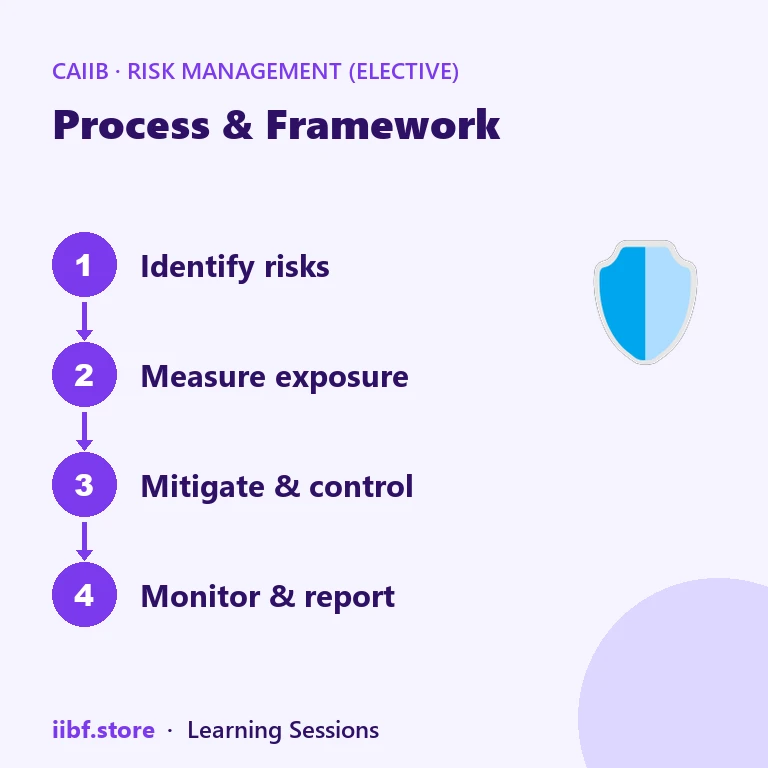
The ICAAP process in banks generally moves through five linked stages. First, risk identification: the bank lists every material risk it faces, from credit and market risk to concentration risk, interest rate risk in the banking book, reputational risk and strategic risk. Second, risk measurement: each identified risk is quantified using the bank's own models where Pillar 1 formulas fall short. Third, risk appetite: the board sets limits on how much of each risk the bank is willing to carry, tying back to the bank's overall asset liability management strategy for balance-sheet risks like duration mismatch and funding concentration.
Fourth, capital planning: the bank projects capital needs over a three-to-five-year horizon under both a base case and adverse scenarios, then decides whether current capital, retained earnings, or fresh issuance will cover the gap. Fifth, capital allocation: some banks push this further and allocate capital notionally across business lines so each unit can be measured on a risk-adjusted basis. A well-written ICAAP document ties every one of these five stages back to actual board-approved policy, not generic industry text. Candidates often lose marks by describing ICAAP as a single calculation rather than this five-stage cycle.
💡 Exam Tip: If a question asks you to sequence ICAAP steps, remember the order — identify, measure, set appetite, plan capital, allocate. Getting the sequence wrong is a common trap in matching-type questions.
📊 Stress Testing, Capital Buffers and the ICAAP Table
Stress testing is the engine that makes ICAAP more than a spreadsheet exercise. The bank runs its balance sheet through severe but plausible scenarios — a sharp rise in non-performing loans, a sudden funding squeeze, or a shock to bond yields — and checks whether capital and liquidity buffers hold up. Statistical techniques used elsewhere in the CAIIB syllabus, including the index construction methods covered under index numbers in banking statistics, resurface here when banks build stress indices to track cumulative risk drift over time.
The table below summarises how ICAAP treats different risk categories compared with the standard Pillar 1 approach, which is a frequent exam contrast.
| Risk Area | Covered Under Pillar 1 Formula | Needs ICAAP Add-on Capital? | Typical ICAAP Tool |
|---|---|---|---|
| Credit risk (standard book) | Yes, standard formula | ❌ Usually no | Portfolio review |
| Concentration risk | No | ✅ Yes | Large exposure stress test |
| Interest rate risk in banking book | No | ✅ Yes | Duration gap analysis |
| Reputational and strategic risk | No | ✅ Yes | Scenario stress test |
⚠️ Common Mistake: Candidates often assume ICAAP capital add-ons apply to every risk. In practice, risks already well covered by Pillar 1 formulas usually need no extra buffer unless the bank's own profile is unusually skewed.
🏦 Board Oversight and RBI Supervisory Review
ICAAP is not just a risk team output; it is a governance document. The board, or a board-level risk committee, must review and approve the ICAAP report before it goes to the supervisor. This mirrors the discipline expected in liquidity risk management, where board sign-off on contingency funding plans is equally non-negotiable. The RBI's Supervisory Review and Evaluation Process then examines the bank's ICAAP, compares it with the supervisor's own risk assessment, and can direct a bank to hold additional capital if the assessment looks too optimistic.
Good ICAAP documentation also cross-references related disclosures. A bank preparing its Pillar 3 disclosure requirements should be able to trace the numbers back to the same risk inventory used in ICAAP, and a bank flagging large-borrower exposures under concentration risk in banks should see that same concentration reflected in its ICAAP capital add-on. Weak internal control processes, tested through risk control self assessment in banks, are exactly the kind of qualitative finding that pushes an ICAAP score down even when the quantitative capital ratio looks fine. For the official supervisory guidance banks follow, see the Reserve Bank of India website.
📌 Remember: ICAAP is reviewed annually, approved by the board, and checked by the supervisor — miss any one of these three and the process is incomplete on paper, even if the underlying numbers are correct.
Browse more topics from this elective on the risk management elective tag hub, and revise past chapters using chapter-wise mock tests before attempt day.
🧠 Practice MCQs: ICAAP Process in Banks
Q1. The ICAAP process in banks primarily addresses which Basel pillar? (a) Pillar 1 (b) Pillar 2 (c) Pillar 3 (d) None of the pillars
Answer: (b) — ICAAP is the bank's own internal capital adequacy assessment carried out under Pillar 2, the supervisory review process.
Q2. Which of the following risks is typically NOT covered by the Pillar 1 minimum capital charge and therefore needs attention under ICAAP? (a) Standard credit risk (b) Concentration risk (c) Standard operational risk events (d) Market risk on the trading book
Answer: (b) — Concentration risk from large exposures is not captured by the standard Pillar 1 credit risk formula and must be separately assessed under ICAAP.
Q3. Who is responsible for approving a bank's ICAAP document before it is submitted to the supervisor? (a) The branch manager (b) The statutory auditor (c) The board of directors (d) The credit rating agency
Answer: (c) — ICAAP is a governance document that requires board-level review and approval before submission to the RBI.
Q4. What is the main purpose of stress testing within the ICAAP process? (a) To calculate daily profit and loss (b) To check whether capital and liquidity buffers hold up under severe but plausible scenarios (c) To fix the interest rate on savings accounts (d) To value fixed assets on the balance sheet
Answer: (b) — Stress testing checks whether the bank's capital and liquidity remain adequate under adverse but plausible conditions, forming the core of the ICAAP capital planning stage.
Q5. In the ICAAP cycle, which step comes immediately after risk identification and measurement? (a) Setting risk appetite (b) Filing tax returns (c) Publishing Pillar 3 disclosures (d) Closing bank branches
Answer: (a) — After risks are identified and measured, the board sets risk appetite limits before capital planning and allocation follow.
Want chapter-wise mock tests with 100+ MCQs? Start practising free →
What does ICAAP stand for in banking?
ICAAP stands for Internal Capital Adequacy Assessment Process, the internal exercise banks run under Pillar 2 to judge whether their capital matches their actual risk profile.
Is ICAAP mandatory for all banks in India?
Yes, the Reserve Bank of India expects every scheduled commercial bank to prepare an annual ICAAP document, though the depth of analysis expected scales with the size and complexity of the bank.
How is ICAAP different from Pillar 1 capital requirements?
Pillar 1 uses standard formulas for credit, market and operational risk, while ICAAP under Pillar 2 asks the bank to assess risks the standard formulas miss, such as concentration risk and interest rate risk in the banking book.
Who reviews a bank's ICAAP report after the board approves it?
Once the board approves the ICAAP document, the Reserve Bank of India reviews it through its Supervisory Review and Evaluation Process and can direct the bank to hold additional capital if needed.
The ICAAP process in banks connects risk identification, stress testing, capital planning and board governance into a single annual discipline, and CAIIB Risk Management questions consistently test that connection rather than isolated definitions. Revise the linked chapters above, work through the five MCQs, and keep practising with full-length CAIIB Risk Management tests to build exam-day speed.
Practice this topic
Take a free mock test, download chapter PDFs, or watch a video class — all included on iibf.store.