Listing Norms for Small Finance Banks: IPO Rules Explained
The listing norms for small finance banks are among the sharpest licensing conditions the Reserve Bank has ever written into a bank category. A small finance bank does not get to decide whether it will face public shareholders — the licence itself carries a clock. Once the bank's net worth touches Rs 500 crore, it must list its equity shares on the stock exchanges within three years. For an IIBF SFB paper candidate, this is a high-yield area because it sits at the junction of RBI licensing conditions, SEBI capital market regulation and corporate governance.
This guide walks you through the trigger, the promoter dilution timetable it interacts with, the SEBI rulebook an SFB must satisfy at the initial public offering, and what changes the day after the shares are quoted.
📈 The Three-Year Listing Clock in the RBI Guidelines
The RBI's Guidelines for Licensing of Small Finance Banks in the Private Sector (2014), carried forward into the On-tap Licensing framework of December 2019, set the rule plainly: a small finance bank must get its shares listed within three years of reaching a net worth of Rs 500 crore. The trigger is net worth, not paid-up capital, not deposits and not branch count.
Banks that have not yet crossed that threshold are not barred from the market. The guidelines expect them to list voluntarily, and several SFBs have done exactly that — tapping the market well before the mandatory clock started ticking, because they needed growth capital anyway. Under the on-tap route the minimum paid-up voting equity capital is Rs 200 crore, so a fast-growing lender can reach Rs 500 crore of net worth in a handful of profitable years.
Note the sequencing you are expected to know for the exam. Listing is a post-commencement obligation, not an entry condition. An applicant is licensed, gets in-principle approval, commences business, builds net worth, and only then does the listing obligation attach. Candidates who study the licensing conditions alongside the operations of banks chapter tend to remember this sequence correctly. If you are still shaky on how a microfinance institution becomes a bank in the first place, revise the mfi to sfb conversion norms before attempting this topic.
| Norm | Requirement | Source | Pre-IPO? |
|---|---|---|---|
| Mandatory listing trigger | List within 3 years of net worth reaching Rs 500 crore | RBI SFB guidelines | ✅ |
| Voluntary listing | Permitted (and expected) below the Rs 500 crore mark | RBI SFB guidelines | ✅ |
| Minimum paid-up voting equity capital | Rs 200 crore (on-tap route) | RBI on-tap guidelines, 2019 | ✅ |
| Promoter minimum initial contribution | 40% of paid-up equity, locked in for 5 years | RBI SFB guidelines | ✅ |
| Promoter dilution | Down to 30% within 10 years of commencement | RBI SFB guidelines | ❌ |
| Minimum promoters' contribution at IPO | 20% of post-issue capital, locked in 18 months | SEBI ICDR Regulations, 2018 | ❌ |
| Minimum public shareholding | 25% public holding, to be reached within 3 years of listing | SCRR Rules 19(2)(b) and 19A | ❌ |
| Voting rights ceiling per shareholder | 26% | Section 12(2), Banking Regulation Act, 1949 | ✅ |
Read that table as the examiner does: the listing norms for small finance banks are an RBI condition, but the mechanics of getting listed are a SEBI subject. Both sets can be tested in the same question.
🏛️ Why the Regulator Wants These Banks Listed
Four supervisory objectives explain the rule. First, market discipline. A listed bank is priced every trading day by investors who read its asset quality the way a supervisor does. A widening gap between reported provisions and the market's view of them shows up in the price long before it shows up in an inspection report.
Second, transparency through continuous disclosure. An unlisted bank publishes accounts annually; a listed one publishes quarterly results, discloses material events promptly, and files shareholding patterns and related-party transactions on a fixed calendar. That flow of information is a supervisory asset, not just an investor convenience.
Third, price discovery for the dilution timetable. The promoter of an SFB is contractually bound to come down from a 40% initial contribution to 30% within ten years, with a further step-down over a longer horizon under the on-tap framework. You cannot dilute an unquoted share sensibly — there is no price. Listing creates the market that makes the promoter shareholding conditions executable.
Fourth, access to growth capital. SFBs lend heavily to microfinance and micro-enterprise borrowers, and must hold a minimum capital to risk-weighted assets ratio well above the universal-bank floor. Loan growth eats capital fast in that segment, and a listed bank can go back to the market through a qualified institutions placement or a rights issue. Revise the capital adequacy norms for small finance banks alongside this section — capital planning is precisely why the listing norms for small finance banks exist in their present form.
💡 Exam Tip: If a question asks what "triggers" the listing obligation, the answer is net worth of Rs 500 crore — not the licence date, not the date of commencement of business.
🧾 SEBI's IPO Rulebook: Public Shareholding, OFS and Lock-ins
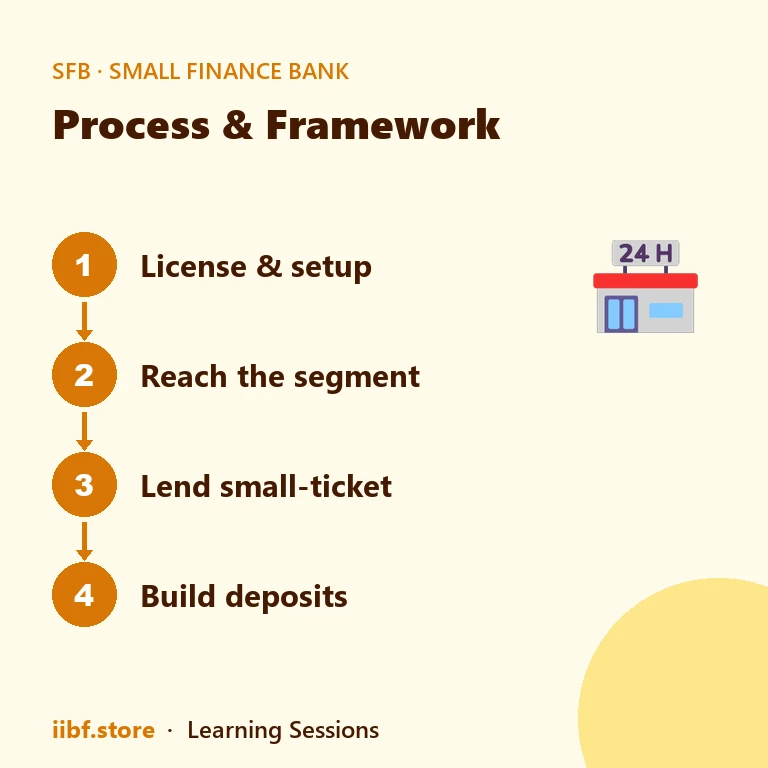
Once the RBI clock starts, the bank enters SEBI territory. Under the Securities Contracts (Regulation) Rules, a company coming to the market must offer at least 25% to the public, with a lower slab available to very large issuers who then have to climb to 25% within three years of listing. Miss that and the exchanges can freeze promoter holdings and levy fines.
The next decision is the mix. A fresh issue creates new shares and the money goes into the bank's Tier 1 capital. An offer for sale is existing shareholders selling out — the proceeds go to them, not to the bank, and not a rupee of it strengthens the capital base. Most SFB IPOs have been hybrids: a fresh issue sized to the bank's capital plan, plus an OFS that lets private equity investors exit and simultaneously helps the promoter meet its dilution schedule.
Lock-ins follow. Under the ICDR Regulations, the minimum promoters' contribution of 20% of post-issue capital is locked in for eighteen months, promoter holding in excess of that for six months, and pre-issue non-promoter capital for six months. Anchor investors hold in two tranches, the second being the longer one. Layer on top the RBI's own five-year lock-in on the promoter's initial 40% and the bank-specific requirement that anyone acquiring 5% or more of a private bank's paid-up capital take prior RBI approval.
⚠️ Common Mistake: Candidates assume every IPO raises capital for the bank. In a pure offer for sale, the bank's net worth and CRAR are unchanged — only the shareholder register moves.
🏢 Holding Company Baggage and the Reverse Merger Route
Several SFBs were born out of microfinance companies, and the licensing structure left them with an awkward two-tier shape: a listed or unlisted holding company at the top that did nothing but hold shares of the bank sitting below it. Once the bank itself had to list, the group ended up with two entities, two boards, two sets of compliance costs and a persistent holding-company discount in valuation.
The clean-up route has been the reverse merger — amalgamating the holding company into the bank so that a single listed entity survives, its former shareholders receive bank shares directly on a court-approved swap ratio, and the promoter percentage falls automatically. Equitas and Ujjivan both took this path with regulatory and NCLT clearance, and the structure they arrived at is now the template other groups study.
This is where the listing norms for small finance banks collide with the promoter shareholding conditions in a way examiners like. A holding company cannot dilute below the RBI's floor without either selling bank shares or being merged away, and the merger route achieves the dilution and the simplification in one transaction. Understanding the parent-subsidiary economics helps here; so does a grounding in the regulation of microfinance institutions, since the microfinance parent's obligations do not vanish the moment a banking licence arrives.
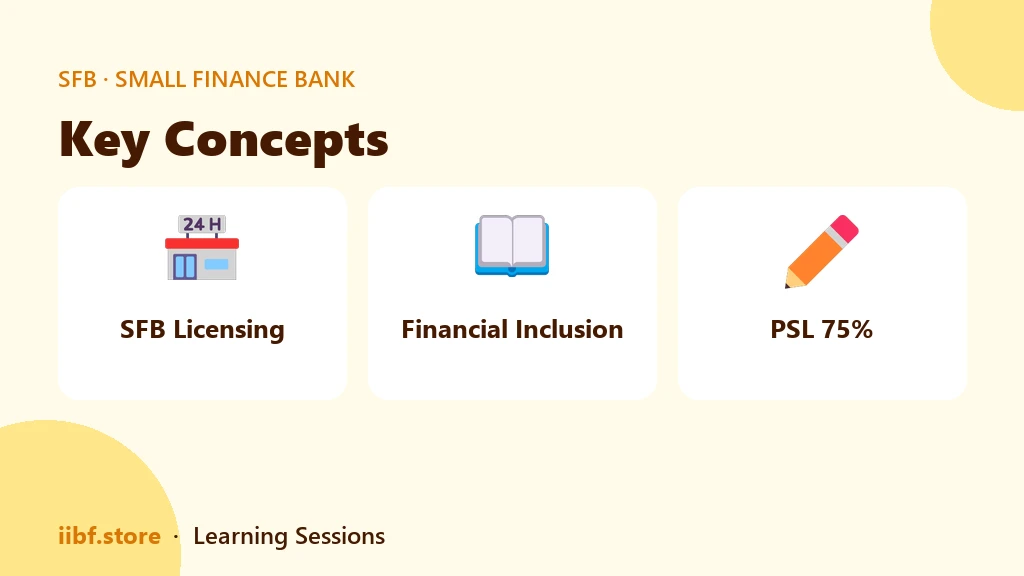
For portfolio-level context, read the chapter on priority sector advances — the 75% PSL obligation is the single biggest driver of the balance sheet that investors are being asked to value.
⚖️ Life After Listing: LODR, Valuation and the Universal Bank Ambition
Listing is a beginning, not an end. The SEBI (Listing Obligations and Disclosure Requirements) Regulations, 2015 impose quarterly financial results, a minimum board composition with independent directors, a mandatory audit committee and nomination and remuneration committee, a code on insider trading with a structured digital database, and prompt disclosure of price-sensitive events. A business responsibility and sustainability report applies to the larger listed entities. All of this stacks on top of RBI's own governance directions — the bank complies with both regulators simultaneously.
Valuation is the hard part. An SFB carries a concentrated, largely unsecured microfinance book, so its earnings swing with rural cash flows, election-season repayment discipline and local events. Market timing therefore matters more than for a diversified lender: a credit-cost spike in one state can shut the IPO window for a year. Investors examine the underwriting discipline described in the principles of lending chapter and, increasingly, how much of the book has been moved off balance sheet — which is why the securitisation by small finance banks disclosures get read closely at IPO time.
There is a strategic payoff. RBI's April 2024 framework for the voluntary transition of small finance banks into universal banks makes listing an explicit eligibility condition, alongside scheduled status, a satisfactory track record of at least five years of operations, a minimum net worth of Rs 1,000 crore, and gross and net NPA ratios within prescribed ceilings for the preceding two years. So the listing norms for small finance banks are not merely a compliance burden — they are the gateway to the licence upgrade every SFB board is chasing. You can verify the underlying guidelines on the Reserve Bank of India website, and track the wider category on our small finance bank article hub.
📌 Remember: Listed status is a precondition for applying to become a universal bank. An unlisted SFB, however profitable, is not eligible.
🧠 Practice MCQs: Listing Norms for Small Finance Banks
Q1. Under RBI's licensing guidelines, a small finance bank must list its equity shares within how long after its net worth reaches Rs 500 crore? (a) One year (b) Two years (c) Three years (d) Five years
Answer: (c) — The guidelines require listing within three years of the bank reaching a net worth of Rs 500 crore.
Q2. Under the SEBI ICDR Regulations, the minimum promoters' contribution in an IPO and its lock-in period are: (a) 20% of post-issue capital for 18 months (b) 26% of pre-issue capital for 3 years (c) 40% of paid-up capital for 5 years (d) 10% of post-issue capital for 1 year
Answer: (a) — Minimum promoters' contribution is 20% of the post-issue capital, locked in for eighteen months; option (c) describes the separate RBI condition.
Q3. A newly listed bank must reach the prescribed minimum public shareholding of 25% within: (a) One year of listing (b) Two years of listing (c) Three years of listing (d) There is no time limit
Answer: (c) — The Securities Contracts (Regulation) Rules allow up to three years from listing to achieve 25% public shareholding.
Q4. In a pure offer for sale component of an IPO, the issue proceeds: (a) Augment the bank's Tier 1 capital (b) Go to the selling shareholders, not the bank (c) Are credited to a statutory reserve (d) Must be used to repay Tier 2 bonds
Answer: (b) — An OFS transfers existing shares, so the money goes to the selling shareholders and the bank's capital position is unchanged.
Q5. Which of the following is an eligibility condition for a small finance bank applying to transition into a universal bank? (a) Its shares must be listed on a recognised stock exchange (b) It must have zero unsecured exposure (c) It must surrender its priority sector obligations (d) It must be promoter-free
Answer: (a) — RBI's 2024 transition framework requires listed status, along with scheduled status, a five-year track record, minimum net worth and asset-quality thresholds.
Want chapter-wise mock tests with 100+ MCQs? Start practising free →
❓ Frequently Asked Questions
Is listing optional for a small finance bank below Rs 500 crore net worth?
Yes. Below that threshold listing is voluntary, and several SFBs have listed early to raise growth capital. Once net worth crosses Rs 500 crore, the three-year mandatory clock starts.
Does an IPO by itself satisfy the promoter dilution requirement?
Not necessarily. Dilution depends on how much of the offer is an offer for sale by the promoter and how large the fresh issue is. A fresh issue dilutes the promoter's percentage indirectly; an OFS reduces the promoter's absolute holding.
Which regulator governs the IPO process for a small finance bank?
SEBI governs the offer document, pricing, allotment and lock-ins under the ICDR Regulations, while RBI governs the licensing condition to list, promoter shareholding and prior approval for acquiring 5% or more of the bank's capital.
What continuing obligations arise after listing?
Quarterly results, board and committee composition requirements, insider trading controls, related-party disclosures and prompt disclosure of material events under the LODR Regulations, in addition to all RBI returns and governance directions.
🎯 Conclusion: Turn This Into Marks
Reduce the topic to a spine you can recall under time pressure: Rs 500 crore net worth triggers a three-year listing deadline; the promoter starts at 40% locked in for five years and steps down to 30% by year ten; SEBI adds a 20% minimum promoters' contribution with an eighteen-month lock-in and a 25% public shareholding target; and listed status is the entry ticket to the universal bank transition. Get those four anchors right and most questions on the listing norms for small finance banks become straightforward.
Now test the recall rather than the reading. Work through a full chapter-wise mock on our IIBF practice test bank, then revise the linked SFB chapters — banker's special relationship included — before the exam window opens.
Practice this topic
Take a free mock test, download chapter PDFs, or watch a video class — all included on iibf.store.
Keep reading