Is the SMIB Exam Preparation Book Right for You? An Honest Guide
It is 10 pm. You have been at the counter, the credit desk or the review meeting since morning, and now there is a paper called Strategic Management and Innovations in Banking waiting for you. The syllabus feels endless, the words sound like an MBA lecture, and you are not sure where to even begin. If that is you, this guide is written for you. We will use the SMIB exam preparation book as the example, but the thinking applies to any study material you consider.
The honest question is not "is this a good book?". It is "is this the right tool for my situation?". A book that suits a first-timer with weekends free may be wrong for someone with three weeks left. So this article is a plain guide to who the SMIB exam preparation book suits, how to use it, and where it will not be enough on its own.
Why this paper feels harder than it is
Most bankers are comfortable with operational subjects: KYC, loans, deposits, forex. Strategy and governance are different. There are frameworks, long definitions and ideas that you may never have used in a branch. The result is a common pattern: you read two chapters, feel lost, and put the paper off for another cycle.
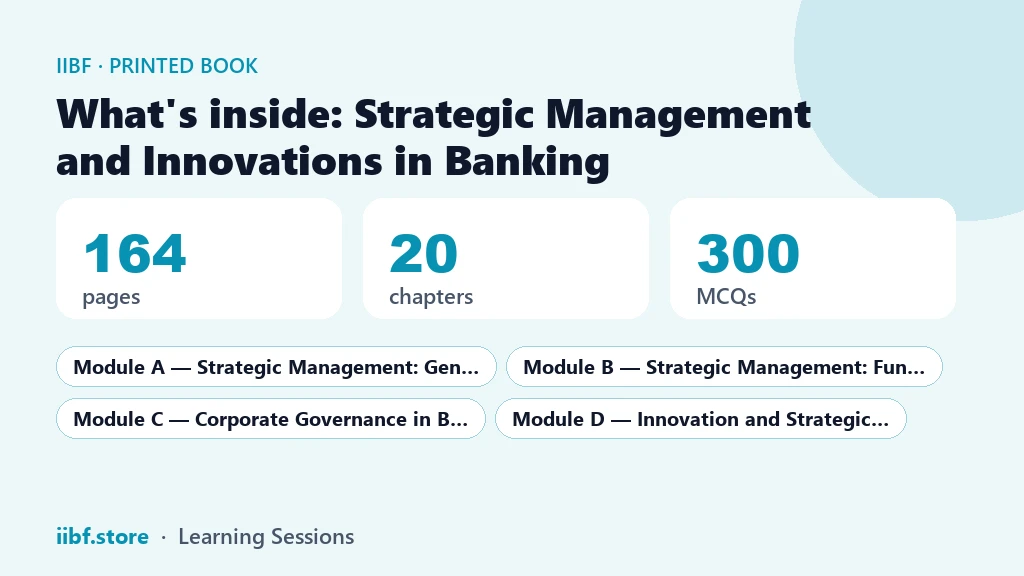
In reality, the paper becomes manageable once you break it into four blocks. The syllabus of the paper sits in four modules, and each one asks a different kind of question:
- Module A is the general concept and process of strategy: environment, business, corporate and global strategies, strategic thinking.
- Module B applies strategy to banking functions: finance, cost, credit and asset-liability management, marketing, HRM and business development.
- Module C is corporate governance in banks: values and ethics, governance in Indian banks, Basel, SEBI LODR, the Companies Act, and structures for different bank types.
- Module D is innovation and strategic challenges: technology management, digital banking, financial innovation, new business models and ESG.
Once you see it as four blocks of five chapters each, the mountain becomes four hills. That alone changes how it feels to start.
What the printed book actually contains
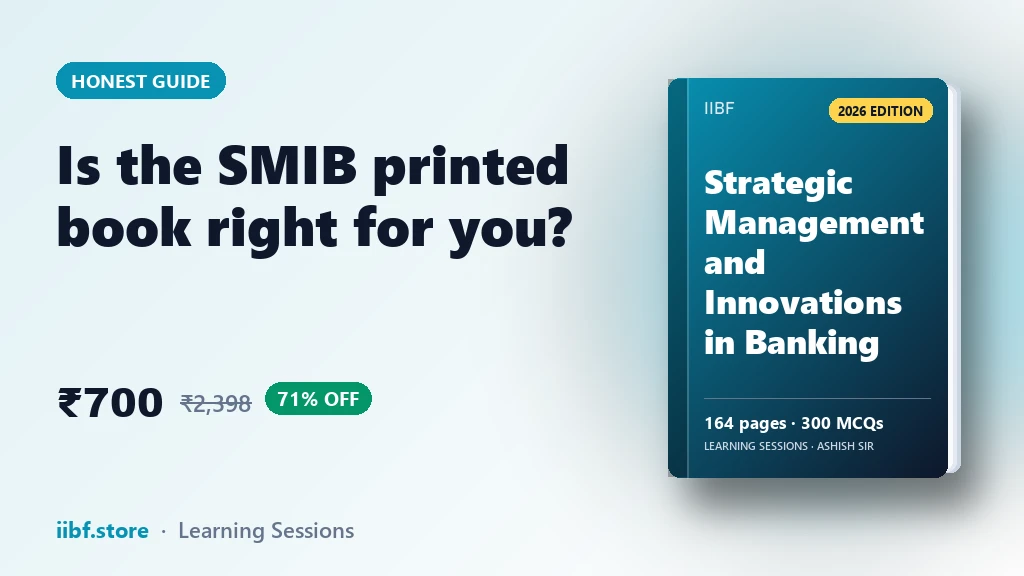
Before deciding anything, look at the facts. The Strategic Management and Innovations in Banking printed book (2026 edition) runs to 164 pages across 20 chapters, with 300 questions. The chapters follow the four modules above, five per module.
The listing also mentions two extras: 30 case studies (120 questions) and 5 mega tests (500 questions). Check the book page for exactly how these are delivered with your order, because that is the current source of truth.
At 164 pages, it is a compact book. That is a strength if you have limited time and a weakness if you expect deep academic coverage of every theory. It is built to help you pass a certificate paper, not to replace a management textbook.
Profile 1: You are attempting the paper for the first time
First attempts usually fail for one reason: the candidate underestimates how different the language of this paper is. If this is you, the SMIB exam preparation book works well as your spine. Read it in module order, because Module A gives you the vocabulary that Modules B, C and D keep using.
How to use it
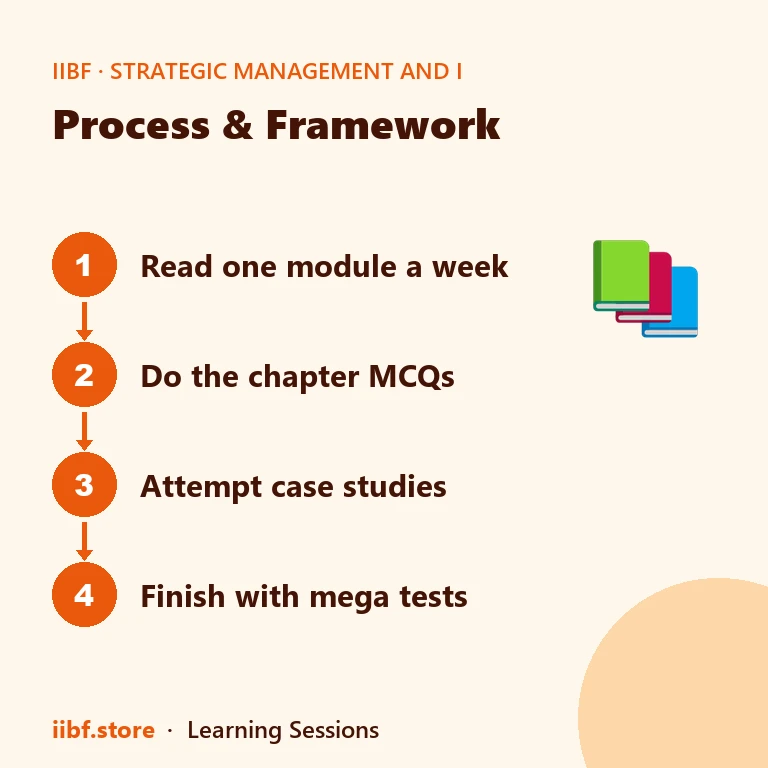
- Read one chapter at a time, and close the book to write three lines from memory before moving on.
- Attempt that chapter's questions the same day, while it is fresh.
- Tie every framework to something you have seen in your own bank. A strategy idea you can link to a real product launch or a branch decision sticks far longer.
When it is not enough alone
Reading builds understanding, but the exam tests recall under time pressure. Pair the book with timed practice. The free mock tests at iibf.store/tests are a reasonable place to feel the clock before you buy anything else.
Profile 2: You have attempted before and want a different approach
If you failed once, do not simply re-read what you read last time. The usual cause of a repeat failure is passive reading. You recognised the content on the page but could not produce it in the exam hall.
For you, the value of the SMIB exam preparation book lies in its question side, not its text. Start with the questions, find the chapters where you score badly, and then read only those chapters. The 30 case studies are especially useful if you struggled with application-type questions, where a banking situation is described and you must pick the right strategic or governance response.
When it is not enough alone
If your earlier attempt went wrong because of time management rather than knowledge, a book cannot fix that. You need full-length timed tests and a habit of reviewing every wrong answer. Keep a short error log: chapter, what you chose, why it was wrong. Patterns appear within two weeks.
Profile 3: You are short on time
Be realistic here. If the exam is only a few weeks away and you have not started, no book makes this paper effortless. But a compact book helps, because you are not hunting through hundreds of pages to decide what matters.
| Block | What to do | Why |
|---|---|---|
| Week 1 | Module A and Module B, one chapter per sitting | Builds vocabulary and banking application |
| Week 2 | Module C and Module D, one chapter per sitting | Governance and innovation are scoring areas for many candidates |
| Week 3 | Chapter questions and case studies | Converts reading into recall |
| Final days | Full-length mock tests, then revise only weak chapters | Builds exam-hall speed |
This is a template, not a promise. If you have less time than this, cut the case studies before you cut the timed tests.
When it is not enough alone
With very little time, the book alone is a risk. You need active practice from day one, not after you finish reading. Use the free PDFs at iibf.store/free-material for quick revision on the move, and treat the book as your reference for the chapters you find difficult.
Profile 4: You simply prefer paper over screens
This one is not a weakness. After a full day on a bank terminal, many people cannot face another screen. Paper lets you underline, write margin notes, fold a page and carry the book on a train or a bus. For a paper heavy on frameworks, being able to sketch a diagram directly beside the text is a real advantage.
If this is you, the SMIB printed book is a natural fit. Do read the book page first so you know exactly what you are getting and in what form.
When it is not enough alone
Paper has no clock and no instant feedback. You will still need a few timed practice sessions, even if you do them on a phone for an hour on Sunday. Also remember that regulatory references, such as those in the governance module, can change, so cross-check anything time-sensitive against official sources at iibf.org.in.
Who should probably skip it
Trust is built by saying this clearly. The SMIB exam preparation book may not be the right purchase if:
- You already have material you understand well and are scoring consistently in mocks. More material only adds noise.
- You want a deep academic text on strategy for a degree. This is exam-focused material.
- You expect a book alone to guarantee a result. No book does. Your practice and revision decide that.
As of writing, the price is ₹700 against an MRP of ₹2,398. Prices can change, so treat the book page as the current figure. You can compare it with other titles on iibf.store/books before you decide.
A simple way to decide today
- Open the free sample on the book page and read a few pages. If the style helps you understand, that is a good sign.
- Take one free mock test. If you score low on governance or innovation questions, those modules need your attention first.
- Check the official schedule for the upcoming exam cycle on the IIBF website and count your real study hours, not hopeful ones.
If after these three steps the SMIB exam preparation book fits your gaps and your habits, buy it. If not, you have lost nothing and gained a clearer plan. Either way, you can find more study help in the iibf.store blog.
The bottom line
A book is a tool. The SMIB exam preparation book gives you a compact, module-wise structure and a lot of questions to practise on, and that suits first-timers, repeaters who want question-led revision, time-pressed candidates and paper-lovers. It will not give you exam-hall speed by itself, so pair it with timed mock tests and a short error log. Study a little every day, review your mistakes, and the paper becomes four manageable hills instead of one mountain.
Frequently asked questions
How many pages and chapters does the printed book have?
The 2026 edition has 164 pages and 20 chapters, arranged in four modules of five chapters each, with 300 questions.
Can I clear the paper using only this book?
Some candidates may, but it is safer not to assume so. Add timed mock tests and revise your wrong answers. A book builds understanding; practice builds speed.
Is there a sample I can read before buying?
Yes, the book page offers a free sample. Read it first to check whether the style suits you.
Where do I find the exam dates and rules?
Use the official IIBF website at iibf.org.in for the schedule and rules of the upcoming exam cycle. We do not quote dates here because they change.
Prefer revising from a printed book?
Chapter-wise books with MCQs after every chapter — minimal pages, complete coverage, delivered anywhere in India. Every book has a free sample to read first.


















































Practice this topic
Take a free mock test, download chapter PDFs, or watch a video class — all included on iibf.store.
Keep reading