Is the Stressed Assets IBC Exam Preparation Book Right for You?
It is 9:40 pm. You have closed the branch, travelled home, eaten something quick, and the Insolvency and Bankruptcy Code is waiting for you. Sections, thresholds, moratorium, committee of creditors, waterfall. The syllabus feels endless and your energy is not. If this is you, you have probably already been offered several "complete packages" this year. So before anything else, let us settle one thing: no single resource is right for everyone, and that includes any IBC exam preparation book, ours included.
This guide is a plain answer to a plain question: who should use the Stressed Assets and IBC printed book, who should not, and what else you need beside it. Even if you never buy it, the plans below work with whatever material you already have.
What this book actually is (and is not)
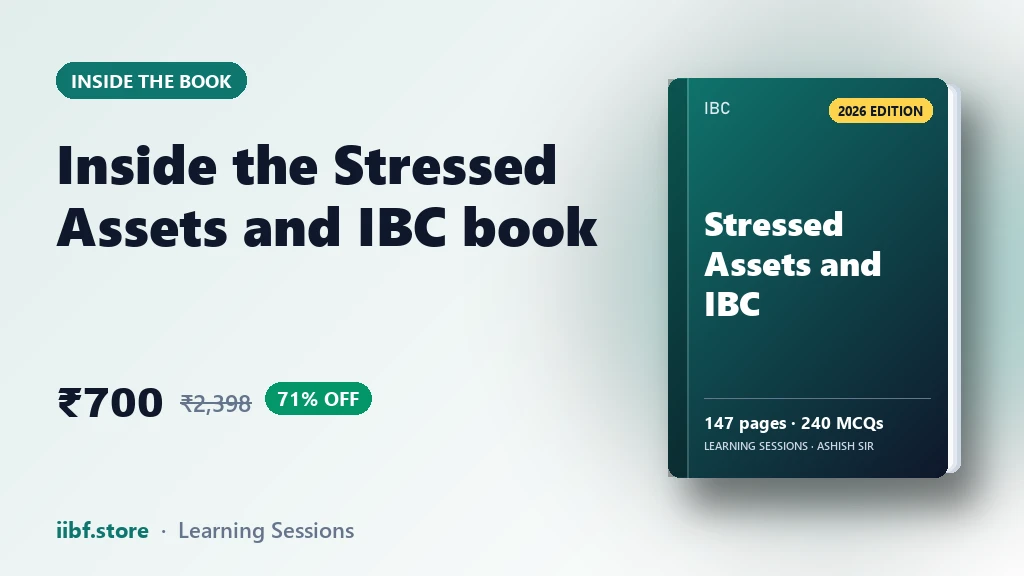
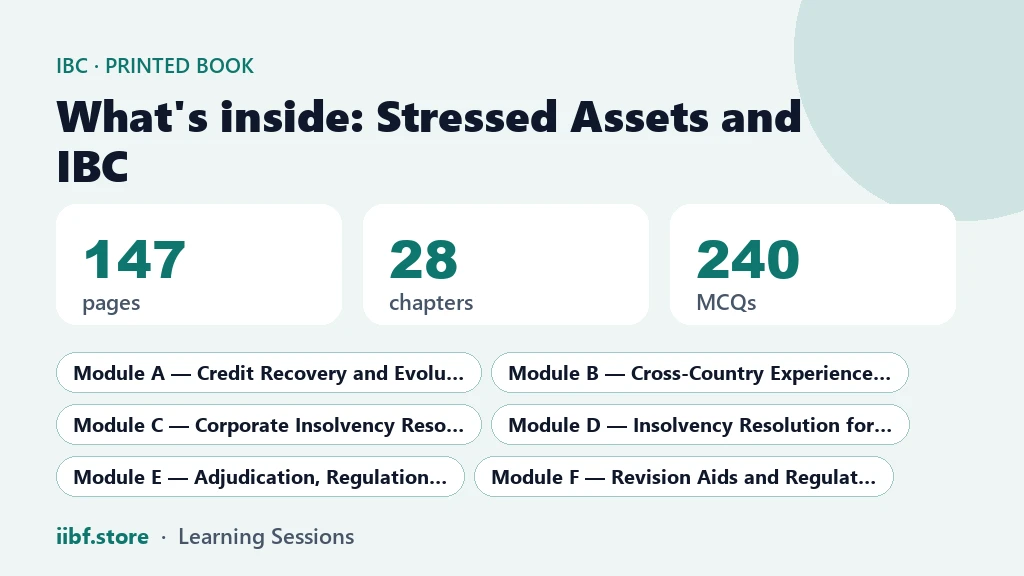
Let us start with facts, not adjectives. The 2026 edition runs to 147 pages across 28 chapters in six modules, with 240 questions built into the book. Beyond the printed pages, the listing mentions 30 case studies (120 questions) and 5 mega tests (500 questions) as extras.
It is a compact, chapter-wise revision book. It is not a 1,000-page reference that tries to teach insolvency law from scratch to a lawyer. That is both its strength and its limit. A short book can be read twice in the time a thick one is read once. But a short book also cannot hold every nuance, so you will sometimes need the official notes, the bare Act or the regulator's circulars.
How the six modules are laid out
- Module A: credit recovery routes, the RBI prudential framework, and why India developed the Code.
- Module B: international restructuring lessons and the architecture of the IBC and its institutions.
- Module C: the heart of the book. Default and the gateway to CIRP, applications under Sections 7, 9 and 10, the committee of creditors, resolution plans, pre-pack for MSMEs, and liquidation.
- Module D: personal guarantors, fresh start and bankruptcy.
- Module E: adjudication, appeals, offences, avoidance transactions, regulation, and important case laws.
- Module F: revision aids, including an application toolkit, an RBI 2019 framework revision sheet, essential terms, and a chapter on what the 2026 changes enacted and what has commenced.
Profile 1: You are attempting for the first time
First attempt, fresh syllabus, and a vague fear that the subject is "legal and heavy". Your real problem is not memory. It is orientation: you do not yet know which parts matter to a banker. Module A and Module B give you that map before you meet the technical sections, and that order helps.
How to use the book:
- Read one module at a time, not one chapter a day at random. The modules are built so that each one answers a question: why the Code exists, how it is structured, how a case moves, what happens to individuals, who adjudicates.
- After each chapter, close the book and write three lines from memory. If you cannot, read it again tomorrow.
- Attempt that chapter's questions only after the recall test, without notes.
When it is not enough on its own: a first-timer who only reads will feel confident and then freeze in the exam hall. The book builds understanding; speed and exam temperament come from timed practice. Plan to add the free mock tests at iibf.store/tests from the second week, not the last.
Profile 2: You have attempted before and need to fix gaps
Maybe you were a few marks short, maybe you ran out of time, maybe you simply forgot the sequence of the process. You do not need to start from page one. You need a diagnosis, and an IBC exam preparation book with a question set in every part is useful for exactly that.
A repeat-attempt method
- Take the questions of Module C first. Attempt them cold, with no reading.
- Mark every wrong or guessed answer with the chapter name.
- Go back and read only those chapters, then redo the questions.
- Repeat the process for the remaining modules.
This turns a heavy syllabus into a short list of your own weak chapters. Many repeaters lose marks not on obscure topics but on precise points: who can file, who votes, what the moratorium covers, how liquidation proceeds are distributed. Those are the places where a crisp chapter plus a few questions beats rereading a long text.
When it is not enough on its own: if you failed because of time management, more reading will not fix it. You need full-length papers under a clock. Look at the free PDFs at iibf.store/free-material and the mock tests, and treat the book as your correction manual, not your only test.
Profile 3: You are short on time
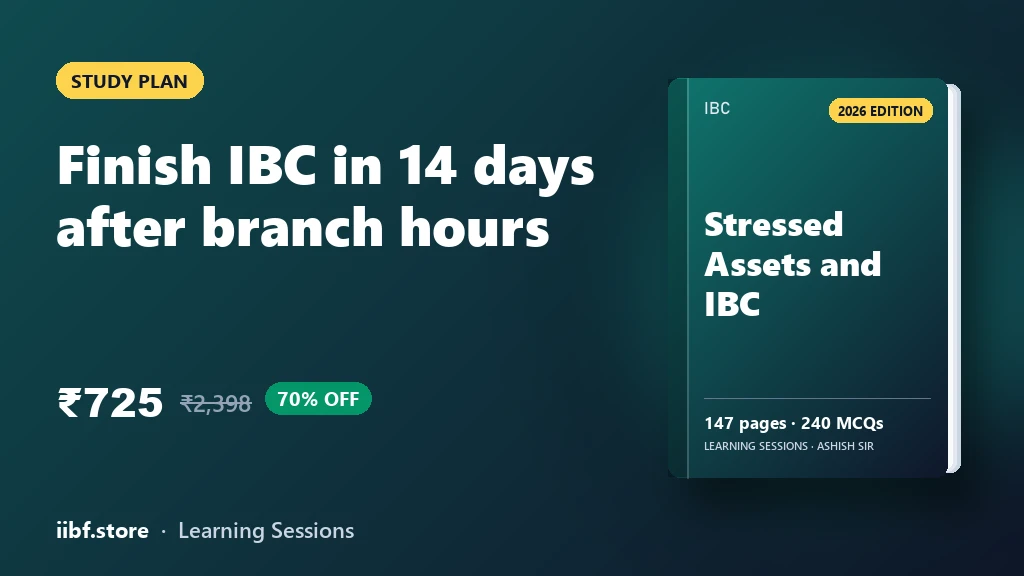
Three weeks left, a branch audit running, and a house that does not go silent until midnight. For you, the honest benefit of a 147-page book is simple arithmetic. If you can give 40 minutes on weekdays and two hours on a weekend day, you can move through all 28 chapters once and still have time for a second, faster pass.
| Week | Focus | Output |
|---|---|---|
| Week 1 | Modules A, B and the first half of C | One-page process flow of CIRP in your own words |
| Week 2 | Second half of C, Modules D and E | List of thresholds, timelines and who-can-do-what |
| Week 3 | Module F, then all weak chapters again | Two timed mock tests and a mistakes list |
Notice what this schedule does not do: it does not ask you to master every case law or memorise every figure. Prioritise the process chapters in Module C, because understanding the sequence lets you reason out many questions even when you forget a detail.
When it is not enough on its own: three weeks is workable for revision, not for learning a new subject from zero while also working. If you have never touched this topic, be honest with yourself and consider whether the upcoming exam cycle is the right one. The official schedule and notices are always on the IIBF website; check there before you decide.
Profile 4: You think better on paper than on a screen
Some people read a PDF for ten minutes and their eyes drift to notifications. If you are one of them, a printed book gives you something a phone cannot: no pings, a pen in your hand, margins you can fill, and pages you can flip back to without losing your place. For an IBC exam preparation book, that matters because the subject is sequential, and you will often flip between a section and an earlier definition.
- Use two colours: one for definitions, one for numbers and timelines.
- Keep a bookmark on Module F. The revision sheet and essential terms are what you will reopen the night before the exam.
- Carry it in your bag. Ten minutes in a bus or a lunch break adds up to hours over a month.
You can see exactly how the pages look by reading the free sample on the book page before you order. If the style does not suit you, you have lost nothing.
When it is not enough on its own: paper cannot grade you. Pair it with the online tests so you get instant feedback, and keep an eye on the notices from the regulator because law-based subjects change. The book itself carries a chapter on the 2026 changes, but the official source always overrides any book.
A four-step plan that works with any material
Whichever profile fits you, the method is the same. It is also the reason a small book can do a big job: you stop reading passively and start testing yourself early.
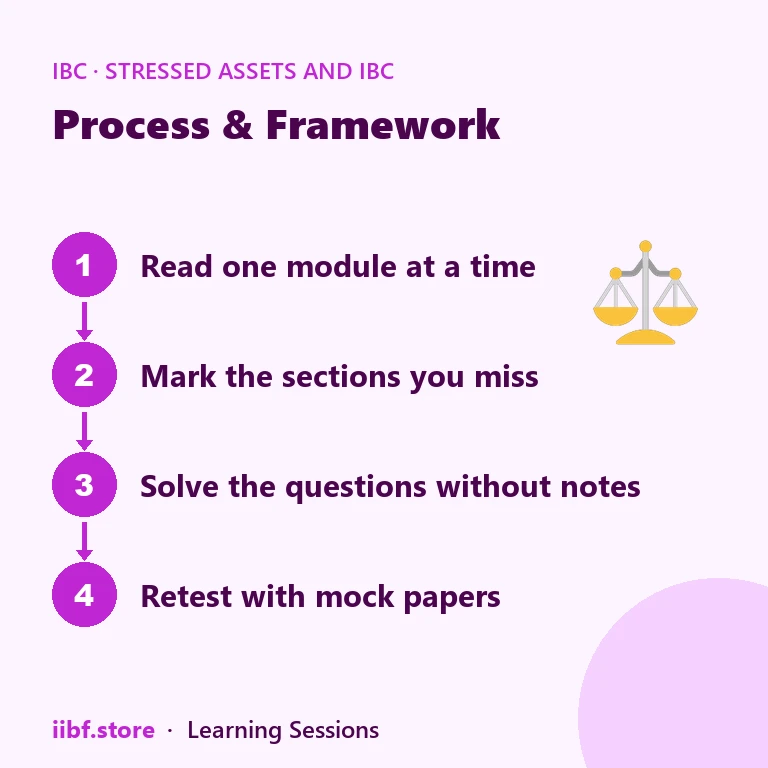
- Read one module at a time. Finish a whole module before moving on, so the logic holds together.
- Mark the sections you miss. A pencil tick beside every concept you could not recall.
- Solve the questions without notes. Wrong answers are information, not failure.
- Retest with mock papers. Timed, in one sitting, as close to exam conditions as possible.
If you want a wider library to rotate through, browse the other titles at iibf.store/books, and read more study guides on the iibf.store blog.
The honest limits, in one place
- A book alone will not give you exam-hall speed. Pair it with timed mocks.
- A short book cannot replace the bare Act or official circulars if you want depth on a point.
- Law changes. Treat the printed edition as a strong base and verify recent amendments on the official site.
- No book passes the exam for you. Consistency does, and that is on your side of the table.
So, is it right for you?
If you want a compact, module-wise tool that you can read twice, test yourself on, and revise from on paper, then this IBC exam preparation book is a reasonable choice. As listed today, the price is ₹700 against an MRP of ₹2,398, but prices may change, so the book page is always the current word. If you want something that teaches law in great depth or replaces mock tests, it is not that, and no honest seller would tell you otherwise.
Decide with the free sample in front of you. Study with a plan. Test early. That combination will do more for your result than any package.
Frequently asked questions
Can I clear the exam with only this book?
It can give you a solid, structured base for the syllabus topics it covers. But clearing an exam also depends on practice under time pressure, so use it along with mock tests and the official updates.
Is the printed book better than a PDF?
It depends on how you read. If screens distract you and you like to write in margins, print helps. If you need to search quickly or travel light, a digital file may suit you better. The free sample helps you judge the style.
How long does it take to finish the book once?
With 147 pages in 28 chapters, many working candidates can complete a first read in two to three weeks at 40 to 60 minutes a day. Allow extra time for questions and a second pass.
Where do I find the official exam dates and syllabus?
Always check the official IIBF website at www.iibf.org.in for the current schedule, syllabus and notices. Do not rely on any third-party page for dates.
Prefer revising from a printed book?
Chapter-wise books with MCQs after every chapter — minimal pages, complete coverage, delivered anywhere in India. Every book has a free sample to read first.


















































Quick quiz on this topic
5 exam-style questions from our free test bank — check yourself before you move on.
Practice this topic
Take a free mock test, download chapter PDFs, or watch a video class — all included on iibf.store.
Keep reading