Operational Creditor Demand Notice Under IBC: Section 8 Guide
An operational creditor demand notice is the most litigated single document in Indian insolvency practice. Section 8 of the Insolvency and Bankruptcy Code, 2016 makes this notice a compulsory pre-condition for a supplier, service provider or employee before the tribunal will even look at the default — unlike a financial creditor, who can walk straight into Section 7. This guide breaks down who can serve it, the prescribed forms, the ten-day clock, the pre-existing dispute test laid down in Mobilox, and exactly what the NCLT verifies before admission.
📜 Who Is an Operational Creditor and What Is Operational Debt
Before you draft anything, confirm that your client actually falls inside the definition. Section 5(21) defines operational debt as a claim in respect of the provision of goods or services, including employment dues, or a debt arising under any law and payable to the Central Government, a State Government or a local authority. Section 5(20) then defines an operational creditor as the person to whom such a debt is owed, including any person to whom the debt has been legally assigned or transferred.
The practical test is the character of the consideration. Money advanced for the time value of money is financial debt; money owed for goods delivered, services rendered, salary earned or statutory dues payable is operational debt. Trade receivables, unpaid vendor invoices, freight bills, professional fees, provident fund arrears and unpaid GST demands all sit on the operational side of the line. Where a bank has purchased a customer's trade bill, the character can shift — a point examiners like to test alongside the mechanics of bill discounting and bills purchase in commercial credit.
The second gate is the threshold. Under Section 4, the minimum amount of default for triggering the corporate insolvency resolution process is one crore rupees, raised from one lakh by a Ministry of Corporate Affairs notification of 24 March 2020. A demand notice for eighty lakh rupees is perfectly valid as a commercial demand, but it will not support a Section 9 application.
💡 Exam Tip: Employees and workmen are operational creditors. A single workman may serve his own notice; where a class of workmen files jointly, the aggregate default must still cross the one crore threshold.
📨 Drafting and Serving the Operational Creditor Demand Notice
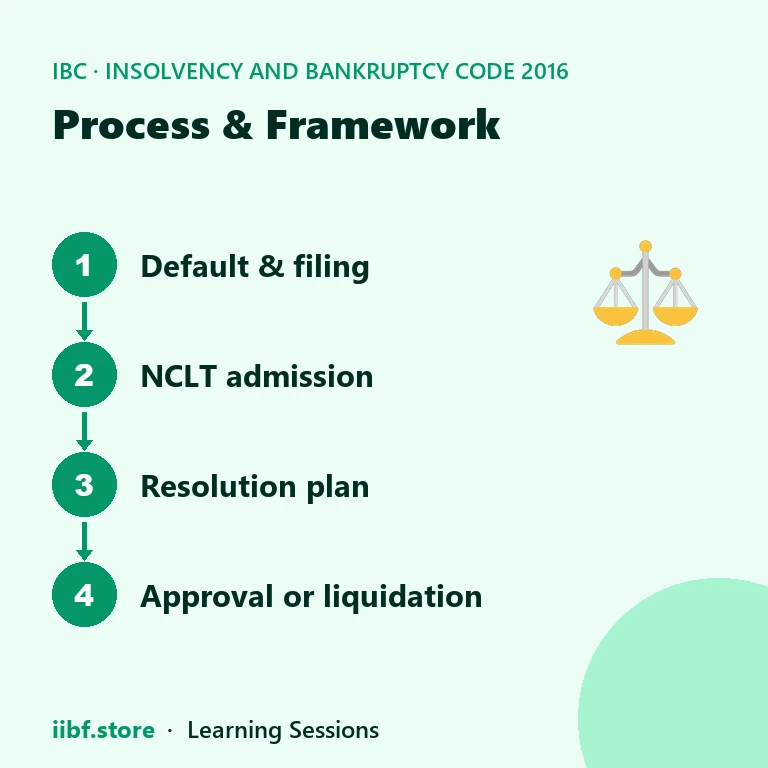
Section 8(1) requires the operational creditor, on occurrence of a default, to deliver a demand notice or a copy of the invoice demanding payment. Rule 5 of the Insolvency and Bankruptcy (Application to Adjudicating Authority) Rules, 2016 prescribes the format: Form 3 where a standalone demand notice is issued, and Form 4 where the notice is served together with a copy of the invoice. Choosing the wrong form is a curable defect, but it invites avoidable objections.
Service is where most applications die. The notice must be delivered at the registered office of the corporate debtor by hand, by registered post or by speed post with acknowledgement due. Rule 5 also permits delivery by electronic mail to a whole-time director, a designated partner or a key managerial person of the corporate debtor — a personal email of an accounts clerk will not do. Retain the postal track report, the acknowledgement card and the email delivery receipt; the date of delivery, not the date of dispatch, starts the statutory clock.
Three drafting points repay attention. First, state the amount of default and the date of default precisely, because limitation runs from the date of default and the tribunal will check it. Second, attach the invoices, purchase orders, delivery challans and any ledger confirmation you rely on. Third, do not inflate the claim with speculative interest unless the contract or the invoice itself provides for it; a padded figure is the easiest way to manufacture a dispute for the other side. The mechanics of this stage are covered in detail in the chapter on the initiation of the corporate insolvency resolution process.
⏳ The Ten-Day Window and the Pre-Existing Dispute Test
Section 8(2) gives the corporate debtor ten days from receipt of the notice to do one of two things: bring to the notice of the operational creditor the existence of a dispute, along with the record of pendency of a suit or arbitration proceeding filed before receipt of the notice; or prove payment of the unpaid operational debt. Silence for ten days clears the runway for a Section 9 filing.
Section 5(6) defines dispute to include a suit or arbitration proceeding relating to the existence of the amount of the debt, the quality of goods or services, or a breach of representation or warranty. The Supreme Court in Mobilox Innovations Private Limited v. Kirusa Software Private Limited (2017) settled the standard that every insolvency professional now applies. The tribunal must ask only whether there is a plausible contention requiring further investigation, and whether the dispute is not patently feeble, spurious, hypothetical or illusory. It must not conduct a mini-trial on the merits.
Two consequences follow. The word "and" in Section 8(2) is read as "or", so a dispute need not be embodied in a pending suit or arbitration — a genuine pre-litigation exchange of correspondence disputing quality or quantity can suffice. Equally, a reply cooked up after the operational creditor demand notice lands, with no earlier trace in the record, will be treated as an afterthought and rejected. This is the highest-yield area of case law in the syllabus, and the chapter on important case laws and the lessons drawn from them maps the leading judgments in sequence.
🚨 Common Mistake: Candidates say the dispute must be "pending in court". It need not be. What it must be is pre-existing — traceable to a point in time before the demand notice was received.
📥 Filing the Section 9 Application Before the NCLT
If ten days pass without payment and without a notice of dispute, Section 9(1) permits the operational creditor to file an application before the National Company Law Tribunal in Form 5 under Rule 6. Section 9(3) lists what must travel with it: a copy of the invoice or demand notice, an affidavit stating that no notice of dispute was received from the corporate debtor, a certificate from the financial institutions maintaining the operational creditor's accounts confirming non-payment, and any record of the debt with an information utility.
Section 9(4) allows — but does not compel — the operational creditor to propose an interim resolution professional. This is a real difference from Section 7, where a financial creditor must name one. Where no name is proposed, the tribunal makes a reference to the Insolvency and Bankruptcy Board of India, which recommends a name. Understanding the split of duties that follows appointment matters, and our explainer on the resolution professional under IBC sets out the full mandate.
Section 9(5) requires the tribunal to admit or reject within fourteen days. Before rejecting for an incomplete application, the proviso obliges it to give the applicant seven days to rectify the defect. Rejection is mandatory where the debt is not due, payment has been received, a notice of dispute was delivered, the demand notice was never served, or a disciplinary proceeding is pending against the proposed professional. Limitation is a live ground too: following B. K. Educational Services v. Parag Gupta, Article 137 of the Limitation Act applies and the claim must be brought within three years of default.
On admission, the commencement of CIRP follows automatically: the insolvency commencement date is fixed, an interim resolution professional is appointed within fourteen days, and the moratorium under Section 14 of IBC freezes suits, enforcement and asset transfers.
📊 Section 7 Route Versus the Section 8 and 9 Route
Almost every objective question on this topic is a comparison question. Learn the two routes as a pair rather than in isolation.
| Point of comparison | Financial creditor (Section 7) | Operational creditor (Sections 8 and 9) |
|---|---|---|
| Demand notice mandatory before filing | ❌ Not required | ✅ Mandatory in Form 3 or Form 4 |
| Application form and rule | Form 1, Rule 4 | Form 5, Rule 6 |
| Waiting period before filing | None once default occurs | 10 days from delivery of notice |
| Proposing an interim resolution professional | Mandatory | Optional |
| Effect of a pre-existing dispute | Not a ground for rejection | Fatal; application must be rejected |
| Position on the committee of creditors | Voting member | No vote; invited if dues are 10 per cent or more of total debt |
The last row explains why operational creditors often prefer the leverage of a demand notice to the outcome of a full process. Under Section 24(3)(c), operational creditors whose aggregate dues are not less than ten per cent of the debt receive notice of committee meetings, but they attend without a vote. Their protection instead comes from Section 30(2)(b), which requires a resolution plan to pay them not less than what they would have received in liquidation. Eligibility screening of applicants under Section 29A of IBC then decides who may bid at all. For the statutory architecture behind these cross-references, work through the chapter on the structure of the IBC and the wider Insolvency and Bankruptcy Code 2016 article hub.
📌 Remember: The operational creditor demand notice is a recovery lever first and an insolvency trigger second. A large share of notices are settled before the tribunal is ever approached.
📎 Always cross-check the current text of the governing circular on the IBBI website before you rely on it in the exam hall or at your desk.
🧠 Practice MCQs: Operational Creditor Demand Notice
Q1. Within how many days of receipt of a demand notice under Section 8 must the corporate debtor bring the existence of a dispute to the notice of the operational creditor? (a) 7 days (b) 10 days (c) 14 days (d) 15 days
Answer: (b) — Section 8(2) prescribes ten days from receipt of the notice to raise a dispute or prove payment.
Q2. Under Rule 5 of the Adjudicating Authority Rules, which form is used when the demand notice is served along with a copy of the invoice? (a) Form 1 (b) Form 3 (c) Form 4 (d) Form 5
Answer: (c) — Form 3 is the standalone demand notice; Form 4 is the invoice demanding payment served with the notice.
Q3. In Mobilox Innovations v. Kirusa Software, the Supreme Court held that the dispute raised by a corporate debtor must be (a) finally adjudicated by the tribunal on merits (b) pre-existing and not spurious, hypothetical or illusory (c) recorded only in a pending civil suit (d) supported by a bank certificate
Answer: (b) — The tribunal only checks for a plausible contention requiring investigation; it does not conduct a mini-trial.
Q4. What is the minimum amount of default required to trigger a corporate insolvency resolution process application? (a) Rs 1 lakh (b) Rs 10 lakh (c) Rs 1 crore (d) Rs 5 crore
Answer: (c) — The Section 4 threshold was raised from one lakh to one crore rupees by the notification of 24 March 2020.
Q5. Under Section 9(5), the tribunal must admit or reject the application within a set period, and a defective application must first be given time to be cured. Which pair is correct? (a) 7 days to decide; no cure period (b) 14 days to decide; 7 days to rectify (c) 30 days to decide; 15 days to rectify (d) 14 days to decide; no cure period
Answer: (b) — Section 9(5) sets fourteen days for the decision, and its proviso gives seven days to rectify a defect before rejection.
Want chapter-wise mock tests with 100+ MCQs? Start practising free →
❓ Frequently Asked Questions
Does a financial creditor also have to serve a demand notice?
No. Section 7 permits a financial creditor to approach the tribunal directly on occurrence of a default, supported by a record of default from an information utility or other evidence. The notice requirement applies only to operational creditors under Section 8.
Can an operational creditor demand notice be sent by email?
Yes. Rule 5 permits delivery by electronic mail to a whole-time director, designated partner or key managerial person of the corporate debtor, in addition to hand delivery, registered post or speed post at the registered office.
What happens if the corporate debtor replies raising a dispute?
If the dispute is genuine and traceable to a point before the notice was received, the tribunal must reject the Section 9 application. The creditor's remedy then lies in a civil suit, arbitration or a summary recovery proceeding, not in insolvency.
Do operational creditors get a vote in the committee of creditors?
No. Operational creditors have no voting right. Where their aggregate dues are at least ten per cent of the total debt they are entitled to notice of committee meetings under Section 24(3)(c), and Section 30(2)(b) guarantees them at least liquidation value in any approved plan.
Treat the operational creditor demand notice as a discipline rather than a formality: correct form, correct address, correct date of default, complete annexures, and a clean record showing no dispute existed before service. Bankers who master this sequence read stressed-account files far more accurately, because they can predict which vendor claims will be admitted and which will collapse at the threshold. Ready to test yourself under exam conditions? Work through the structured mocks and chapter tests on our CAIIB and certification course page and turn this checklist into marks.
Quick quiz on this topic
5 exam-style questions from our free test bank — check yourself before you move on.
Practice this topic
Take a free mock test, download chapter PDFs, or watch a video class — all included on iibf.store.