PMLA Provisional Attachment Order: A Banker's Guide
An Enforcement Directorate letter lands at the branch: a customer's savings account, fixed deposits and one immovable property are being attached under the Prevention of Money Laundering Act. The branch manager's first question is usually the wrong one — "can we release the funds?" — when the real question is what a PMLA provisional attachment order actually is, how long it lasts, and who confirms or reverses it. This is core JAIIB and CAIIB KYC-AML material and a live operational situation any compliance officer will eventually face. This article walks through Section 5 of the PMLA, 2002, the confirmation process before the Adjudicating Authority, the appeal route, and what a bank must and must not do while an attachment is in force.
📜 What Section 5 of the PMLA Actually Empowers
Section 5 of the Prevention of Money Laundering Act, 2002 gives the Enforcement Directorate a narrow but powerful tool: the power to provisionally attach property that is believed to be proceeds of crime, before a court has decided anything. The officer passing the order — the Director, or an officer not below the rank of Deputy Director specifically authorised by the Director — must record "reasons to believe," in writing, that the property is proceeds of crime and that it is likely to be concealed, transferred or dealt with in a way that would frustrate any eventual confiscation proceedings.
Attachment can cover bank balances, fixed deposits, shares, and immovable property, and it is ordered in connection with a scheduled offence under the PMLA — the underlying predicate crime that generated the tainted money in the first place. The order is provisional by design: it does not itself confiscate anything, it simply freezes the asset so it cannot disappear while the case proceeds. A provisional attachment under Section 5 cannot run indefinitely — it is capped at a maximum of 180 days from the date of the order, after which it must be confirmed or it lapses.
These powers, and the authority that exercises them, are set out in the legislation at national level chapter, alongside the wider PMLA framework that gives India's AML regime its legal teeth.
🏛️ From Attachment to Confirmation by the Adjudicating Authority
A provisional attachment order does not stand on its own. Within the 180-day window, the ED must forward a complaint to the Adjudicating Authority — a quasi-judicial body set up under the PMLA specifically to test whether an attachment should hold. The Adjudicating Authority issues a show-cause notice to the person whose property has been attached, giving them a genuine opportunity to explain why the property is not proceeds of crime and why the attachment should be released.
Both sides are heard: the ED presents the material that led to the "reasons to believe," and the affected person presents evidence and argument against it. On this basis the Adjudicating Authority passes a reasoned order under Section 8, either confirming the attachment — which then continues until the trial concludes — or rejecting it, in which case the property is released back to the person immediately.
This body sits within India's wider AML institutional set-up, alongside the ED, FIU-India and the Appellate Tribunal — the full map of which is covered under organization structure in India. Getting these bodies and their roles straight, rather than treating them as interchangeable, is where exam questions on this topic most often trip candidates up.
💡 Exam Tip: If a question describes property being frozen and later confirmed or released after a hearing, the confirming body is the Adjudicating Authority under Section 8 — not the Special Court and not FIU-India.
⚖️ Appeal to the Appellate Tribunal and Final Confiscation
A person aggrieved by the Adjudicating Authority's order — and the ED itself, if the order goes against it — can appeal to the Appellate Tribunal constituted under the PMLA. The Tribunal hears the matter afresh on both facts and law, and its order can be further challenged before the jurisdictional High Court on a substantial question of law.
Attachment and appeal are only the holding stage. Final confiscation — the point at which the property permanently vests in the Central Government, free of all encumbrances — happens only after the accused is convicted of the scheduled offence by the Special Court trying the case. If the accused is acquitted, the attachment ceases to have effect and the property must be released. The entire chain — provisional attachment, confirmation, trial, conviction, confiscation — is the mechanism through which the wider theme of money laundering and terrorism financing moves from investigation to an actual, enforceable outcome.
For exam purposes, keep the sequence in order: attach first, confirm second, try third, confiscate last. A common trap is assuming confiscation happens automatically once an attachment is confirmed — it does not; conviction is the trigger.
🏦 What a Bank Does When It Receives an Attachment Order
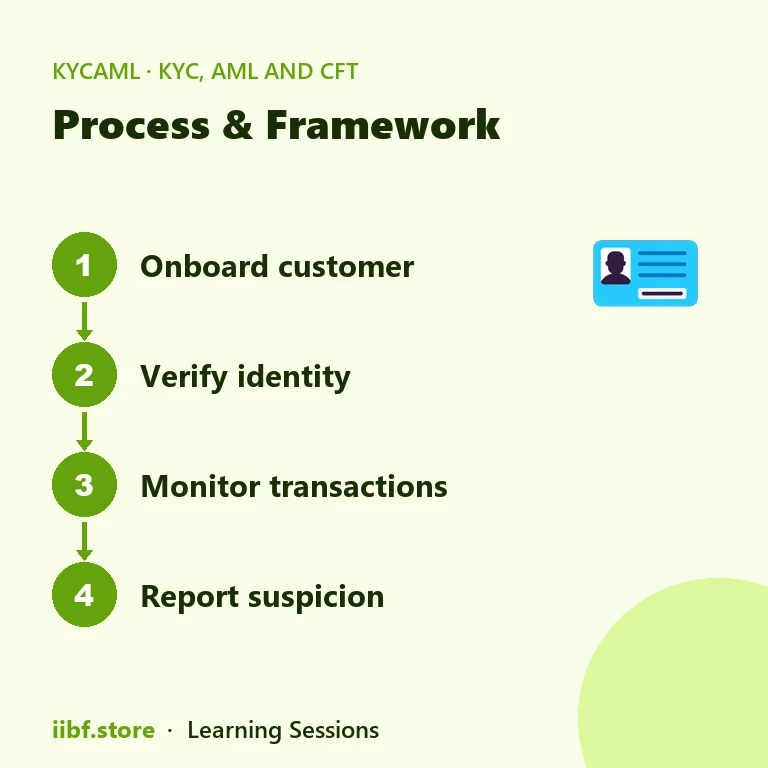
When a branch receives a written communication from the ED referencing a Section 5 order, its role is administrative, not adjudicatory. The bank marks a lien or freeze on the specified account or instrument exactly as directed, stops further debits against the attached balance, and preserves the underlying KYC and transaction records for the period the ED requests — the bank does not independently decide whether the attachment is justified.
This is where day-to-day KYC discipline and PMLA enforcement meet. The identity documents captured at onboarding — the same officially valid documents for KYC every account opening relies on — and the account's CKYC ID trail are frequently the first records the ED asks for when building the case that supports an attachment order. A bank with clean, complete KYC records can respond to such a request within hours; one with gaps ends up explaining those gaps to its regulator later.
Attachment cases also increasingly originate from cyber-enabled fraud, where stolen funds are layered through mule accounts before an ED investigation traces them back — the account-takeover and credential-theft techniques behind many such cases are covered under types of hackers in cyber security. A branch that recognises this pattern early, and files its own suspicious transaction report before an attachment order arrives, is in a far stronger position than one reacting purely to the ED's letter.
⚠️ Common Mistake: Candidates often assume a bank can release an attached account once the customer produces documents "proving" innocence. It cannot. Only the Adjudicating Authority, on a formal application, can lift a confirmed attachment.

🔍 PEP Cases and Why Attachment Orders Cluster Around Certain Accounts
Not every account is equally likely to see an ED attachment order, and the exam tests this pattern. Accounts flagged as high-risk during onboarding — including those held by or linked to politically exposed persons in KYC — attract closer scrutiny precisely because the proceeds-of-crime risk associated with abuse of public office is well documented internationally. A bank's own risk categorisation, done correctly at onboarding, is often the first signal that later feeds an ED investigation.
Accounts already carrying an internal alert — from earlier transaction monitoring, an unusual fund pattern, or a prior suspicious transaction report — are also disproportionately represented among attachment cases, because the ED frequently builds its "reasons to believe" on exactly the kind of red flags a bank's own AML systems were designed to catch. This is the practical argument for taking routine KYC and monitoring seriously well before any legal process begins: the quality of a bank's ordinary controls determines how quickly and cleanly it can respond when an attachment order does arrive.
None of this changes the bank's role once an order is served — it still simply complies — but it explains why compliance teams treat certain account categories with extra caution long before any ED communication is received.
🌍 FATF Standards Behind India's Attachment and Confiscation Framework
India's attachment-confirmation-confiscation chain is not a purely domestic invention. FATF's global standards require member countries to have effective legal mechanisms for provisional measures and confiscation of proceeds of crime and terrorist property, and India's PMLA structure — Section 5 attachment, Section 8 adjudication, Appellate Tribunal appeal, and confiscation on conviction — is how the country meets that requirement. The international guidelines & standards chapter sets out this backdrop in full and is worth revising alongside this topic, since exam questions often ask candidates to connect a domestic provision back to the global standard it implements.
For the exact statutory text of the PMLA, 2002 and its amendments, the authoritative source is the official gazette notification, available at egazette.gov.in. Candidates preparing for JAIIB or CAIIB should treat the Act's text, not secondhand summaries, as the final word whenever a section number is in question.
📌 Remember: Attach (Section 5, max 180 days) → confirm (Adjudicating Authority, Section 8) → appeal (Appellate Tribunal) → confiscate (only after conviction). Skipping or reordering any stage is the most common exam trap.
| Stage | Authority | Key Limit | Outcome |
|---|---|---|---|
| Provisional attachment | Director / Deputy Director, Enforcement Directorate | Maximum 180 days from the order | Property frozen, not yet confiscated |
| Confirmation hearing | Adjudicating Authority | Complaint filed and decided within the 180-day window | Attachment confirmed ✅ or released ❌ |
| Appeal | Appellate Tribunal, then High Court on law | Filed against the Adjudicating Authority's order | Order upheld, modified, or set aside |
| Confiscation | Special Court | Only on conviction for the scheduled offence | Property vests absolutely in Central Government |
🧠 Practice MCQs: PMLA Provisional Attachment Order
Q1. Under Section 5 of the PMLA, 2002, a provisional attachment order can remain in force for a maximum of: (a) 90 days (b) 180 days (c) 1 year (d) 6 months, non-extendable
Answer: (b) — Section 5 caps provisional attachment at 180 days from the date of the order.
Q2. Who is empowered to pass a provisional attachment order under the PMLA? (a) Any bank's Principal Officer (b) The Director, or an officer not below Deputy Director authorised by the Director (c) The Adjudicating Authority (d) The RBI Governor
Answer: (b) — Only the Director of Enforcement, or an officer of at least Deputy Director rank specifically authorised, can pass the order, after recording reasons to believe in writing.
Q3. A provisional attachment order under PMLA is confirmed or released by: (a) The Special Court (b) FIU-India (c) The Adjudicating Authority (d) The bank's compliance officer
Answer: (c) — The Adjudicating Authority hears both sides and passes a reasoned order under Section 8 confirming or releasing the attachment.
Q4. An appeal against an order of the Adjudicating Authority under PMLA lies before the: (a) Supreme Court directly (b) Appellate Tribunal (c) RBI Ombudsman (d) District Consumer Court
Answer: (b) — The PMLA constitutes an Appellate Tribunal specifically to hear appeals against Adjudicating Authority orders, with a further appeal to the High Court on law.
Q5. Final confiscation of attached proceeds of crime under the PMLA takes place: (a) Immediately once an FIR is registered (b) On confirmation by the Adjudicating Authority alone (c) Upon conviction of the accused by the Special Court (d) When the branch manager approves it
Answer: (c) — Confiscation, where the property vests absolutely in the Central Government, follows conviction for the scheduled offence; acquittal releases the attachment instead.
Want chapter-wise mock tests with 100+ MCQs? Start practising free →
Can a bank release funds once a PMLA provisional attachment order is served?
No. The bank must comply with the order as directed — marking a lien or freeze — and cannot independently release the funds. Only the Adjudicating Authority, or a higher appellate body, can lift a confirmed attachment.
What happens if the Adjudicating Authority does not confirm the attachment within 180 days?
If the complaint is not decided and confirmed within the statutory window, the provisional attachment lapses and the property must be released back to the person from whom it was attached.
Is confiscation automatic once an attachment order is confirmed?
No. Confirmation only keeps the property frozen through the trial. Confiscation, where the property permanently vests in the Central Government, happens only after the accused is convicted of the scheduled offence by the Special Court.
Which body decides an appeal against the Adjudicating Authority's order?
The Appellate Tribunal constituted under the PMLA hears such appeals, and its order can be further challenged before the jurisdictional High Court on a substantial question of law.
A PMLA provisional attachment order is the hinge between investigation and eventual confiscation — and knowing exactly which authority acts at each stage is what separates a confident CAIIB answer from a guess. Once the sequence of attach, confirm, appeal and confiscate is second nature, related questions on the Adjudicating Authority, the Appellate Tribunal and FATF's confiscation standards fall into place on their own. For more explainers like this, browse the KYC, AML and CFT tag hub. Ready to test yourself? Practise topic-wise questions on iibf.store's CAIIB course before exam day.
Quick quiz on this topic
5 exam-style questions from our free test bank — check yourself before you move on.
Practice this topic
Take a free mock test, download chapter PDFs, or watch a video class — all included on iibf.store.
Keep reading