Politically Exposed Persons in KYC: Rules Every Banker Must Know

Ask any experienced compliance officer which single customer category gives risk teams the most sleepless nights, and most will say the same thing: politically exposed persons in KYC files. A PEP is not automatically a criminal, but the position they hold — or once held — creates an elevated opportunity for bribery, embezzlement and the laundering of proceeds through the banking system. For JAIIB and CAIIB candidates, understanding how banks identify, classify and monitor these accounts is one of the most frequently tested slices of the KYC-AML-CFT syllabus, and it connects directly to correspondent banking, sanctions and country-risk questions that examiners love to combine into a single case-study.
This article walks through the definition, the onboarding workflow, the ongoing monitoring obligations, and how Indian practice lines up with global standards — with an exam-ready comparison table and a full practice set at the end.
🕵️ Who Counts as a Politically Exposed Person?
A politically exposed person is an individual who is or has been entrusted with a prominent public function — a head of state, a senior politician, a senior government, judicial or military official, a senior executive of a state-owned enterprise, or an important political party official. The FATF definition, which Indian banks follow through RBI guidance, extends beyond the individual to their immediate family members and close associates, since illicit funds are routinely parked in a spouse's, sibling's or business partner's account rather than the official's own name.
Banks generally work with three buckets: foreign PEPs (holding public office in another country), domestic PEPs (holding office within India), and PEPs entrusted with a prominent function by an international organisation, such as a senior official of the UN or the World Bank. Foreign PEPs are treated as automatically high risk under FATF Recommendation 12, while domestic and international-organisation PEPs are risk-assessed rather than auto-escalated — though in practice most Indian banks apply enhanced scrutiny to all three categories once the relationship crosses a materiality threshold. The classification is never permanent either: a person who demits public office is still treated as a PEP for a defined look-back period, because influence and the associated risk of laundering historical proceeds does not vanish the day a term ends.
📋 Onboarding a PEP: What Changes at Account Opening
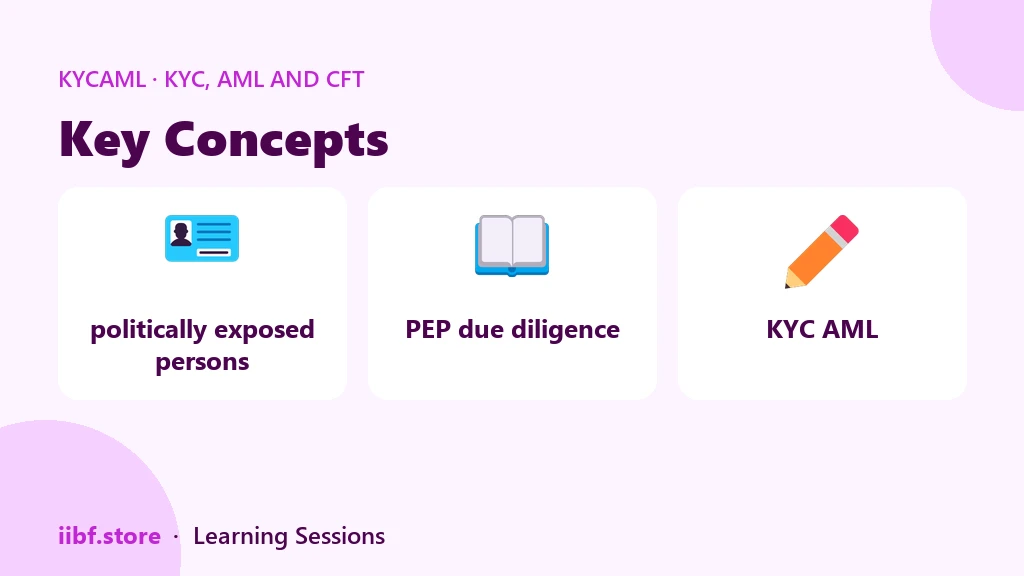
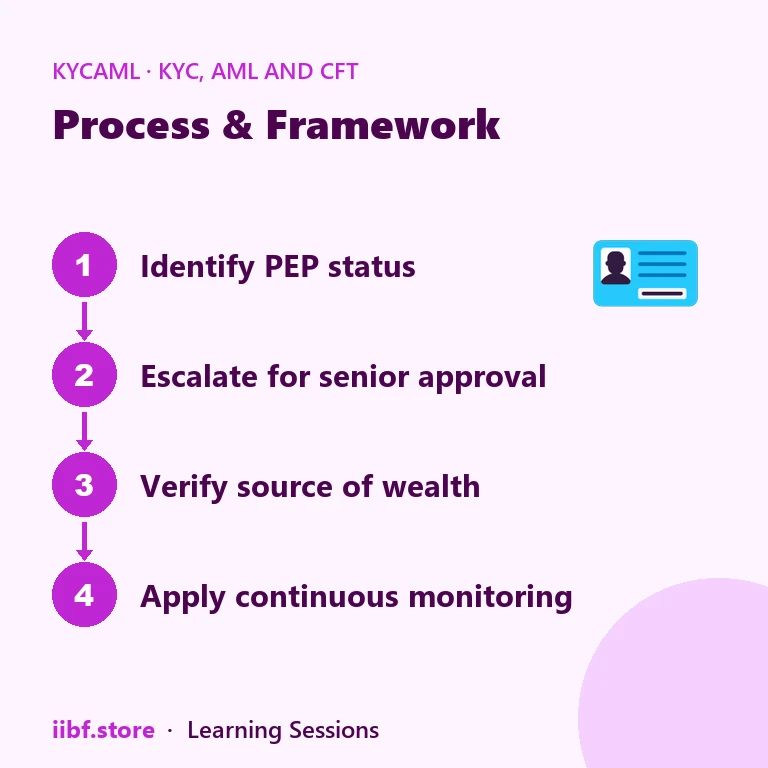
The moment a prospective customer, or a beneficial owner behind a corporate account, is flagged as a PEP, the standard KYC workflow branches into a heavier track. Senior management approval — typically at a level above the branch, often the designated director or a regional risk committee — is mandatory before the account can be opened. The bank must also establish the source of wealth and the source of funds for the specific transactions expected in the account, not merely accept a self-declaration. This is a distinct and deeper exercise than a normal customer due diligence check, because the object is to satisfy the bank that the money is explainable relative to the person's known income, assets and public role.
Many of these onboarding controls interact directly with the bank's wider international exposure. A foreign PEP opening a India-linked account through a correspondent relationship, for instance, pulls in the full weight of correspondent banking due diligence, because the respondent bank must be satisfied that its counterpart has performed equivalent PEP screening on the originating side. Examiners frequently test this overlap — a standalone PEP question is common, but so is a scenario that asks a candidate to spot the correspondent-banking angle hiding inside a PEP case study.
💡 Exam Tip: If a question mentions "senior management approval" and "source of wealth" together in the same account-opening scenario, the answer is almost always PEP onboarding, even if the word "PEP" never appears in the question.
🔍 Ongoing Monitoring: Why the File Never Closes
Onboarding is only the entry gate. Once a PEP relationship is live, the account is placed under continuous enhanced monitoring rather than the periodic review cycle applied to an ordinary customer. Transaction patterns are checked against the declared source of income, unusual counterparties are flagged faster, and the relationship is re-approved by senior management at shorter intervals than a standard file. Banks are also expected to keep the PEP flag current — a customer who was a junior official at onboarding but is later promoted to a cabinet-level or equivalent position needs the file re-rated, and the reverse is true too: a former official who has been out of office for the bank's defined look-back period may eventually be downgraded, subject to a documented risk review rather than an automatic reset.
This ties closely into two other syllabus threads. First, where the PEP is a foreign official, the bank's assessment of the home jurisdiction's own country risk and money laundering exposure directly shapes how aggressively the account is monitored — a PEP from a jurisdiction with weak AML controls or known corruption indicators warrants tighter transaction thresholds than one from a jurisdiction with a strong FATF compliance record. Second, the legal backbone for all of this — the obligation to identify, escalate and, where warranted, report PEP-linked transactions — sits in the domestic AML statute; candidates should be comfortable locating these duties within the legislation at national level chapter, since exam questions often ask which provision actually creates the obligation rather than just describing the practice.
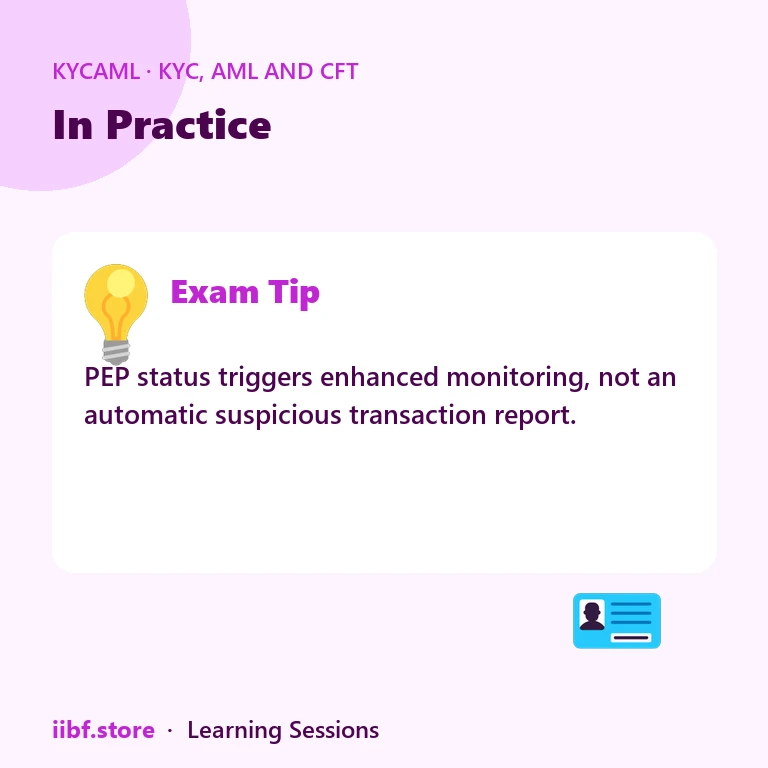
⚠️ Common Mistake: Students often assume PEP status alone triggers a suspicious transaction report. It does not — PEP status triggers enhanced due diligence and closer monitoring; an STR is filed only when actual suspicion of laundering or a predicate offence arises from the pattern observed.
🌍 How Global Standards Shape the Indian Approach
India's PEP framework did not emerge in isolation. FATF's 40 Recommendations set the baseline that every member jurisdiction, including India, is expected to transpose into domestic rules, and Recommendation 12 specifically addresses PEPs — foreign, domestic and international-organisation categories, the risk-based approval hierarchy, and the source-of-wealth obligation described above. Indian banks map their internal PEP policies to this recommendation, and RBI's own guidance draws heavily on it. For candidates who want to read the underlying standard rather than a paraphrase, FATF's Recommendation 12 guidance on politically exposed persons is available directly from FATF's own site, and RBI's parallel domestic requirements are set out in its Master Directions on KYC.
The exam syllabus groups this comparative material under two related chapters worth revising side by side: international guidelines & standards, which covers FATF, the Wolfsberg Group and Basel Committee guidance on PEP handling, and organization structure in India, which maps which domestic body — RBI, FIU-India, the designated director within the bank — actually owns which piece of the PEP control chain. A question that names a specific committee or officer is testing the second chapter; a question that names FATF or a Recommendation number is testing the first.
📊 PEP Due Diligence vs. Standard Customer Due Diligence
| Control Element | Standard Customer | Politically Exposed Person |
|---|---|---|
| Account approval level | Branch / normal KYC authority | Senior management / designated director ✅ |
| Source of wealth check | Not mandatory ❌ | Mandatory, documented ✅ |
| Ongoing monitoring frequency | Periodic (risk-based cycle) | Continuous / shorter re-approval intervals ✅ |
| Family & close associates covered | No ❌ | Yes, extended screening ✅ |
| Status after leaving office | Not applicable | Retained for a defined look-back period ✅ |
| Automatic STR on classification | No | No — classification alone does not trigger an STR ❌ |
📌 Remember: The table's last row is the trap most candidates fall into — PEP status raises the monitoring bar, it does not by itself create a reporting event.
The same escalation logic appears elsewhere in customer risk work. Two closely related concepts worth revising together with PEPs are how a bank sets its overall risk categorisation of customers — PEP status is one of several inputs into that score, not the whole of it — and how the same senior-approval logic feeds into sanctions screening in banks, since a PEP name match against a sanctions list escalates far faster than an ordinary hit. It is also worth cross-checking PEP files against beneficial ownership identification in KYC, because a PEP frequently tries to route funds through a corporate structure rather than a personal account, which is exactly where beneficial-ownership checks are designed to catch them.
Outside the KYC-AML syllabus itself, the same "who is really behind this transaction" instinct shows up in digital-channel fraud too — for a contrast in how banks apply similar red-flag thinking to a very different risk, see how banks handle QR code and payment link fraud. For the full spread of KYC-AML-CFT topics this article sits within, browse the KYC-AML-CFT tag hub on the blog.
🧠 Practice MCQs: Politically Exposed Persons in KYC
Q1. Under the FATF framework followed in Indian bank policy, which category of PEP is treated as automatically high risk regardless of a separate risk assessment? (a) Domestic PEP (b) Foreign PEP (c) International-organisation PEP (d) None, all categories need individual assessment
Answer: (b) — FATF Recommendation 12 treats foreign PEPs as inherently high risk; domestic and international-organisation PEPs are risk-assessed.
Q2. Who must approve the opening of an account for a customer identified as a PEP? (a) The branch manager alone (b) Any KYC-trained officer (c) Senior management / designated director (d) The customer's relationship manager without escalation
Answer: (c) — Senior management approval, often routed through the designated director, is mandatory before onboarding a PEP.
Q3. Which additional check is mandatory for a PEP that is not required for a standard low-risk customer at onboarding? (a) PAN verification (b) Source of wealth and source of funds (c) Mobile number verification (d) Address proof
Answer: (b) — Establishing source of wealth and source of funds is a defining requirement of PEP due diligence.
Q4. Does classifying a customer as a PEP, by itself, require the bank to file a Suspicious Transaction Report? (a) Yes, always (b) No, PEP status triggers enhanced monitoring, not an automatic STR (c) Only for foreign PEPs (d) Only if the account exceeds Rs 10 lakh
Answer: (b) — An STR is filed on actual suspicion arising from transaction behaviour, not merely from PEP classification.
Q5. Whose relationships must a bank also screen when a customer is identified as a PEP? (a) Only the individual (b) Only co-borrowers on a loan (c) Family members and close associates (d) Only business partners named in KYC documents
Answer: (c) — PEP screening extends to family members and close associates, since illicit funds are often routed through them.
Want chapter-wise mock tests with 100+ MCQs? Start practising free →
❓ Frequently Asked Questions
Is every senior government employee automatically a PEP?
No. PEP status attaches to individuals entrusted with a prominent public function — typically senior political, judicial, military or state-enterprise roles — not every government employee regardless of seniority.
Does PEP status ever expire?
Banks retain PEP treatment for a defined look-back period after the person leaves office, then reassess the risk rather than removing the flag on the first day the office is vacated.
Are domestic PEPs treated the same as foreign PEPs in India?
Not automatically. Foreign PEPs are treated as inherently high risk under FATF guidance, while domestic and international-organisation PEPs are subjected to a risk-based assessment, though many Indian banks apply broadly similar controls to both once risk indicators are present.
Where is the PEP obligation legally anchored in India?
The reporting and due-diligence duties around PEP-linked transactions trace back to the domestic AML statute and RBI's KYC directions, which is why this topic is examined alongside the legislation-at-national-level chapter.
✅ Conclusion: Lock This Topic Down Before the Exam
Politically exposed persons sit at the intersection of onboarding controls, ongoing monitoring, correspondent banking and international standards — which is exactly why examiners like combining them into scenario-based questions rather than one-line definitions. Know the three PEP categories, the senior-approval and source-of-wealth requirements, and the crucial distinction between enhanced monitoring and an automatic STR, and you can handle almost any variation the paper throws at you. Reinforce it with timed practice: attempt a full KYC-AML mock test on iibf.store and see exactly where your PEP knowledge still has gaps.
Quick quiz on this topic
5 exam-style questions from our free test bank — check yourself before you move on.
Practice this topic
Take a free mock test, download chapter PDFs, or watch a video class — all included on iibf.store.
Keep reading