Politically Exposed Persons Monitoring: A KYC-AML Exam Guide (2026)
Every JAIIB and CAIIB candidate eventually meets a question on politically exposed persons monitoring, and most lose marks not because the concept is hard but because they confuse it with plain customer due diligence. A PEP is not automatically a suspicious customer — but RBI's KYC Master Direction requires banks to treat such accounts with a permanently higher risk lens, from onboarding right through account closure. This guide walks through the exam-relevant rules on identification, enhanced due diligence, family/associate coverage, and ongoing monitoring, so you can answer both the definitional and the scenario-based questions confidently.
🕵️ Who Qualifies as a Politically Exposed Person
The RBI KYC Master Direction defines a Politically Exposed Person as an individual who is or has been entrusted with a prominent public function in a foreign country — think heads of state, senior politicians, senior government, judicial or military officials, senior executives of state-owned corporations, and important political party officials. Note the word "foreign": the Indian regulatory framework's PEP definition is explicitly built around foreign public functionaries, though banks are expected to apply similar caution to domestic prominent public figures as a matter of prudent risk management, even where the strict legal PEP tag does not apply.
This distinction is a favourite exam trap. Questions often present a senior Indian bureaucrat or a state minister and ask whether the account must be treated as a "PEP account" under the master direction — the technical answer is that the formal PEP classification is for foreign public functionaries, while domestic dignitaries are handled under a bank's internal enhanced-monitoring policy. Once a customer is identified as a PEP, the bank must obtain senior management approval before establishing the relationship, and must continue that heightened posture for as long as the relationship lasts, not just at onboarding. Practically, this ties directly into the account-opening controls covered under customer identification and beneficial ownership requirements, since a PEP determination is really a special case of knowing exactly who you are banking.
💡 Exam Tip: If a question asks "who approves opening an account for a PEP," the answer is always senior management — never a branch manager acting alone, regardless of relationship value.
📋 Enhanced Due Diligence Requirements for PEP Accounts
Once flagged, a PEP account moves into the enhanced due diligence (EDD) track rather than the standard KYC track. This means the bank must establish the source of wealth and source of funds using more than a self-declaration — independent verification, where feasible, is expected. It also means more frequent periodic updation of KYC records; while a low-risk customer may be reviewed once every ten years and medium-risk once every eight years, PEP accounts sit in the high-risk bucket and are reviewed at least every two years, sometimes annually depending on the bank's internal risk matrix.
Transaction monitoring thresholds are also tightened. Alerts that would be routine for a standard retail account — a large cash deposit, a sudden inflow from an overseas remittance, a pattern of round-tripping — get escalated faster and reviewed by a more senior compliance function when the account belongs to a PEP. This is the same logic that governs correspondent banking due diligence, where the counterparty's own KYC rigour becomes the deciding factor in whether a relationship is even opened. The KYC specific requirements chapter is worth revisiting here, since it lays out the documentation hierarchy banks must follow for high-risk categories — see the KYC specific requirements chapter for the full list of officially valid documents and the risk-categorisation logic that feeds into EDD triggers.
⚠️ Common Mistake: Students often assume a PEP account can be closed the moment risk is detected. In reality, banks must first file the relevant suspicious transaction report and only then decide on exit, following board-approved exit procedures — abrupt account closure without documentation is itself a compliance lapse.
🌍 Family Members, Close Associates and Cross-Border Risk
The PEP net is wider than just the named individual. Family members and close associates of a PEP — spouses, children, parents, and known business partners — are also brought under the same enhanced monitoring regime, because layering money through relatives is one of the oldest tricks in the money-laundering playbook. A joint account, a beneficiary nomination, or even a guarantor relationship linked to a known PEP is enough to trigger the enhanced review, which is why relationship managers are trained to run family-network checks, not just individual-name checks, during onboarding.
Country risk compounds this further. An account holder connected to a jurisdiction with weak AML supervision, active conflict, or FATF grey-list status attracts additional scrutiny even without a PEP tag, and the two risk factors stack when both are present — a foreign PEP from a high-risk jurisdiction is about as high-risk as a KYC file gets. This cross-border angle links closely with two other exam-heavy areas: the country-risk chapter within this subject, and the broader sibling topics on sanctions screening in banks and beneficial ownership identification, both of which examiners like to combine with PEP scenarios in a single case-study question.
📌 Remember: PEP status is a lifetime tag in practice — even after a person demits public office, RBI guidance requires continued enhanced monitoring for a reasonable period, since influence and residual risk don't vanish the day a term ends.
⏱️ Ongoing Monitoring, Reporting and Exit Triggers
PEP monitoring does not stop at onboarding — it is a continuous obligation. Banks must run their PEP accounts through periodic name-screening against updated global PEP and sanctions databases, refresh risk ratings when public roles change, and document every review decision for audit trail purposes. Where transaction patterns don't match the declared source of funds or business profile, the account triggers a Suspicious Transaction Report to FIU-India, following the same reporting discipline used for other high-risk categories under the broader anti-money-laundering framework.
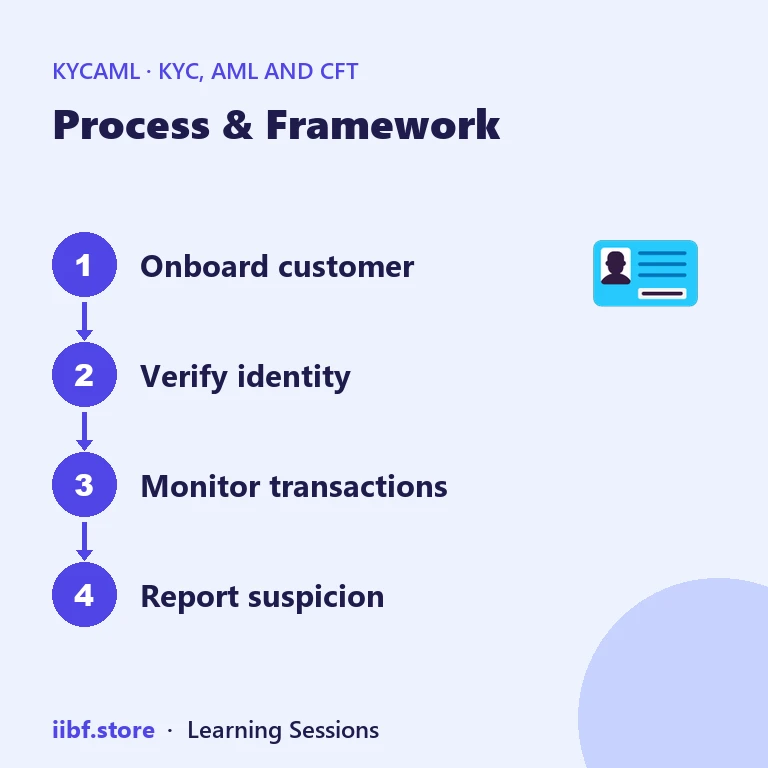
For exam purposes, remember the sequencing: identify → senior management approval → EDD onboarding → continuous monitoring → periodic KYC updation → STR filing if warranted → documented exit if risk becomes unmanageable. Examiners frequently scramble this sequence in MCQs and ask you to spot the step that's out of order, so internalising the flow (not just the individual facts) is the fastest way to lock in marks on this topic.
| Control Aspect | Standard (Non-PEP) Customer | PEP / Enhanced-Risk Customer |
|---|---|---|
| Account opening approval | Branch-level KYC officer ✅ | Senior management sign-off required ✅ |
| Periodic KYC updation cycle | Up to 10 years (low risk) | Up to 2 years (high risk) ✅ |
| Source of funds verification | Self-declaration generally accepted ✅ | Independent verification expected ❌ (self-declaration alone insufficient) |
| Family/associate screening | Not mandatory by default ❌ | Mandatory for related parties ✅ |
| Exit on emerging risk | Standard offboarding | STR filing before exit, board-approved process ✅ |
Before moving to practice questions, it helps to place this topic within the wider subject map. Money-laundering typologies, global measures and country-risk material all feed into how examiners frame PEP scenarios — the country risk and money laundering chapter is a natural companion read, and the sibling article on FATF 40 Recommendations explains the global standard-setting body whose guidance underpins India's PEP rules. You can browse every related post on the KYC-AML and CFT tag hub, and check the latest circular updates at RBI rates and regulatory updates before your exam. For the authoritative regulatory text itself, the RBI's KYC Master Direction is hosted on the Reserve Bank of India website and is worth skimming at least once before test day.
🧠 Practice MCQs: Politically Exposed Persons Monitoring
Q1. Under RBI's KYC Master Direction, a Politically Exposed Person is formally defined as an individual entrusted with a prominent public function in: (a) any country including India (b) a foreign country (c) only G20 member countries (d) only FATF member countries
Answer: (b) — The formal PEP definition under the master direction applies to individuals holding prominent public functions in a foreign country.
Q2. Who must approve establishing a banking relationship with a customer identified as a PEP? (a) The branch KYC officer alone (b) Senior management (c) Any two employees jointly (d) The customer's introducer
Answer: (b) — RBI guidelines require senior management approval before opening or continuing a relationship with a PEP.
Q3. What is the maximum periodic KYC updation interval typically applied to high-risk customers such as PEPs? (a) 10 years (b) 8 years (c) 2 years (d) 5 years
Answer: (c) — High-risk customers, including PEPs, require periodic KYC updation at intervals of up to two years, compared to longer cycles for low and medium risk.
Q4. If a PEP's transaction pattern does not match the declared source of funds, the bank's primary reporting obligation is to file a: (a) Currency Transaction Report only (b) Suspicious Transaction Report to FIU-India (c) Customer complaint form (d) RBI ombudsman reference
Answer: (b) — A mismatch between declared profile and actual transaction behaviour is a classic trigger for filing a Suspicious Transaction Report with FIU-India.
Q5. Which of the following is mandatory enhanced due diligence for a PEP account but not typically required for a standard low-risk account? (a) PAN collection (b) Independent verification of source of funds (c) Photograph on file (d) Address proof submission
Answer: (b) — Standard accounts generally accept self-declared source of funds, whereas PEP accounts require independent verification as part of enhanced due diligence.
Want chapter-wise mock tests with 100+ MCQs? Start practising free →
❓ Frequently Asked Questions
Does PEP status automatically make a customer high-risk forever?
Yes, in practice. Even after a person leaves public office, banks are expected to continue enhanced monitoring for a reasonable period because the residual risk and influence associated with the former role do not disappear immediately.
Are family members of a PEP also treated as PEPs?
Not formally classified as PEPs themselves, but close family members and known associates are brought under the same enhanced due diligence and monitoring regime because they are common channels for layering illicit funds.
Is a domestic Indian public figure treated the same as a foreign PEP under RBI rules?
The strict legal PEP definition under the master direction covers foreign public functionaries. Domestic prominent individuals are typically handled under a bank's internal risk policy with similar enhanced scrutiny, even without the formal PEP tag.
Can a bank close a PEP's account immediately upon detecting suspicious activity?
No. The correct sequence is to file a Suspicious Transaction Report with FIU-India and follow the board-approved exit process, rather than abruptly closing the account without documentation.
Mastering politically exposed persons monitoring means learning the sequence — identification, senior approval, enhanced due diligence, continuous monitoring, and documented exit — rather than memorising isolated facts. Reinforce it with full-length CAIIB and JAIIB mock papers, and browse more KYC-AML explainers on the iibf.store blog to round out your revision.
Prefer revising from a printed book?
Chapter-wise books with MCQs after every chapter — minimal pages, complete coverage, delivered anywhere in India. Every book has a free sample to read first.
117 pages · 236 MCQs
Learning Sessions · Ashish Sir
132 pages · 225 MCQs
Learning Sessions · Ashish Sir
188 pages · 435 MCQs
Learning Sessions · Ashish Sir
Learning Sessions · Ashish Sir
118 pages · 299 MCQs
Learning Sessions · Ashish Sir
Learning Sessions · Ashish Sir
Learning Sessions · Ashish Sir
Learning Sessions · Ashish Sir
115 pages · 255 MCQs
Learning Sessions · Ashish Sir
Learning Sessions · Ashish Sir
334 pages · 936 MCQs
Learning Sessions · Ashish Sir
Learning Sessions · Ashish Sir
115 pages · 344 MCQs
Learning Sessions · Ashish Sir
107 pages · 240 MCQs
Learning Sessions · Ashish Sir
90 pages · 150 MCQs
Learning Sessions · Ashish Sir
Learning Sessions · Ashish Sir
131 pages · 672 MCQs
Learning Sessions · Ashish Sir
221 pages · 831 MCQs
Learning Sessions · Ashish Sir
128 pages · 524 MCQs
Learning Sessions · Ashish Sir
107 pages · 445 MCQs
Learning Sessions · Ashish Sir
148 pages · 478 MCQs
Learning Sessions · Ashish Sir
151 pages · 465 MCQs
Learning Sessions · Ashish Sir
148 pages · 375 MCQs
Learning Sessions · Ashish Sir
216 pages · 895 MCQs
Learning Sessions · Ashish Sir
109 pages · 300 MCQs
Learning Sessions · Ashish Sir
104 pages · 360 MCQs
Learning Sessions · Ashish Sir
82 pages · 297 MCQs
Learning Sessions · Ashish Sir
151 pages · 600 MCQs
Learning Sessions · Ashish Sir
98 pages · 282 MCQs
Learning Sessions · Ashish Sir
Quick quiz on this topic
5 exam-style questions from our free test bank — check yourself before you move on.
Practice this topic
Take a free mock test, download chapter PDFs, or watch a video class — all included on iibf.store.
Keep reading