Correspondent Banking Due Diligence: IIBF KYC-AML Exam Guide 2026
When one bank holds an account for another bank, it inherits a stranger's customers without ever meeting them. That is the whole risk of correspondent banking — and it is exactly why correspondent banking due diligence sits at the sharp end of every IIBF KYC, AML and CFT syllabus. In the 2026 exam you are expected to know not just what customer due diligence is, but why a bank-to-bank relationship demands a heavier, enhanced version of it. This guide walks a working banker through the concept, the risk logic, the checklist a compliance officer runs before opening a correspondent (nostro/vostro) account, and the red flags that separate a routine relationship from a laundering channel.
Correspondent banking lets a domestic bank offer its customers cross-border payments, trade settlement and foreign-currency services without a physical presence abroad. The convenience is real; so is the exposure. Because the respondent bank's customers are invisible to the correspondent, money-laundering and terrorist-financing risk is imported wholesale. Regulators — RBI through its Master Direction on KYC, and the FATF through Recommendation 13 — therefore treat these relationships as inherently high-risk and mandate enhanced due diligence rather than ordinary checks.
🏦 What Correspondent Banking Due Diligence Actually Means
A correspondent relationship is a banking arrangement in which one institution (the correspondent) provides deposit, payment or other services to another institution (the respondent). The classic form is the nostro/vostro account pair used to settle international payments. Correspondent banking due diligence is the enhanced, ongoing assessment the correspondent bank performs on the respondent institution before and throughout the relationship.
Unlike opening an account for a retail customer, here the "customer" is itself a regulated entity with its own book of clients. The correspondent cannot see those underlying clients directly, so it must instead satisfy itself that the respondent runs a credible AML/CFT programme. This means gathering information on the respondent's ownership and management, understanding the nature of its business, evaluating the quality of its regulation and supervision in its home jurisdiction, and assessing whether that jurisdiction has been the subject of money-laundering investigations or regulatory action.
The correspondent must also understand the respondent's own KYC and monitoring standards — effectively performing due diligence on the respondent's due diligence. Senior management approval is required before establishing a new correspondent relationship, and the respective AML/CFT responsibilities of each institution should be documented. This layered approach is what the IIBF wants candidates to articulate: correspondent banking is not "KYC for banks" done casually, it is a formal enhanced-due-diligence regime. For the mechanics of nostro/vostro operation and settlement, revise the dedicated chapter on correspondent banking.
🌍 Why Correspondent Relationships Carry Elevated Risk
The core problem is distance. Every layer between the correspondent bank and the ultimate originator of a payment weakens visibility. A single correspondent account can channel thousands of transactions daily on behalf of a respondent's customers whom the correspondent has never identified. If the respondent's controls are weak — or if it deliberately turns a blind eye — the correspondent becomes an unwitting conduit for illicit flows.
💡 Exam Tip: The FATF places correspondent banking under Recommendation 13. Remember the pairing "correspondent banking = enhanced due diligence + senior management sign-off + shell-bank prohibition" — examiners love this three-part answer.
Geography compounds the risk. If the respondent operates in a jurisdiction with weak AML supervision, high corruption, or FATF grey/black-list status, the correspondent inherits that country's risk profile. This is why country risk assessment is inseparable from correspondent due diligence — a technically clean respondent in a high-risk jurisdiction still elevates exposure. The interplay of jurisdiction and laundering is covered thoroughly in the chapter on country risk and money laundering, and the supranational rulebook in international guidelines and standards.
A further hazard is the "nested" or downstream relationship, where the respondent itself provides correspondent services to other banks. The correspondent may then be indirectly serving institutions it has never assessed at all. Similar layering risks appear in trade-based money laundering, where trade documents disguise value transfer across borders — a topic worth revising alongside this one.
📋 The Enhanced Due Diligence Checklist
Before a correspondent account is opened, the compliance function should be able to answer a defined set of questions. The exam frequently frames these as "which of the following is NOT part of correspondent EDD", so knowing the full list matters.
First, gather sufficient information about the respondent to understand fully the nature of its business — ownership, control structure, and beneficial owners. Proper identification of controllers overlaps with beneficial ownership identification, a recurring theme across the KYC-AML paper. Second, determine from public information the reputation of the respondent and the quality of supervision it is subject to, including whether it has faced money-laundering or terrorist-financing investigation. Third, assess the respondent's AML/CFT controls to satisfy the correspondent that they are adequate and effective.
Fourth, obtain approval from senior management before establishing the relationship. Fifth, clearly document the respective responsibilities of each institution. Sixth, where "payable-through accounts" are involved — accounts a respondent's customers can operate directly — the correspondent must be satisfied the respondent has verified those customers and can provide their identification data on request. Screening of the respondent's directors and owners against sanctions lists is also essential; see sanctions screening in banks for how watch-list checks integrate into onboarding. All of this must be refreshed periodically as part of ongoing monitoring, not treated as a one-time gate.
📊 Ordinary CDD vs Correspondent EDD
The cleanest way to lock this in for the exam is a side-by-side comparison of standard customer due diligence and the enhanced regime applied to correspondents.
| Feature | Ordinary CDD (retail) | Correspondent EDD (bank) |
|---|---|---|
| Identify beneficial owners | ✅ Yes | ✅ Yes, plus respondent's controllers |
| Assess counterparty's own AML controls | ❌ Not required | ✅ Mandatory |
| Senior-management approval to onboard | ❌ Generally not | ✅ Required |
| Document responsibilities of each party | ❌ Not applicable | ✅ Required |
| Relationship with shell banks | N/A | ❌ Prohibited |
| Country / jurisdiction risk weighting | Considered | ✅ Central to decision |
⚠️ Common Mistake: Candidates write that correspondent banking uses the "same CDD as any customer". It does not — it is always enhanced due diligence, and shell-bank relationships are outright prohibited, not merely discouraged.
🚫 Shell Banks, Nested Accounts and Red Flags
A shell bank is a bank incorporated in a jurisdiction where it has no physical presence and is unaffiliated with a regulated financial group. FATF standards and RBI guidance prohibit banks from entering into, or continuing, correspondent relationships with shell banks, and require them to satisfy themselves that respondents do not permit their accounts to be used by shell banks. This absolute prohibition is a favourite one-mark question.
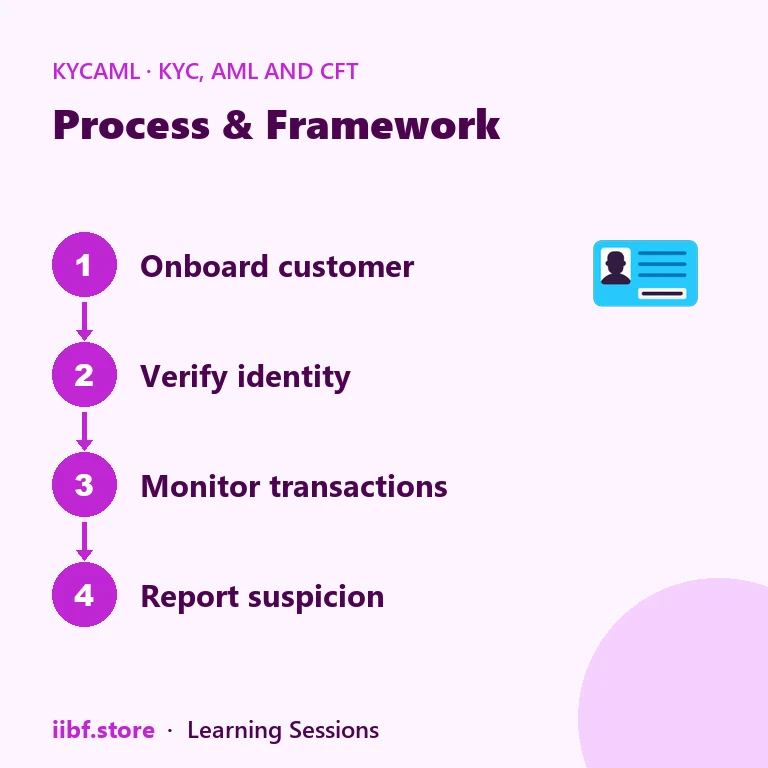
Red flags in a live correspondent relationship include: transaction volumes or values that are inconsistent with the respondent's stated business; sudden activity through a previously dormant account; payments to or from jurisdictions unrelated to the respondent's customer base; reluctance to provide beneficial-ownership or underlying-customer information; and evidence of nested relationships that were never disclosed at onboarding. Any of these should trigger review and, where warranted, a Suspicious Transaction Report to FIU-India under the PMLA framework. The national statutory architecture — obligations, reporting entities and penalties — is set out in the chapter on legislation at national level.
📌 Remember: Enhanced due diligence is ongoing, not one-off. Even a well-vetted respondent must be re-assessed as its risk profile, ownership or jurisdiction changes.
Because correspondent channels move value across borders at speed, they are also probed by cyber-enabled fraud; bankers preparing broadly should skim computer hacking techniques from the cyber-crime paper to see how technical and financial controls intersect. For a consolidated revision list, the KYC, AML and CFT topic hub gathers every related article in one place.
📚 Official reference: Always verify the latest rules, circulars and thresholds on the Reserve Bank of India (RBI) website before your exam — regulations change and only primary sources are authoritative.
🧠 Practice MCQs: Correspondent Banking Due Diligence
Q1. Under FATF standards, which type of relationship is a bank absolutely prohibited from entering into? (a) A respondent in a high-tax country (b) A respondent that is a shell bank (c) A respondent using a payable-through account (d) A respondent supervised by a foreign regulator
Answer: (b) — Correspondent relationships with shell banks (no physical presence, unaffiliated with a regulated group) are prohibited outright.
Q2. Which FATF Recommendation deals specifically with correspondent banking? (a) Recommendation 10 (b) Recommendation 12 (c) Recommendation 13 (d) Recommendation 20
Answer: (c) — FATF Recommendation 13 sets out the enhanced measures required for cross-border correspondent banking.
Q3. Before opening a new correspondent account, a bank must obtain approval from which level? (a) The branch manager (b) The respondent's board (c) Senior management (d) The account holder
Answer: (c) — Senior-management approval is a mandatory pre-condition for establishing a correspondent relationship.
Q4. A "payable-through account" is risky mainly because: (a) It pays high interest (b) The respondent's customers can operate it directly (c) It is denominated in foreign currency (d) It cannot be closed
Answer: (b) — The respondent's own customers transact directly through it, so the correspondent must ensure they have been identified and can be traced.
Q5. Which of the following is NOT part of correspondent due diligence? (a) Assessing the respondent's AML controls (b) Documenting each party's responsibilities (c) Individually verifying every one of the respondent's retail customers (d) Understanding the respondent's ownership
Answer: (c) — The correspondent relies on the respondent's own KYC; it cannot and need not individually verify every underlying retail customer.
Want chapter-wise mock tests with 100+ MCQs? Start practising free →
Is correspondent banking due diligence the same as ordinary KYC?
No. It is enhanced due diligence: the correspondent assesses the respondent bank's ownership, reputation, supervision and AML controls, obtains senior-management approval, and documents each party's responsibilities — well beyond standard retail KYC.
Can a bank keep a correspondent account with a shell bank if the KYC is strong?
No. Relationships with shell banks are prohibited regardless of KYC quality, and the correspondent must also ensure the respondent does not let its accounts be used by shell banks.
What is a nested correspondent relationship?
It is when a respondent bank itself provides correspondent services to other banks, so the correspondent indirectly serves institutions it never assessed. Undisclosed nesting is a major red flag.
Who receives Suspicious Transaction Reports arising from correspondent accounts in India?
They are filed with FIU-India (Financial Intelligence Unit) under the Prevention of Money Laundering Act framework, the same channel used for other reporting entities' STRs.
✅ Conclusion
Correspondent banking due diligence is where the abstract principles of KYC, AML and CFT meet real cross-border risk. Master the logic — imported customer risk, enhanced checks, senior-management approval, the shell-bank prohibition, and continuous monitoring — and you can answer almost any exam question in this area with confidence. Reinforce it with the linked chapters, then test yourself under exam conditions. Take a free KYC-AML mock test or enrol in the full JAIIB preparation course to lock in your score for 2026.
Prefer revising from a printed book?
Chapter-wise books with MCQs after every chapter — minimal pages, complete coverage, delivered anywhere in India. Every book has a free sample to read first.
117 pages · 236 MCQs
Learning Sessions · Ashish Sir
132 pages · 225 MCQs
Learning Sessions · Ashish Sir
188 pages · 435 MCQs
Learning Sessions · Ashish Sir
Learning Sessions · Ashish Sir
118 pages · 299 MCQs
Learning Sessions · Ashish Sir
Learning Sessions · Ashish Sir
Learning Sessions · Ashish Sir
Learning Sessions · Ashish Sir
115 pages · 255 MCQs
Learning Sessions · Ashish Sir
Learning Sessions · Ashish Sir
334 pages · 936 MCQs
Learning Sessions · Ashish Sir
Learning Sessions · Ashish Sir
115 pages · 344 MCQs
Learning Sessions · Ashish Sir
107 pages · 240 MCQs
Learning Sessions · Ashish Sir
90 pages · 150 MCQs
Learning Sessions · Ashish Sir
Learning Sessions · Ashish Sir
131 pages · 672 MCQs
Learning Sessions · Ashish Sir
221 pages · 831 MCQs
Learning Sessions · Ashish Sir
128 pages · 524 MCQs
Learning Sessions · Ashish Sir
107 pages · 445 MCQs
Learning Sessions · Ashish Sir
148 pages · 478 MCQs
Learning Sessions · Ashish Sir
151 pages · 465 MCQs
Learning Sessions · Ashish Sir
148 pages · 375 MCQs
Learning Sessions · Ashish Sir
216 pages · 895 MCQs
Learning Sessions · Ashish Sir
109 pages · 300 MCQs
Learning Sessions · Ashish Sir
104 pages · 360 MCQs
Learning Sessions · Ashish Sir
82 pages · 297 MCQs
Learning Sessions · Ashish Sir
151 pages · 600 MCQs
Learning Sessions · Ashish Sir
98 pages · 282 MCQs
Learning Sessions · Ashish Sir
Quick quiz on this topic
5 exam-style questions from our free test bank — check yourself before you move on.
Practice this topic
Take a free mock test, download chapter PDFs, or watch a video class — all included on iibf.store.
Keep reading