RBI Retail Direct Scheme: RDG Account, Auctions and G-Sec Buying (CAIIB Central Banking)
If you are preparing the Central Banking elective for CAIIB, the RBI Retail Direct Scheme is a topic examiners return to every cycle, because it sits at the intersection of government securities, central bank market operations, and financial inclusion. Launched to let ordinary savers hold sovereign paper the same way banks and institutions do, the scheme lets you open a Retail Direct Gilt (RDG) account directly with the Reserve Bank of India, bid in primary auctions through the non-competitive route, and trade existing securities on NDS-OM. This guide walks through account opening, the auction mechanics, secondary-market access, and the tax treatment you must remember, both for the exam and for real investing decisions.
🏦 What Is the RBI Retail Direct Scheme
The RBI Retail Direct Scheme was launched in November 2021 as a one-stop, free-of-cost facility that lets resident individual investors access the government securities market without going through a bank, primary dealer, or mutual fund. Before this scheme, retail participation in G-Secs was indirect — through gilt mutual funds or bond ETFs — because primary auctions and the wholesale secondary market were built for institutions.
Under the scheme, an eligible investor opens a Retail Direct Gilt (RDG) account with RBI itself, functioning like a Subsidiary General Ledger holding for retail investors. Through this single account you can invest in Central Government securities, Treasury Bills, State Development Loans (SDLs), and Sovereign Gold Bonds. The stated objective is to deepen the retail base of the G-Sec market and improve financial inclusion by giving households a direct, low-friction channel into sovereign debt. This ties closely into the broader mandate covered under the functions of central banks chapter, where debt management and market development sit alongside monetary and regulatory functions. You can register and read the scheme's official terms on RBI's own Retail Direct portal, hosted on the rbi.org.in domain.
📝 Opening Your RDG Account Step by Step
Opening an account under the RBI Retail Direct Scheme is entirely online. A resident individual investor — singly or jointly with another resident individual — registers on the official portal using PAN, a valid KYC document, an Aadhaar-linked mobile number and email ID, and the details of a rupee savings bank account. Eligible NRIs may also participate subject to FEMA provisions on investment in government securities.
Registration is completed through OTP-based verification followed by online KYC; no physical paperwork or branch visit is required in the normal case. Once activated, the RDG account is linked to your savings bank account for two purposes: debiting funds when you buy a security, and crediting interest, maturity proceeds, or sale proceeds. Unlike a working capital facility such as a cash credit account — where misapplied funds can trigger the kind of issues discussed in our article on diversion of funds — payments here move directly between your personal savings account and RBI, with no intermediary credit exposure. There is no account-opening fee and no annual maintenance charge, which is one of the scheme's core selling points versus routing G-Sec exposure through a fund with an expense ratio.
🎯 Non-Competitive Bidding in Primary Auctions
Primary auctions of dated G-Secs, Treasury Bills, and SDLs are conducted by RBI on behalf of the government and states. Bids fall into two categories: competitive bids, placed mainly by banks, primary dealers, and large institutions who specify the price or yield they want, and non-competitive bids, meant for smaller investors who do not want to guess the market-clearing rate.
Through the RDG account, a retail investor places a non-competitive bid specifying only the amount, not a price or yield. These bids are allotted first, up to the notified aggregate ceiling for the non-competitive segment of that auction, at the weighted average price or yield of the accepted competitive bids — so you are guaranteed allotment without having to predict the cut-off. Bids and eligible investments are typically placed in denominations of Rs 10,000 face value and multiples thereof. This mechanism builds on the long-standing non-competitive bidding facility for retail participants, and it is a natural extension of the operations covered under contemporary issues in central banking. Auction results and cut-off yields are published by RBI and can be tracked alongside our RBI rates resource for quick reference before an exam.
💡 Exam Tip: Remember the sequence — non-competitive bids are allotted first, at the weighted average rate of accepted competitive bids, not at a rate the retail investor chooses.
💹 Trading on NDS-OM: The Secondary Market Route
Buying only in primary auctions would lock a retail investor into holding a security until maturity, which is not always desirable. That is where NDS-OM, the Negotiated Dealing System-Order Matching platform, comes in. NDS-OM is RBI's anonymous, order-driven, screen-based electronic trading system for G-Secs, historically accessible only to banks, primary dealers, and select institutions through the regular lot segment.
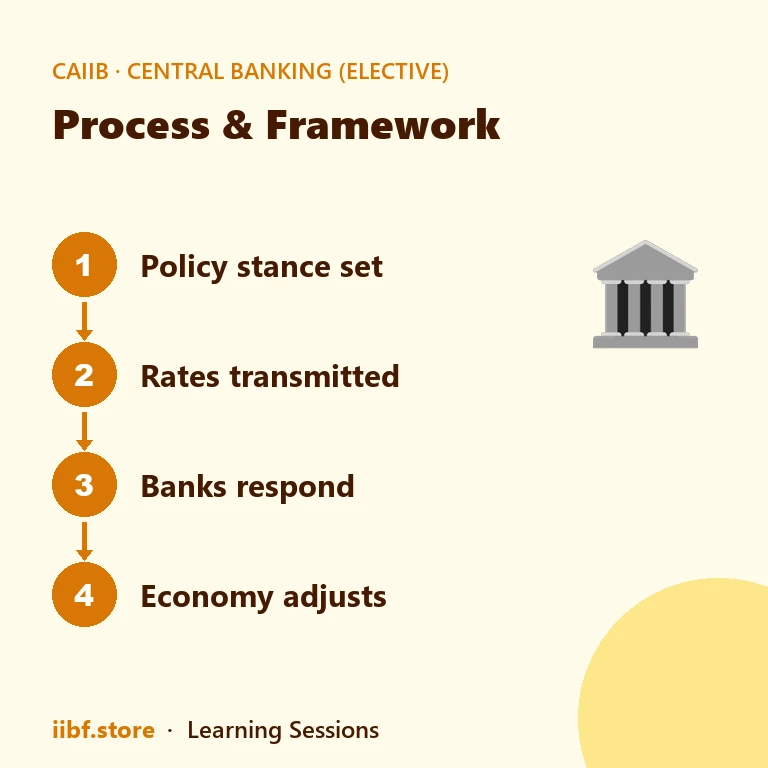
The RBI Retail Direct Scheme opened a dedicated retail access window into NDS-OM, letting RDG account holders place buy and sell orders on already-issued securities directly, at live market prices, without a broker in between. This gives retail investors genuine price transparency and same-day visibility into where the market is trading a given security, reinforcing the price-discovery role you study under theory and practice of central banking. Because yields on outstanding securities respond to policy rate expectations and liquidity conditions, this secondary-market layer is also where you see the monetary policy transmission mechanism in India play out in real time on screen. RBI does not charge brokerage or commission on trades executed through the Retail Direct portal; settlement follows the standard G-Sec cycle, with funds and securities moving through your linked bank account and RDG account.
⚠️ Common Mistake: Candidates often assume NDS-OM access for retail investors is identical to the institutional regular-lot segment. It is a separate retail window layered on the same platform, not direct institutional-grade access.
💰 Taxation and Investment Limits You Must Know
A frequent misconception is that government securities bought through the RBI Retail Direct Scheme enjoy some special tax break because RBI itself is the counterparty. That is not correct. Interest income earned on G-Secs, T-Bills, and SDLs held in an RDG account is taxable under the Income Tax Act as per your applicable slab, exactly as with any other debt investment. Capital gains realised on selling a security before maturity — either through NDS-OM or otherwise — are taxed under the capital gains provisions applicable to government securities, with the classification and rate depending on the holding period and the rules in force in the year of transfer. Because these thresholds are periodically revised in the Union Budget, always verify the current holding-period and rate rules before advising a customer or answering a numeric exam question on this point, rather than relying on a remembered figure.
On limits: there is no scheme-wide personal ceiling stopping a retail investor from holding a large G-Sec portfolio through the RDG account, but non-competitive bids in any single auction remain capped by the notified aggregate ceiling reserved for that segment, and allotment is pro-rata if that segment is oversubscribed. Compare this to bank deposits, where cover is capped and insured by the mechanism described in our piece on deposit insurance and DICGC in India — G-Secs carry sovereign credit risk protection by nature of the issuer, but no deposit-insurance-style cover, since they are not bank deposits at all.
📌 Remember: No brokerage, no account fee, but full taxability — the scheme removes distribution cost, not tax liability.
| Feature | Primary Auction (Non-Competitive) | Secondary Market (NDS-OM) |
|---|---|---|
| What you buy | Newly issued G-Secs, T-Bills, SDLs | Already-issued securities from other holders |
| Price you get | Weighted average rate of competitive bids | Live market price at order matching |
| Allotment certainty | Guaranteed, subject to aggregate ceiling | Depends on a matching counter-order |
| Best suited for | Hold-to-maturity investors | Investors wanting flexibility to exit early |
| Brokerage/commission via RBI portal | ❌ None charged | ❌ None charged |
🧠 Practice MCQs: RBI Retail Direct Scheme
Q1. Through which platform does a retail investor open an RDG account under the RBI Retail Direct Scheme? (a) NSE goBID (b) RBI's Retail Direct portal (c) NSDL e-CAS (d) CDSL Easi
Answer: (b) — The scheme is accessed through RBI's own Retail Direct portal, not a depository or exchange platform.
Q2. Under the non-competitive bidding route in a primary G-Sec auction, at what price or yield is a retail investor's bid allotted? (a) The rate the investor specifies (b) The lowest yield quoted by any bidder (c) The weighted average price/yield of accepted competitive bids (d) A fixed rate fixed a week in advance
Answer: (c) — Non-competitive bidders do not quote a rate; allotment happens at the weighted average of accepted competitive bids.
Q3. Which RBI trading platform gives Retail Direct investors access to buy and sell existing government securities before maturity? (a) NDS-OM (b) e-Kuber (c) CCIL TREPS (d) F-TRAC
Answer: (a) — NDS-OM is the order-matching secondary market platform now opened to retail investors through a dedicated segment.
Q4. Which of the following can an RDG account NOT be used to subscribe to? (a) Treasury Bills (b) State Development Loans (c) Sovereign Gold Bonds (d) Equity shares of listed companies
Answer: (d) — The RDG account covers Central Government securities, T-Bills, SDLs, and Sovereign Gold Bonds — not equities.
Q5. How does RBI treat brokerage or commission on transactions routed through the Retail Direct portal? (a) A flat annual fee is charged (b) No fee or commission is charged (c) 0.5% brokerage per trade (d) Fee only on secondary market trades
Answer: (b) — RBI charges no account-opening, maintenance, or transaction fee under the scheme.
Want chapter-wise mock tests with 100+ MCQs? Start practising free →
Who is eligible to open an RDG account under the RBI Retail Direct Scheme?
Resident individuals, singly or jointly with another resident individual, who have a PAN, a valid KYC document, and a rupee savings bank account can open an RDG account; eligible NRIs may also participate under applicable FEMA provisions.
Is there a fee for opening or maintaining an RDG account?
No. RBI does not charge any account-opening or maintenance fee, and no brokerage is levied on primary or secondary market transactions routed through the Retail Direct portal.
What is the minimum amount needed to invest through the scheme?
Investments are generally made in denominations of Rs 10,000 face value and multiples of that amount, in line with the standard lot size for the government security being bought.
Are RBI Retail Direct Scheme investments tax-free?
No. Interest income and capital gains on securities held through an RDG account are taxable under the Income Tax Act as per the investor's applicable slab and the holding-period rules in force, the same as any other G-Sec holding.
✅ Take This Further
For CAIIB Central Banking candidates, the RBI Retail Direct Scheme is more than a current-affairs footnote — it links debt management, auction mechanics, and secondary-market operations into one testable unit. Revisit the related material on liquidity management in the system to see how these auctions interact with overall market liquidity, browse more coverage on the Central Banking elective tag hub, and then lock in the concepts with a full mock test on the CAIIB course page before exam day.
Quick quiz on this topic
5 exam-style questions from our free test bank — check yourself before you move on.
Practice this topic
Take a free mock test, download chapter PDFs, or watch a video class — all included on iibf.store.
Keep reading