Credit Management Lifecycle in Banks: CAIIB ABM Module C Explained
Credit Management Stages — CAIIB ABM Module C · Watch on YouTube
Ever wondered why one loan file sails through the branch while another gets stuck for weeks? The answer is the credit management lifecycle — the disciplined chain of stages every bank follows before, during and after it lends money. This CAIIB ABM Module C topic looks effortless in a 60-second reel, but the exam quietly tests whether you can name each stage in the right order and explain what breaks when one is skipped. Below we unpack the full credit management process in plain language, add a worked example, and list the exact points examiners reward.
What Is the Credit Management Lifecycle?
Credit management is the end-to-end discipline of deciding whom to lend to, on what terms, and how to make sure the money comes back. In ABM Module C, it is presented as a lifecycle because a loan is never a one-time event — it is a relationship that a bank must actively supervise from the first enquiry until the last rupee is repaid. Strong credit management protects the bank's capital, keeps Gross NPAs low, and satisfies RBI's prudential norms. Weak credit management is the single biggest reason banks report losses.
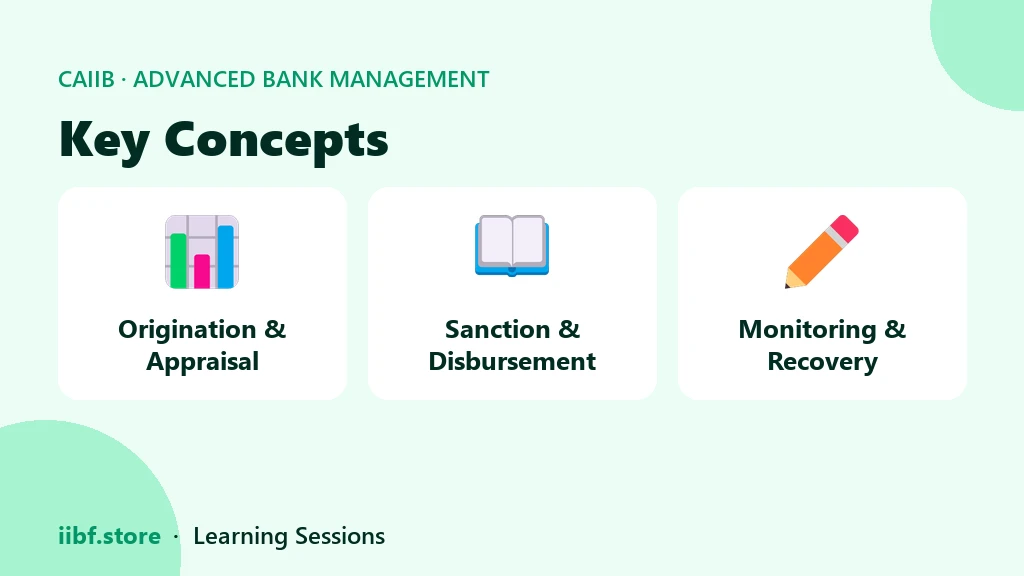
The Six Stages of Credit Management
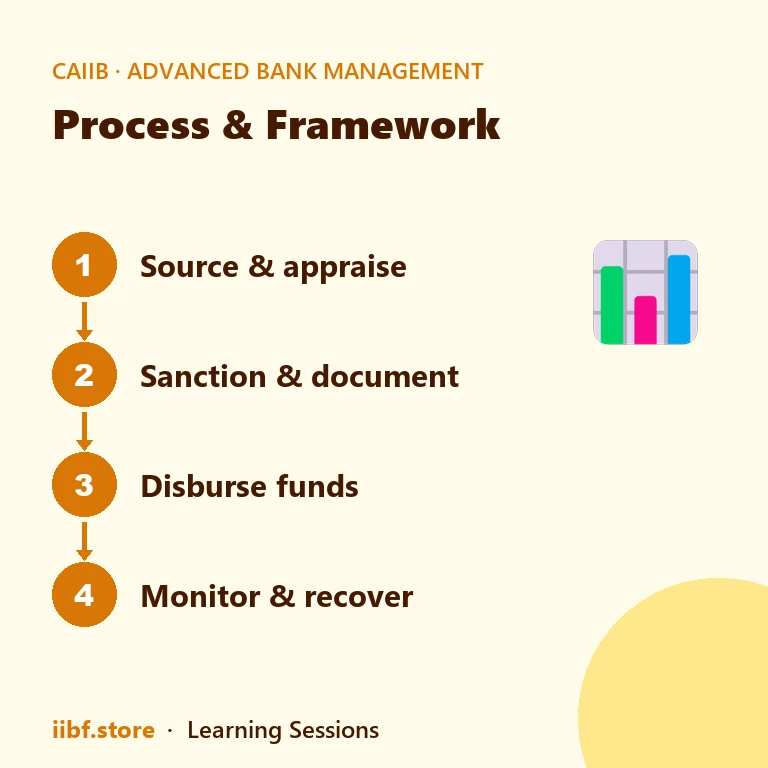
The syllabus breaks the lifecycle into six connected stages. Memorise them in sequence — MCQs love to shuffle the order and ask you to spot the mistake.
- Origination / Sourcing: Identifying a genuine borrower and a viable purpose. The proposal is only as good as the lead behind it.
- Credit Appraisal: The heart of credit management — assessing the 6 C's (Character, Capacity, Capital, Collateral, Conditions, Compliance), analysing financial statements, and computing key ratios.
- Sanction: The competent authority approves the limit, interest rate and covenants within its delegated powers.
- Documentation & Disbursement: Executing valid, enforceable documents and releasing funds against agreed conditions.
- Monitoring & Supervision: Tracking end-use, reviewing the account, and watching for early-warning signals (SMA-0, SMA-1, SMA-2).
- Recovery / NPA Management: If the account slips, classification, provisioning and recovery action under SARFAESI or IBC begin.
A Worked Example: From Application to Recovery
Suppose a trader applies for a ₹50 lakh cash-credit limit. Watch how each credit management stage adds a control:
| Stage | Action | Control Added |
|---|---|---|
| Origination | KYC + purpose check | Genuine borrower |
| Appraisal | Current Ratio 1.33, DSCR 1.8 | Repayment capacity |
| Sanction | Limit fixed at ₹40 lakh | Prudent exposure |
| Documentation | Hypothecation of stock | Enforceable security |
| Monitoring | Monthly stock statements | Early warning |
| Recovery | Notice if overdue 90 days | NPA containment |
Notice how skipping even one stage — say, monitoring — would let the borrower divert stock without the bank ever knowing. That is why examiners treat credit management as a chain, not a checklist.
Common Exam Traps in ABM Module C
Three traps catch most candidates. First, confusing appraisal (before sanction) with monitoring (after disbursement). Second, forgetting that SMA classification is part of monitoring, not recovery. Third, assuming collateral replaces appraisal — it never does; strong credit management always rests on repayment capacity first, security second. Practise these distinctions in a timed mock test and they will stick.
Ready to go deeper? The full Module C is covered in the CAIIB Advanced Bank Management course, and you can benchmark your prep across the whole CAIIB programme. For the official syllabus, always cross-check the IIBF website. More revision reels are on our blog.
How RBI Prudential Norms Shape Credit Management
Credit management does not happen in a vacuum — it operates inside the guard-rails RBI sets through its prudential norms. Income-recognition and asset-classification (IRAC) rules decide when interest can be booked and when an account must be flagged as stressed. Exposure norms cap how much a bank may lend to a single borrower or group, so that no one default can sink the balance sheet. Provisioning norms force the bank to set aside capital the moment an account turns sub-standard. Every one of these rules is a control layered on top of ordinary credit management, and ABM Module C expects you to connect the lifecycle stage to the norm that governs it.
Credit Monitoring in Practice
Of the six stages, monitoring is where most banks lose money, because it is the one stage that never ends. Good credit management treats monitoring as a continuous radar: stock and receivable statements are compared with sanctioned drawing power, quarterly financials are checked against projections, and account conduct — cheque returns, overdrawings, delayed servicing — is watched for the earliest sign of stress. The Special Mention Account (SMA) framework formalises this: SMA-0 flags principal or interest overdue up to 30 days, SMA-1 up to 60 days, and SMA-2 up to 90 days. Cross the 90-day line and the account becomes a Non-Performing Asset. Examiners frequently give a scenario with a number of days overdue and ask you to state the correct SMA sub-category, so drill these thresholds until they are automatic.
From Monitoring to NPA Provisioning
When credit management fails to arrest a slippage, the recovery stage takes over, and provisioning kicks in. A sub-standard asset attracts a base provision, doubtful assets attract higher provisions rising with age, and a loss asset must be fully provided or written off. The bank may also invoke SARFAESI to enforce security without court intervention, or refer larger defaults to the National Company Law Tribunal under the Insolvency and Bankruptcy Code. The point ABM drives home is that recovery is expensive and uncertain — which is exactly why disciplined appraisal and monitoring earlier in the credit management chain are worth far more than aggressive recovery later.
A Quick Revision Checklist
Before the exam, be able to answer these in one breath: name the six stages in order; state what the 6 C's stand for; give the three SMA thresholds; explain the difference between hypothecation and pledge; and describe when SARFAESI applies. Master those and the credit management questions in ABM Module C become easy marks rather than guesswork. Reinforce each point with active recall on a timed mock test rather than passive re-reading — spaced retrieval is what makes the lifecycle stick under exam pressure.
How many stages are there in the credit management lifecycle?
Six: origination, appraisal, sanction, documentation & disbursement, monitoring, and recovery. ABM Module C expects you to list them in this exact order.
Which stage is the most important for scoring in ABM?
Credit appraisal. It carries the 6 C's and ratio analysis, which together generate the largest cluster of numerical and conceptual MCQs.
Is SMA classification part of monitoring or recovery?
Monitoring. SMA-0, SMA-1 and SMA-2 are early-warning stages that flag stress before an account becomes an NPA and moves into recovery.
Does collateral remove the need for appraisal?
No. Sound credit management always assesses repayment capacity first; collateral is a fallback, never a substitute for a proper appraisal.
Prefer revising from a printed book?
Chapter-wise books with MCQs after every chapter — minimal pages, complete coverage, delivered anywhere in India. Every book has a free sample to read first.
148 pages · 478 MCQs
Learning Sessions · Ashish Sir
151 pages · 465 MCQs
Learning Sessions · Ashish Sir
148 pages · 375 MCQs
Learning Sessions · Ashish Sir
216 pages · 895 MCQs
Learning Sessions · Ashish Sir
109 pages · 300 MCQs
Learning Sessions · Ashish Sir
104 pages · 360 MCQs
Learning Sessions · Ashish Sir
82 pages · 297 MCQs
Learning Sessions · Ashish Sir
151 pages · 600 MCQs
Learning Sessions · Ashish Sir
98 pages · 282 MCQs
Learning Sessions · Ashish Sir
131 pages · 672 MCQs
Learning Sessions · Ashish Sir
221 pages · 831 MCQs
Learning Sessions · Ashish Sir
128 pages · 524 MCQs
Learning Sessions · Ashish Sir
107 pages · 445 MCQs
Learning Sessions · Ashish Sir
132 pages · 225 MCQs
Learning Sessions · Ashish Sir
188 pages · 435 MCQs
Learning Sessions · Ashish Sir
117 pages · 236 MCQs
Learning Sessions · Ashish Sir
Learning Sessions · Ashish Sir
118 pages · 299 MCQs
Learning Sessions · Ashish Sir
Learning Sessions · Ashish Sir
Learning Sessions · Ashish Sir
Learning Sessions · Ashish Sir
115 pages · 255 MCQs
Learning Sessions · Ashish Sir
Learning Sessions · Ashish Sir
334 pages · 936 MCQs
Learning Sessions · Ashish Sir
Learning Sessions · Ashish Sir
115 pages · 344 MCQs
Learning Sessions · Ashish Sir
107 pages · 240 MCQs
Learning Sessions · Ashish Sir
90 pages · 150 MCQs
Learning Sessions · Ashish Sir
Learning Sessions · Ashish Sir
Quick quiz on this topic
5 exam-style questions from our free test bank — check yourself before you move on.
Practice this topic
Take a free mock test, download chapter PDFs, or watch a video class — all included on iibf.store.