Six Principles of Lending: CAIIB ABM Quick Revision 2026
Every credit decision a bank makes is the same handful of questions asked in a different order. That is really all the six principles of lending are. Not a list to memorise, but the checklist a sanctioning authority runs through before signing anything.
The short below runs the list. What follows is the part the video does not have room for: what each principle actually stops a bank from doing, and how CAIIB ABM turns them into marks.
CAIIB ABM: six principles of lending · Watch on YouTube
The list, and the question behind each one
Textbooks state the principles as nouns, which makes them easy to forget. Turn each one into the question a credit officer is actually asking and they stop being a list.
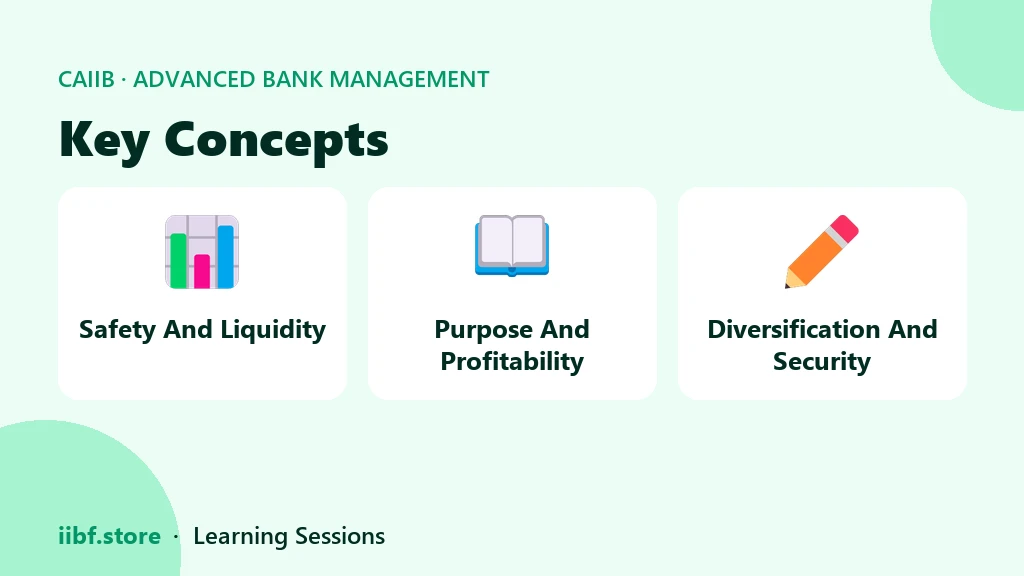
| Principle | The question it asks | What goes wrong if ignored |
|---|---|---|
| Safety | Will this money come back? | The advance slips into NPA |
| Liquidity | Can we get it back when we need it? | Asset liability mismatch |
| Purpose | What is the money actually for? | Diversion of funds |
| Profitability | Does the spread cover the risk? | Business that loses money |
| Diversification of risk | Are we too concentrated? | One sector takes the book down |
| Security | What is the fallback? | Nothing to recover against |
Safety and liquidity are not the same thing
This is the distinction the exam loves, and the one candidates blur most often.
Safety asks whether the borrower can repay at all. It is about creditworthiness. The character of the borrower, the capacity of the business, the capital already at stake. A loan is safe if repayment is genuinely likely.
Liquidity asks something different. It asks whether the bank can convert the advance back into cash when it needs to. A loan can be perfectly safe and still be badly illiquid. A twenty year infrastructure term loan to a rock solid borrower is safe. It is not liquid.
Why does the difference matter? Because a bank lends money that is mostly not its own. Deposits are repayable, many of them on demand. If every advance on the book is safe but none of it is liquid, the bank is still in trouble the moment depositors ask for their money back.
Purpose is the principle that gets tested hardest
A banker does not lend for a good borrower. A banker lends for a good purpose, to a good borrower.
Purpose does two jobs. It decides the right product, because working capital needs a cash credit limit rather than a term loan, and a machine purchase needs a term loan rather than an overdraft. And it sets up the monitoring, because once you know what the money was for, you can check whether it went there.
When it goes wrong you get diversion of funds. A working capital limit sanctioned for raw material quietly funds a property purchase instead. The advance can look perfectly regular for a while. It usually stops looking regular all at once.
Profitability, diversification and security
The last three are the ones candidates skip because they sound obvious. They are not.
Profitability is the spread between what the bank pays for funds and what it earns on the advance, after the cost of the risk taken. A finely priced loan to a weak borrower is not good business, however large the exposure looks on a target sheet.
Diversification of risk is why exposure norms exist. Spread the book across borrowers, sectors, geographies and tenors, so one bad harvest or one sector downturn does not take the whole portfolio with it. Concentration is comfortable right up until it is not.
Security comes last for a reason. It is a fallback, never a substitute for the first five. If a proposal only works because the collateral is strong, the bank is not lending. It is preparing to recover. Some texts add a seventh principle, national interest or the social objective, covering directed lending priorities. Check which list your courseware uses before the exam.
How ABM asks it
Direct recall questions do appear, but the marks are in the applied version. A short case describes a proposal, and you have to name the principle being violated.
A branch sanctions a Rs 5 crore cash credit limit for raw material to a textile unit. Within a month the funds move to an associate concern to buy land. The limit is fully secured by the promoter's property.
Which principle failed? Not security, because the collateral is there. The failure is purpose, and behind it, monitoring. The security detail is a distractor, planted to see whether you treat collateral as a substitute for the other five.
That is the habit worth building. When you read a credit case, run the six principles of lending in order and stop at the first one that breaks. It is almost never the last one.
You can work through the full credit module in the Advanced Bank Management course, and the rest of the paper sits under the CAIIB course. Time yourself on applied cases in the practice tests, and browse more quick revisions on the blog. The prudential norms underneath all of this come from the Reserve Bank of India.
Frequently asked questions
What are the six principles of lending in order?
Safety, liquidity, purpose, profitability, diversification of risk and security. Some courseware adds national interest or the social objective as a seventh principle.
What is the difference between safety and liquidity?
Safety is about whether the borrower will repay at all. Liquidity is about how quickly the bank can convert the advance back into cash. A long term loan to a strong borrower is safe but not liquid.
Why is security listed last?
Because it is a fallback, not a reason to lend. If a proposal only stands up because of the collateral, the first five principles have already failed.
Which principle does diversion of funds violate?
Purpose. The money was sanctioned for a stated end use and went somewhere else, which also means the monitoring that follows from purpose was not working.
Prefer revising from a printed book?
Chapter-wise books with MCQs after every chapter — minimal pages, complete coverage, delivered anywhere in India. Every book has a free sample to read first.
148 pages · 478 MCQs
Learning Sessions · Ashish Sir
151 pages · 465 MCQs
Learning Sessions · Ashish Sir
148 pages · 375 MCQs
Learning Sessions · Ashish Sir
216 pages · 895 MCQs
Learning Sessions · Ashish Sir
109 pages · 300 MCQs
Learning Sessions · Ashish Sir
104 pages · 360 MCQs
Learning Sessions · Ashish Sir
82 pages · 297 MCQs
Learning Sessions · Ashish Sir
151 pages · 600 MCQs
Learning Sessions · Ashish Sir
98 pages · 282 MCQs
Learning Sessions · Ashish Sir
131 pages · 672 MCQs
Learning Sessions · Ashish Sir
221 pages · 831 MCQs
Learning Sessions · Ashish Sir
128 pages · 524 MCQs
Learning Sessions · Ashish Sir
107 pages · 445 MCQs
Learning Sessions · Ashish Sir
132 pages · 225 MCQs
Learning Sessions · Ashish Sir
188 pages · 435 MCQs
Learning Sessions · Ashish Sir
117 pages · 236 MCQs
Learning Sessions · Ashish Sir
Learning Sessions · Ashish Sir
118 pages · 299 MCQs
Learning Sessions · Ashish Sir
Learning Sessions · Ashish Sir
Learning Sessions · Ashish Sir
Learning Sessions · Ashish Sir
115 pages · 255 MCQs
Learning Sessions · Ashish Sir
Learning Sessions · Ashish Sir
334 pages · 936 MCQs
Learning Sessions · Ashish Sir
Learning Sessions · Ashish Sir
115 pages · 344 MCQs
Learning Sessions · Ashish Sir
107 pages · 240 MCQs
Learning Sessions · Ashish Sir
90 pages · 150 MCQs
Learning Sessions · Ashish Sir
Learning Sessions · Ashish Sir
Quick quiz on this topic
5 exam-style questions from our free test bank — check yourself before you move on.
Practice this topic
Take a free mock test, download chapter PDFs, or watch a video class — all included on iibf.store.
Keep reading