Workplace Ethics for Bank Employees: A Practical IIBF Guide
Workplace ethics for bank employees is not an abstract compliance slogan tucked away in an HR manual — it is the everyday judgment call a teller, loan officer, or branch manager makes when nobody else is watching. For IIBF's Ethics in Banking module, this is one of the most heavily tested and practically relevant themes, because examiners want to know whether candidates can apply principles to real situations rather than merely recite definitions. This article walks through what workplace ethics for bank employees actually means on the floor, how an organization builds a culture that supports it, why globalization has made the terrain more complex, and how to handle the ethical dilemmas that show up in almost every posting.
🏢 What Is Workplace Ethics for Bank Employees?
At its core, workplace ethics for bank employees refers to the standards of honesty, fairness, and professional conduct that govern how staff treat customers, colleagues, and the institution itself. Unlike a rulebook that lists every possible scenario, ethics fills the gaps where regulation is silent — the moment a junior officer notices a senior colleague pressuring a customer into an unsuitable product, or when a cashier is asked to overlook a minor discrepancy "just this once." The IIBF chapter on Work Ethics and the Workplace frames this as a continuous exercise in professional discretion, not a one-time training module.
Practically, this covers punctuality and diligence, respectful treatment of colleagues regardless of hierarchy, honest record-keeping, avoiding favoritism in appraisals or postings, and treating customer information as a trust rather than an asset to be shared casually. Banks increasingly assess this dimension during confirmation and promotion reviews, not just during recruitment. A employee who cuts corners on documentation to "help" a customer close a loan faster is often the same employee who later features in an audit exception report. Examiners frequently frame case-study questions around exactly this kind of scenario, testing whether the candidate recognizes the ethical breach before it becomes a regulatory one.
💡 Exam Tip: When a case study describes an employee bending a rule "to help the customer," the ethically correct answer is almost always escalation or refusal — not silent accommodation.
🤝 Building an Ethical Culture from the Top Down
Individual conduct rarely exists in isolation; it is shaped heavily by what leadership tolerates. The chapter on Building an Ethical Organization explains that "tone at the top" is the single strongest predictor of how staff behave under pressure. If a branch head routinely waives documentation checks to hit quarterly targets, junior staff absorb the message that numbers matter more than process, regardless of what the induction manual says.
A genuinely ethical organization embeds its values into structures, not just posters. That means aligning incentive schemes so that staff are not rewarded purely for volume without regard to quality, building internal escalation channels that employees trust will not backfire on them, and ensuring that disciplinary action for ethical lapses is applied consistently across seniority levels. It also means training that uses real, anonymized case studies rather than generic slideware, so staff can rehearse the judgment calls they will actually face. Corporate culture surveys conducted across Indian banks have repeatedly shown that employees who believe their concerns will be taken seriously are far more likely to raise issues early, before they escalate into loss events or reputational damage.
This organizational dimension connects closely to how banks handle related obligations, including the duty banks owe their customers around information handling — a theme explored in depth in our companion piece on customer confidentiality and duty of secrecy, and in the broader discussion of corporate social responsibility in banks, both of which flow from the same institutional commitment to ethical practice.
🌍 Changing Dynamics: Ethics in a Globalized Banking World
Banking ethics has never been static, but the pace of change has accelerated sharply as Indian banks expand cross-border operations, partner with fintechs, and serve customers who transact across multiple jurisdictions in a single day. The chapters on Banking Ethics: Changing Dynamics capture how digital channels, algorithmic decision-making, and remote servicing have introduced ethical questions that did not exist a generation ago — who is accountable when an automated system denies a loan unfairly, or when a chatbot gives a customer subtly misleading information?
Globalization compounds this further. A bank employee working with NRI clients, correspondent banking relationships, or trade finance transactions must reconcile domestic conduct expectations with the regulatory and cultural norms of partner jurisdictions, as discussed in the chapter on Ethics and Globalization. What counts as an acceptable business courtesy in one market may look like an inducement in another. Staff dealing with capital markets-adjacent products should also understand how ethics intersects with market infrastructure; our related article on stock exchanges and depositories in India is a useful cross-reference for candidates studying the Indian Economy and Financial System paper alongside Ethics.
⚠️ Common Mistake: Candidates often assume "globalization" questions are only about foreign banks. IIBF case studies just as often test how a purely domestic branch handles an NRI or cross-border transaction ethically.
⚖️ Common Workplace Ethical Dilemmas and How to Handle Them
Most real-world ethical failures in banking do not begin as grand conspiracies; they begin as small, individually justifiable shortcuts that compound over time. The chapter on Ethical Issues of Corruption, Bribery and White-Collar Crime catalogues how these begin — a small favor accepted from a vendor, a document backdated to meet a deadline, a blind eye turned to a colleague's minor policy breach. None of these look like "crime" in the moment, which is precisely what makes them dangerous.
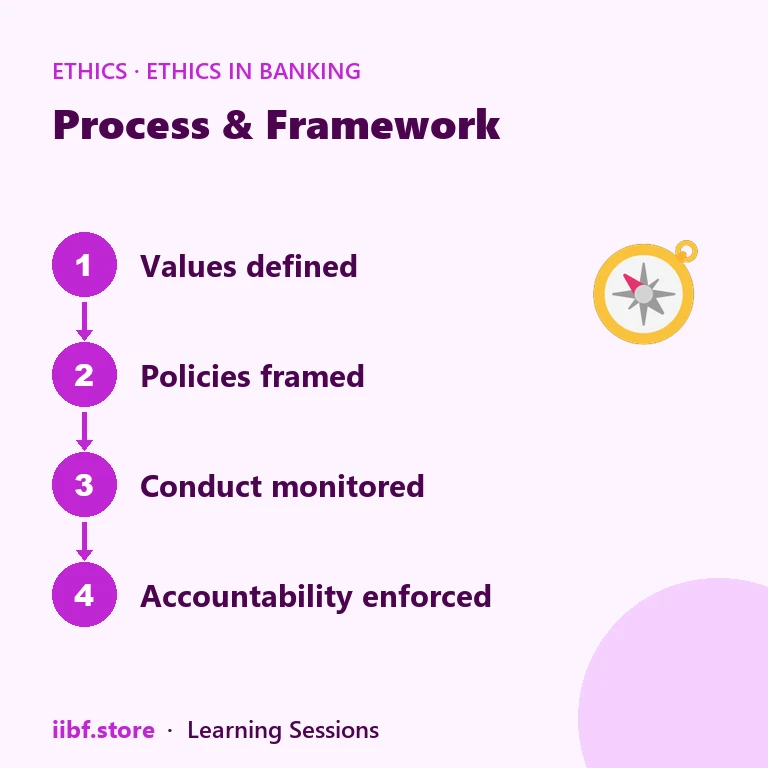
The environmental dimension of ethics has also grown in importance, particularly for staff involved in project appraisal and corporate lending, a theme our sister article on environmental ethics in banking covers in detail. Handling these dilemmas well comes down to a repeatable discipline: pause before acting, name the conflict explicitly rather than rationalizing it away, consult a supervisor or the designated ethics/compliance contact, and document the decision trail. Employees who internalize this habit rarely find themselves at the center of an inquiry, because the paper trail itself demonstrates good faith.
📌 Remember: Ethical dilemmas are rarely solved by memorizing rules — they are solved by pausing long enough to recognize that a dilemma exists in the first place.
Institutions such as the Indian Institute of Banking and Finance continue to emphasize this behavioral dimension in certification syllabi precisely because technical competence without ethical judgment leaves banks exposed to exactly the kind of losses that regulators scrutinize most closely.
| Workplace Situation | Ethical Response | Compliant? |
|---|---|---|
| Vendor offers an expensive personal gift before contract renewal | Politely decline and log it per internal policy | ✅ Compliant if declined / ❌ Not compliant if accepted |
| Colleague asks you to backdate a sanction document | Refuse and escalate to your reporting manager | ✅ Refusing is compliant |
| Customer data requested informally by a friend or relative | Decline; data may only be shared through authorized channels | ❌ Sharing informally is a breach |
| You are assigned to appraise a loan for a relative's firm | Disclose the conflict in writing before proceeding | ✅ Compliant once disclosed |
🧠 Practice MCQs: Workplace Ethics for Bank Employees
Q1. A bank employee is offered a lavish personal gift by a loan applicant just before sanction. What is the MOST appropriate action? (a) Politely decline and report it as per the bank's gift policy (b) Accept it since it is a personal gift (c) Accept it quietly if the value seems small (d) Ask a colleague to accept it on their behalf
Answer: (a) — Declining and reporting protects both the employee and the institution from an appearance of impropriety.
Q2. Which statement BEST describes the role of "tone at the top" in workplace ethics? (a) It is relevant only to the compliance department (b) Senior management's conduct sets the ethical benchmark for the whole organization (c) It applies only to unionized staff (d) It has no bearing on frontline behavior
Answer: (b) — Staff calibrate their own conduct largely by observing what leadership actually tolerates, not just what manuals state.
Q3. A senior colleague asks a junior employee to backdate a document to help meet a monthly target. This is best classified as: (a) A standard operating procedure (b) A permissible discretionary act (c) An ethical dilemma requiring escalation (d) A performance improvement technique
Answer: (c) — Backdating records is a documentation breach and should be escalated, not quietly executed.
Q4. Under a sound internal reporting framework, an employee who raises a genuine concern in good faith should: (a) Be transferred out of the department immediately (b) Be protected against retaliation (c) Be required to prove guilt beyond doubt before it is examined (d) Lose eligibility for future promotion
Answer: (b) — Protection against retaliation is what makes internal reporting channels credible and effective.
Q5. Globalization has increased ethical complexity in banking mainly because: (a) Banks now operate under one uniform global law (b) Ethical rules no longer apply to cross-border operations (c) Only foreign customers are affected by ethics rules (d) Employees must reconcile diverse cultural and regulatory expectations across jurisdictions
Answer: (d) — Cross-border dealings require staff to navigate differing norms of conduct without losing sight of core ethical principles.
Want chapter-wise mock tests with 100+ MCQs? Start practising free →
What is workplace ethics for bank employees?
It refers to the standards of honesty, fairness, and professional conduct expected from bank staff in their day-to-day dealings with customers, colleagues, and the institution, covering everything from confidentiality to conflict-of-interest disclosure.
Why does workplace ethics matter so much in banking specifically?
Banks handle other people's money and sensitive financial data, so even small lapses in individual conduct can cascade into significant financial loss, regulatory action, or reputational damage for the institution.
What happens if a bank employee violates workplace ethics norms?
Consequences range from internal disciplinary action and denial of promotion to termination and, in serious cases involving fraud or corruption, regulatory or criminal proceedings depending on the nature of the violation.
How can new bank employees build good workplace ethics habits early?
By pausing before acting on any shortcut, documenting decisions honestly, raising doubts with a supervisor rather than guessing, and treating every customer interaction as though it will later be reviewed.
Workplace ethics for bank employees is ultimately less about memorizing a code and more about building the reflex to pause, disclose, and escalate before a small shortcut becomes a serious lapse. For candidates preparing for the IIBF Ethics module, the case studies above are a preview of exactly how exam scenarios are framed — practical, ambiguous, and resolved only by sound judgment. Reinforce these concepts with full-length mock tests or explore the complete Ethics in Banking article library for related chapter-wise guides before your next attempt.
Quick quiz on this topic
5 exam-style questions from our free test bank — check yourself before you move on.
Practice this topic
Take a free mock test, download chapter PDFs, or watch a video class — all included on iibf.store.