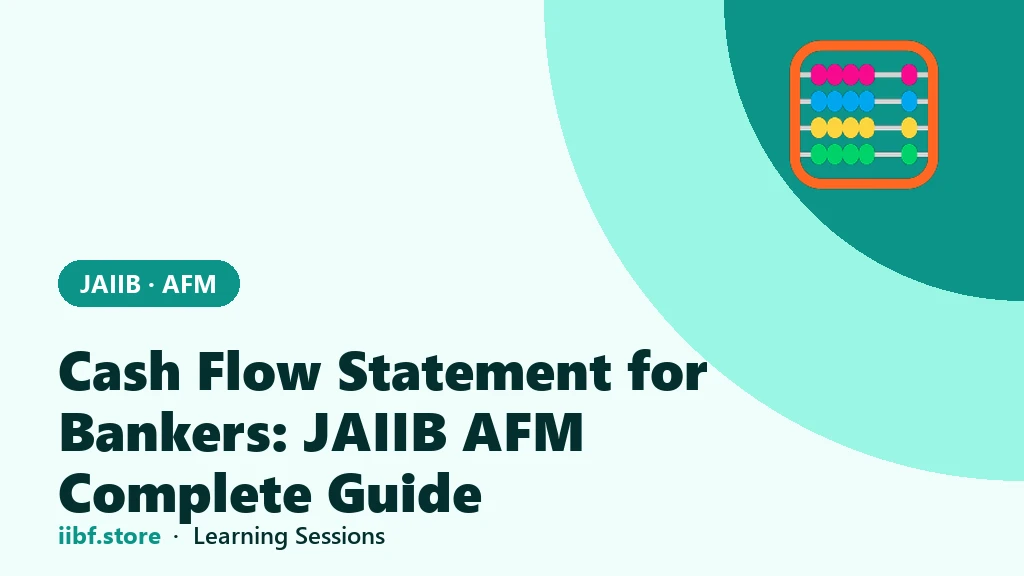
Cash Flow Statement for Bankers: JAIIB AFM Complete Guide
Every JAIIB AFM candidate eventually has to master the cash flow statement for bankers — the statement that shows where a bank's cash actually came from and went, rather than what profit alone suggests. It classifies movements into operating, investing and financing activities under AS-3 (Ind AS 7), and getting that classification right is a recurring exam topic.
This article covers the concepts the way JAIIB tests them — classification of specific transactions, direct vs indirect method, and how banks treat interest, dividend and tax flows differently from a manufacturing company.
📊 What a Cash Flow Statement Tells a Banker
A cash flow statement summarises inflows and outflows of cash and cash equivalents during a period, classified into operating, investing and financing activities. It is governed in India by AS-3 for smaller entities and Ind AS 7 for banks that have migrated to Indian Accounting Standards — both define the same three-way classification tested in JAIIB AFM.
Unlike the profit and loss account, which recognises income and expense on an accrual basis, the cash flow statement records only movements of cash and cash equivalents. A bank can report healthy profit while its actual cash position tightens because advances are growing faster than deposits — the cash flow statement exposes exactly this gap.
Cash equivalents, as defined under AS-3, are short-term, highly liquid investments readily convertible into known amounts of cash with insignificant risk of value change — think treasury bills and commercial paper held for short-term commitments rather than investment. Bank overdraft balances that are repayable on demand and form an integral part of cash management are also treated as part of cash equivalents for this purpose.
📌 Remember: Cash equivalents under AS-3 must have an original maturity of three months or less from the date of acquisition — a figure examiners test directly.
For a bank, this statement is mandatory disclosure, forming part of the annual financial statements presented to shareholders, the RBI and other regulators alongside the balance sheet and profit and loss account.
🏦 Operating, Investing and Financing Activities Explained
Operating activities are cash effects of transactions entering the determination of net profit — for a bank this means interest received on advances and investments, interest paid on deposits and borrowings, fee income, and payments to employees and suppliers. Since lending and deposit-taking are the bank's principal business, most day-to-day cash flows sit here.
Investing activities cover acquisition and disposal of long-term assets and other investments not included in cash equivalents — purchase or sale of fixed assets, and long-term investments outside the trading book.
Financing activities change the size and composition of the bank's own capital and borrowings — issue of share capital, raising or repaying subordinated debt and Tier-2 bonds, and dividend payments to shareholders.
The tricky part: because interest and dividend received (and interest paid) arise from the bank's core lending and investment business, they are classified as operating activities for a bank rather than investing or financing as for a non-financial company. Dividend paid to the bank's own shareholders remains a financing activity either way, since it changes the composition of shareholders' funds rather than arising from lending operations.
💡 Exam Tip: For banks, interest paid and interest/dividend received sit under operating activities — this single rule drives most classification questions.
This activity-based structure builds directly on the Definition, Scope and accounting standards chapter, since classification logic flows from that framework.
🧮 Direct Method vs Indirect Method of Reporting
AS-3 and Ind AS 7 permit two ways to present cash flow from operating activities — direct and indirect — and the choice affects only that section; investing and financing are always reported the same way regardless of method.
The direct method discloses gross cash receipts and payments — cash from customers, cash paid to employees, cash paid for interest — arriving at net operating cash flow. It is more granular but requires re-analysing every transaction on a cash basis, which is heavy work for an institution with millions of entries.
The indirect method starts from net profit before tax and adjusts for non-cash items (depreciation, provisions) and working-capital changes such as advances, deposits and other current items. Because the starting figures already exist in the P&L and balance sheet, this method takes far less effort — which is why almost every Indian bank uses it.
| Aspect | Direct Method | Indirect Method |
|---|---|---|
| Starting Point | Gross cash receipts & payments | Net profit before tax |
| Ease of Preparation | ❌ Data-intensive | ✅ Reuses P&L and balance sheet |
| Shows Gross Cash Flows | ✅ Full detail | ❌ Net adjustments only |
| Common in Indian Banks | ❌ Rare | ✅ Overwhelmingly preferred |
| Permitted under AS-3 / Ind AS 7 | ✅ Yes | ✅ Yes |
Only the operating-activities section changes between methods; both must still arrive at the identical net increase or decrease in cash and cash equivalents for the period.
💰 Treating Interest, Dividends, Tax and Non-Cash Items
A recurring exam trap is tax and non-cash-item treatment. Cash flows from taxes on income are classified as operating activities unless specifically identifiable with financing or investing activities, in which case they are disclosed separately under that head.
Non-cash items — depreciation, amortisation, provisions for non-performing assets, and unrealised forex gains or losses — never appear as cash flows themselves. Under the indirect method they are added back to, or deducted from, net profit precisely because they changed reported profit without any corresponding cash movement.
⚠️ Common Mistake: Students often try to show depreciation as a cash outflow. It is a non-cash expense — added back to net profit under the indirect method, never shown as an outflow anywhere.
For a bank, movements in advances, deposits and trading investments are treated as working-capital adjustments within operating activities, since sanctioning loans and accepting deposits are core operating business — not investing or financing decisions. This is why a bank's cash flow statement looks structurally different from a manufacturer's, despite following the same framework — a manufacturer's inventory purchases sit in operating activities too, but a bank's "inventory" is effectively the loan book itself.
This tax-adjustment logic connects directly to the Taxation: Income Tax / TDS / Deferred Tax chapter, since deferred tax movements feed the same non-cash add-back mechanics.
📐 Cash Flow Statement vs Other Bank Financial Statements
Candidates often confuse the cash flow statement with the balance sheet, profit and loss account, and older funds-flow-style analysis. The clearest distinction is scope: the balance sheet is a point-in-time snapshot; the profit and loss account measures accrual-based income and expense over a period; the cash flow statement measures only cash and cash-equivalent movement over that same period.
Accurate source records in the MAINTENANCE OF Cash And SUBSIDIARY BOOKS AND LEDGER chapter are ultimately what feed the raw entries a bank later aggregates into its cash flow statement.
It also helps to revisit how a bank balance sheet format is structured, since several adjustments — change in advances, deposits, investments — come from comparing two consecutive balance sheets. Once the balance sheet is familiar, cash flow reconciliation becomes largely mechanical.
Cash flow analysis complements rather than replaces ratio-based evaluation — a bank with strong financial ratio analysis numbers can still show a temporary cash squeeze, which is why auditors read both statements together.
An older funds-flow statement, by contrast, tracked changes in overall working capital rather than cash alone, so a bank could show a positive funds flow while its actual cash and cash-equivalent balance was falling. The narrower, cash-specific focus is precisely why AS-3 and Ind AS 7 moved reporting practice toward the cash flow statement as the primary liquidity disclosure.
🧠 Practice MCQs: Cash Flow Statement for Bankers
Q1. Under AS-3 (Ind AS 7), interest and dividend received by a bank are normally classified under which activity? (a) Financing (b) Investing (c) Operating (d) Extraordinary item
Answer: (c) — For banks, interest and dividend received relate directly to the core revenue-generating business, so they sit under operating activities.
Q2. Which is a financing activity in a bank's cash flow statement? (a) Purchase of fixed assets (b) Repayment of long-term subordinated borrowing (c) Interest received on advances (d) Sale of long-term investments
Answer: (b) — Repaying long-term borrowing changes the bank's capital structure, the defining feature of a financing activity.
Q3. As per AS-3, cash equivalents are short-term investments with an original maturity of: (a) 12 months or less (b) 6 months or less (c) 3 months or less (d) 1 month or less
Answer: (c) — AS-3 defines cash equivalents as investments with original maturity of three months or less.
Q4. Which method starts with net profit before tax and adjusts for non-cash items? (a) Direct method (b) Indirect method (c) Accrual method (d) Cash method
Answer: (b) — The indirect method reconciles net profit before tax to net operating cash flow via non-cash and working-capital adjustments.
Q5. A bank's cash flow statement differs from an older funds flow statement mainly because it: (a) Includes only capital transactions (b) Tracks broad working-capital changes (c) Focuses strictly on cash and cash-equivalent movements (d) Is for internal use only
Answer: (c) — A cash flow statement narrows scope to cash and cash equivalents, unlike the wider resource pool a funds flow statement tracks.
Want chapter-wise mock tests with 100+ MCQs? Start practising free →
❓ Frequently Asked Questions
Why is a cash flow statement important for a bank specifically?
It shows whether lending, investing and borrowing activities are generating or consuming actual cash, which profit figures alone can mask, helping regulators and shareholders assess liquidity health.
Is a cash flow statement mandatory for Indian banks?
Yes. Scheduled commercial banks preparing statements under AS-3 or Ind AS 7 must include a cash flow statement in their annual financial statements alongside the balance sheet and profit and loss account.
Which method do most Indian banks actually use?
Almost all use the indirect method, since it builds directly on the existing profit and loss account and comparative balance sheets rather than re-analysing every transaction.
How does JAIIB AFM typically test this topic?
Questions usually ask you to classify a transaction — interest received, loan repayment, purchase of fixed assets — or to identify correct treatment of non-cash items like depreciation under the indirect method.
Wrapping Up: Making Cash Flow Classification Second Nature
The cash flow statement for bankers rewards pattern recognition over rote memorisation — once you internalise that a bank's interest and dividend flows sit under operating activities, most classification questions answer themselves. Pair this with the inflation accounting for bankers chapter and the JAIIB PPB latest updates for rounded revision. For the accounting-standard wording behind AS-3, see the Institute of Chartered Accountants of India's published accounting standards. Explore more at the AFM topic hub, or start a full JAIIB course ahead of exam day.
Prefer revising from a printed book?
Chapter-wise books with MCQs after every chapter — minimal pages, complete coverage, delivered anywhere in India. Every book has a free sample to read first.
128 pages · 524 MCQs
Learning Sessions · Ashish Sir
131 pages · 672 MCQs
Learning Sessions · Ashish Sir
221 pages · 831 MCQs
Learning Sessions · Ashish Sir
107 pages · 445 MCQs
Learning Sessions · Ashish Sir
148 pages · 478 MCQs
Learning Sessions · Ashish Sir
151 pages · 465 MCQs
Learning Sessions · Ashish Sir
148 pages · 375 MCQs
Learning Sessions · Ashish Sir
216 pages · 895 MCQs
Learning Sessions · Ashish Sir
109 pages · 300 MCQs
Learning Sessions · Ashish Sir
104 pages · 360 MCQs
Learning Sessions · Ashish Sir
82 pages · 297 MCQs
Learning Sessions · Ashish Sir
151 pages · 600 MCQs
Learning Sessions · Ashish Sir
98 pages · 282 MCQs
Learning Sessions · Ashish Sir
132 pages · 225 MCQs
Learning Sessions · Ashish Sir
188 pages · 435 MCQs
Learning Sessions · Ashish Sir
117 pages · 236 MCQs
Learning Sessions · Ashish Sir
Learning Sessions · Ashish Sir
118 pages · 299 MCQs
Learning Sessions · Ashish Sir
Learning Sessions · Ashish Sir
Learning Sessions · Ashish Sir
Learning Sessions · Ashish Sir
115 pages · 255 MCQs
Learning Sessions · Ashish Sir
Learning Sessions · Ashish Sir
334 pages · 936 MCQs
Learning Sessions · Ashish Sir
Learning Sessions · Ashish Sir
115 pages · 344 MCQs
Learning Sessions · Ashish Sir
107 pages · 240 MCQs
Learning Sessions · Ashish Sir
90 pages · 150 MCQs
Learning Sessions · Ashish Sir
Learning Sessions · Ashish Sir
Quick quiz on this topic
5 exam-style questions from our free test bank — check yourself before you move on.
Practice this topic
Take a free mock test, download chapter PDFs, or watch a video class — all included on iibf.store.