Data Protection Framework for Banks: IIBF BCP Guide 2026
Every bank in India now sits on a mountain of customer data — PAN details, biometric KYC, transaction histories, credit scores — and regulators have stopped treating its safekeeping as an IT afterthought. For anyone preparing for the IIBF Banking Compliance Professional exam, the data protection framework for banks is one of the fastest-growing compliance verticals, sitting at the intersection of the Digital Personal Data Protection Act, 2023 (DPDPA) and existing RBI cyber-security and IT-governance directions. Compliance officers are increasingly expected to translate this framework into board-level policy, breach-response drills, and vendor contracts — not leave it to the technology team alone. This article walks through the legal architecture, the compliance officer's operational duties, and how it compares with related RBI norms so you can answer BCP exam questions with confidence.
📊 What Is the Data Protection Framework for Banks
The data protection framework for banks in India rests on two pillars that a BCP-certified compliance officer must reconcile. The first is the Digital Personal Data Protection Act, 2023, India's first comprehensive personal-data law, which applies to any "Data Fiduciary" — including every bank — that processes digital personal data of customers, whether collected online or digitised later. The second is the RBI's own body of IT-governance and cyber-security circulars issued over the past decade, which impose sector-specific controls on top of the general law. Banks must layer DPDPA obligations — lawful purpose, notice, consent, and grievance redressal — over pre-existing RBI requirements on IT governance, business continuity, and incident reporting to CERT-In and the Reserve Bank.
A bank qualifying as a "Significant Data Fiduciary" (SDF) under the DPDPA — a classification most scheduled commercial banks will meet given the volume and sensitivity of personal data they hold — faces heightened duties: appointing a India-based Data Protection Officer (DPO), conducting periodic Data Protection Impact Assessments (DPIAs), and undergoing independent data-audits. For the compliance function, this converts what used to be a purely technical cyber-security exercise into a documented, auditable governance obligation that the CCO must sign off on.
💡 Exam Tip: Remember the DPDPA applies to "digital personal data" — data collected in digital form, or non-digital data that is later digitised. Paper KYC forms that are never scanned fall outside its direct scope, though RBI's own records-retention rules still apply.
🔐 Key Pillars of the Data Protection Framework for Banks
Four pillars anchor the data protection framework for banks that examiners expect candidates to know cold. First, consent and notice: banks must give a clear notice in English or any Eighth Schedule language before processing personal data, and consent must be free, specific, informed, and revocable — a big shift from the implied-consent culture common in loan-application forms. Second, purpose limitation and data minimisation: banks can only use data for the purpose disclosed, which affects cross-selling and analytics teams that previously repurposed KYC data freely. Third, breach notification: on becoming aware of a personal-data breach, a bank must inform the Data Protection Board of India (DPBI) and every affected data principal, with the DPDP Rules prescribing tight notification timelines — a duty that dovetails with the bank's existing RBI-mandated cyber-incident reporting.
Fourth, penalties: the DPDPA's schedule sets some of the steepest civil penalties in Indian regulatory history — up to ₹250 crore for failing to implement reasonable security safeguards leading to a breach, and up to ₹200 crore for failing to notify the Board or affected individuals in time. These are levied per instance by the DPBI, independent of any RBI monetary penalty for the same lapse, meaning a single mishandled data breach can trigger parallel regulatory exposure. This is precisely the kind of overlapping-regulator scenario that also arises under the bank's guarantees, acceptances and finance-to-NBFCs obligations, where customer data shared with a partner NBFC under a co-lending arrangement must still meet the originating bank's data-protection commitments.
⚠️ Common Mistake: Candidates often assume RBI's data-localisation circular and the DPDPA's data protection framework for banks are the same rule. They are not — localisation governs *where* payment-system data is stored, while the DPDPA governs *how* personal data of any kind is collected, used, and protected, wherever it sits.
🏦 Compliance Officer's Role in Implementing Data Protection
A BCP-qualified compliance officer's job does not end at reading the DPDPA — it starts there. In practice, the CCO's data-protection mandate includes maintaining a data-processing register across every business line, reviewing consent-collection scripts used at loan origination (an area that also touches the bank's loans and advances regulatory restrictions module, since KYC and financial data collected for sanctioning a loan must satisfy DPDPA notice requirements), and running an annual DPIA covering high-risk processing such as credit-scoring models and fraud-analytics engines.
Just as importantly, data-protection risk must be folded into the bank's enterprise risk and control self-assessment cycle rather than treated as a standalone IT checklist — an integration point examined in depth in our companion piece on compliance risk assessment. The CCO also owns the vendor-risk angle: every fintech partner, cloud host, or collection agency that touches customer data needs a contractual data-processing clause, an audit right, and a breach-notification SLA flowing back to the bank — because under the DPDPA the bank as Data Fiduciary remains accountable even when a Data Processor causes the breach.
📌 Remember: Under the DPDPA, liability for a data breach rests with the Data Fiduciary (the bank), not the outsourced Data Processor — vendor contracts must therefore build in indemnities and audit rights, they cannot shift regulatory accountability.
⚖️ Data Protection Framework vs RBI Data Localisation Norms
Exam-setters love pairing the DPDPA-driven data protection framework for banks against the older, narrower RBI data-localisation mandate, because candidates frequently conflate the two. The table below separates them on scope, regulator, and enforcement — and if you want the localisation side explained chapter-and-verse, our dedicated guide on data localisation norms for banks is the natural next read.
| Parameter | DPDPA Data Protection Framework | RBI Data Localisation Norms |
|---|---|---|
| Regulator | Data Protection Board of India | Reserve Bank of India |
| Core focus | Consent, purpose, breach notice | Storage location of payment data |
| Applies to | ✅ All digital personal data | ❌ Only payment-system transaction data |
Understanding this distinction also helps when the compliance officer is reviewing loans routed through export-finance channels — a scenario covered in our export credit and customer service to exporters chapter — since exporter data may cross borders for trade-finance processing even while payment-system copies must still be localised. For the authoritative regulatory text on cyber-security expectations that underpin both frameworks, refer to the RBI's own guidance at rbi.org.in's Master Directions page.
🔒 Building a Compliance Roadmap Around the New Framework
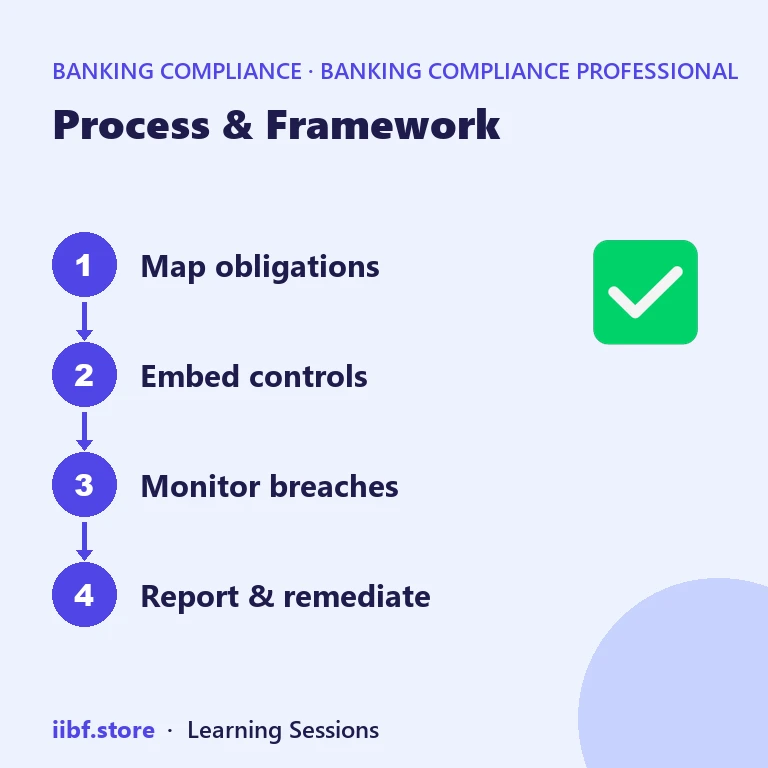
Rolling out the data protection framework for banks is not a one-time project — it needs a standing roadmap the compliance function revisits at least annually. Start with a data-mapping exercise across retail, corporate, and digital-lending verticals to identify every system that stores personal data, then classify processing activities by risk to prioritise DPIAs. Next, retrain frontline staff and DSAs on consent-capture scripts so the language matches DPDPA notice requirements rather than legacy T&C boilerplate. Banks should also stress-test their breach-response plan with tabletop exercises that simulate simultaneous reporting obligations to CERT-In, the RBI, and the DPBI, since a single incident can trigger all three within tight windows.
Finally, embed data-protection metrics into the compliance dashboard the CCO presents to the Board and the Audit Committee — number of DPIAs completed, vendor audits closed, and consent-withdrawal requests processed — so data protection reads as a governed, measurable program rather than a legal afterthought bolted onto IT security. Candidates preparing for the BCP exam should be ready to connect this roadmap to the bank's broader RCSA and regulatory-reporting cadence, since examiners routinely test how these compliance sub-functions interlock rather than testing each in isolation. For a broader view of how India's other bank-facing exam tracks build on these same regulatory habits, browse more IIBF exam-prep guides on our blog, and revisit the full BCP-specific archive on the Banking Compliance Professional tag hub.
🧠 Practice MCQs: Data Protection Framework for Banks
Q1. Under the DPDPA, 2023, a bank processing customers' digital personal data is legally classified as a: (a) Data Principal (b) Data Fiduciary (c) Consent Manager (d) Data Auditor
Answer: (b) — The bank is the "Data Fiduciary" that determines the purpose and means of processing personal data.
Q2. Which body adjudicates penalties for personal-data breaches under the DPDPA? (a) RBI (b) SEBI (c) Data Protection Board of India (d) IIBF
Answer: (c) — The Data Protection Board of India (DPBI) is the dedicated adjudicating authority for DPDPA violations.
Q3. A bank classified as a "Significant Data Fiduciary" must specifically appoint a: (a) Nodal Compliance Officer (b) Data Protection Officer based in India (c) Chief Risk Officer (d) Ombudsman
Answer: (b) — Significant Data Fiduciaries must appoint an India-based Data Protection Officer as an additional obligation.
Q4. Under the DPDPA schedule, the highest civil penalty tier applies to: (a) Minor documentation lapses (b) Failure to implement reasonable security safeguards leading to a breach (c) Late filing of an annual report (d) Incorrect branding on a notice
Answer: (b) — Failure to take reasonable security safeguards resulting in a breach attracts penalties up to ₹250 crore, the highest tier in the schedule.
Q5. How does RBI's data-localisation requirement differ from the DPDPA's data protection framework for banks? (a) They are identical rules (b) Localisation governs storage location of payment data; DPDPA governs consent and use of personal data generally (c) Localisation replaced the DPDPA (d) DPDPA only applies to foreign banks
Answer: (b) — Localisation is a narrower RBI storage mandate for payment-system data, while the DPDPA is a broader law governing consent, purpose, and breach handling for all personal data.
Want chapter-wise mock tests with 100+ MCQs? Start practising free →
Is the DPDPA, 2023 applicable to public and private sector banks alike?
Yes. The Digital Personal Data Protection Act, 2023 applies uniformly to any entity, public or private, that processes digital personal data as a Data Fiduciary, including all scheduled commercial banks.
Does the data protection framework for banks replace RBI's cyber-security circulars?
No. It operates alongside existing RBI IT-governance and cyber-security directions; banks must comply with both the DPDPA and sector-specific RBI requirements simultaneously.
What triggers a bank's obligation to appoint a Data Protection Officer?
Being notified as a Significant Data Fiduciary triggers the obligation, based on factors like the volume and sensitivity of personal data processed and the risk to data principals' rights.
Who is liable if a bank's outsourced vendor causes a data breach?
The bank, as the Data Fiduciary, remains primarily liable to the Data Protection Board even when a contracted Data Processor's failure caused the breach, making vendor oversight a core compliance duty.
Ready to put this into practice? Take a full-length BCP mock test or explore the complete course catalogue to keep building your compliance edge before exam day.
Prefer revising from a printed book?
Chapter-wise books with MCQs after every chapter — minimal pages, complete coverage, delivered anywhere in India. Every book has a free sample to read first.
Learning Sessions · Ashish Sir
132 pages · 225 MCQs
Learning Sessions · Ashish Sir
188 pages · 435 MCQs
Learning Sessions · Ashish Sir
117 pages · 236 MCQs
Learning Sessions · Ashish Sir
Learning Sessions · Ashish Sir
118 pages · 299 MCQs
Learning Sessions · Ashish Sir
Learning Sessions · Ashish Sir
Learning Sessions · Ashish Sir
Learning Sessions · Ashish Sir
115 pages · 255 MCQs
Learning Sessions · Ashish Sir
Learning Sessions · Ashish Sir
334 pages · 936 MCQs
Learning Sessions · Ashish Sir
Learning Sessions · Ashish Sir
115 pages · 344 MCQs
Learning Sessions · Ashish Sir
107 pages · 240 MCQs
Learning Sessions · Ashish Sir
90 pages · 150 MCQs
Learning Sessions · Ashish Sir
131 pages · 672 MCQs
Learning Sessions · Ashish Sir
221 pages · 831 MCQs
Learning Sessions · Ashish Sir
128 pages · 524 MCQs
Learning Sessions · Ashish Sir
107 pages · 445 MCQs
Learning Sessions · Ashish Sir
148 pages · 478 MCQs
Learning Sessions · Ashish Sir
151 pages · 465 MCQs
Learning Sessions · Ashish Sir
148 pages · 375 MCQs
Learning Sessions · Ashish Sir
216 pages · 895 MCQs
Learning Sessions · Ashish Sir
109 pages · 300 MCQs
Learning Sessions · Ashish Sir
104 pages · 360 MCQs
Learning Sessions · Ashish Sir
82 pages · 297 MCQs
Learning Sessions · Ashish Sir
151 pages · 600 MCQs
Learning Sessions · Ashish Sir
98 pages · 282 MCQs
Learning Sessions · Ashish Sir
Practice this topic
Take a free mock test, download chapter PDFs, or watch a video class — all included on iibf.store.
Keep reading