RCSA in Banking Compliance: IIBF BCP Guide 2026
Every bank's compliance function is judged not just on the policies it writes but on how well it can find its own weak spots before the regulator does. That is exactly what RCSA in banking compliance is built for — a structured, business-owned exercise that turns abstract compliance risk into a rated, trackable heat map. For IIBF's Banking Compliance Professional (BCP) exam, understanding how RCSA fits into the RBI's supervisory architecture is a recurring, high-weightage theme.
🔍 What RCSA Means and Why the Compliance Function Owns It
RCSA stands for Risk and Control Self-Assessment. It is a bottom-up exercise in which business and process owners — with the compliance function acting as facilitator and second line of defence — identify the inherent risks in a process, evaluate the controls already in place, and arrive at a residual risk rating. Unlike a statutory audit, which is conducted periodically by an independent third party, RCSA is owned by the people who actually run the process day to day, which is precisely why regulators value it: it surfaces operational and compliance risk earlier than an annual inspection cycle ever could.
In the three-lines-of-defence model that IIBF's BCP curriculum builds on, business units are the first line, compliance and risk management form the second line, and internal audit is the third. RCSA sits at the intersection of the first and second lines. The compliance function does not perform the assessment on the business's behalf; it designs the framework, sets the risk taxonomy, challenges self-ratings that look optimistic, and consolidates the output into the bank's overall compliance risk assessment. Many of the regulatory-restriction areas covered in Loans and Advances: Regulatory Restrictions are exactly the kind of process risks an RCSA exercise is designed to catch before they become RBI observations.
🛠️ How the RCSA Process Actually Runs
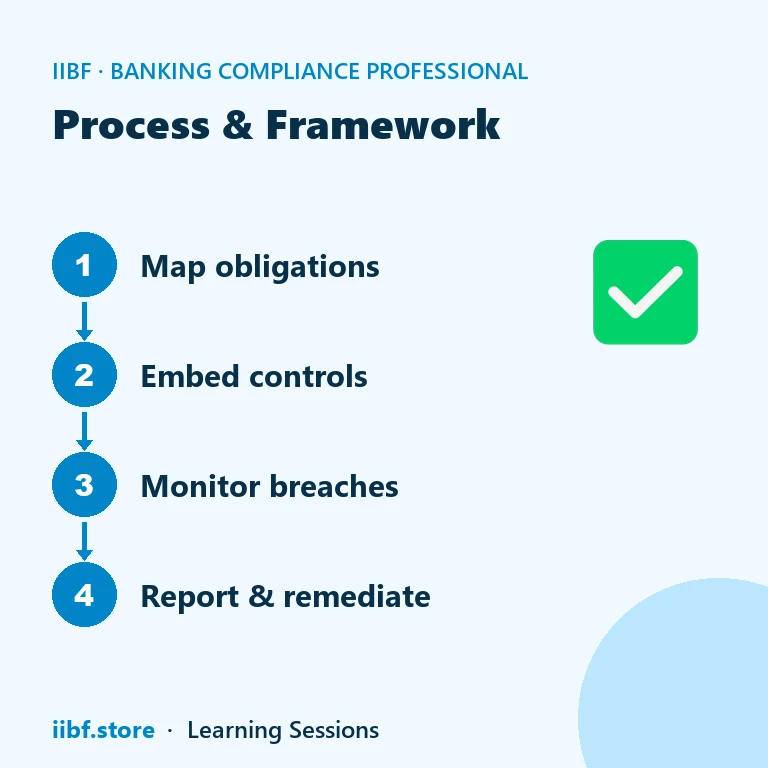
A typical RCSA cycle has five steps. First, process mapping — the business documents every step of a workflow, whether it is loan sanctioning, KYC onboarding, or large-exposure reporting. Second, risk identification — for each step, the team lists what could go wrong: a missed regulatory ceiling, a data entry error, an unauthorised exception. Third, control mapping — existing controls (maker-checker, system validations, MIS alerts) are matched against each identified risk. Fourth, rating — both inherent risk (before controls) and residual risk (after controls) are scored, usually on a low/medium/high or a numeric scale that rolls up into a heat map. Fifth, action planning — any residual risk above the bank's risk appetite gets a remediation owner and a deadline.
Exposure-heavy portfolios are a natural RCSA focus area. A bank running self-assessment on its credit book will almost always test controls against the Large Exposures and Exposure Norms framework, since a single breached ceiling can trigger both a regulatory reporting event and a reputational issue. Similarly, credit classification controls tested during RCSA link directly to the asset-quality rules covered under IRAC norms.
💡 Exam Tip: If a question asks "who conducts RCSA," the answer is the business/process owner, facilitated by compliance — not the compliance officer alone, and never external auditors.
📊 RCSA and the RBI's Risk-Based Supervision Framework
RCSA outputs do not stay inside the bank. Under the RBI's risk-based supervision (RBS) approach, supervisors expect banks to demonstrate a live, evidence-backed compliance risk assessment rather than a static annual document. RCSA scores, trend lines, and open remediation items are exactly the kind of granular evidence RBI examiners look for during a supervisory review, because they show whether a bank's own control culture is catching problems or merely documenting them after the fact. A bank with a mature RCSA programme can walk into a supervisory meeting with a heat map showing which processes moved from red to amber over the last two quarters — a far stronger signal than a policy binder.
This is also where RCSA intersects with sectoral obligations such as the IRAC Norms and Wilful Defaulters chapter — RCSA is frequently the mechanism that first flags a slippage in asset-classification discipline, well before it shows up in an external audit finding. For the exact regulatory expectations around such classification and defaulter-identification processes, see IRAC Norms and Wilful Defaulters: Complete IIBF BCP Guide 2026.
⚠️ Common Mistake: Candidates often confuse RCSA with internal audit. RCSA is continuous and self-owned by the business; internal audit is periodic and independent. Both feed the same compliance risk register but are governed differently.
⚖️ Governance: Reporting RCSA Output to the Board and CCO
RCSA is not a paperwork exercise that ends at the branch or department level — its consolidated output is a standing agenda item for the Audit Committee of the Board (ACB) and the Chief Compliance Officer. The CCO uses aggregated RCSA data to build the bank's annual compliance risk assessment, prioritise where compliance testing resources go next, and justify escalations when a business unit repeatedly under-rates a known risk. Governance frameworks for related high-risk activity — for instance, controls preventing misuse of confidential deal information — follow a similar self-assessment-plus-escalation logic, as detailed in Chinese Wall and Insider Trading Controls in Banks (2026).
RCSA also has to keep pace with how a bank handles customer and regulatory data, since process risk assessments increasingly include data-handling steps. Banks running RCSA over digital lending or KYC workflows now routinely assess data-protection controls alongside the traditional process risks — a theme covered in depth in Data Protection Framework for Banks: IIBF BCP Guide 2026, and, for cross-border data flows, in Data Localisation Norms for Banks: A BCP Compliance Guide (2026). Even macro-level shifts such as those explained in Types of Inflation in India can indirectly change a bank's risk appetite thresholds used to calibrate RCSA ratings during a review cycle.
📌 Remember: RCSA ratings roll up into the CCO's compliance risk assessment, which in turn feeds the board-level risk dashboard reviewed under RBI's supervisory framework.
The table below sums up how an RCSA cycle differs from a statutory or RBI inspection on the parameters most exam questions probe.
| Feature | Applies to RCSA? | Typical Frequency |
|---|---|---|
| Conducted by the business/process owner itself | ✅ | Quarterly to half-yearly |
| Independent of the unit being assessed | ❌ | Not applicable |
| Produces a heat map of residual risk | ✅ | Refreshed each cycle |
| Replaces the need for RBI inspection | ❌ | Complements, never replaces |
According to the RBI's published supervisory approach, banks are expected to maintain robust internal risk-identification mechanisms as a precondition for a favourable supervisory rating — see the official framework at rbi.org.in. RCSA is the operational tool banks use to meet that expectation on the ground.
🧠 Practice MCQs: RCSA in Banking Compliance
Q1. What does RCSA stand for in the context of banking compliance? (a) Risk Control Self-Assessment (b) Regulatory Compliance Standard Audit (c) Risk Committee Self-Audit (d) Regulatory Control System Analysis
Answer: (a) — RCSA is Risk and Control Self-Assessment, a business-owned exercise to rate inherent and residual risk.
Q2. Who primarily conducts the RCSA exercise in a bank? (a) External statutory auditors (b) RBI inspection officers (c) Business/process owners, facilitated by compliance (d) Retail customers
Answer: (c) — RCSA is a first-line self-assessment facilitated and challenged by the second-line compliance function.
Q3. In an RCSA heat map, a process rated "red" typically indicates: (a) Low residual risk, fully controlled (b) High residual risk needing urgent remediation (c) No risk identified (d) Risk fully transferred via insurance
Answer: (b) — Red ratings flag high residual risk after existing controls, requiring an action plan and owner.
Q4. How does RCSA differ fundamentally from a statutory or internal audit? (a) It is conducted only once every five years (b) It is a continuous, business-owned self-assessment rather than an independent periodic review (c) It applies only to NBFCs (d) It is optional under RBI norms
Answer: (b) — RCSA is continuous and self-owned; audit is periodic and independent, though both feed the same risk register.
Q5. Consolidated RCSA output primarily feeds into: (a) The bank's marketing budget (b) The CCO's compliance risk assessment and board-level risk dashboard (c) Branch interior design decisions (d) Employee leave approvals
Answer: (b) — RCSA data rolls up to the CCO, who uses it to build the compliance risk assessment reported to the Audit Committee of the Board.
Want chapter-wise mock tests with 100+ MCQs? Start practising free →
What is RCSA in banking compliance?
RCSA (Risk and Control Self-Assessment) is a structured exercise where business and process owners, facilitated by the compliance function, identify risks in a process, evaluate existing controls, and rate the residual risk on a heat map.
How often should banks run an RCSA cycle?
Most banks run RCSA quarterly to half-yearly for high-risk processes, with a full refresh at least annually, though the exact cadence is set by each bank's internal risk-governance policy.
Is RCSA a substitute for internal or statutory audit?
No. RCSA complements audit but never replaces it — RCSA is a continuous, self-owned assessment, while audit remains an independent, periodic verification of the same control environment.
How does RCSA support the CCO's role?
The CCO consolidates RCSA ratings from across business units into the bank's overall compliance risk assessment, using it to prioritise testing resources and report residual-risk trends to the Audit Committee of the Board.
RCSA turns compliance from a once-a-year checklist into a living, business-owned discipline — and that shift is exactly what IIBF's BCP paper tests you on. Reinforce the framework with chapter-wise practice on iibf.store/tests, browse related governance topics on the Banking Compliance Professional blog hub, or work through the full CAIIB course to see how RCSA connects with the rest of the compliance and risk syllabus.
Prefer revising from a printed book?
Chapter-wise books with MCQs after every chapter — minimal pages, complete coverage, delivered anywhere in India. Every book has a free sample to read first.
Learning Sessions · Ashish Sir
132 pages · 225 MCQs
Learning Sessions · Ashish Sir
188 pages · 435 MCQs
Learning Sessions · Ashish Sir
117 pages · 236 MCQs
Learning Sessions · Ashish Sir
Learning Sessions · Ashish Sir
118 pages · 299 MCQs
Learning Sessions · Ashish Sir
Learning Sessions · Ashish Sir
Learning Sessions · Ashish Sir
Learning Sessions · Ashish Sir
115 pages · 255 MCQs
Learning Sessions · Ashish Sir
Learning Sessions · Ashish Sir
334 pages · 936 MCQs
Learning Sessions · Ashish Sir
Learning Sessions · Ashish Sir
115 pages · 344 MCQs
Learning Sessions · Ashish Sir
107 pages · 240 MCQs
Learning Sessions · Ashish Sir
90 pages · 150 MCQs
Learning Sessions · Ashish Sir
131 pages · 672 MCQs
Learning Sessions · Ashish Sir
221 pages · 831 MCQs
Learning Sessions · Ashish Sir
128 pages · 524 MCQs
Learning Sessions · Ashish Sir
107 pages · 445 MCQs
Learning Sessions · Ashish Sir
148 pages · 478 MCQs
Learning Sessions · Ashish Sir
151 pages · 465 MCQs
Learning Sessions · Ashish Sir
148 pages · 375 MCQs
Learning Sessions · Ashish Sir
216 pages · 895 MCQs
Learning Sessions · Ashish Sir
109 pages · 300 MCQs
Learning Sessions · Ashish Sir
104 pages · 360 MCQs
Learning Sessions · Ashish Sir
82 pages · 297 MCQs
Learning Sessions · Ashish Sir
151 pages · 600 MCQs
Learning Sessions · Ashish Sir
98 pages · 282 MCQs
Learning Sessions · Ashish Sir
Practice this topic
Take a free mock test, download chapter PDFs, or watch a video class — all included on iibf.store.
Keep reading