Reverse Stress Testing in Banks: A Risk Management Exam Guide (2026)
For IIBF Risk Management candidates, reverse stress testing in banks is the exam topic that trips up even well-prepared students, because it flips the usual question around: instead of asking "what happens to capital if the economy worsens," it asks "what specific combination of events would destroy this bank's business model, and how plausible is that combination today?" This article breaks the concept down chapter by chapter, ties it to RBI supervisory expectations, and gives you exam-ready practice questions.
🎯 What Is Reverse Stress Testing in Banks
Traditional stress testing starts with a scenario — say, a 200 basis point rate shock or a sharp GDP contraction — and measures the resulting hit to capital, liquidity, and earnings. Reverse stress testing works backwards. The bank first defines an outcome it cannot survive, typically breaching regulatory capital minimums, triggering a liquidity crisis, or making the current business model commercially unviable, and then works out which combination of events could produce that outcome. This matters because standard scenarios are built from historical experience or regulator-supplied assumptions, and history has a habit of not repeating itself in the same shape twice. A bank that only tests scenarios it already expects can pass every stress test on the books and still fail in the real world, because the scenario that actually breaks it was never modelled. Reverse stress testing forces risk teams to hunt for the bank's specific vulnerabilities — concentrated exposures, funding mismatches, correlated risks across business lines — rather than simply running a generic shock through the balance sheet. For candidates studying value at risk alongside this topic, the contrast is useful: VaR answers "how bad could a normal bad day be," while reverse stress testing answers "what would an abnormal, business-ending event actually look like."
💡 Exam Tip: If a question describes working "backwards from a pre-defined outcome to the causing events," it is testing reverse stress testing, not scenario analysis — examiners frequently swap the two to check whether you know the direction of the exercise.
📉 How Reverse Stress Testing Differs From Regular Stress Tests
Regular (forward) stress testing is scenario-driven: the regulator or the bank's own risk committee picks a macro shock, applies it through credit, market, and liquidity models, and reads off the capital and liquidity impact. It is repeatable, comparable across banks, and relatively easy to automate once the models exist. Reverse stress testing is outcome-driven and far more qualitative in its early stages — it needs senior management and business-line heads in the room, not just the model output, because the exercise is really asking "where are we blind?" This is also why reverse stress testing is harder to game. A forward stress test can be satisfied by tuning assumptions so the bank always looks resilient; a properly run reverse stress test instead asks the uncomfortable question of what set of assumptions would have to be true for the bank to fail, and then checks whether any of those assumptions are already partly true today. Banks with concentrated exposure to a single sector, a single large depositor base, or a single funding market tend to discover their reverse stress test scenario is uncomfortably close to their actual balance sheet. This is closely linked to the work covered under asset liability management and interest rate risk, since funding concentration and tenor mismatches are among the most common threads that reverse stress tests uncover.
⚠️ Common Mistake: Candidates often assume reverse stress testing produces a single "doomsday number." It does not — it produces a narrative of causally linked events (e.g., a rating downgrade → deposit outflow → forced asset sales → capital breach) that the bank then assesses for plausibility and mitigation.
🏦 RBI and Basel Guidance on Stress Testing Frameworks
The RBI's supervisory framework requires banks to run both sensitivity-based stress tests and integrated, enterprise-wide scenarios as part of their internal capital adequacy assessment, with reverse stress testing expected as a supplementary tool for identifying tail-risk vulnerabilities that standard scenarios miss. The Basel Committee's guidance similarly treats reverse stress testing as good practice for institutions with complex or concentrated business models, precisely because a purely forward-looking stress programme can miss idiosyncratic weaknesses that only show up when you ask what would actually break the bank. You can review the RBI's official stress testing and risk management guidance directly at rbi.org.in for the latest master directions. In practice, examiners expect you to know that reverse stress testing feeds into a bank's recovery planning — once a scenario is identified as plausible, the bank must also document the management actions (capital raising, asset sales, business line exit) it would take in response, closing the loop between risk identification and recovery. This links directly to the governance expectations covered under risk based internal audit, since internal audit is expected to independently challenge whether the bank's stress testing scenarios — forward and reverse — are genuinely severe enough.
🧩 Building a Reverse Stress Test: Step-by-Step
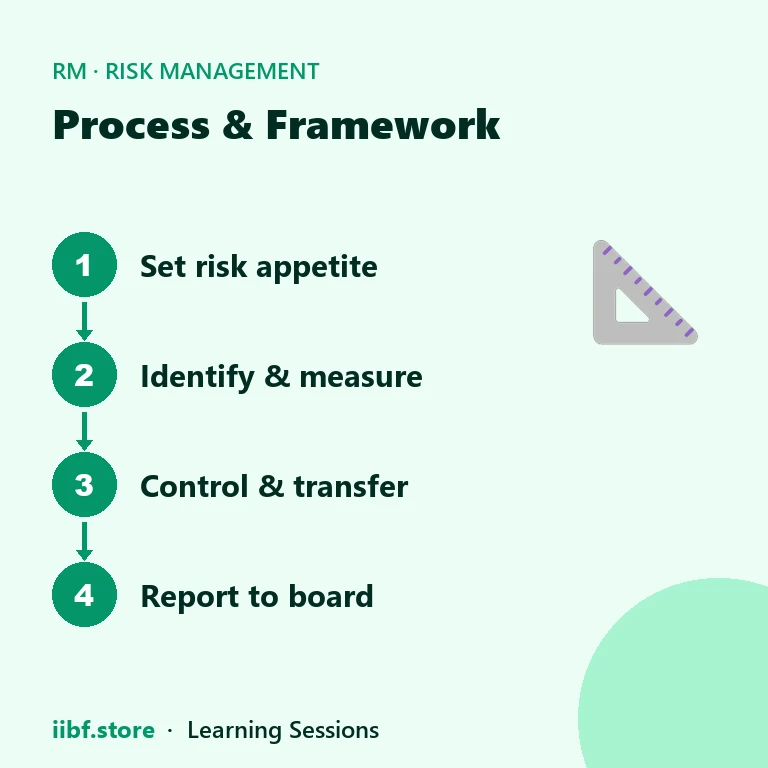
A reverse stress testing exercise typically runs through four stages. First, the bank defines the failure point — commonly a breach of minimum regulatory capital, a liquidity coverage ratio collapse, or a point at which the business model is no longer commercially viable even without a formal capital breach. Second, risk teams work backwards through the bank's risk drivers (credit losses, funding withdrawal, market losses, operational disruption) to identify which combinations, and at what severity, would produce that failure point. Third, the bank assesses the plausibility of each pathway against its current risk profile, concentrations, and known vulnerabilities — a pathway that requires an implausible sequence of unrelated shocks is deprioritised, while one that only needs a modest tightening of already-stressed conditions is flagged as a priority. Fourth, the results feed into recovery and contingency planning, including trigger levels for management action well before the failure point is reached. This process depends heavily on good loss and exposure data; banks that have weak internal data on past stress episodes struggle to calibrate plausible reverse scenarios, which is why the discipline covered under collection of loss data is a direct input into a credible reverse stress testing programme.
📌 Remember: The four stages are: define failure point → identify causal pathways → assess plausibility → feed into recovery planning. Exam questions often ask you to sequence these steps correctly.
📊 Forward vs Reverse Stress Testing at a Glance
| Feature | Forward (Scenario-Based) Stress Test | Reverse Stress Test |
|---|---|---|
| Starting point | A pre-defined macro/market shock | A pre-defined failure outcome |
| Direction of analysis | Scenario → impact | Outcome → causal scenario |
| Comparable across banks | ✅ Yes, broadly standardised | ❌ No, highly bank-specific |
| Best at finding idiosyncratic weaknesses | ❌ Limited | ✅ Yes, by design |
| Regulatory status under RBI/Basel | Core requirement | Supplementary but expected |
Both approaches are complementary rather than substitutes, and IIBF exam questions frequently test whether you understand that a bank needs both a standardised, comparable forward programme and a bank-specific reverse programme to get a full picture of its resilience.
🧠 Practice MCQs: Reverse Stress Testing in Banks
Q1. Reverse stress testing primarily differs from standard scenario-based stress testing because it: (a) uses only historical data (b) starts from a pre-defined failure outcome and works backwards to causal events (c) is mandatory only for foreign banks (d) ignores liquidity risk entirely
Answer: (b) — Reverse stress testing begins with an unacceptable outcome and identifies the events that could cause it, unlike forward testing which starts from a scenario.
Q2. In a reverse stress test, the "failure point" most commonly refers to: (a) a single day's trading loss (b) breach of minimum regulatory capital or unviability of the business model (c) a change in the repo rate (d) an increase in loan sanctioning time
Answer: (b) — The failure point is typically a capital or liquidity breach, or a point where the business model is no longer commercially viable.
Q3. Why is reverse stress testing considered harder to "game" than forward stress testing? (a) it uses only regulator-approved assumptions (b) it requires no management involvement (c) it forces identification of the bank's own vulnerabilities rather than relying on tunable assumptions about an external scenario (d) it is not reviewed by internal audit
Answer: (c) — Because it starts from failure and works backward, banks cannot simply tune scenario assumptions to appear resilient.
Q4. Which of the following is the correct sequence in building a reverse stress test? (a) recovery planning → plausibility assessment → causal pathway → failure point (b) define failure point → identify causal pathways → assess plausibility → feed into recovery planning (c) causal pathway → recovery planning → failure point → plausibility (d) plausibility assessment → failure point → recovery planning → causal pathway
Answer: (b) — The standard sequence starts with defining the failure point and ends with feeding results into recovery planning.
Q5. Reverse stress testing is best described in the regulatory framework as: (a) a replacement for all other stress tests (b) an optional exercise with no regulatory relevance (c) a supplementary tool expected alongside core forward-looking stress testing (d) relevant only to market risk, not credit or liquidity risk
Answer: (c) — Regulators expect reverse stress testing as a supplementary tool to catch idiosyncratic vulnerabilities that standard scenarios can miss.
Want chapter-wise mock tests with 100+ MCQs? Start practising free →
❓ Frequently Asked Questions
What is reverse stress testing in simple terms?
It is a risk analysis technique where a bank first defines an outcome it cannot survive — such as breaching minimum capital requirements — and then works backwards to identify which combination of events could realistically cause that outcome.
Is reverse stress testing mandatory for all banks?
Regulators including the RBI expect banks, particularly those with complex or concentrated business models, to run reverse stress tests as a supplementary part of their overall stress testing and capital adequacy assessment framework, even though the specific scope can vary by bank size and complexity.
How does reverse stress testing relate to recovery planning?
Once a plausible failure pathway is identified, the bank documents the management actions — such as capital raising, asset sales, or exiting a business line — it would take before reaching that failure point, directly feeding the results into its recovery plan.
What is the main advantage of reverse stress testing over standard scenario analysis?
It is better at uncovering a bank's own idiosyncratic vulnerabilities, such as concentrated exposures or funding mismatches, because it is built around the bank's specific failure point rather than a generic, industry-wide shock.
Reverse stress testing rounds out a bank's risk management toolkit alongside economic capital allocation, ICAAP in banks, and Value at Risk methods — all frequently tested together in the IIBF Risk Management certificate exam. If your bank's stress testing programme also touches operational resilience, revisit RCSA and Key Risk Indicators for the full picture. For more exam-focused reads, browse the full Risk Management blog archive.
Ready to test yourself? Attempt a full-length mock at iibf.store/tests or explore the complete CAIIB course for structured, chapter-wise preparation.
Prefer revising from a printed book?
Chapter-wise books with MCQs after every chapter — minimal pages, complete coverage, delivered anywhere in India. Every book has a free sample to read first.
Learning Sessions · Ashish Sir
132 pages · 225 MCQs
Learning Sessions · Ashish Sir
188 pages · 435 MCQs
Learning Sessions · Ashish Sir
117 pages · 236 MCQs
Learning Sessions · Ashish Sir
Learning Sessions · Ashish Sir
118 pages · 299 MCQs
Learning Sessions · Ashish Sir
Learning Sessions · Ashish Sir
Learning Sessions · Ashish Sir
Learning Sessions · Ashish Sir
115 pages · 255 MCQs
Learning Sessions · Ashish Sir
Learning Sessions · Ashish Sir
334 pages · 936 MCQs
Learning Sessions · Ashish Sir
115 pages · 344 MCQs
Learning Sessions · Ashish Sir
107 pages · 240 MCQs
Learning Sessions · Ashish Sir
90 pages · 150 MCQs
Learning Sessions · Ashish Sir
Learning Sessions · Ashish Sir
131 pages · 672 MCQs
Learning Sessions · Ashish Sir
221 pages · 831 MCQs
Learning Sessions · Ashish Sir
128 pages · 524 MCQs
Learning Sessions · Ashish Sir
107 pages · 445 MCQs
Learning Sessions · Ashish Sir
148 pages · 478 MCQs
Learning Sessions · Ashish Sir
151 pages · 465 MCQs
Learning Sessions · Ashish Sir
148 pages · 375 MCQs
Learning Sessions · Ashish Sir
216 pages · 895 MCQs
Learning Sessions · Ashish Sir
109 pages · 300 MCQs
Learning Sessions · Ashish Sir
104 pages · 360 MCQs
Learning Sessions · Ashish Sir
82 pages · 297 MCQs
Learning Sessions · Ashish Sir
151 pages · 600 MCQs
Learning Sessions · Ashish Sir
98 pages · 282 MCQs
Learning Sessions · Ashish Sir
Practice this topic
Take a free mock test, download chapter PDFs, or watch a video class — all included on iibf.store.
Keep reading