Operational Risk Management in Banks: IIBF RM Guide 2026
Operational risk management is the discipline that keeps banks solvent when a system crashes, a rogue trader books a fake trade, or a branch is hit by fraud — and it is one of the most heavily tested areas in IIBF's Risk Management certificate exam. Unlike credit or market risk, operational risk sits inside every process a bank runs, which is exactly why the Basel Committee and RBI have spent the last decade tightening how banks measure and capitalise it.
🎯 What Is Operational Risk in Banking?
The Basel Committee defines operational risk as "the risk of loss resulting from inadequate or failed internal processes, people and systems, or from external events." This definition explicitly includes legal risk but excludes strategic risk and reputational risk — a distinction examiners love to test. Because the definition is so broad, the Committee groups actual loss events into seven standard categories: Internal Fraud, External Fraud, Employment Practices and Workplace Safety, Clients Products and Business Practices, Damage to Physical Assets, Business Disruption and System Failures, and Execution Delivery and Process Management.
These seven event types matter beyond theory — every bank's internal loss database is coded against them, and regulators use the classification to compare loss patterns across the industry. A core-banking outage falls under Business Disruption and System Failures; a mis-sold insurance product falls under Clients Products and Business Practices; a forged cheque falls under External Fraud. For a deeper dive into how banks build the governance layer around these categories, see the Operational Risk and Management Framework chapter, which walks through the policy, ownership and escalation structure banks are required to maintain.
Operational risk is unique among the major risk types because it cannot be diversified away the way credit or market exposure can — a bigger, more complex bank simply has more processes that can fail. That is why regulators tie capital requirements directly to the size of a bank's business activity rather than to a risk-weighted asset book alone.
📐 Measuring Operational Risk Capital: From BIA to SMA
Basel II originally offered banks three ways to calculate operational risk capital: the Basic Indicator Approach (a flat 15% of average gross income), the Standardised Approach (business-line-specific beta factors of 12-18%), and the Advanced Measurement Approach (a bank's own internal statistical model). In practice, AMA models proved wildly inconsistent across banks holding near-identical risk profiles, which undermined comparability and defeated the purpose of a capital standard.
Basel III's final reforms scrapped all three in favour of a single Standardised Measurement Approach (SMA). SMA capital is a function of the Business Indicator Component (BIC), a formula-driven proxy for business volume built from interest/lease/dividend income, services income and financial-statement items, multiplied by an Internal Loss Multiplier (ILM) derived from the bank's own average annual operational losses over the preceding 10 years. A bank with a clean loss history gets a lower multiplier; a bank with a heavy loss record pays more capital for the same business size.
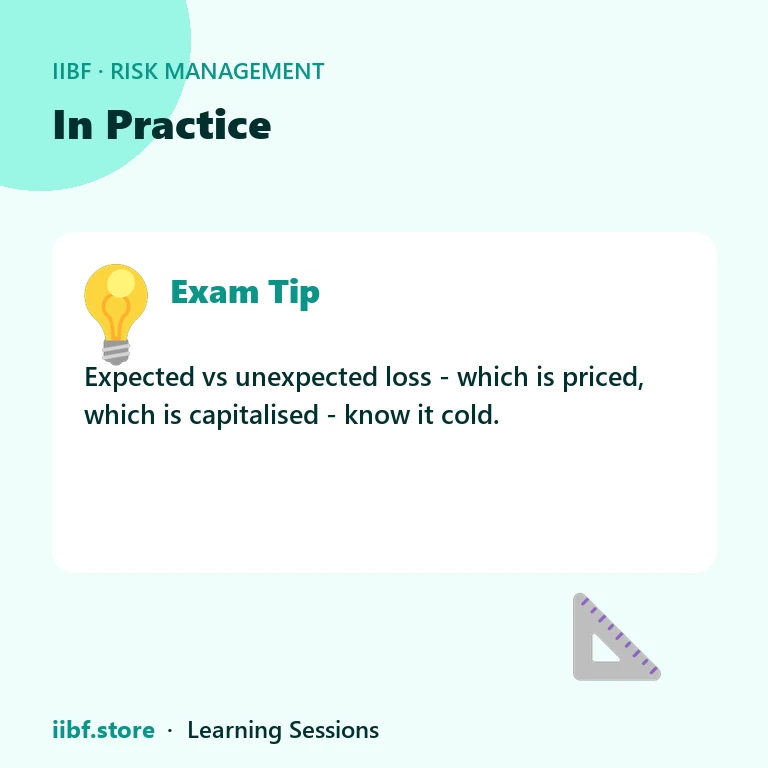
💡 Exam Tip: Remember the formula chain — Business Indicator → Business Indicator Component → × Internal Loss Multiplier = SMA operational risk capital. Questions often test which input uses which time window (BI uses a 3-year average; the ILM uses 10 years of loss data).
RBI adopted the SMA for Indian banks through its "Basel III Capital Regulations — Standardised Approach for Operational Risk" guidelines, applicable from FY2023-24, formally retiring the Basic Indicator Approach that most domestic banks had used for years. This is a live, current-affairs-relevant fact for the 2026 exam cycle.
🛡️ Three Lines of Defence, RCSA and KRIs
Sound operational risk governance rests on the three-lines-of-defence model. The first line — business and operating units — owns the risk because they run the processes that generate it. The second line — the operational risk management function and compliance — sets policy, designs the framework and independently challenges the first line. The third line — internal audit — provides independent assurance to the board that both the first and second lines are actually working as designed.
Two tools sit at the heart of the second line's day-to-day work: Risk and Control Self-Assessment (RCSA) and Key Risk Indicators (KRIs). RCSA is a structured, qualitative exercise where a business unit identifies its risks, rates their likelihood and impact, and scores the effectiveness of existing controls — producing a heat map that tells senior management where the framework is weakest. KRIs are quantitative, forward-looking metrics — staff attrition rate, system downtime minutes, failed transaction counts — that are tracked against thresholds so a deteriorating risk position is flagged before it turns into an actual loss event.
The full mechanics of building an RCSA matrix, setting KRI thresholds and escalation triggers are covered in the RCSA and Key Risk Indicators chapter — a near-certain source of scenario-based questions in the exam.
⚠️ Common Mistake: Candidates often confuse RCSA (a qualitative, self-assessed control review) with loss data collection (a quantitative record of events that have already happened). They are complementary but answer different questions — "what could go wrong" versus "what has already gone wrong."
📉 Loss Data Collection and the Internal Loss Multiplier
None of the SMA's math works without a disciplined internal loss database. Banks are required to capture every operational loss above a defined threshold (commonly ₹1 lakh or its regulatory-specified equivalent), classify it by the seven Basel event types, and retain at least 10 years of history to calculate a credible Internal Loss Multiplier. Gross loss amounts, recoveries, and near-miss events all need separate treatment — a loss that was later recovered is not the same, for capital purposes, as one that was fully absorbed.
Good loss-data governance also feeds back into RCSA: a spike in External Fraud losses in a particular product line should trigger a fresh control self-assessment for that business unit, closing the loop between what happened historically and what could happen next. The complete data-quality standards, thresholds and reconciliation requirements banks must meet are detailed in the Collection of Loss Data chapter.
Weak loss-data discipline is one of the most common findings in RBI inspections — incomplete event coding, missing near-miss capture, and inconsistent thresholds across branches all directly inflate a bank's Internal Loss Multiplier and, therefore, its capital charge. This operational discipline sits alongside other risk verticals candidates must master; readers preparing across subjects may also want the guide on technology risk management in banks, since system-failure losses increasingly originate from the same digital infrastructure gaps.
🏦 Operational Risk Inside the Basel III Capital Framework
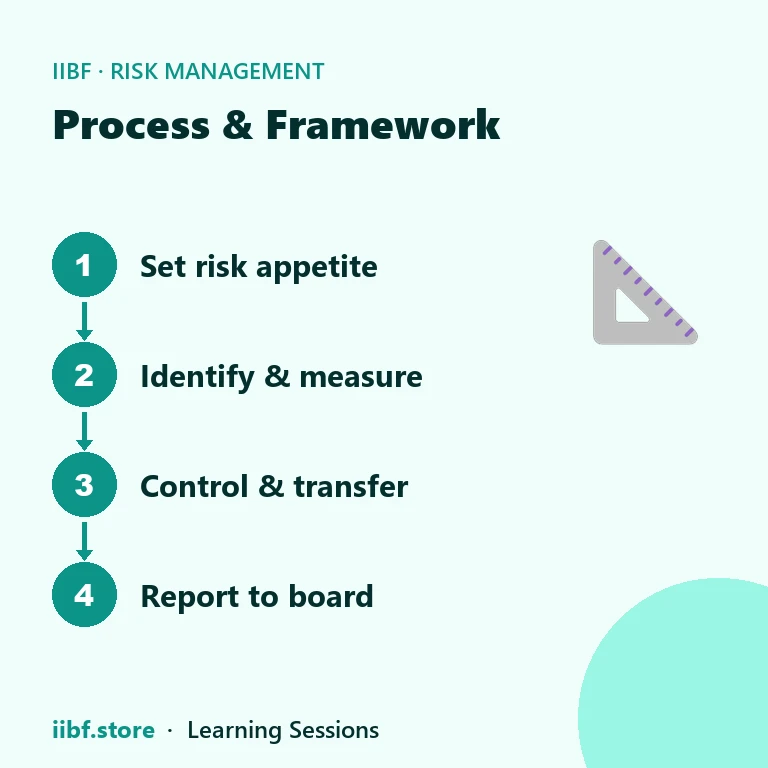
Operational risk capital does not sit in isolation — it is one leg of the overall regulatory capital stool alongside credit and market risk, all rolled into the capital-to-risk-weighted-assets ratio (CRAR) that every Indian bank must maintain under RBI's Basel III capital regulations. The interplay between the three pillars — minimum capital, supervisory review and market discipline — determines how much operational risk capital ultimately affects a bank's lending headroom. For the full mechanics of how risk-weighted assets and CRAR are built up, see the Regulatory Capital and Capital Adequacy chapter.
Boards are also expected to fold operational risk appetite into the bank's Internal Capital Adequacy Assessment Process and into stress-testing scenarios — a severe cyberattack or a large-scale mis-selling event should show up in a bank's stress-tested capital projections, not just its ordinary-course capital plan. Candidates who want the ICAAP and stress-testing angle in more depth should also revisit the sibling guide on reverse stress testing in banks, and the related piece on economic capital allocation, both of which build directly on the capital concepts introduced here.
SMA capital is a regulatory minimum, not a risk-management strategy — a bank can be fully SMA-compliant and still suffer a large operational loss if its RCSA, KRI monitoring and three-lines-of-defence governance are weak in practice. As detailed in RBI's Basel III capital regulations (rbi.org.in), Indian banks must report operational risk capital alongside credit and market risk capital every quarter — and examiners frequently cross-reference this with broader macro-financial context, so it helps to also understand adjacent economy topics such as the types of inflation in India that shape RBI's overall monetary and prudential stance.
| Approach | Capital Basis | Loss Data Required | Permitted in 2026? |
|---|---|---|---|
| Basic Indicator Approach (BIA) | 15% of 3-yr average gross income | Not required | ❌ Withdrawn |
| Standardised Approach (TSA) | Business-line beta factors (12-18%) | Not required | ❌ Withdrawn |
| Advanced Measurement Approach (AMA) | Bank's internal statistical model | Extensive (bank-specific) | ❌ Withdrawn |
| Standardised Measurement Approach (SMA) | BIC × Internal Loss Multiplier | Yes — 10 years internal loss data | ✅ Mandatory (RBI, from FY2023-24) |
🧠 Practice MCQs: Operational Risk Management
Q1. Under the SMA (Standardised Measurement Approach), operational risk capital is a function of the Business Indicator Component and which other factor? (a) Credit Valuation Adjustment (b) Internal Loss Multiplier (c) Liquidity Coverage Ratio (d) Net Stable Funding Ratio
Answer: (b) — the Internal Loss Multiplier scales the Business Indicator Component using 10 years of the bank's own loss history.
Q2. Which of the following is NOT one of the Basel Committee's seven operational risk event-type categories? (a) Internal Fraud (b) Business Disruption and System Failures (c) Interest Rate Risk in the Banking Book (d) Execution, Delivery and Process Management
Answer: (c) — IRRBB is a balance-sheet/market risk category, not an operational risk event type.
Q3. In the three-lines-of-defence model, who owns and manages operational risk on a day-to-day basis? (a) Internal audit (b) The business/operating units (c) The board risk committee (d) External auditors
Answer: (b) — first-line business units generate and own the risk; risk management is the second line, and audit is the third.
Q4. Risk and Control Self-Assessment (RCSA) is primarily used to: (a) Calculate VaR for the trading book (b) Identify and rate risks and control effectiveness within a business unit (c) Set the bank's overall capital adequacy ratio (d) Compute the Liquidity Coverage Ratio
Answer: (b) — RCSA is a structured, qualitative self-assessment of risks and control effectiveness.
Q5. Under RBI's operational risk capital framework effective from FY2023-24, which approach did the Standardised Measurement Approach (SMA) replace for Indian banks? (a) Only the Basic Indicator Approach (b) Only the Advanced Measurement Approach (c) BIA, TSA and AMA — all three prior approaches (d) The Standardised Approach for credit risk
Answer: (c) — SMA is a single unified approach that replaced all three earlier Basel II operational risk methods.
Want chapter-wise mock tests with 100+ MCQs? Start practising free →
Frequently Asked Questions
Is operational risk management part of the IIBF Risk Management certificate syllabus?
Yes. Operational risk — including its Basel definition, the SMA capital approach, RCSA, KRIs and loss data collection — is a core module in IIBF's Risk Management certificate curriculum and features regularly in the exam.
What replaced the Advanced Measurement Approach (AMA) for operational risk capital?
The Standardised Measurement Approach (SMA), introduced under Basel III's final reforms, replaced AMA along with the Basic Indicator Approach and the Standardised Approach. RBI applied SMA to Indian banks from FY2023-24.
What is the difference between RCSA and Key Risk Indicators?
RCSA is a qualitative, periodic self-assessment of risks and control effectiveness within a business unit. KRIs are quantitative, continuously tracked metrics with thresholds that provide an early warning of deteriorating risk conditions.
Does reputational risk fall under operational risk in the Basel definition?
No. The Basel Committee's definition of operational risk explicitly includes legal risk but excludes strategic risk and reputational risk, even though a large operational loss event often causes reputational damage as a side effect.
Operational risk management is where governance, data discipline and capital math meet — and it rewards candidates who can trace a single loss event all the way from RCSA identification through loss-data classification to its effect on SMA capital. Build that end-to-end picture with free chapter-wise mock tests on iibf.store, and browse the full Risk Management article hub for more exam-focused guides.
Prefer revising from a printed book?
Chapter-wise books with MCQs after every chapter — minimal pages, complete coverage, delivered anywhere in India. Every book has a free sample to read first.
Learning Sessions · Ashish Sir
132 pages · 225 MCQs
Learning Sessions · Ashish Sir
188 pages · 435 MCQs
Learning Sessions · Ashish Sir
117 pages · 236 MCQs
Learning Sessions · Ashish Sir
Learning Sessions · Ashish Sir
118 pages · 299 MCQs
Learning Sessions · Ashish Sir
Learning Sessions · Ashish Sir
Learning Sessions · Ashish Sir
Learning Sessions · Ashish Sir
115 pages · 255 MCQs
Learning Sessions · Ashish Sir
Learning Sessions · Ashish Sir
334 pages · 936 MCQs
Learning Sessions · Ashish Sir
115 pages · 344 MCQs
Learning Sessions · Ashish Sir
107 pages · 240 MCQs
Learning Sessions · Ashish Sir
90 pages · 150 MCQs
Learning Sessions · Ashish Sir
Learning Sessions · Ashish Sir
131 pages · 672 MCQs
Learning Sessions · Ashish Sir
221 pages · 831 MCQs
Learning Sessions · Ashish Sir
128 pages · 524 MCQs
Learning Sessions · Ashish Sir
107 pages · 445 MCQs
Learning Sessions · Ashish Sir
148 pages · 478 MCQs
Learning Sessions · Ashish Sir
151 pages · 465 MCQs
Learning Sessions · Ashish Sir
148 pages · 375 MCQs
Learning Sessions · Ashish Sir
216 pages · 895 MCQs
Learning Sessions · Ashish Sir
109 pages · 300 MCQs
Learning Sessions · Ashish Sir
104 pages · 360 MCQs
Learning Sessions · Ashish Sir
82 pages · 297 MCQs
Learning Sessions · Ashish Sir
151 pages · 600 MCQs
Learning Sessions · Ashish Sir
98 pages · 282 MCQs
Learning Sessions · Ashish Sir
Practice this topic
Take a free mock test, download chapter PDFs, or watch a video class — all included on iibf.store.
Keep reading