DICGC deposit insurance cover: limit and rules for JAIIB PPB
Every JAIIB PPB candidate eventually meets a question on the DICGC deposit insurance cover: what it protects, who pays for it, and how much a depositor actually gets back if a bank fails. It is one of the most examiner-favourite topics in the Principles and Practices of Banking syllabus because it sits at the intersection of law, depositor protection, and everyday branch operations. This article walks through the cover limit, the deposits and institutions it applies to, how claims are settled, and the exam angles you must not miss.
🏦 What DICGC Deposit Insurance Cover Actually Means
The Deposit Insurance and Credit Guarantee Corporation (DICGC), a wholly-owned subsidiary of the Reserve Bank of India, insures deposits held with commercial banks, regional rural banks, and eligible cooperative banks under the DICGC Act, 1961. The insurance is automatic — a depositor does not apply for it, and no separate premium is deducted from the customer's account. Every insured bank pays the premium to DICGC on the total assessable deposits it holds, and that cost is absorbed by the bank, not passed on visibly to the depositor. Understanding this "automatic, bank-funded" structure is a recurring one-mark trap in JAIIB exams, because students often assume depositors pay a premium directly. For candidates studying ancillary banking services, this concept connects naturally with how banks manage ancillary services that build customer trust alongside statutory safeguards like deposit insurance.
💰 How the ₹5 Lakh Cover Limit Is Calculated
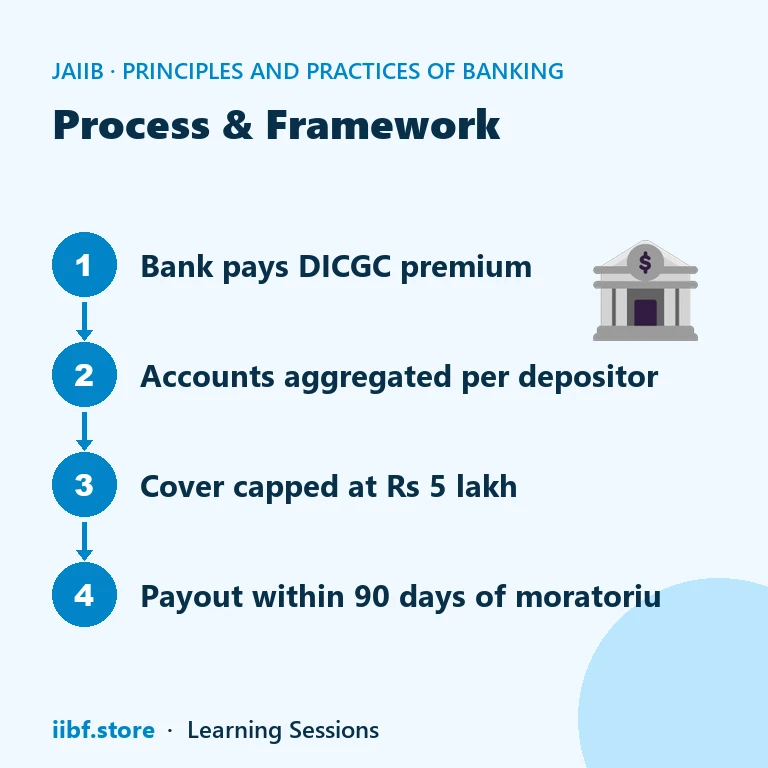
Since 4 February 2020, the DICGC deposit insurance cover stands at ₹5 lakh per depositor, per bank, inclusive of both principal and interest. Before that revision the limit had stood at ₹1 lakh since 1993, so the jump is a favourite "recent amendment" question. The ₹5 lakh ceiling is not applied per branch or per account — all accounts held by one depositor in the same capacity and same right, across every branch of that bank, are aggregated first, and the insured amount is then paid on the combined balance. A depositor with a savings account, a fixed deposit, and a recurring deposit in the same bank does not get ₹5 lakh cover on each; the three are added together and capped once at ₹5 lakh. Joint accounts are treated separately from single accounts held by the same individual, since the "capacity and right" differs. This aggregation rule is one of the most tested numerical concepts under this head, alongside topics such as bank locker liability cap rules, which use a similarly capped-liability structure but for a completely different risk.
💡 Exam Tip: Memorise the sequence — ₹1,500 (1968) → ₹30,000 (1970) → ₹1 lakh (1993) → ₹5 lakh (2020). Examiners love asking "which year did the cover change to X amount."
📋 Which Deposits and Institutions Are Covered
DICGC cover extends to savings, current, fixed, and recurring deposits held with any bank operating in India, including foreign banks with branches here, provided the bank is registered with DICGC as an insured bank — and almost all are. Regional rural banks and eligible cooperative banks (including many urban cooperative banks after the 2020 amendment strengthened depositor protection) also fall under the scheme. However, several deposit categories are explicitly excluded, and this exclusion list is exam gold. Deposits of foreign governments, deposits of central and state governments, inter-bank deposits, deposits of the State Land Development Bank with the State cooperative bank, and any deposit received outside India are all outside DICGC cover. The table below summarises the coverage position candidates must memorise verbatim.
| Deposit / Institution Type | DICGC Cover |
|---|---|
| Savings, current, FD, RD with commercial banks | ✅ Covered |
| Deposits with regional rural banks | ✅ Covered |
| Deposits with eligible cooperative banks | ✅ Covered |
| Central / State Government deposits | ❌ Not covered |
| Inter-bank deposits | ❌ Not covered |
| Deposits of foreign governments | ❌ Not covered |
| State Land Development Bank deposits with State co-op bank | ❌ Not covered |
Notice that the exclusions are largely institutional (government-to-government or bank-to-bank money) rather than about the depositor's identity — an individual, HUF, partnership firm, company, or trust holding an ordinary account is covered in the same way. This ties in with how banks handle allied processes such as cash management services, where institutional and retail deposit flows are treated very differently at the operational level even though both may ultimately sit in DICGC-insured accounts.
⏱️ Claim Settlement: The 90-Day Interim Payment Rule
Post the 2021 amendment to the DICGC Act, when a bank is placed under the RBI's moratorium or restructuring direction, insured depositors are entitled to receive their deposit insurance amount — up to the ₹5 lakh cap — within 90 days of the bank being placed under such restriction, not only after final liquidation. This was a direct response to depositors of stressed cooperative banks facing years-long delays. The liquidator or the bank submits depositor details to DICGC within 45 days, DICGC verifies the claims, and payment follows within the next 45 days, giving the full 90-day window. This interim-payment mechanism is distinct from the older process, which paid out only after a bank was formally liquidated or amalgamated, sometimes years after depositors lost access to their funds. Candidates should also link this timeline to related depositor-protection concepts like unclaimed deposits and DEA Fund handling, since both mechanisms exist to protect depositor money when normal account operation is interrupted, and both are frequently paired in the same case-study question.
⚠️ Common Mistake: Students often confuse the DICGC's 90-day interim payment with final claim settlement after liquidation — they are two different stages, and the exam distinguishes them carefully.
🔐 DICGC Cover in Practice: Legal Recourse and Related Safeguards
The DICGC cover operates alongside, not instead of, other depositor remedies. If a bank fails to honour obligations for reasons unrelated to insolvency — say, a dispute over a frozen account — depositors still rely on separate legal tools. A garnishee order and attachment order can freeze specific funds under a court's direction, which is a completely separate legal process from deposit insurance and should never be confused with it in an exam answer. Similarly, banks maintain provisioning and disclosure practices — including how deferred tax positions are treated on the balance sheet, a concept covered under deferred tax assets in banks — that indirectly reflect the financial health regulators monitor before a bank ever reaches the stage where DICGC cover becomes relevant. Reading these topics together gives a fuller picture of how the banking safety net is layered: prudential regulation first, corrective action second, and deposit insurance as the final backstop for the depositor. For a broader view of how such safety nets support inclusion goals, revisit the chapter on financial inclusion, since confidence in deposit safety is a precondition for bringing unbanked households into the formal system.
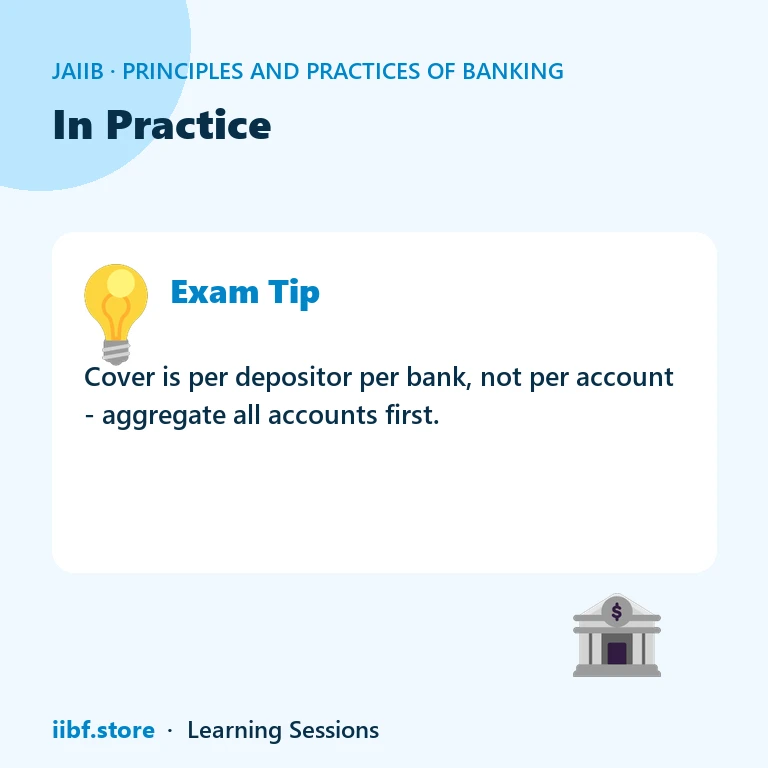
📌 Remember: DICGC cover is per depositor per bank, not per account per bank — this single line answers most numerical questions on the topic.
All PPB topics dealing with depositor protection, account operations, and banking law sit together under one syllabus head — browse the full set on the Principles and Practices of Banking tag hub for related reading before your next mock test.
🧠 Practice MCQs: DICGC Deposit Insurance Cover
Q1. What is the current DICGC deposit insurance cover limit per depositor per bank? (a) ₹1 lakh (b) ₹2 lakh (c) ₹5 lakh (d) ₹10 lakh
Answer: (c) — The limit was revised from ₹1 lakh to ₹5 lakh with effect from 4 February 2020.
Q2. The DICGC insurance premium is paid by: (a) The depositor directly (b) The insured bank (c) The RBI (d) The central government
Answer: (b) — Insured banks pay the premium to DICGC on their assessable deposits; no charge is passed to the depositor.
Q3. Which of the following deposits is NOT covered under DICGC insurance? (a) Savings account with a commercial bank (b) Fixed deposit with a regional rural bank (c) Inter-bank deposit (d) Recurring deposit with an eligible cooperative bank
Answer: (c) — Inter-bank deposits are specifically excluded from DICGC cover.
Q4. Under the 2021 amendment, insured depositors of a bank under RBI moratorium must receive the interim insurance payout within: (a) 30 days (b) 45 days (c) 60 days (d) 90 days
Answer: (d) — The full process, from submission of claims to disbursal, must be completed within 90 days of the moratorium being imposed.
Q5. A depositor holds a savings account (₹2 lakh) and a fixed deposit (₹4 lakh) in the same bank, in the same capacity. What amount is insured by DICGC? (a) ₹6 lakh (b) ₹5 lakh (c) ₹4 lakh (d) ₹2 lakh
Answer: (b) — Balances across accounts held in the same capacity at the same bank are aggregated and capped at ₹5 lakh.
Want chapter-wise mock tests with 100+ MCQs? Start practising free →
❓ Frequently Asked Questions
Does DICGC cover apply separately to each branch of a bank?
No. All deposits held by one depositor in the same right and capacity across every branch of an insured bank are aggregated and covered up to a single ₹5 lakh limit.
Are deposits with cooperative banks covered by DICGC?
Yes, eligible cooperative banks registered with DICGC are covered, and the 2020-21 amendments extended and strengthened this protection for cooperative bank depositors specifically.
What happens if a depositor has accounts in two different banks?
The ₹5 lakh cover applies per bank, so the same depositor gets a separate ₹5 lakh cover in each insured bank where they hold deposits.
Is interest on a deposit included within the ₹5 lakh cover?
Yes, the ₹5 lakh limit is inclusive of both principal and accrued interest as on the date the bank is placed under liquidation or restructuring.
The DICGC deposit insurance cover is a compact but high-yield topic in the PPB syllabus — a handful of facts (₹5 lakh limit, aggregation rule, exclusion list, 90-day interim payment) account for a disproportionate share of exam marks. For the authoritative rules and latest circulars, refer to the DICGC official website. To lock in these numbers under exam conditions, work through timed chapter tests on the JAIIB course page before attempt day.
Quick quiz on this topic
5 exam-style questions from our free test bank — check yourself before you move on.
Practice this topic
Take a free mock test, download chapter PDFs, or watch a video class — all included on iibf.store.
Keep reading