Ethical Audit in Banks: Scope, Process and Findings (IIBF Ethics)
Every bank has a code of conduct on paper. Far fewer banks can prove, with evidence, that the culture on the ground actually matches it. That is the gap an ethical audit in banks is designed to close. Unlike a statutory or concurrent audit, which tests whether transactions and books comply with rules, this exercise tests whether the people making decisions — from the branch counter to the boardroom — are actually behaving the way the code of conduct says they should. For JAIIB, CAIIB and Ethics in Banking candidates, this distinction is a favourite examiner trap, so get the mechanics right before you move on.
📋 What Is an Ethical Audit in Banks?
A statutory audit checks whether financial statements are true and fair. A concurrent audit checks whether transactions comply with laid-down procedures as they happen. A compliance audit checks whether the bank has followed regulatory circulars and internal policy. All three are rules-based: they ask "was the correct process followed?" This kind of review asks a different question — "was the right thing done, and would the bank be comfortable if this decision were made public?" It tests culture and conduct, not just paperwork.
This matters because a branch can pass every compliance checklist and still mis-sell a product, pressure a vulnerable customer, or look away from a colleague's conflict of interest. Rules can be satisfied on the surface while the underlying intent is compromised. That is precisely the blind spot this kind of review is built to catch, and it is why boards increasingly treat it as a distinct exercise rather than an add-on to the existing audit calendar. If you are studying Work Ethics and the Workplace (Chapter 10), this is the practical extension of that theory — how workplace conduct actually gets measured.
🔍 Scope of the Review — Culture, Not Just Compliance
The scope of an ethical audit in banks is deliberately broad because culture shows up in dozens of small decisions rather than one big control. Auditors typically examine the code of conduct itself — is it current, is it understood at every level, or is it a document nobody has reread since induction? They then look hard at "tone at the top": do senior managers model the values they preach, or do they quietly reward numbers over conduct?
Incentive and sales-target design gets particular attention, because aggressive targets are the single biggest driver of mis-selling and forced cross-selling. Auditors also pull complaint and whistle-blower data, conflict-of-interest declarations, gift and hospitality registers, procurement and vendor-selection files, related-party dealings, and recovery-agent conduct records. Each of these is a place where individual incentive can override institutional duty, and each leaves a data trail this review is designed to follow. Candidates preparing Building an Ethical Organization (Chapter 11) will recognise most of these as the exact pillars that chapter lists as markers of organisational integrity.
💡 Exam Tip: If a question asks you to distinguish this kind of audit from a compliance audit, anchor your answer on "culture and conduct" versus "rules and procedure" — that phrase is the examiner's shortcut for the correct option.
🧪 Evidence Sources — Surveys, Mystery Shopping and Case Files
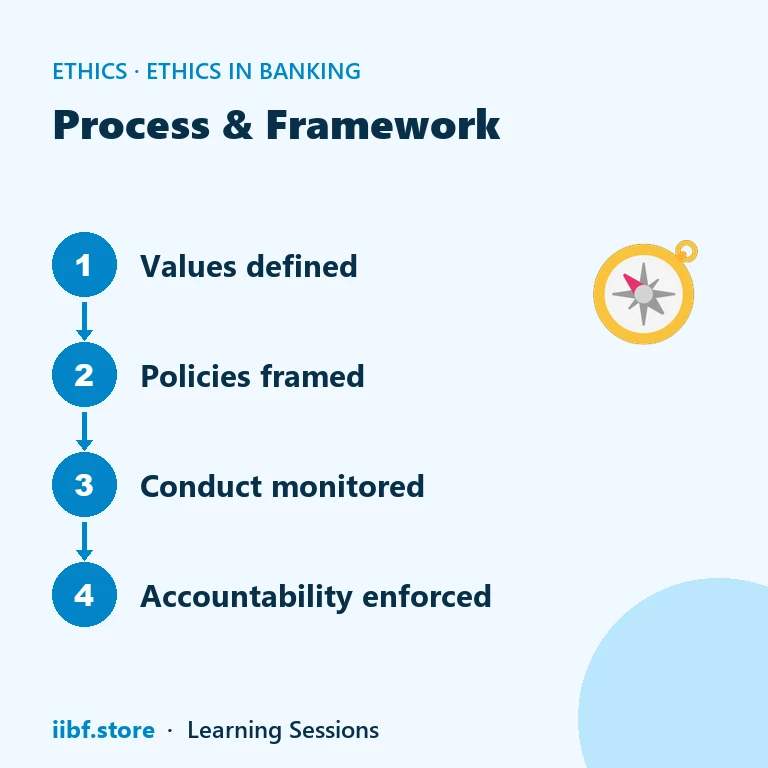
This kind of audit lives or dies on the quality of its evidence, and evidence here rarely comes from a ledger. Staff surveys and anonymous focus groups surface what employees actually believe about pressure to hit targets or report a colleague. Exit interviews are underused but valuable — people who are leaving are far more candid about what really happens on the floor than people who still need a good appraisal rating.
Mystery shopping tests the customer-facing moment directly: does the counter staff disclose charges honestly, or does the sales pitch quietly omit the downside of a product? Customer complaint root-cause analysis turns a pile of grievances into a pattern — repeated complaints about the same product or the same branch point to a systemic conduct problem, not a one-off error. Disciplinary case files close the loop, showing whether misconduct was actually acted upon or quietly buried. Together these sources let the review build a picture that a rulebook check alone can never produce, and this evidence-first approach is exactly why the Ethical Issues of Corruption, Bribery and White-Collar Crime chapter treats detection as a data problem, not a legal one.
📈 Maturity Models, Scoring and Reporting to the Board
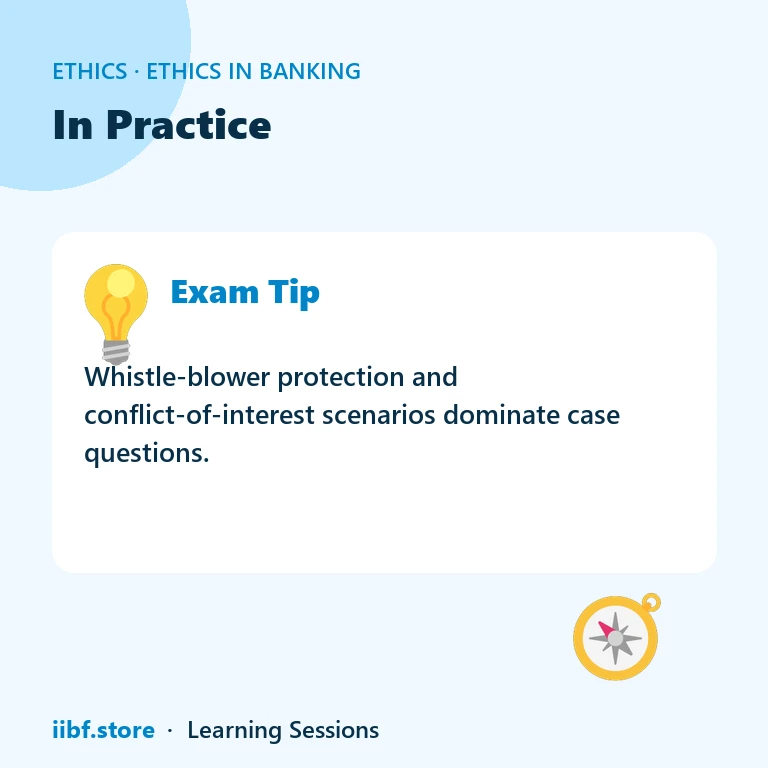
Most banks now score ethical performance on a maturity model rather than a pass/fail checklist, because culture is a spectrum, not a binary. A typical model runs from "reactive" (the bank only responds once a scandal breaks) through "developing" and "systematic" to "embedded" (ethical conduct is monitored continuously and built into performance appraisal). The scoring itself blends quantitative signals — complaint volumes, disciplinary case closure rates, whistle-blower report trends — with qualitative signals from surveys and mystery shopping.
Findings are reported to the audit committee first and then escalated to the board, distinct from routine compliance reporting because conduct risk carries reputational and regulatory weight that a simple rule breach does not. The Reserve Bank of India has repeatedly flagged governance and risk culture as board-level responsibilities in its guidance to banks, underlining that a healthy conduct culture cannot be delegated to a compliance department alone — see RBI's official guidance on bank governance for the regulator's own framing of this expectation.
| Audit type | Primary question | Tests culture? | Reports to |
|---|---|---|---|
| Statutory audit | Are the financial statements true and fair? | ❌ | Shareholders/RBI |
| Concurrent audit | Was procedure followed at the transaction level? | ❌ | Audit committee |
| Compliance audit | Were regulatory circulars followed? | ❌ | Compliance/audit committee |
| Ethical audit in banks | Was the right thing done, not just the rule followed? | ✅ | Audit committee and board |
⚠️ Common Mistake: Candidates often assume a clean concurrent audit report means culture is fine. It only means procedure was followed on the transactions sampled — it says nothing about incentive design or tone at the top.
🎯 From Findings to Action — Training, Policy and Accountability
A review like this that ends as a filed report has failed its purpose. The value only materialises when findings are converted into three concrete outputs: targeted training for the specific gaps uncovered, policy changes where the incentive structure itself is the problem, and visible accountability where individuals — including senior managers — face consequences for conduct failures.
Boards that treat the exercise seriously build a closed loop: findings feed a corrective action plan with named owners and deadlines, the audit committee tracks closure the same way it tracks any other audit finding, and the next cycle explicitly re-tests the areas flagged previously. Without that loop, staff quickly learn that the survey and the mystery-shopping exercise carry no real weight, and the entire process becomes a box-ticking ritual rather than a genuine culture check. This is the same principle explored in fiduciary duty of bankers — trust has to be continuously earned through action, not asserted once in a policy document.
Conclusion: Why This Matters for Your IIBF Exam and Your Bank
For exam purposes, remember the core distinction cold: statutory, concurrent and compliance audits test rules and transactions; an ethical audit in banks tests culture, conduct and tone at the top, using evidence like surveys, mystery shopping, complaint patterns and disciplinary files, scored on a maturity model and reported to the audit committee and board. For your career, the same framework is what separates a bank that reacts to scandals from one that prevents them. Related reading worth pairing with this topic includes conflict of interest in banking, which drives much of the disclosure data this review examines, and moral hazard in banking, which explains why incentive design is such a recurring finding. If your paper also covers lending conduct, see prepayment charges on loans for a related BCP-side fairness issue. Browse more topics on the Ethics in Banking tag hub, and when you are ready to test yourself, take a full-length mock at iibf.store/tests.
🧠 Practice MCQs: Ethical Audit in Banks
Q1. This kind of review primarily differs from a compliance audit because it — (a) checks financial statement accuracy (b) tests culture and conduct rather than only rules (c) is conducted only by external CAs (d) replaces the concurrent audit entirely
Answer: (b) — It tests whether behaviour matches stated values, not just whether procedure was followed.
Q2. Which of the following is NOT a typical scope item for this kind of review? (a) gift and hospitality registers (b) incentive and sales-target design (c) foreign exchange reserve ratios (d) conflict-of-interest declarations
Answer: (c) — Foreign exchange reserve ratios are a prudential/statutory matter, not a conduct-culture scope item.
Q3. Exit interviews are a useful evidence source here mainly because — (a) they are legally mandatory (b) departing staff tend to speak more candidly about workplace conduct (c) they replace mystery shopping (d) they are reported directly to RBI
Answer: (b) — Employees leaving the organisation have less incentive to withhold honest feedback about pressure or misconduct.
Q4. In a bank's ethics maturity model, an organisation that only reacts after a scandal breaks is typically classified as — (a) embedded (b) systematic (c) reactive (d) developing
Answer: (c) — "Reactive" is the lowest stage, where conduct issues are addressed only after they become visible failures.
Q5. Findings from this kind of audit should ultimately be escalated to — (a) only the branch manager (b) the audit committee and the board (c) the marketing department (d) no one, as it is confidential
Answer: (b) — Conduct risk carries reputational and governance weight, so findings are routed to the audit committee and then the board, not kept at branch level.
Want chapter-wise mock tests with 100+ MCQs? Start practising free →
What is meant by an ethics-and-conduct audit at a bank?
It is a structured review that tests whether a bank's actual culture and staff conduct match its stated code of conduct, covering areas like incentive design, complaint data, conflicts of interest and vendor selection, rather than only checking transaction-level rule compliance.
How is it different from a concurrent audit?
A concurrent audit checks whether procedures were followed on sampled transactions as they happen. This review checks whether the underlying decisions and behaviour reflect the bank's values, using evidence like staff surveys, mystery shopping and disciplinary case files.
Who conducts and reviews it?
It is typically carried out by an internal ethics or governance function, sometimes with external facilitators for surveys and mystery shopping, with findings reported to the audit committee and escalated to the board for oversight.
What happens after gaps are identified?
Findings should convert into targeted staff training, policy or incentive-structure changes, and visible accountability actions with tracked deadlines — a review that ends as a filed report without follow-up action has failed its purpose.
Quick quiz on this topic
5 exam-style questions from our free test bank — check yourself before you move on.
Practice this topic
Take a free mock test, download chapter PDFs, or watch a video class — all included on iibf.store.