Whistleblower Policy in Banks: A Complete IIBF Ethics Guide
Every bank depends on employees who dare to flag wrongdoing before it becomes a scandal. A strong whistleblower policy in banks turns that individual courage into a protected, institutional channel — the difference between a fraud caught in week one and a fraud that makes headlines two years later. For JAIIB, CAIIB and IIBF Ethics in Banking candidates, this topic sits at the intersection of corporate governance, company law, RBI's supervisory expectations and everyday ethical leadership. This guide walks through what a whistleblower mechanism is, how it is regulated in India, what makes one effective, and how examiners typically test it.
🛡️ What Is a Whistleblower Policy in Banks
A whistleblower policy in banks is a formal, board-approved mechanism that lets employees, vendors and sometimes customers report suspected fraud, corruption or unethical conduct without fear of retaliation. It is often called a Vigil Mechanism in Indian company law, and in public sector banks it overlaps with the Public Interest Disclosure and Protection of Informer (PIDPI) resolution administered through the Central Vigilance Commission.
The policy typically covers three things: a defined reporting channel (helpline, email, an independent ombudsperson, or an online portal), a promise of confidentiality or anonymity, and a non-retaliation guarantee backed by disciplinary consequences for anyone who victimises a genuine whistleblower. Coverage usually extends beyond financial fraud to include harassment, safety violations, conflicts of interest and breaches of the code of conduct.
Students preparing for the Building An Ethical Organization chapter will recognise the whistleblower mechanism as one of the four pillars of an ethical infrastructure, alongside a written code, an ethics officer or committee, and regular ethics training.
Importantly, a whistleblower policy is not a substitute for internal audit or fraud risk management — it is a complementary early-warning system that surfaces issues audit cycles might miss, precisely because it relies on people closest to the problem.
📋 Key Elements of an Effective Whistleblower Mechanism
Not every "we have a helpline" policy actually works. Examiners and real-world audits both look for the same structural elements when judging whether a whistleblower mechanism in banks is genuinely effective, or merely a document on a shelf.
- Multiple reporting channels — phone, email, web form and, ideally, an option to report anonymously without creating a traceable digital footprint.
- An independent recipient — reports should not funnel only through the whistleblower's direct manager, since that person may be implicated. Many banks route serious disclosures to the Audit Committee Chair or a dedicated Chief Ethics/Vigilance Officer.
- Time-bound acknowledgement and investigation — a policy that promises action but sets no timelines invites drift and erodes trust.
- Non-retaliation with teeth — protection clauses must be enforceable, with disciplinary action against anyone who demotes, isolates or harasses a genuine complainant.
- Feedback loop — even when details stay confidential, the whistleblower should know the matter was reviewed and closed, not left wondering if the report vanished.
These elements echo the broader values in banking that the Work Ethics And The Workplace chapter emphasises: trust is built through consistent, visible follow-through, not policy language alone.
💡 Exam Tip: If a question asks "what makes a whistleblower policy effective," always mention independence of the reporting channel and enforceable non-retaliation — these are the two most commonly tested discriminators.
⚖️ Legal and Regulatory Framework Governing Whistleblowing
India's whistleblower framework for banks is layered across company law, securities regulation and RBI supervisory expectations rather than a single standalone statute.
Under the Companies Act, 2013, Section 177 mandates a Vigil Mechanism for listed companies and certain classes of unlisted companies, requiring direct access to the Audit Committee Chairperson in exceptional cases. SEBI's Listing Obligations and Disclosure Requirements (LODR) Regulations reinforce this for listed banks, requiring disclosure of the vigil mechanism in the annual corporate governance report.
Separately, RBI operates a Protected Disclosure Scheme that allows employees and members of the public to report suspected fraud, corruption or misconduct in private sector and foreign banks directly to the regulator, with identity protection built in. Public sector banks route similar disclosures through the CVC's PIDPI resolution. You can read RBI's own guidance on protected disclosures at rbi.org.in.
For CAIIB and JAIIB candidates, the practical takeaway is that whistleblowing sits under corporate governance obligations, not merely HR policy — a lapse can trigger regulatory scrutiny, not just an internal disciplinary matter. This regulatory layering is explored further in the Ethical Issues Of Corruption, Bribery And White-Collar Crime chapter, since most whistleblower reports in banking relate to exactly these categories.
⚠️ Common Mistake: Students often confuse the Vigil Mechanism (Companies Act, internal governance) with RBI's Protected Disclosure Scheme (regulator-facing). Exams test this distinction directly — know which body each report ultimately reaches.
🧭 Building a Speak-Up Culture: Leadership's Role
A policy document alone never stopped a fraud. What actually determines whether employees speak up is whether they believe leadership genuinely wants to hear bad news — this is the domain of ethical leadership.
Banks with a strong speak-up culture share visible habits: senior management publicly acknowledges past cases where whistleblowing prevented loss, ethics training includes real (anonymised) case studies, and performance appraisals never penalise a manager whose team reported an issue. Conversely, a single visible act of retaliation — even one — can silence a mechanism for years, regardless of how well it is written on paper.
This links directly to customer protection outcomes too: many of the largest mis-selling and mis-conduct cases globally were first flagged internally, months or years before regulators or media caught on, by employees who were ignored or punished. A bank that listens early avoids both financial loss and reputational damage.
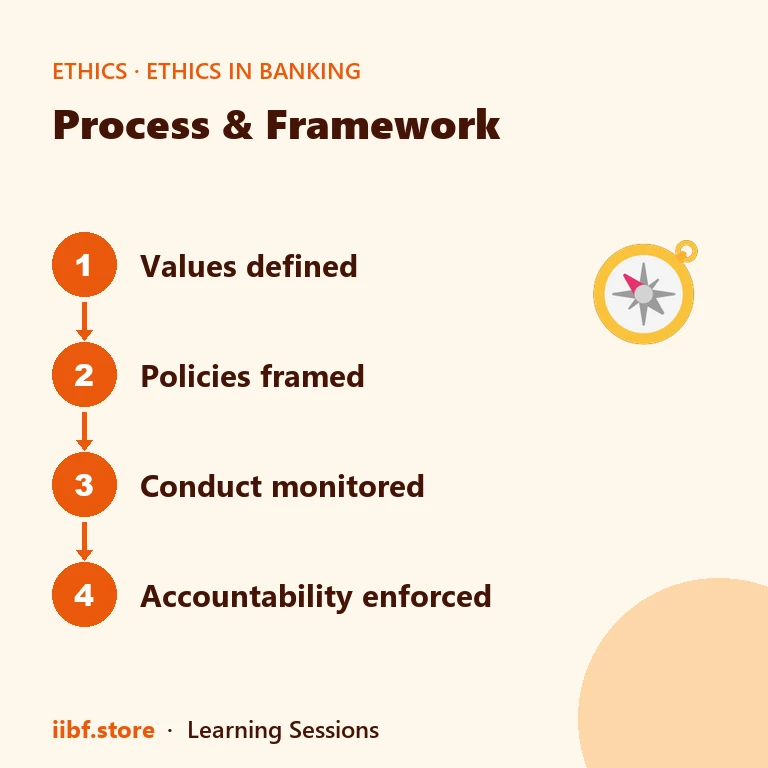
The Ethics: A Holistic Approach chapter frames this well — ethical infrastructure (policies, committees, hotlines) only works when it is reinforced by ethical culture (behaviour, tone from the top, lived values). Neither survives alone.
📌 Remember: Vigil Mechanism = internal governance channel under company law. Protected Disclosure Scheme = regulator-facing RBI channel. A speak-up culture is what makes either one actually get used.
📊 Whistleblower Policy in Banks: Channels Compared
| Reporting Channel | Governing Framework | Anonymous Option | Reaches Regulator Directly |
|---|---|---|---|
| Internal Vigil Mechanism | Companies Act, 2013 § 177 / SEBI LODR | ✅ Usually yes | ❌ No |
| RBI Protected Disclosure Scheme | RBI supervisory framework | ✅ Yes, identity protected | ✅ Yes |
| PIDPI Resolution (PSU banks) | Central Vigilance Commission | ✅ Yes | ✅ Yes, via CVC |
| Direct manager reporting | None (informal) | ❌ No | ❌ No |
Related reading: our piece on corporate social responsibility in banks covers the wider governance obligations banks carry beyond whistleblowing, while workplace ethics for bank employees looks at day-to-day conduct expectations that often generate the very reports a whistleblower channel is built to receive. If your interest runs toward how recovery agents are held accountable, our article on ethics in loan recovery practices is a natural next read.
🧠 Practice MCQs: Whistleblower Policy in Banks
Q1. Under the Companies Act, 2013, which section mandates a Vigil Mechanism for listed and certain unlisted companies? (a) Section 135 (b) Section 149 (c) Section 177 (d) Section 188
Answer: (c) — Section 177 requires a Vigil Mechanism with direct access to the Audit Committee Chairperson in exceptional cases.
Q2. RBI's Protected Disclosure Scheme is primarily meant to receive reports from employees and the public regarding which category of banks? (a) Only public sector banks (b) Private sector and foreign banks (c) Only regional rural banks (d) Only cooperative banks
Answer: (b) — RBI's Protected Disclosure Scheme applies to private sector and foreign banks; public sector banks route similar disclosures through the CVC's PIDPI resolution.
Q3. Which of the following is the MOST critical structural element for a whistleblower mechanism to be considered genuinely effective? (a) A large advertising budget for the helpline (b) An independent recipient outside the whistleblower's direct reporting line (c) Mandatory disclosure of the whistleblower's identity (d) Restricting reports to financial fraud only
Answer: (b) — Routing reports to an independent recipient, such as the Audit Committee Chair, prevents suppression by an implicated manager.
Q4. In public sector banks, whistleblower disclosures are commonly routed through which body? (a) SEBI (b) The Central Vigilance Commission via the PIDPI resolution (c) IRDAI (d) The Ministry of Corporate Affairs directly
Answer: (b) — The Public Interest Disclosure and Protection of Informer (PIDPI) resolution, administered through the CVC, governs PSU bank whistleblower reports.
Q5. What is the primary risk of a whistleblower policy that lacks an enforceable non-retaliation clause? (a) It becomes too expensive to run (b) Employees stop trusting the channel and stay silent (c) It automatically violates SEBI LODR (d) It cannot be reviewed by internal audit
Answer: (b) — Without real protection against retaliation, employees rationally choose silence over risk, and the mechanism stops generating genuine reports.
Want chapter-wise mock tests with 100+ MCQs? Start practising free →
❓ Frequently Asked Questions
Is a whistleblower policy legally mandatory for all Indian banks?
It is mandatory under Section 177 of the Companies Act, 2013 for listed banks and certain unlisted companies; most banks adopt one voluntarily as good governance practice regardless of the strict legal threshold.
Can a whistleblower report anonymously in Indian banks?
Most bank vigil mechanisms and RBI's Protected Disclosure Scheme allow anonymous or confidential reporting, though fully anonymous reports can be harder to investigate than confidential ones with a verified identity known only to a small team.
What happens if a bank retaliates against a genuine whistleblower?
A well-designed policy treats retaliation as a serious disciplinary offence in itself, separate from the original complaint, and regulators may also take a dim view of banks that fail to protect informants.
How does a whistleblower policy differ from a fraud risk management framework?
A whistleblower policy is one input channel that feeds an early warning into the organisation; a fraud risk management framework is the broader system of controls, detection and response that acts on that information alongside audit and monitoring data.
A whistleblower policy in banks only earns its keep when employees actually trust it enough to use it — that trust is built through independent channels, real non-retaliation enforcement and visible follow-through from leadership. For a structured walkthrough of this and related corporate governance topics, revisit the Banking Ethics - Changing Dynamics chapter, or explore how these obligations interact with grievance escalation in our note on internal ombudsman in banks. Ready to test yourself? Start your CAIIB Ethics preparation today with structured chapters and full-length mocks.
Explore more Ethics in Banking topics on our Ethics in Banking tag hub.
Quick quiz on this topic
5 exam-style questions from our free test bank — check yourself before you move on.
Practice this topic
Take a free mock test, download chapter PDFs, or watch a video class — all included on iibf.store.