Information Utility NeSL IBC: Records of Default and Section 7 Filings (2026)
The information utility NeSL IBC framework is what lets a bank prove a default to the NCLT without a lengthy trial of facts. Under the Insolvency and Bankruptcy Code, 2016, an Information Utility (IU) is a specialised repository that stores authenticated financial information — loan amounts, security interests, and defaults — submitted by creditors and corroborated by debtors. National E-Governance Services Limited (NeSL) is the country's first, and to date the principal, IU registered with the Insolvency and Bankruptcy Board of India (IBBI). For bankers preparing for JAIIB and CAIIB, and for credit officers who actually file recovery cases, understanding how NeSL records feed into a Section 7 application is now core exam and practice knowledge.
This article explains what an IU does, how NeSL authenticates a default, why financial creditors increasingly attach a Record of Default (RoD) to their Section 7 filings, and where the evidentiary limits of that record lie.
🏦 What Is an Information Utility Under IBC
Section 3(21) of the IBC defines an information utility as a person registered with the IBBI to provide services relating to the collection, collation, authentication, and storage of financial information of debtors. The idea, borrowed from international insolvency practice, is to create a neutral, electronic, tamper-resistant record of who owes what to whom — so that when a creditor approaches the NCLT, the tribunal does not have to re-litigate basic facts of debt and default from scratch.
The IBBI (Information Utilities) Regulations, 2017 lay down the eligibility, registration, and operating conditions for an IU, including governance safeguards, data security norms, and the process by which financial information is accepted and stored. NeSL was the first entity to be granted this registration and remains the principal operational IU serving Indian banks and financial institutions. Its database now covers a large share of corporate borrowing accounts across public and private sector banks, non-banking financial companies, and increasingly, smaller creditors as well.
For a bank, registering loan and security information with NeSL is not a one-time compliance exercise — it is an ongoing discipline. Every disbursement, every restructuring, and every default event ideally gets reflected in the IU record, so that the data trail is current by the time recovery action becomes necessary. This is directly relevant to the credit recovery framework for banks, which increasingly assumes IU records as a starting evidentiary base rather than an optional add-on.
💡 Exam Tip: Remember the anchor: Section 3(21) defines "information utility," while the operating rules sit in the IBBI (Information Utilities) Regulations, 2017. Examiners often test which of these two sources a given feature belongs to.
🔗 How NeSL Records and Authenticates a Default
The authentication workflow is what gives an IU record its evidentiary weight. A creditor — typically a bank or NBFC — submits financial information about a borrower's facility to NeSL electronically, including sanctioned amount, outstanding balance, security details, and, where applicable, the date of default. NeSL then sends this information to the debtor for verification.
The debtor gets an opportunity to respond and either confirm or dispute the entry. If the debtor does not respond within the period specified under the applicable regulations, the information is treated as deemed authenticated. If the debtor disputes it, the record is flagged accordingly, and the underlying disagreement typically has to be resolved outside the IU process itself — the IU's role is to record and authenticate, not to adjudicate.
Once authenticated, the record becomes part of NeSL's database and can be retrieved by the creditor as a certified Record of Default whenever it needs to demonstrate that a debt exists and that the borrower has failed to pay. This is conceptually similar to how a credit bureau report works, except an IU record is purpose-built for insolvency proceedings and carries statutory backing under the Code. Students studying the evolution of the Insolvency and Bankruptcy Code will notice that the IU mechanism was a deliberate design choice to speed up admission of insolvency applications compared to pre-IBC recovery regimes.
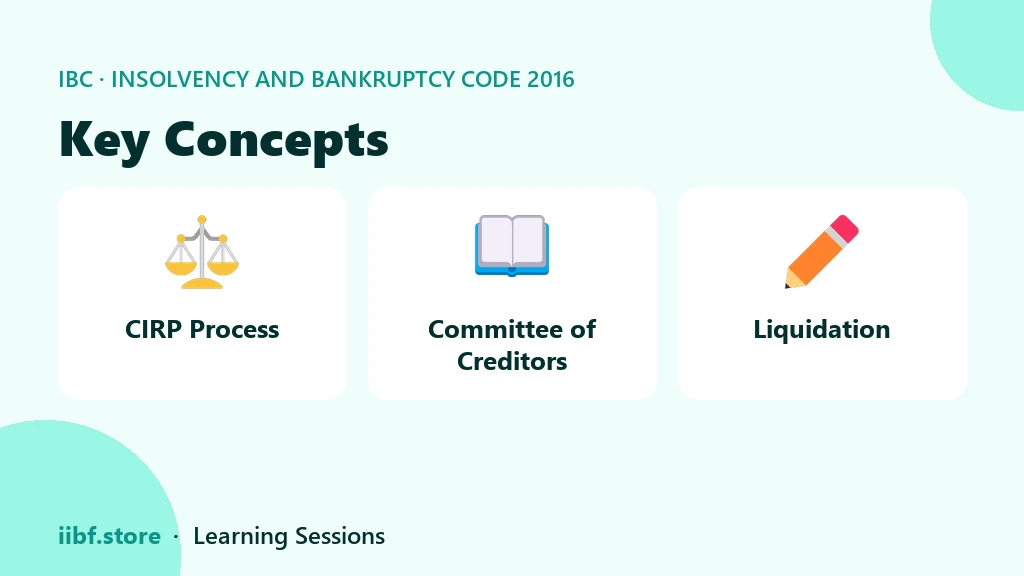
⚖️ Using NeSL Records in Section 7 Filings
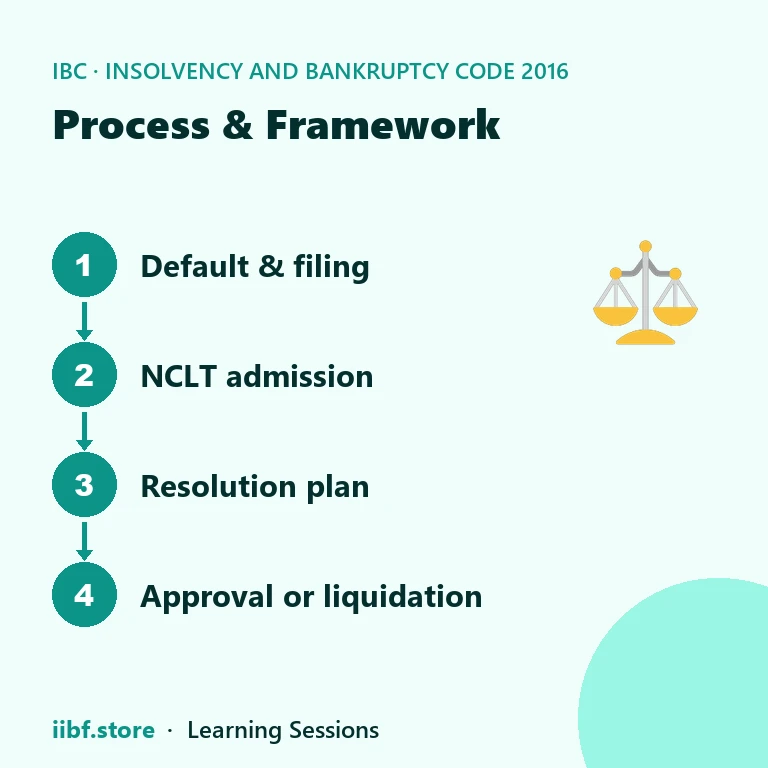
Section 7 of the IBC allows a financial creditor — on its own or jointly with other financial creditors — to file an application before the NCLT to initiate the Corporate Insolvency Resolution Process (CIRP) against a corporate debtor, once a default has occurred. The application must be accompanied by evidence of default, and this is exactly where NeSL's Record of Default becomes useful in practice.
Instead of relying solely on internal bank statements, loan agreements, and manually prepared default certificates — all of which a corporate debtor's counsel can contest at length — a financial creditor can attach an authenticated RoD from NeSL. Because the debtor already had a chance to dispute the entry at the authentication stage, courts and tribunals tend to treat an undisputed IU record as strong, readily verifiable evidence of default, which can shorten the time NCLT benches spend examining preliminary facts before deciding on admission.
This matters for exam purposes because it links directly to the initiation of CIRP stage and the subsequent commencement of CIRP once the NCLT is satisfied that a default has occurred and the application is complete. Banks handling large corporate exposures, including consortium and syndicated accounts, now routinely pull IU records as a first step before drafting a Section 7 petition.
⚠️ Common Mistake: Do not assume a Record of Default from NeSL is legally mandatory for every Section 7 filing. It strengthens the evidentiary base and can speed up admission, but the IBC does not bar a financial creditor from proving default through other means such as loan documents, bank statements, or an auditor's certificate.
🛡️ Evidentiary Value and Its Limitations
It is important not to overstate what an IU record does. An authenticated NeSL record is persuasive evidence that a debt and a default exist, but the NCLT retains discretion to examine the application as a whole — including whether the applicant qualifies as a financial creditor, whether the debt falls within the definition of "financial debt," and whether the application is otherwise complete under the Code and the applicable NCLT rules.
In practice, tribunals have generally been comfortable relying on an undisputed IU record to establish the fact of default quickly, which reduces the scope for a corporate debtor to stall admission purely by contesting the existence of debt. But where the underlying facility itself is disputed — for instance, if the debtor argues the loan was never validly disbursed or was fully settled — the IU record alone will not resolve that dispute, and the NCLT will still weigh the wider factual record. This is a subtle but important distinction for candidates studying the structure of the IBC, since it shows how the Code layers statutory evidence tools on top of, rather than instead of, ordinary rules of proof.
Banks should also note that IU adoption varies by lender and by loan vintage — older facilities, or those originated before an account's information was uploaded to NeSL, may simply not have a corresponding IU record, which is why parallel documentation discipline under existing regulatory frameworks that govern bank documentation remains essential regardless of IU coverage.
| Evidence Type for Section 7 | Source | Debtor Gets to Dispute Beforehand | Sufficient Alone in Most Cases |
|---|---|---|---|
| NeSL Record of Default (IU) | Registered Information Utility | ✅ Yes, at authentication stage | ✅ Usually, if undisputed |
| Bank statements / loan account ledger | Creditor's internal records | ❌ No | ❌ Often contested |
| Auditor's default certificate | Chartered accountant engaged by creditor | ❌ No | ❌ Supporting, not standalone |
| Loan agreement plus recall notice | Original transaction documents | ❌ No | ❌ Foundational but needs default proof |
📊 Why Banks Increasingly Prefer IU-Backed Filings
From a bank's operational standpoint, an IU-backed filing offers three practical advantages. First, it reduces the paperwork burden on the credit and legal teams preparing a Section 7 petition, since a single certified record substitutes for compiling and notarising multiple internal documents. Second, because the debtor had an earlier opportunity to contest the entry through NeSL's authentication notice, banks face a narrower window for the corporate debtor to raise fresh, delaying disputes about the existence of default at the admission stage. Third, it creates a consistent, centralised data trail across a borrower's entire lending relationships — useful when several banks in a consortium are separately assessing whether to jointly or individually invoke Section 7.
There are limits too. IU registration and authentication take time, so banks that wait until a loan is already in default to submit information to NeSL may find the process runs in parallel with, rather than ahead of, their recovery timeline. The better practice — and the one increasingly expected of well-run banks — is to register facility and security information with the IU at or near disbursement, and to keep it updated through the life of the loan, so that a Record of Default is ready the moment it is actually needed. This operational discipline sits alongside the broader study of the role of the resolution professional under IBC and insolvency professionals and IBBI oversight, both of which come into play once CIRP actually commences.
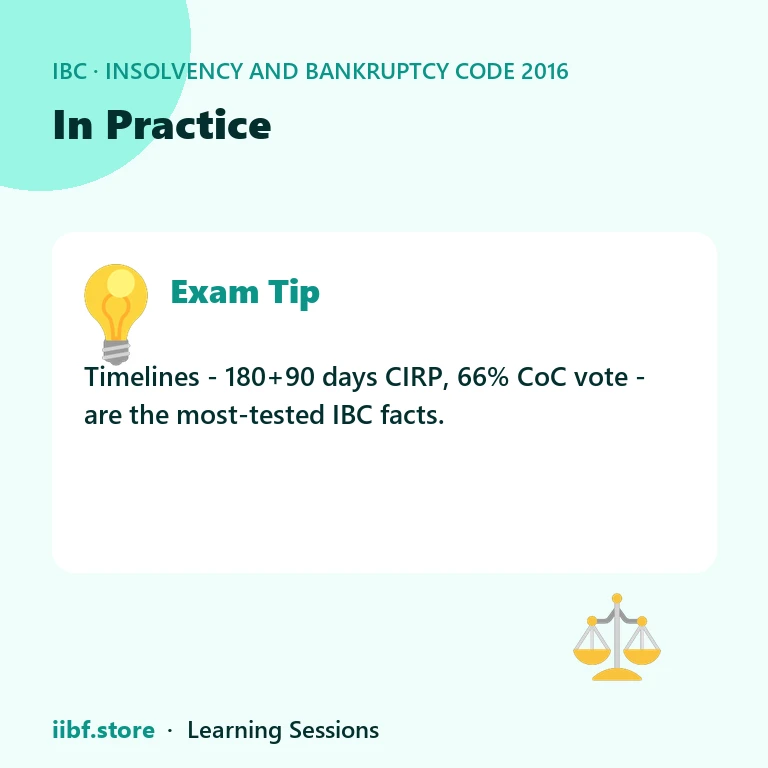
Candidates preparing for JAIIB and CAIIB should also connect this topic to what happens after admission — once a Section 7 application succeeds, the process moves toward resolution or, if that fails, toward liquidation, covered in the chapter on failure of CIRP and liquidation. The IU mechanism is deliberately front-loaded into the process so that disputes about the bare fact of default do not eat into the Code's tight resolution timelines.
📌 Quick Recap: IU = registered under Section 3(21) and the 2017 Regulations → NeSL is the principal operational IU → creditor submits data → debtor authenticates or disputes → undisputed record becomes a Record of Default → attached to Section 7 application → NCLT treats it as strong, though not exclusive, evidence of default.
For a wider view of how creditor remedies fit together across banking law, see the broader Insolvency and Bankruptcy Code 2016 topic hub, and compare this mechanism with related filings such as resolution plan approval under IBC once CIRP is underway.
🧠 Practice MCQs: Information Utility NeSL IBC
Q1. What does Section 3(21) of the IBC define? (a) Resolution professional (b) Information utility (c) Committee of creditors (d) Liquidation estate
Answer: (b) - Section 3(21) provides the statutory definition of an information utility.
Q2. Which entity is India's first registered Information Utility under the IBC? (a) CIBIL (b) CERSAI (c) National E-Governance Services Limited (NeSL) (d) IBBI itself
Answer: (c) - NeSL was the first entity registered with IBBI to operate as an information utility.
Q3. Under the IU authentication process, what happens if a debtor does not respond to submitted default information within the specified period? (a) The record is automatically rejected (b) The information is deemed authenticated (c) The creditor must refile through the NCLT (d) The IU permanently deletes the record
Answer: (b) - Non-response within the specified period results in the information being treated as deemed authenticated.
Q4. A financial creditor filing a Section 7 application typically strengthens its proof of default by attaching which document? (a) Board resolution of the corporate debtor (b) Record of Default from an Information Utility (c) Income tax return of the promoter (d) GST registration certificate
Answer: (b) - An authenticated Record of Default from an IU like NeSL is commonly attached as strong evidence of default.
Q5. Which statement best describes how the NCLT treats an undisputed IU record in a Section 7 case? (a) It is the only evidence the NCLT can consider (b) It carries strong evidentiary value but the NCLT can still weigh other facts (c) It is irrelevant to CIRP admission (d) It can only be used at the liquidation stage
Answer: (b) - An IU record is persuasive but does not remove the NCLT's discretion to examine the application as a whole.
Want chapter-wise mock tests with 100+ MCQs? Start practising free
What is an Information Utility under the IBC?
An Information Utility (IU) is an entity registered with the IBBI under Section 3(21) of the IBC to collect, authenticate, and store financial information about debtors, so that creditors have a reliable, tamper-resistant record of debt and default for use in insolvency proceedings.
Is NeSL the only Information Utility in India?
National E-Governance Services Limited (NeSL) was the first IU registered with the IBBI and remains the principal operational IU used by banks and financial institutions for recording and authenticating default information.
Is an NeSL Record of Default mandatory for a Section 7 application?
No. The IBC does not make an IU-issued Record of Default mandatory. A financial creditor can still prove default through loan documents, bank statements, or other evidence, but an authenticated IU record generally makes the proof of default faster to establish before the NCLT.
How does NeSL authenticate a default record?
The creditor submits financial information electronically, NeSL notifies the debtor, and the debtor can confirm or dispute it within a specified period. If the debtor does not respond in time, the information is deemed authenticated and can then be used as a certified Record of Default.
The information utility NeSL IBC mechanism is a practical time-saver for banks pursuing recovery under Section 7, but it works best as part of a disciplined recovery process, not a substitute for one. Strengthen your understanding of the full CIRP lifecycle with structured practice — explore the CAIIB course or take a free mock test to check where you stand before exam day.
Prefer revising from a printed book?
Chapter-wise books with MCQs after every chapter — minimal pages, complete coverage, delivered anywhere in India. Every book has a free sample to read first.
132 pages · 225 MCQs
Learning Sessions · Ashish Sir
188 pages · 435 MCQs
Learning Sessions · Ashish Sir
117 pages · 236 MCQs
Learning Sessions · Ashish Sir
Learning Sessions · Ashish Sir
118 pages · 299 MCQs
Learning Sessions · Ashish Sir
Learning Sessions · Ashish Sir
Learning Sessions · Ashish Sir
Learning Sessions · Ashish Sir
115 pages · 255 MCQs
Learning Sessions · Ashish Sir
Learning Sessions · Ashish Sir
334 pages · 936 MCQs
Learning Sessions · Ashish Sir
Learning Sessions · Ashish Sir
115 pages · 344 MCQs
Learning Sessions · Ashish Sir
107 pages · 240 MCQs
Learning Sessions · Ashish Sir
90 pages · 150 MCQs
Learning Sessions · Ashish Sir
Learning Sessions · Ashish Sir
131 pages · 672 MCQs
Learning Sessions · Ashish Sir
221 pages · 831 MCQs
Learning Sessions · Ashish Sir
128 pages · 524 MCQs
Learning Sessions · Ashish Sir
107 pages · 445 MCQs
Learning Sessions · Ashish Sir
148 pages · 478 MCQs
Learning Sessions · Ashish Sir
151 pages · 465 MCQs
Learning Sessions · Ashish Sir
148 pages · 375 MCQs
Learning Sessions · Ashish Sir
216 pages · 895 MCQs
Learning Sessions · Ashish Sir
109 pages · 300 MCQs
Learning Sessions · Ashish Sir
104 pages · 360 MCQs
Learning Sessions · Ashish Sir
82 pages · 297 MCQs
Learning Sessions · Ashish Sir
151 pages · 600 MCQs
Learning Sessions · Ashish Sir
98 pages · 282 MCQs
Learning Sessions · Ashish Sir
Quick quiz on this topic
5 exam-style questions from our free test bank — check yourself before you move on.
Practice this topic
Take a free mock test, download chapter PDFs, or watch a video class — all included on iibf.store.