Financial Creditors vs Operational Creditors Under IBC
Every corporate insolvency case decided under the Insolvency and Bankruptcy Code, 2016 hinges on one foundational split: financial creditors vs operational creditors under IBC. Banking exam questions repeatedly test this distinction because it decides who sits on the Committee of Creditors, who can trigger the Corporate Insolvency Resolution Process, and who gets paid first when a company is liquidated. For bankers, understanding this split is not academic — banks themselves are almost always financial creditors, while vendors, suppliers and employees usually fall in the operational bucket. This article breaks down the statutory definitions, the practical consequences of the classification, and the exam angles you are most likely to face.
📋 Who Is a Financial Creditor Under the IBC
Section 5(7) of the IBC defines a financial creditor as any person to whom a "financial debt" is owed, including a person to whom such debt has been legally assigned or transferred. Section 5(8) then defines financial debt broadly — money disbursed against consideration for the time value of money. This covers term loans, working capital facilities, debentures, bonds, guarantees invoked by a lender, and even amounts raised through securitisation or factoring arrangements. Banks, NBFCs, bondholders and even home buyers under real-estate projects (deemed financial creditors after the 2018 amendment) fall squarely within this class. The defining feature is the time value of money: interest accrues on the sum advanced, and repayment is structured with tenure, rate and schedule, exactly like a bank loan.
Because a financial creditor's claim usually arises from a formal facility agreement or security document, proving the debt before the National Company Law Tribunal is comparatively straightforward — a loan account statement, sanction letter and default record from the credit information framework will typically suffice to admit a Section 7 application.
💡 Exam Tip: If a question mentions "time value of money," "interest," or "tenure," it is almost always pointing to a financial creditor, not an operational one.
🧾 Who Is an Operational Creditor Under the IBC
Section 5(20) defines an operational creditor as any person to whom an operational debt is owed, and Section 5(21) defines operational debt as a claim for goods or services supplied, including employment dues, and dues payable under any law to the Central or State Government or a local authority. Trade creditors, raw-material suppliers, contractors, landlords for unpaid rent, employees for unpaid wages, and even tax authorities for statutory dues are operational creditors. Unlike a financial creditor, an operational creditor's claim does not carry the time-value-of-money element — it is a straightforward payment obligation for goods, services or statutory dues rendered.
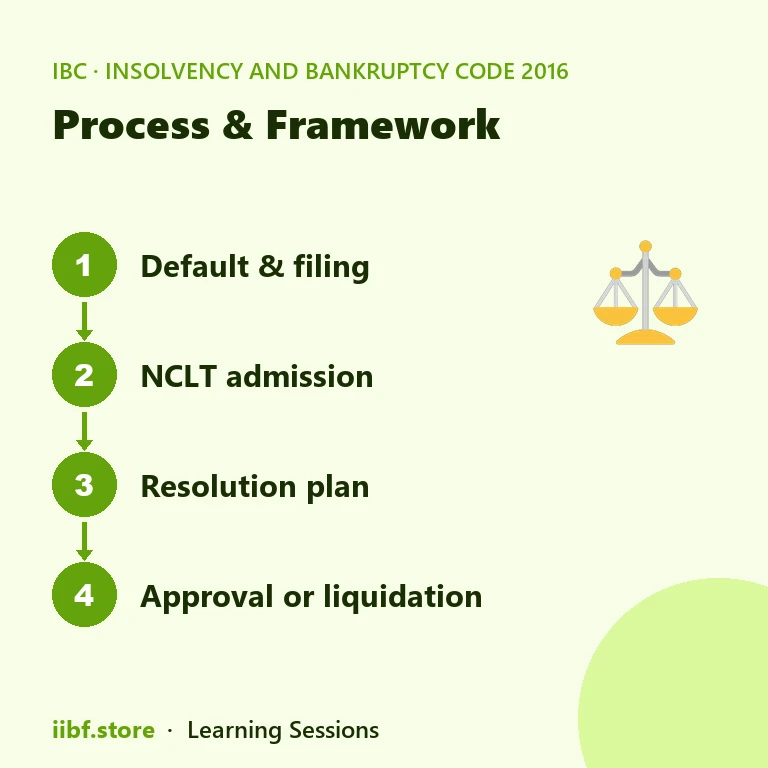
This is precisely why the IBC requires an operational creditor to first send a demand notice under Section 8 before approaching the NCLT. If the corporate debtor does not respond with a notice of dispute within ten days, the operational creditor can file a Section 9 application. This extra procedural step exists because operational debts are more prone to genuine commercial disputes over quality, delivery or quantum than a straightforward loan default.
⚖️ Key Differences: Financial vs Operational Creditors
The table below summarises the practical distinctions that examiners test most often — from the governing sections to voting rights and payment priority.
| Parameter | Financial Creditor | Operational Creditor |
|---|---|---|
| Governing definition | Section 5(7) / 5(8) | Section 5(20) / 5(21) |
| Nature of debt | Disbursed with time value of money | Payment for goods, services, employment or statutory dues |
| Trigger section for CIRP | Section 7 | Section 9 (after Section 8 demand notice) |
| Pre-filing demand notice required | ❌ No | ✅ Yes (10-day dispute window) |
| Voting right on Committee of Creditors | ✅ Yes | ❌ No (unless no financial creditors exist) |
| Typical members | Banks, NBFCs, bondholders, debenture holders | Suppliers, contractors, employees, tax authorities |
| Priority in Section 53 waterfall | Ranks above unsecured operational creditors | Ranks below financial creditors (workmen dues protected separately) |
🏛️ Why the Distinction Matters for CoC Voting and Resolution Plans
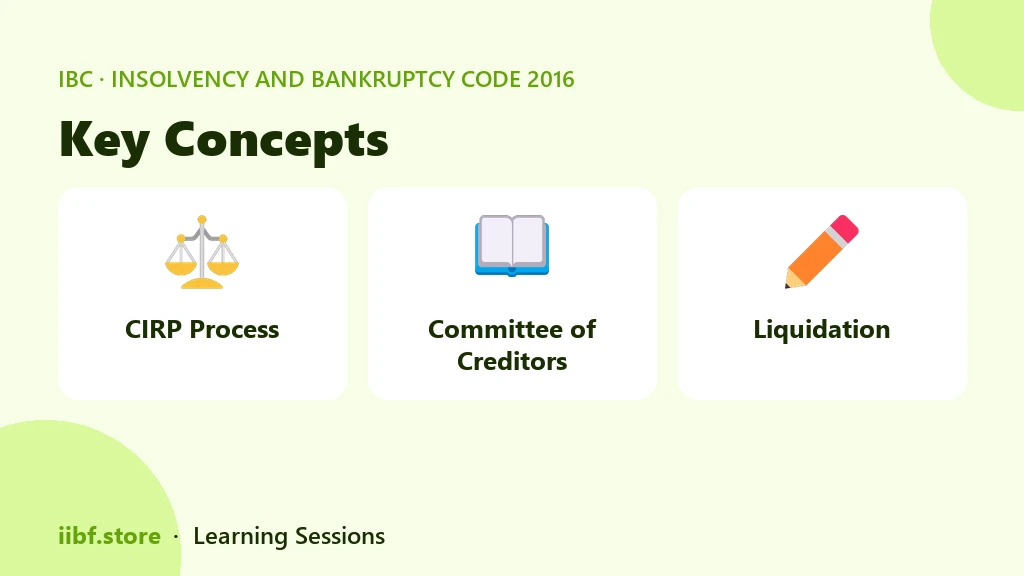
The Committee of Creditors, constituted by the interim resolution professional under Section 21, comprises only financial creditors — this was the single most litigated point in the early years of the Code. In Swiss Ribbons Pvt. Ltd. v. Union of India, the Supreme Court upheld this classification, reasoning that financial creditors are better placed to assess the commercial viability of a resolution plan because they carry out due diligence, monitor cash flows and restructure facilities as a matter of ordinary business. Operational creditors get a seat at CoC meetings only if their aggregate dues exceed a prescribed threshold relative to total debt, and even then, without voting rights, unless no financial creditor exists.
This asymmetry directly affects how resolution plans are drafted. Any resolution plan approved by the CoC and later sanctioned by the NCLT must still provide operational creditors at least the amount they would have received in liquidation under the Section 53 waterfall, or the amount due to them, whichever is higher — a safeguard read into the Code after the Essar Steel litigation. Bankers preparing for CoC roles must therefore understand both sides: their own voting power as financial creditors, and the statutory floor protection operational creditors are entitled to.
⚠️ Common Mistake: Candidates often assume operational creditors never get a CoC vote. They do, but only when no financial creditor of the corporate debtor exists — a narrow exception, not the rule.
🔍 Practical Relevance for Bank Officers
For a banking professional, this classification is not just exam trivia — it shapes how recovery teams strategise. A bank filing a Section 7 application does not need to prove "dispute" the way an operational creditor must; admission is largely mechanical once default and debt are established through records maintained with the information utility. This is one reason banks increasingly prefer to trigger CIRP directly rather than wait for operational creditors like suppliers to move first. It also explains why banks, as financial creditors, dominate the resolution process end-to-end — from appointing the resolution professional to approving or rejecting the final resolution plan by the requisite 66% voting share.
Understanding creditor classification also matters when a bank itself owes money to a vendor of a corporate debtor undergoing CIRP, or when a bank's own subsidiary supplies services to group companies — in both cases, the classification determines standing and recovery priority. Officers preparing credit recovery strategy must map every counterparty correctly before initiating action, since a wrongly classified application can be dismissed by the NCLT at the admission stage itself.
📌 Remember: Time value of money = financial creditor. Goods, services, wages or statutory dues without interest-style consideration = operational creditor.
🧠 Practice MCQs: Financial vs Operational Creditors Under IBC
Q1. Which section of the IBC, 2016 defines a "financial creditor"? (a) Section 5(7) (b) Section 5(20) (c) Section 3(11) (d) Section 5(21)
Answer: (a) — Section 5(7) defines "financial creditor," with "financial debt" defined in Section 5(8).
Q2. An "operational creditor" under the IBC is defined in which section? (a) Section 5(8) (b) Section 5(7) (c) Section 5(20) (d) Section 5(24)
Answer: (c) — Section 5(20) defines "operational creditor," with "operational debt" defined in Section 5(21).
Q3. Only which class of creditors has voting rights on the Committee of Creditors (CoC) constituted under Section 21 of the IBC? (a) Operational creditors exclusively (b) Financial creditors (c) Both classes equally (d) The resolution professional
Answer: (b) — The CoC comprises financial creditors; operational creditors get voting rights only if no financial creditor exists.
Q4. An operational creditor seeking to initiate CIRP against a corporate debtor must file an application under which section? (a) Section 7 (b) Section 10 (c) Section 33 (d) Section 9
Answer: (d) — Section 9 applications follow a mandatory Section 8 demand notice with a 10-day dispute window.
Q5. Under the Section 53 liquidation waterfall, unsecured financial creditors' dues rank _____ operational creditors' dues (for the same period). (a) below (b) equal to (c) above (d) after government dues only
Answer: (c) — Financial creditors (secured and unsecured) rank above operational creditors in the Section 53 waterfall, subject to workmen dues protection.
Want chapter-wise mock tests with 100+ MCQs? Start practising free →
❓ Frequently Asked Questions
Is a homebuyer treated as a financial creditor under the IBC?
Yes. After the 2018 amendment, allottees under a real-estate project are deemed financial creditors, since the amount paid to a builder is treated as having the commercial effect of a borrowing.
Can an operational creditor ever vote in the Committee of Creditors?
Only in the rare situation where the corporate debtor has no financial creditors at all — the CoC is then constituted with the 18 largest operational creditors by value, each getting a vote.
Why does an operational creditor need to send a demand notice before filing a case?
Section 8 requires a 10-day demand notice so the corporate debtor can raise a pre-existing dispute, since operational debts (goods, services, quality disputes) are more likely to be contested than a straightforward loan default.
Do financial creditors get repaid before operational creditors in liquidation?
Generally yes — under the Section 53 waterfall, financial creditors (secured and then unsecured) rank above operational creditors, though workmen's dues for the preceding 24 months share priority with secured financial creditors.
Getting the financial creditor vs operational creditor distinction right unlocks several other IBC concepts — how the Initiation of Corporate Insolvency Resolution Process (CIRP) actually begins, and how the Roles and Duties of IRP and RP connect both creditor classes to a single resolution timeline. Bankers should also revisit the role of the resolution professional under IBC, since the RP is the officer who verifies and classifies every claim, and study how resolution plan approval under IBC works before the NCLT, where the operational-creditor payout floor is finally tested. For the professionals who administer this entire process, see our guide to insolvency professionals and IBBI regulation. The creditor-classification logic of the IBC also has a close cousin in company law — read how the Companies Act 2013 governs charges and borrowing powers for bankers, since a registered charge often decides whether a financial creditor's claim is secured or unsecured in the very waterfall discussed above. For the official legislative text and IBBI regulations on creditor classification, refer to the Insolvency and Bankruptcy Board of India at ibbi.gov.in. You can browse more chapter notes and practice sets on our Insolvency and Bankruptcy Code 2016 tag hub.
Financial creditors and operational creditors are treated differently by design — one drives the commercial decision-making of a resolution process, the other is protected by a statutory payout floor. Master this distinction, work through the linked chapters above, and then test your recall with full-length mock papers on iibf.store's CAIIB course to lock in exam-day confidence.
Prefer revising from a printed book?
Chapter-wise books with MCQs after every chapter — minimal pages, complete coverage, delivered anywhere in India. Every book has a free sample to read first.
132 pages · 225 MCQs
Learning Sessions · Ashish Sir
188 pages · 435 MCQs
Learning Sessions · Ashish Sir
117 pages · 236 MCQs
Learning Sessions · Ashish Sir
Learning Sessions · Ashish Sir
118 pages · 299 MCQs
Learning Sessions · Ashish Sir
Learning Sessions · Ashish Sir
Learning Sessions · Ashish Sir
Learning Sessions · Ashish Sir
115 pages · 255 MCQs
Learning Sessions · Ashish Sir
Learning Sessions · Ashish Sir
334 pages · 936 MCQs
Learning Sessions · Ashish Sir
Learning Sessions · Ashish Sir
115 pages · 344 MCQs
Learning Sessions · Ashish Sir
107 pages · 240 MCQs
Learning Sessions · Ashish Sir
90 pages · 150 MCQs
Learning Sessions · Ashish Sir
Learning Sessions · Ashish Sir
131 pages · 672 MCQs
Learning Sessions · Ashish Sir
221 pages · 831 MCQs
Learning Sessions · Ashish Sir
128 pages · 524 MCQs
Learning Sessions · Ashish Sir
107 pages · 445 MCQs
Learning Sessions · Ashish Sir
148 pages · 478 MCQs
Learning Sessions · Ashish Sir
151 pages · 465 MCQs
Learning Sessions · Ashish Sir
148 pages · 375 MCQs
Learning Sessions · Ashish Sir
216 pages · 895 MCQs
Learning Sessions · Ashish Sir
109 pages · 300 MCQs
Learning Sessions · Ashish Sir
104 pages · 360 MCQs
Learning Sessions · Ashish Sir
82 pages · 297 MCQs
Learning Sessions · Ashish Sir
151 pages · 600 MCQs
Learning Sessions · Ashish Sir
98 pages · 282 MCQs
Learning Sessions · Ashish Sir
Quick quiz on this topic
5 exam-style questions from our free test bank — check yourself before you move on.
Practice this topic
Take a free mock test, download chapter PDFs, or watch a video class — all included on iibf.store.