Role of Resolution Professional Under IBC: 2026 Exam Guide
The role of resolution professional under IBC sits at the heart of every corporate insolvency case in India — this licensed intermediary steps into the shoes of the board of directors, runs the company as a going concern, and shepherds the case from admission to a final resolution plan. For JAIIB/CAIIB and other IIBF candidates, understanding exactly what this officer can and cannot do is a recurring exam theme, since bankers deal with resolution professionals directly whenever a borrower account is referred to the NCLT.
🧑⚖️ Who Becomes the Resolution Professional?
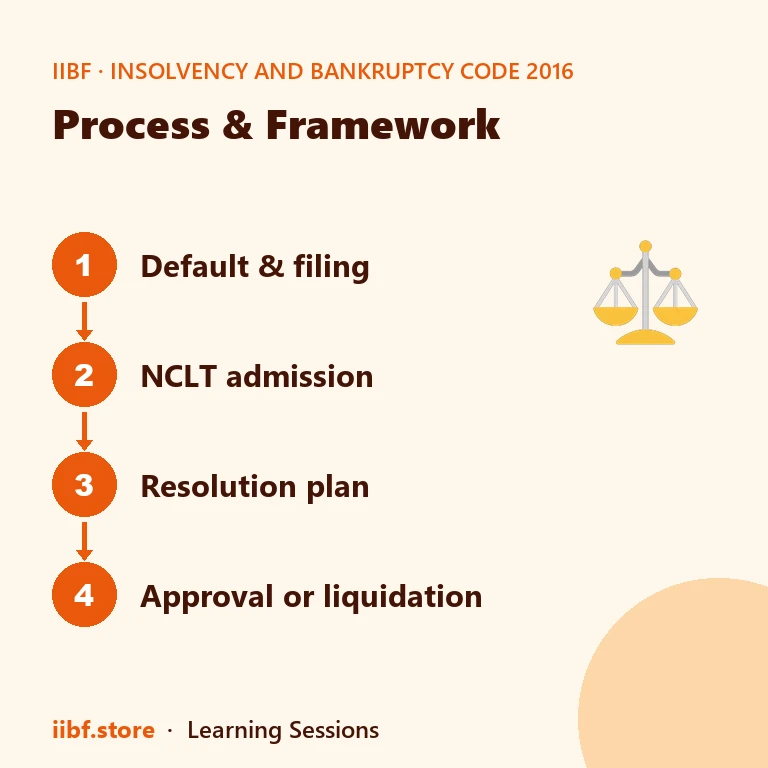
Every corporate insolvency resolution process (CIRP) begins with an Interim Resolution Professional (IRP), appointed by the National Company Law Tribunal (NCLT) on the same order that admits the insolvency application. The IRP is a licensed Insolvency Professional (IP) registered with an Insolvency Professional Agency and regulated by the IBBI. Once the Committee of Creditors (CoC) is constituted, its very first meeting — held within seven days of constitution — decides whether the IRP continues as the Resolution Professional (RP) or is replaced. Confirming or replacing the RP needs a voting share of not less than 66% of the CoC. This appointment mechanic is explained in detail in the chapter on Roles and Duties of IRP and RP, which candidates should read alongside the process of Commencement of CIRP to see exactly where the RP's mandate begins.
📋 Powers, Duties and the Suspended Board
The moment the RP is confirmed, the powers of the corporate debtor's board of directors stand suspended and are exercised by the RP under Section 17 of the Code. Key duties include taking custody and control of the corporate debtor's assets, operating its bank accounts, appointing valuers and other professionals, collecting all claims from creditors and preparing the final list, preserving the business as a going concern, and constituting and convening meetings of the Committee of Creditors. The RP also prepares the Information Memorandum — the confidential document that gives prospective resolution applicants the financial, operational and legal picture needed to submit a viable resolution plan. Promoters and existing management are legally bound to extend full cooperation; refusal can invite NCLT directions against them. This entire admission-to-management chain traces back to how a case is first filed, covered under Initiation of Corporate Insolvency Resolution Process (CIRP).
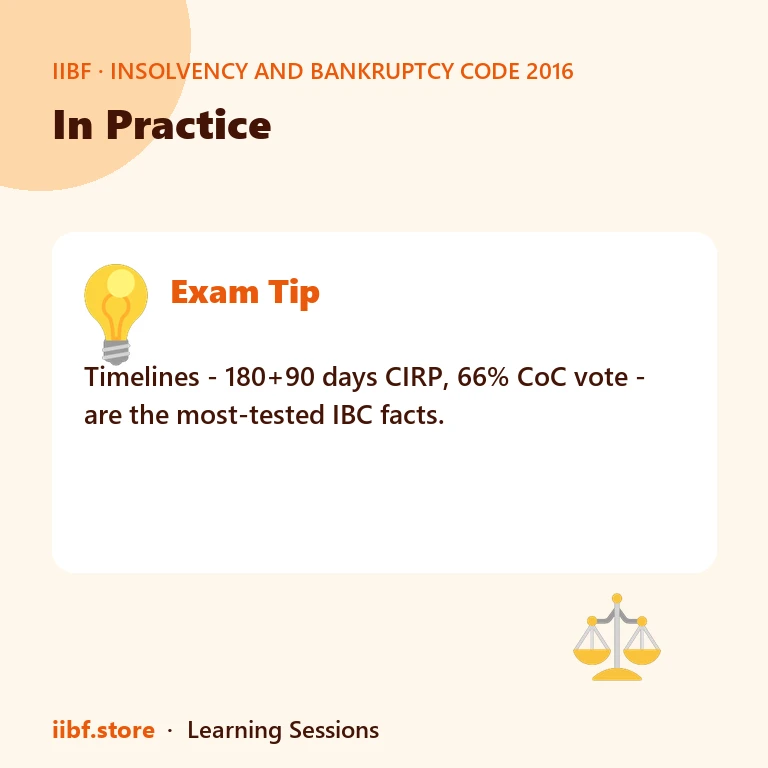
💡 Exam Tip: The RP does not approve or reject a resolution plan — that decision belongs to the CoC (commercially) and the NCLT (legally, as adjudicating authority). The RP only examines the plan for compliance with Section 30(2) before placing it before the CoC.
🤝 Resolution Professional and the Committee of Creditors
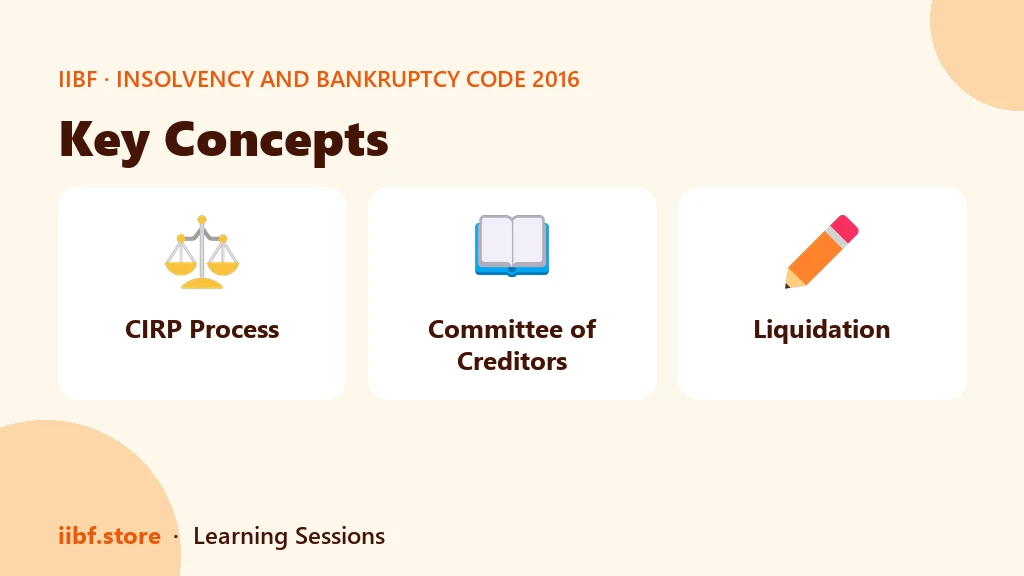
The RP is not an independent decision-maker on commercial matters; it acts as the CoC's agent for running the process. Every material action — raising interim finance beyond approved limits, creating security interests, or approving a resolution plan for submission to the NCLT — needs the CoC's sanction. The RP conducts CoC meetings, circulates agenda and minutes, and reports on progress at each stage, including seeking extensions of the CIRP period from the tribunal when needed. This close operational coupling is why bank officers who sit on a CoC as financial creditors deal with the RP almost daily once an account is admitted into CIRP. Candidates preparing this topic often confuse the RP's administrative authority with the CoC's commercial authority — remembering that split is critical for both exams and real-world credit recovery work, a theme also covered in Credit Recovery Laws for Banks.
⚠️ Common Mistake: Students often assume the RP can unilaterally reject a resolution plan. In reality, the RP can only flag non-compliance with Section 30(2); the commercial decision to approve or reject always rests with the CoC.
⚖️ Accountability, Removal and IBBI Oversight
The Resolution Professional is a fiduciary, not a free agent. The IBBI (Insolvency and Bankruptcy Board of India) registers, monitors and disciplines insolvency professionals through its regulations and its recognised Insolvency Professional Agencies (IPAs). If the RP acts fraudulently, negligently, or in a manner prejudicial to creditors, the CoC can move the NCLT for replacement with a 66% voting share, and the IBBI can independently initiate disciplinary proceedings that may lead to suspension or cancellation of the professional's registration. The RP is also personally accountable for filing correct forms, maintaining records, and depositing funds in a designated bank account — lapses here are a frequent source of IBBI disciplinary orders. Readers can verify current IP regulations and disciplinary orders directly on the regulator's website, ibbi.gov.in.
📌 Remember: RP replacement mid-CIRP does not restart the resolution clock — the process continues under the newly appointed professional within the same overall timeline.
📊 IRP vs RP vs Liquidator — Quick Comparison
| Role | Appointed by | CoC approval needed for appointment? | Primary mandate |
|---|---|---|---|
| Interim Resolution Professional (IRP) | NCLT (on admission order) | ❌ No | Take immediate control, constitute CoC |
| Resolution Professional (RP) | CoC (66% vote), confirmed by NCLT | ✅ Yes | Run CIRP, invite and evaluate resolution plans |
| Liquidator | CoC recommendation, appointed by NCLT | ✅ Yes | Realise and distribute assets under Section 53 waterfall |
Note that the same person can, and often does, continue as IRP, then RP, and finally Liquidator if the CIRP fails and the corporate debtor moves into liquidation — a transition explained further in Failure of CIRP or Business: Liquidation & Voluntary Liquidation.
🌍 Where This Fits in the Bigger Picture
The resolution professional's function only makes sense against the backdrop of the wider Code. Before an RP is even appointed, a case must clear the admission bar under initiation provisions, and once admitted it runs under a strict moratorium under Section 14 IBC that freezes recovery suits against the corporate debtor. The RP is also the officer responsible for identifying and reporting suspicious transactions — a duty examined closely in coverage of avoidance transactions under IBC. Since the RP's own registration, code of conduct and disciplinary framework flow from the regulator, it pairs naturally with the exam-guide on insolvency professionals and IBBI. For a broader macro-banking angle, candidates revising the same exam cycle often pair this chapter with types of inflation in India from the Indian Economy paper, since both are recurring high-weightage areas.
📌 Explore the full Insolvency and Bankruptcy Code 2016 topic hub for more chapter-wise exam notes.
🧠 Practice MCQs: Role of Resolution Professional
Q1. Who takes immediate charge of a corporate debtor's affairs the moment a CIRP application is admitted? (a) Liquidator (b) Interim Resolution Professional (c) Committee of Creditors (d) NCLT Registrar
Answer: (b) — The NCLT appoints an Interim Resolution Professional in the same order that admits the CIRP application.
Q2. What voting share of the Committee of Creditors is required to replace the Interim Resolution Professional with a different Resolution Professional? (a) 51% (b) 60% (c) 66% (d) 75%
Answer: (c) — Section 22 of the IBC requires a voting share of not less than 66% to replace the IRP.
Q3. Which regulator registers and disciplines Insolvency Professionals in India? (a) SEBI (b) RBI (c) IBBI (d) Ministry of Corporate Affairs directly
Answer: (c) — The Insolvency and Bankruptcy Board of India (IBBI) regulates insolvency professionals through recognised IPAs.
Q4. Once the Resolution Professional is confirmed, the powers of the corporate debtor's board of directors are: (a) Enhanced (b) Suspended and vested in the RP (c) Transferred to the CoC (d) Unaffected
Answer: (b) — Under Section 17, board powers stand suspended and are exercised by the RP during CIRP.
Q5. Which of the following is NOT a duty of the Resolution Professional during CIRP? (a) Preserve and protect the assets of the corporate debtor (b) Constitute the Committee of Creditors (c) Sanction the resolution plan on behalf of the NCLT (d) Conduct the corporate debtor as a going concern
Answer: (c) — The RP examines the plan for compliance but only the CoC approves and the NCLT sanctions the resolution plan.
Want chapter-wise mock tests with 100+ MCQs? Start practising free →
❓ Frequently Asked Questions
Is the Resolution Professional the same as the Interim Resolution Professional?
Not necessarily. The IRP is the first appointee named by the NCLT on admission; the CoC then decides in its first meeting, by a 66% voting share, whether to confirm the same person as RP or appoint someone else.
Can the Resolution Professional approve a resolution plan on its own?
No. The RP only checks the plan for compliance with Section 30(2) of the IBC and places it before the CoC. Commercial approval rests with the CoC, and final sanction rests with the NCLT.
Who regulates the conduct of a Resolution Professional?
The IBBI regulates Insolvency Professionals through recognised Insolvency Professional Agencies, and can suspend or cancel registration for misconduct, in addition to the CoC's power to seek replacement.
Does the corporate debtor's management have any role once an RP is appointed?
Promoters and existing management must cooperate with the RP and hand over records and assets, but they lose control of day-to-day operations, since board powers are suspended under Section 17.
The resolution professional is the operational engine of every CIRP — understanding its powers, its limits, and its accountability to both the CoC and the IBBI is essential for anyone appearing for JAIIB/CAIIB or handling stressed-asset accounts on the job. Sharpen this topic further with chapter-wise practice tests or explore the full CAIIB course for structured IBC coverage.
Prefer revising from a printed book?
Chapter-wise books with MCQs after every chapter — minimal pages, complete coverage, delivered anywhere in India. Every book has a free sample to read first.
132 pages · 225 MCQs
Learning Sessions · Ashish Sir
188 pages · 435 MCQs
Learning Sessions · Ashish Sir
117 pages · 236 MCQs
Learning Sessions · Ashish Sir
Learning Sessions · Ashish Sir
118 pages · 299 MCQs
Learning Sessions · Ashish Sir
Learning Sessions · Ashish Sir
Learning Sessions · Ashish Sir
Learning Sessions · Ashish Sir
115 pages · 255 MCQs
Learning Sessions · Ashish Sir
Learning Sessions · Ashish Sir
334 pages · 936 MCQs
Learning Sessions · Ashish Sir
Learning Sessions · Ashish Sir
115 pages · 344 MCQs
Learning Sessions · Ashish Sir
107 pages · 240 MCQs
Learning Sessions · Ashish Sir
90 pages · 150 MCQs
Learning Sessions · Ashish Sir
Learning Sessions · Ashish Sir
131 pages · 672 MCQs
Learning Sessions · Ashish Sir
221 pages · 831 MCQs
Learning Sessions · Ashish Sir
128 pages · 524 MCQs
Learning Sessions · Ashish Sir
107 pages · 445 MCQs
Learning Sessions · Ashish Sir
148 pages · 478 MCQs
Learning Sessions · Ashish Sir
151 pages · 465 MCQs
Learning Sessions · Ashish Sir
148 pages · 375 MCQs
Learning Sessions · Ashish Sir
216 pages · 895 MCQs
Learning Sessions · Ashish Sir
109 pages · 300 MCQs
Learning Sessions · Ashish Sir
104 pages · 360 MCQs
Learning Sessions · Ashish Sir
82 pages · 297 MCQs
Learning Sessions · Ashish Sir
151 pages · 600 MCQs
Learning Sessions · Ashish Sir
98 pages · 282 MCQs
Learning Sessions · Ashish Sir
Quick quiz on this topic
5 exam-style questions from our free test bank — check yourself before you move on.
Practice this topic
Take a free mock test, download chapter PDFs, or watch a video class — all included on iibf.store.