JAIIB 2026 Topic Updates: What Is Actually Examinable
Every few weeks a new list of "changed topics" does the rounds in JAIIB WhatsApp groups, and every few weeks the same panic follows: has the syllabus moved again, and is my book now useless? The short below runs through the current crop. What almost nobody tells you is that IIBF has already written down the rule that decides which of these JAIIB 2026 topic updates can legally appear in your question paper — and it is a date, not a rumour.
Jaiib 2026 topic updates · Watch on YouTube
The cut-off date almost nobody reads
Open the JAIIB Rules & Syllabus booklet published on iibf.org.in and you will find a section titled "Cut-off date of guidelines / important developments for examinations". The Institute states the problem in its own words: it wants to test whether candidates keep themselves abreast of current developments, but question papers are prepared well before the exam date, so a regulator's circular issued last week cannot fairly be asked next week.
The fix is a fixed window. For examinations conducted between March and August of a calendar year, only instructions, guidelines and important developments issued up to 31st December of the preceding year are considered for inclusion. For examinations conducted between September and February, the line is 30th June of that year. The booklet illustrates this with a table — exams from March to August 2025 took developments up to 31 December 2024; exams from September 2025 to February 2026 took them up to 30 June 2025.
Apply the same published rule to your own attempt and the arithmetic does itself. If you are writing in the March–August 2026 window, the relevant boundary is 31 December 2025. If your attempt falls between September 2026 and February 2027, it moves to 30 June 2026. Anything a regulator announced after that line may be excellent banking knowledge, but it is not your problem in the hall.
This one paragraph should change how you consume update videos. Instead of asking "is this new?", ask "was it issued before my cut-off?" That converts an endless feed into a finite list.
The four papers have not changed
The subjects of examination remain four, and all of them are compulsory: Indian Economy & Indian Financial System, Principles & Practices of Banking, Accounting & Financial Management for Bankers, and Retail Banking & Wealth Management. If a forwarded message tells you a fifth paper has been added or one has been dropped, check the booklet before you rearrange your study plan.
What genuinely moves, year after year, is the content inside those papers — and it moves in predictable places. The syllabus itself is described by the Institute as indicative, with a clear warning that questions may be asked on all relevant matters under a subject and on current developments, even where a topic is not spelled out in the booklet.
| Paper | Where updates usually land | Primary source to track |
|---|---|---|
| IE & IFS | Policy rates, Union Budget numbers, NBFC scale-based regulation, MSME definition, microfinance directions | RBI, Union Budget documents |
| PPB | KYC master direction amendments, priority sector lending norms, digital payment limits, customer service | RBI master directions |
| AFM | Accounting standards, taxation thresholds, depreciation and GST treatment | ICAI, Finance Act |
| RBWM | Government social security schemes, insurance and pension rules, deposit insurance cover | RBI, IRDAI, PFRDA, scheme portals |
The booklet is explicit about where to look. It advises candidates to go through updates published on the IIBF website, to read RBI master circulars and master directions, and to use the Institute's own publications — IIBF Vision and Bank Quest. It further advises visiting the websites of the RBI, SEBI, BIS, IRDAI and FEDAI. That is a source list handed to you by the examiner; treating it as optional is a strange choice.
Build a monthly routine instead of a panic
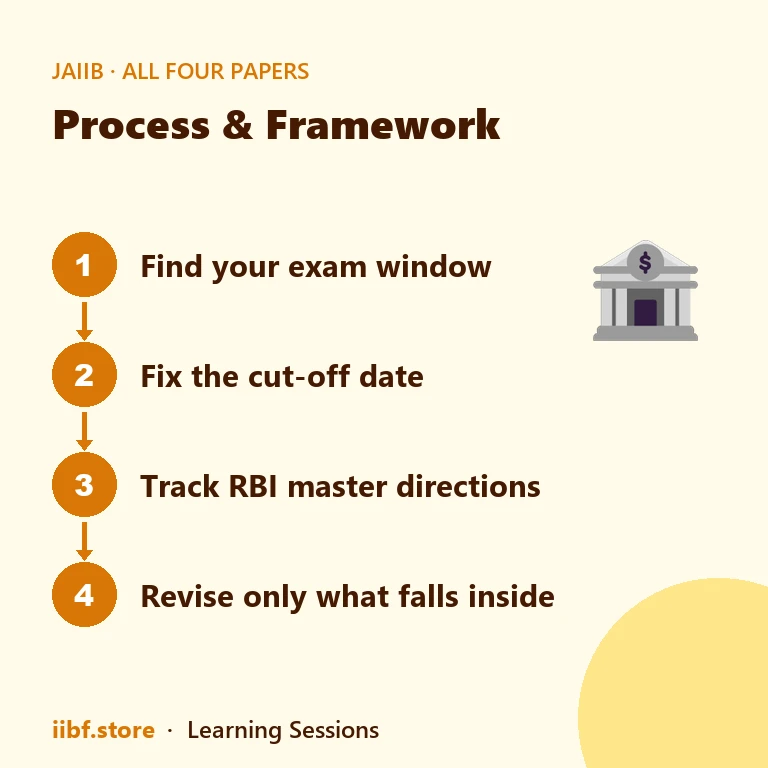
Here is a routine that takes about twenty minutes a month. Step one, write your exam month at the top of a page and derive your cut-off date from the rule above. Step two, skim the RBI master directions relevant to KYC, priority sector lending and customer service, noting only amendments dated before that cut-off. Step three, log the current policy rates and any Budget figure that moved. Step four, add each item as a one-line flashcard rather than a printout you will never reread.
Then test the recall, because reading updates and remembering them are different skills. A short set on the iibf.store mock tests after each monthly sweep tells you within ten minutes whether the new number actually stuck. If your weekly schedule keeps slipping, the day-wise study planner will fit the update sweep alongside your regular chapters instead of pretending it is free time. For the standing chapters underneath all this, the JAIIB course material stays the backbone, and the live RBI rates page saves you a search every time a numerical question needs a current figure.
The rules that did not move at all
While chasing JAIIB 2026 topic updates, do not lose sight of the exam mechanics, because they are stable and they decide your strategy.
| Rule | Position for 2026 |
|---|---|
| Pattern | Approximately 100 objective multiple-choice questions for 100 marks per paper |
| Mode | Online only |
| Negative marking | None |
| Duration | 2 hours |
| Pass mark | 50 out of 100 in the subject |
| Aggregate route | At least 45 in each subject with a 50% aggregate in a single attempt |
| Attempts | 5 attempts, or 3 years from first registration, whichever is earlier |
| Medium | Hindi or English, chosen at registration and not changeable later |
Two of those deserve a second read. First, because there is no negative marking, leaving a question blank is strictly worse than a considered guess — and yet candidates still submit papers with unanswered questions. Second, an attempt is counted when you apply, irrespective of whether you actually appear. Registering "just in case" and skipping the exam burns one of your five.
So the honest summary of the JAIIB 2026 topic updates conversation is this: the paper structure is unchanged, the syllabus is deliberately indicative, and the only filter that matters is the published cut-off date. Track the regulator, respect the date, convert each item into one line, and test it. That beats memorising every forwarded list in the group, most of which will not be examinable in your window anyway. More five-minute revision reads sit on the iibf.store blog.
Frequently asked questions
Which updates can actually be asked in my JAIIB paper?
Only those issued on or before the Institute's published cut-off date. For examinations held from March to August of a calendar year, developments up to 31st December of the previous year are considered; for examinations from September to February, the cut-off is 30th June. Anything later is outside the window for that attempt.
Has the JAIIB syllabus structure changed for 2026?
The examination still has four compulsory papers — Indian Economy & Indian Financial System, Principles & Practices of Banking, Accounting & Financial Management for Bankers, and Retail Banking & Wealth Management. The Institute does reserve the right to vary rules and syllabus from time to time, and notifies any alteration on its website, so verify on iibf.org.in before your registration window.
Where does IIBF tell candidates to read updates from?
The Rules & Syllabus booklet points candidates to RBI master circulars and master directions, the Institute's own publications IIBF Vision and Bank Quest, and the websites of the RBI, SEBI, BIS, IRDAI and FEDAI. The courseware alone is not treated as the sole source of information.
How many attempts do I get, and does a skipped exam count?
Five attempts, or three years from the date of registration for the first attempt, whichever is earlier. Attempts need not be consecutive, and they are counted when you apply for the examination — irrespective of whether you appear. Registering without sitting the paper still consumes an attempt.
Prefer revising from a printed book?
Chapter-wise books with MCQs after every chapter — minimal pages, complete coverage, delivered anywhere in India. Every book has a free sample to read first.













Quick quiz on this topic
5 exam-style questions from our free test bank — check yourself before you move on.
Practice this topic
Take a free mock test, download chapter PDFs, or watch a video class — all included on iibf.store.