JAIIB CAIIB Revision PDFs: How to Use One-Liners and Notes
The pitch in the clip below is straightforward: a free material library is open, grab it before it goes. That is true, and you should. But here is the part nobody says out loud. Almost everyone downloads the JAIIB CAIIB revision PDFs, drops them into a folder called "Banking" and never opens them again. The folder becomes a substitute for the studying. A PDF set is not preparation; it is raw material, and it only pays off if you have a method for turning it into recall you can produce under exam pressure.
JAIIB CAIIB free study material — what is inside · Watch on YouTube
What is actually inside the free material
The library is not one undifferentiated pile. It splits into three document types, and each one does a different job. Confusing them is the single most common reason a candidate reads for six weeks and still blanks in the hall.
| Document type | What it is for | When to use it | How long per session |
|---|---|---|---|
| Note PDFs | Building understanding — concepts, definitions, worked logic | First contact with a chapter | 45–60 minutes |
| Question PDFs | Testing whether the understanding survived | Within 24 hours of the notes | 25–30 minutes |
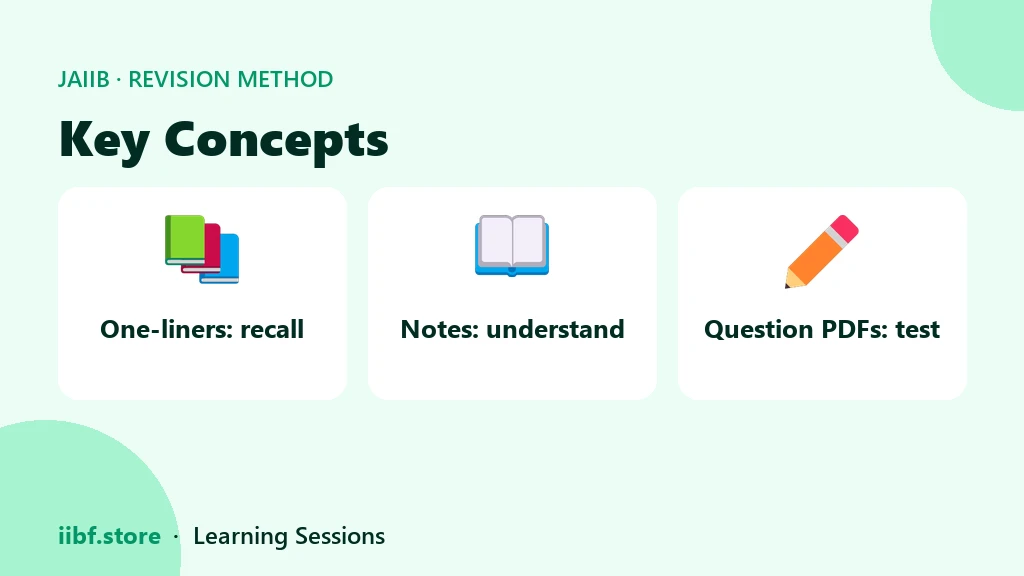
| One-liner PDFs | Fast recall of facts, figures, thresholds and section numbers | Daily, from week two onward | 10–15 minutes |
The coverage runs across JAIIB, all the CAIIB papers including the electives, bank promotion preparation and the IIBF certification courses such as Certified Credit Professional, MSME and KYC/AML. There is also a large block of material on government schemes, which is disproportionately useful because scheme questions are pure recall and appear in more than one paper. If you want the full inventory of what is available, we have written it up separately in what you actually get in the free study material, and everything sits on the free material library.
The three-pass method
Here is the method, and it is deliberately boring. Boring is what survives a working week.
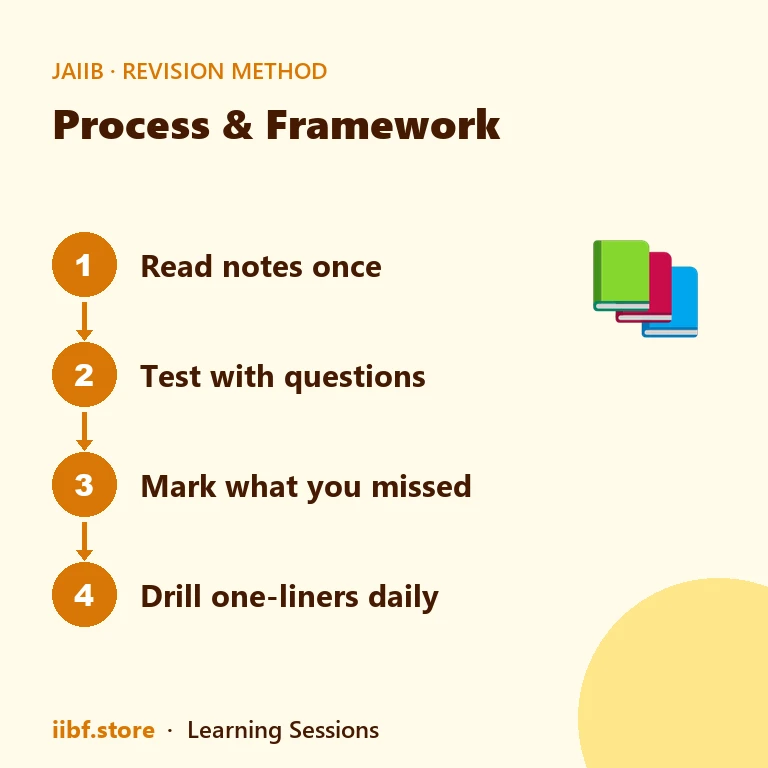
Pass one: read the notes once, slowly, and do not highlight. Highlighting feels like work and produces nothing. Instead, at the end of each section, close the file and write three lines in your own words. If you cannot write the three lines, you did not read it, you looked at it. This pass is about building a skeleton you can hang facts on later.
Pass two: attempt the question PDF cold, within a day. Not open-book. Not "let me revise first". Cold. The score does not matter and you should expect it to be bad. What matters is the list it produces — every question you got wrong is a precise, personal syllabus of what you do not know. That list is worth more than the notes themselves, because it is specific to you.
Pass three: drill the one-liners daily, forever. Ten minutes, same slot every day, no exceptions. One-liners are how thresholds, percentages, section numbers and scheme limits stay in your head over a long run-up. They are also the only part of this you can genuinely do on a commute or between customers at a branch counter.
One week of AFM, worked through
Abstract advice is easy to nod at and impossible to follow, so here is a concrete week for Accounting & Financial Management, assuming you are a working banker with roughly ninety minutes on weeknights.
Monday: notes on ratio analysis, sixty minutes, plus the three-line summaries. Tuesday: the ratio question PDF, cold, thirty minutes, then thirty minutes going through only the wrong answers. Wednesday: notes on the next chapter, and ten minutes of one-liners before bed. Thursday: question PDF for that chapter, same cold rule. Friday: nothing new — re-attempt Tuesday's wrong answers only, which should take fifteen minutes if the method is working. Saturday: a longer session, two chapters of notes. Sunday: a full mock on the test section, then one-liners.
That is five wrong-answer lists a fortnight, each one shrinking. It is far more effective than reading the same chapter four times, and it takes less total time. The same shape works for any paper — swap the chapter names and keep the rhythm. Paper-wise chapter lists are on the JAIIB course page if you need something to slot into the Monday and Saturday blocks.
Mistakes that waste a good PDF set
Three failure modes come up again and again. The first is collecting: downloading every file for all four papers on day one, which produces a folder so large it becomes intimidating rather than useful. Download one paper at a time. The second is reading questions as content — scrolling a question PDF and reading the answers along the way. That teaches recognition, not recall, and recognition collapses the moment the option wording changes. The third is treating one-liners as a final-week activity. They work through repetition over months; started in the last ten days they are just panic with extra steps.
One caution on currency. Free material of any origin ages, and banking numbers move — repo rates, priority sector targets, ombudsman limits, deposit insurance thresholds. When a figure will decide a mark, check it against a primary source such as iibf.org.in or the RBI site rather than trusting a PDF of unknown vintage. Our current RBI rates page tracks the ones that change most often, and the study planner will schedule the three passes against your actual exam date.
Download the set today, by all means. Then open the first note PDF tonight and write three lines. The JAIIB CAIIB revision PDFs are genuinely good material; they simply cannot do the work for you, and the candidates who clear are the ones who worked out that difference early.
Are the JAIIB CAIIB revision PDFs really free?
Yes. The notes, question sets and one-liner files are available at no cost, covering JAIIB, the CAIIB papers, bank promotion preparation and the IIBF certification courses.
Should I read the notes or attempt the questions first?
Notes first, then questions cold within twenty-four hours. Attempting questions before any reading wastes the diagnostic value of the attempt, and reading twice before attempting hides the gaps you need to find.
How many one-liners should I do a day?
Ten to fifteen minutes is enough, but it has to be daily. Consistency beats volume here — a hundred one-liners once a week is far weaker than twenty every day.
Do these PDFs replace the IIBF courseware?
No. Treat them as revision and testing layers on top of the prescribed syllabus. Check any figure, threshold or section number against the Institute's own material before relying on it in the exam.
Quick quiz on this topic
5 exam-style questions from our free test bank — check yourself before you move on.
Practice this topic
Take a free mock test, download chapter PDFs, or watch a video class — all included on iibf.store.
Keep reading