Liquidation Process Under IBC: From CIRP Failure to Asset Sale
When a corporate insolvency case cannot end in a rescue, the liquidation process under IBC takes over — winding down the corporate debtor, realising its assets, and paying creditors in an orderly, time-bound manner. For JAIIB and CAIIB candidates, this is the natural "what happens next" question after a failed resolution attempt, and examiners love testing the precise triggers, the liquidator's role, and the closure timeline. This article walks through each stage bankers need to know, from the Adjudicating Authority's liquidation order to final dissolution.
📉 When CIRP Fails: The Trigger for Liquidation
Liquidation under the IBC is not a standalone filing route for a distressed company — with a narrow exception for voluntary liquidation, it is the fallback once the corporate insolvency resolution process (CIRP) does not deliver a workable rescue. Section 33 of the Code lists the specific circumstances in which the National Company Law Tribunal (NCLT), acting as Adjudicating Authority, must pass a liquidation order. These include: the Committee of Creditors (CoC), by the requisite 66% voting share, decides to liquidate the corporate debtor any time before the resolution plan is confirmed; the CIRP period (including permitted extensions) lapses without a resolution plan being received or approved; the NCLT rejects a resolution plan for non-compliance with Section 30(2); or the resolution professional applies to the NCLT because the approved plan is being contravened and the debtor's affairs are prejudicial to stakeholders.
Once passed, the liquidation order effectively converts the moratorium that shielded the debtor during CIRP into a fresh legal footing under Section 33(5) — no suit or legal proceeding can be instituted against the corporate debtor without the NCLT's leave, except by the liquidator itself. The order also directs that the liquidation process be conducted in the manner laid down in Chapter III of the Code, read with the IBBI (Liquidation Process) Regulations. Understanding this trigger is foundational, because a large share of case-study questions test whether a fact pattern (CoC vote share, missed timeline, plan rejection) actually satisfies Section 33 or is a red herring.
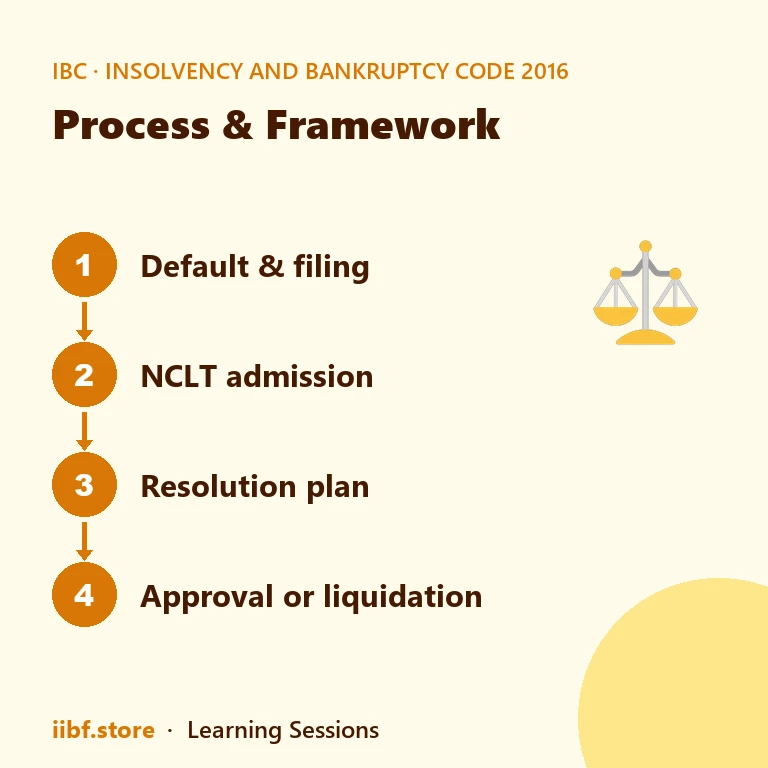
💡 Exam Tip: Memorise the four Section 33 triggers as a checklist — CoC decides to liquidate (66% vote), CIRP period lapses, plan rejected by NCLT, or approved plan contravened. Case studies usually hinge on which trigger applies.
⚖️ Appointment of the Liquidator and Public Announcement
Section 34 governs who takes charge once liquidation begins. As a default rule, the resolution professional who was functioning during CIRP continues as the liquidator, unless the CoC — by a majority of 66% voting share — resolves to replace that person, or the NCLT itself directs a change (for instance, on grounds of contravention or a Section 34(4) trigger such as the resolution professional's failure to submit a resolution plan). Every liquidator must be a registered insolvency professional and must give a written consent under Form AA before appointment, since the role attracts significant fiduciary responsibility and personal accountability under the IBBI framework. Readers who want the mechanics of how an interim resolution professional first becomes RP should revisit the earlier stage covered in roles and duties of IRP and RP, since liquidator powers build directly on that foundation.
From the liquidation commencement date, Section 33(7) treats the order as a notice of discharge to the corporate debtor's officers, employees and workmen, except where the liquidator needs their continued cooperation to run the business. The liquidator must make a public announcement within a prescribed period, calling upon stakeholders to submit their claims with proof, and must also request the National Company Law Tribunal-appointed forum to consolidate claims and form the asset base of the "liquidation estate" under Section 36. All assets that were part of the corporate debtor — barring specific exclusions like assets held in trust, personal assets of promoters, or assets subject to a security interest not relinquished — flow into this estate for realisation and distribution.
⚠️ Common Mistake: Candidates often assume liquidation always means the same resolution professional loses the assignment. In practice, continuity is the default — replacement needs a specific CoC resolution or NCLT direction.
🏛️ Stakeholders' Consultation Committee and Asset Sale
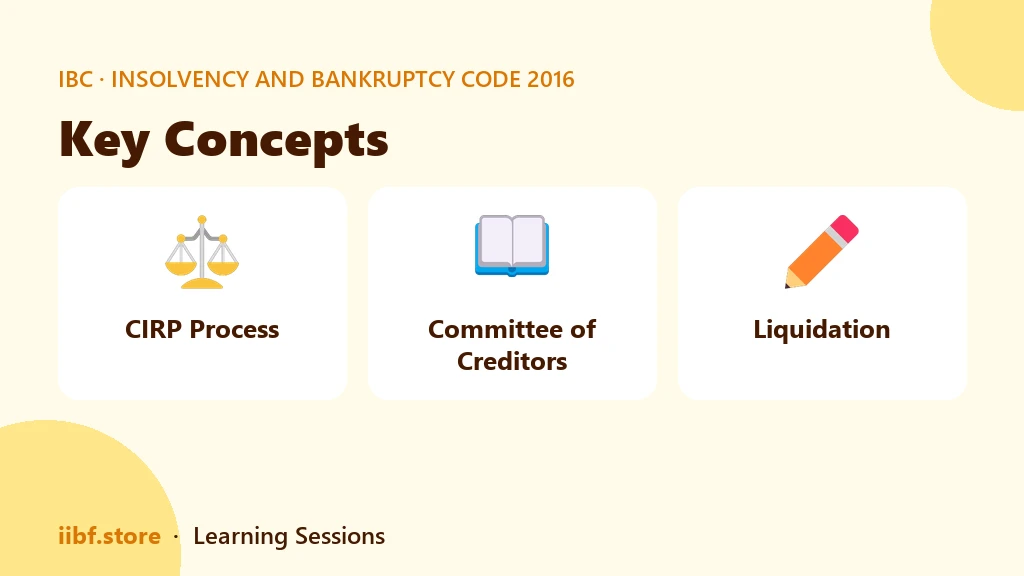
Because the Committee of Creditors dissolves once liquidation begins, the IBBI (Liquidation Process) Regulations created the Stakeholders' Consultation Committee (SCC) — a body of up to ten members representing secured and unsecured financial creditors, workmen, employees and other stakeholders in proportion to their claims. The SCC's role is advisory rather than binding: the liquidator must consult it on decisions such as the manner of sale, engagement of professional valuers, and the timeline for realising assets, but the liquidator is not obliged to follow its advice, provided reasons for deviation are recorded. This is a deliberate design choice — unlike the CoC's commercial-wisdom control over a resolution plan, liquidation is meant to be liquidator-driven and time-bound.
On the sale itself, the regulatory preference is to first attempt selling the corporate debtor (or its business) as a going concern, since that typically preserves more value and employment than a piecemeal, asset-by-asset sale. Only if a going-concern sale is not achievable does the liquidator move to selling individual assets, groups of assets, or the corporate debtor's shareholding, ordinarily through an auction process with adequate publicity to maximise realisation. Secured creditors also get a distinct choice under Section 52: they may either relinquish their security interest into the common liquidation estate and be paid in the Section 53 waterfall, or realise the security outside the liquidation process — but any surplus after satisfying their debt must be handed back to the liquidator for the estate. Banks holding NBFC exposures should note that similar creditor-priority logic underlies broader lending frameworks; see how non-banking financial companies in India are regulated for a related JAIIB IEIFS angle on secured lending.
📌 Remember: Once assets are realised, distribution still follows the Section 53 waterfall — liquidation costs and workmen's dues rank ahead of unsecured financial creditors and government dues.
⏳ Liquidation Timeline and Closure of the Process
Liquidation under the IBC is designed to be time-bound, not open-ended. The IBBI (Liquidation Process) Regulations require the liquidator to ordinarily complete the entire process — public announcement, claims consolidation, asset realisation and distribution — within one year from the liquidation commencement date, with periodic progress reports filed with the NCLT and the IBBI. Delays beyond this window attract scrutiny and must be justified with specific reasons, since prolonged liquidations erode asset value and stakeholder confidence, the very problem the Code was enacted to fix. This contrasts with the earlier regime under the Companies Act, where winding-up proceedings could stretch on for years without a firm outer limit.
Once all assets are realised and proceeds distributed per Section 53, the liquidator applies to the NCLT for dissolution of the corporate debtor under Section 54. On passing the dissolution order, the corporate debtor ceases to exist as a legal entity, and a copy of the order must be forwarded to the authority with which the company is registered (the Registrar of Companies) within seven days. It is worth distinguishing this NCLT-driven route — which begins from a failed or abandoned CIRP — from the separate procedure a solvent company follows when its own members choose to wind up voluntarily; that process is covered in detail in the guide on voluntary liquidation under IBC. Bankers should also track how the Failure of CIRP or Business: Liquidation and Voluntary Liquidation chapter frames both routes side by side, since exam questions frequently ask candidates to tell them apart.
| Parameter | Resolution (Successful CIRP) | Liquidation (Section 33) |
|---|---|---|
| Trigger | Resolution plan approved by CoC and NCLT | CoC vote, timeline lapse, plan rejection, or contravention |
| Governing provision | Section 31 | Section 33 |
| Company survives as a going concern under new management | ✅ | ❌ (unless sold as going concern to a buyer) |
| Controlling body | Committee of Creditors | Liquidator, advised by Stakeholders' Consultation Committee |
| Typical statutory timeline | 330 days (including litigation) | 1 year from liquidation commencement |
| Outcome | Debtor continues operations | Assets realised, proceeds distributed, entity dissolved |
🧠 Practice MCQs: Liquidation Process under IBC
Q1. Under Section 33 of the IBC, which of the following is a valid ground for the NCLT to pass a liquidation order? (a) The corporate debtor has fewer than 10 employees (b) The Committee of Creditors, with 66% voting share, decides to liquidate before a resolution plan is approved (c) The information utility has incomplete records (d) The registered valuer resigns mid-process
Answer: (b) — A CoC decision to liquidate, backed by the requisite 66% voting share, is one of the four express triggers under Section 33.
Q2. Who ordinarily continues as the liquidator once a liquidation order is passed, unless replaced? (a) A retired NCLAT judge (b) The Registrar of Companies (c) The resolution professional who managed the CIRP (d) The chairperson of the Stakeholders' Consultation Committee
Answer: (c) — Section 34 provides that the CIRP resolution professional continues as liquidator by default, unless the CoC or NCLT directs otherwise.
Q3. What is the primary role of the Stakeholders' Consultation Committee (SCC) during liquidation? (a) To approve the final resolution plan (b) To advise the liquidator on matters like asset sale, subject to the liquidator recording reasons for any deviation (c) To replace the Adjudicating Authority (d) To collect statutory dues on behalf of the government
Answer: (b) — The SCC's function is advisory; the liquidator may deviate from its advice provided the reasons are documented.
Q4. Within what period is the liquidator ordinarily required to complete the liquidation process from the liquidation commencement date, under IBBI regulations? (a) 90 days (b) 180 days (c) One year (d) Five years
Answer: (c) — The IBBI (Liquidation Process) Regulations require liquidation to ordinarily be completed within one year, with reasons required for any delay.
Q5. Under Section 52, if a secured creditor realises its security interest outside the liquidation process, what must it do with any surplus after satisfying its debt? (a) Retain the surplus (b) Remit the surplus to the liquidator to form part of the liquidation estate (c) Transfer the surplus to the IBBI (d) Distribute the surplus directly to workmen
Answer: (b) — Any surplus after the secured creditor recovers its debt must be handed over to the liquidator for the common liquidation estate.
Want chapter-wise mock tests with 100+ MCQs? Start practising free →
What is the difference between liquidation and voluntary liquidation under the IBC?
Liquidation under Section 33 is ordered by the NCLT after a failed or abandoned CIRP, whereas voluntary liquidation under Section 59 is initiated by a solvent corporate debtor's own members or partners who choose to wind up the entity.
Who appoints the liquidator in the liquidation process under IBC?
The resolution professional handling the CIRP ordinarily continues as liquidator under Section 34, unless the Committee of Creditors resolves to replace the person or the NCLT directs a change.
What happens to employees when a liquidation order is passed?
The liquidation order is treated as a notice of discharge to officers, employees and workmen, except where the liquidator retains their services to keep the business running for a going-concern sale.
How does liquidation end under the IBC?
Once assets are realised and proceeds distributed per the Section 53 waterfall, the liquidator applies to the NCLT for dissolution of the corporate debtor under Section 54, after which the company ceases to legally exist.
🏁 Getting Liquidation Right for Your IIBF Exam
The liquidation process under IBC is one of the highest-yield topics for JAIIB and CAIIB candidates precisely because it sits at the intersection of several Code provisions — Section 33 triggers, Section 34 appointment, Section 52 secured-creditor choices, and Section 54 dissolution. For related exam context, compare this against the approval mechanics covered in resolution plan approval under IBC and the appeal ladder explained in NCLT and NCLAT under IBC, since liquidation orders themselves can be appealed through the same forums. Browse more coverage on the Insolvency and Bankruptcy Code tag hub, and when you're ready to test your recall under exam conditions, take a free chapter-wise mock test to lock in these provisions before exam day.
Prefer revising from a printed book?
Chapter-wise books with MCQs after every chapter — minimal pages, complete coverage, delivered anywhere in India. Every book has a free sample to read first.


























Quick quiz on this topic
5 exam-style questions from our free test bank — check yourself before you move on.
Practice this topic
Take a free mock test, download chapter PDFs, or watch a video class — all included on iibf.store.