NCLT and NCLAT Under IBC: Adjudicating Authority and Appeal Ladder (2026)
Every insolvency case filed under the Code lands on the desk of a specialist tribunal, and understanding NCLT and NCLAT under IBC is one of the highest-yield areas in the IIBF Insolvency and Bankruptcy Code exam. The National Company Law Tribunal (NCLT) is the adjudicating authority that admits, monitors and closes corporate insolvency cases, while the National Company Law Appellate Tribunal (NCLAT) hears appeals against its orders. Candidates routinely lose marks by confusing which body has original jurisdiction, which handles appeals, and the strict timelines that govern each stage. This guide breaks down the powers, jurisdiction, appeal ladder and exam traps around NCLT and NCLAT under IBC so you can answer confidently under time pressure.
🏛️ What Is the Adjudicating Authority Under IBC
Section 5(1) of the Insolvency and Bankruptcy Code, 2016 defines the "Adjudicating Authority" for corporate persons as the NCLT. A corporate person means a company incorporated under the Companies Act, a Limited Liability Partnership, or any other person incorporated with limited liability — but crucially it excludes financial service providers. So whenever a company or LLP defaults, the case is filed before the NCLT bench having territorial jurisdiction over the registered office of the corporate debtor, as laid down in Section 60(1).
The NCLT was constituted under Section 408 of the Companies Act, 2013 and functions through multiple benches across India, with the Principal Bench at New Delhi. It is a quasi-judicial body: each bench is headed by a judicial member and a technical member. For individuals and partnership firms — including personal guarantors in certain situations — the adjudicating authority is instead the Debt Recovery Tribunal under Section 179. This split between NCLT (corporates) and DRT (individuals/firms) is a favourite one-mark question. To see how the tribunal fits into the wider machinery, review the structure of the IBC before attempting the paper.
📌 Exam Tip: Remember the mapping — NCLT for corporate persons, DRT for individuals and partnership firms. The word "corporate" in the question is your signal that the answer is NCLT, not DRT.
⚖️ NCLT: Powers, Jurisdiction and Key Timelines
The NCLT's role begins the moment an application is filed under Section 7 (financial creditor), Section 9 (operational creditor) or Section 10 (corporate applicant). On admission, the tribunal declares a moratorium, appoints an interim resolution professional and triggers the public announcement. Under Section 7(4) the NCLT is expected to ascertain the existence of default and admit or reject the application within 14 days of receipt — though the Supreme Court has clarified this period is directory, not mandatory, so delay alone does not invalidate proceedings.
Section 60(5) grants the NCLT sweeping residuary jurisdiction to decide any question of law or fact arising in the insolvency of a corporate debtor, which is why disputes over avoidance transactions, resolution plan objections and liquidation issues all funnel back to it. The tribunal also approves the resolution plan under Section 31 and passes the liquidation order where resolution fails. Understanding how a case reaches the tribunal is easier once you have studied the initiation of the insolvency process. The overall CIRP must conclude within 330 days including litigation time, and it is the NCLT that grants or refuses any extension. For deeper context on how the tribunal scrutinises the final plan, see our note on resolution plan approval under IBC.
💡 Remember: The 14-day admission window under Section 7(4) is directory. Exam options that call it a strict mandatory deadline that voids the case are almost always the wrong answer.
🔺 NCLAT and the Appeal Ladder
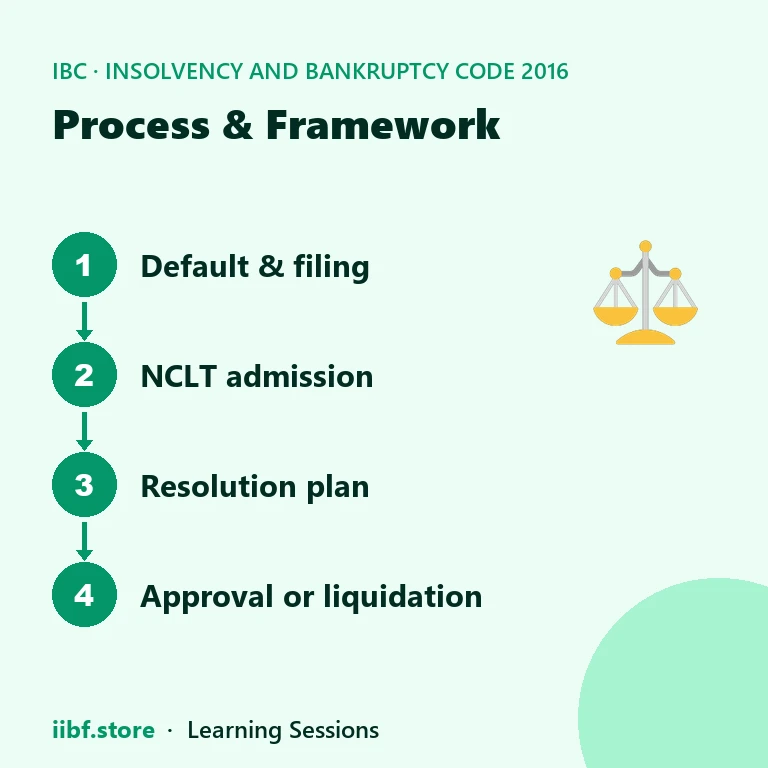
Any person aggrieved by an order of the NCLT may appeal to the NCLAT under Section 61 of the Code. The appeal must be filed within 30 days of the order. If the appellant shows sufficient cause for the delay, the NCLAT may condone a further period not exceeding 15 days — giving a hard outer limit of 45 days. The grounds of appeal against an approved resolution plan are deliberately narrow and are listed in Section 61(3), covering material irregularity, contravention of law, and non-compliance with statutory priorities.
The NCLAT was constituted under Section 410 of the Companies Act, 2013 and sits as the single appellate forum for both IBC and company-law matters, with its Principal Bench at New Delhi and a bench at Chennai. From the NCLAT, a further appeal lies to the Supreme Court under Section 62, but only on a question of law, and it must be filed within 45 days (extendable by another 15 days for sufficient cause). This tiered ladder — NCLT, then NCLAT, then Supreme Court — is examined almost every session. Because the resolution professional's conduct is often the subject of appeals, revise the role of the resolution professional under IBC alongside this topic, and note how the distinction between financial and operational creditors often decides who has standing to appeal.
📊 NCLT vs NCLAT vs DRT: Quick Comparison
The single most effective revision tool for this chapter is a side-by-side comparison of the forums and their timelines. The table below consolidates the jurisdiction, governing sections and appeal routes you must memorise. Notice how appeals always move upward and how only corporate persons touch the NCLT, whereas individuals and partnership firms are routed through the DRT. Keeping these lanes separate prevents the most common mistakes seen in the objective paper.
| Forum | Deals with corporates | Governing section (IBC) | Appeal lies to | Appeal time limit |
|---|---|---|---|---|
| NCLT (Adjudicating Authority) | ✔ Yes | Section 60(1) | NCLAT | 30 + 15 days |
| NCLAT (Appellate Tribunal) | ✔ Yes | Section 61 | Supreme Court | 45 + 15 days |
| DRT (individuals / firms) | ✘ No | Section 179 | DRAT | 30 days |
| Supreme Court | ✔ Yes (law only) | Section 62 | Final | — |
⚠️ Common Mistake: Students write that appeals from NCLT go directly to the High Court. They do not — IBC appeals bypass High Courts entirely and go to the NCLAT, then to the Supreme Court on a question of law.
🎯 How These Questions Appear in the IIBF Exam
IIBF frames this topic in three predictable ways. First, direct recall: "Which is the adjudicating authority for corporate persons under IBC?" — answer NCLT. Second, timeline traps: matching 30 days to NCLAT appeals, 45 days to Supreme Court appeals, and 14 days to admission of the application. Third, jurisdiction sorting: given a defaulting LLP versus a defaulting proprietor, deciding whether the case goes to NCLT or DRT. Reading the question stem carefully for the words "corporate person", "appeal" or "question of law" usually reveals the intended answer.
Because the same tribunal handles the closing stages, it helps to connect this material with the liquidation and voluntary liquidation route, where the NCLT passes the liquidation order. Bankers preparing for recovery-law papers should also compare this forum with the parallel machinery explained in our guide to the Debt Recovery Tribunal process for banks, since the DRT is both an IBC adjudicating authority for individuals and a SARFAESI/RDDBFI forum. For structured practice, browse more explainers in the Insolvency and Bankruptcy Code hub and lock in the timelines with full-length mock tests. Candidates targeting the professional exam can also map this into the wider CAIIB syllabus where stressed-asset resolution recurs.
🧠 Practice MCQs: NCLT and NCLAT Under IBC
Q1. Under the IBC 2016, who is the adjudicating authority for corporate persons? (a) DRT (b) High Court (c) NCLT (d) SEBI
Answer: (c) — Section 5(1) read with Section 60(1) makes the NCLT the adjudicating authority for corporate debtors.
Q2. An appeal against an order of the NCLT must be filed before the NCLAT within how many days? (a) 15 days (b) 30 days (c) 45 days (d) 90 days
Answer: (b) — Section 61 prescribes 30 days, extendable by a further 15 days for sufficient cause.
Q3. An appeal from an order of the NCLAT lies to the Supreme Court on: (a) any ground (b) a question of law only (c) a question of fact only (d) no appeal is allowed
Answer: (b) — Under Section 62, the appeal to the Supreme Court is limited to a question of law.
Q4. For personal insolvency of individuals and partnership firms, the adjudicating authority is: (a) NCLT (b) NCLAT (c) DRT (d) Civil Court
Answer: (c) — Section 179 designates the Debt Recovery Tribunal as the adjudicating authority for individuals and partnership firms.
Q5. The NCLT is expected to admit or reject an application under Section 7 within: (a) 7 days (b) 14 days (c) 30 days (d) 60 days
Answer: (b) — Section 7(4) provides a 14-day period, held by the Supreme Court to be directory rather than mandatory.
Want chapter-wise mock tests with 100+ MCQs? Start practising free
❓ Frequently Asked Questions
Authoritative reference: see the latest guidelines on the Reserve Bank of India website and the IIBF syllabus portal.
Is the NCLT a court or a tribunal?
It is a quasi-judicial tribunal constituted under Section 408 of the Companies Act, 2013, exercising powers similar to a civil court but operating outside the regular court hierarchy.
Can an NCLT order be challenged in a High Court?
No. Appeals under the IBC bypass the High Courts. The correct route is an appeal to the NCLAT, and thereafter to the Supreme Court on a question of law.
What is the maximum time to file an NCLAT appeal?
Thirty days from the order, plus a maximum condonable delay of 15 days on showing sufficient cause — an outer limit of 45 days.
Does the NCLT handle personal guarantor insolvency?
Where the corporate debtor is already before the NCLT, the personal guarantor's case is also filed before the NCLT; otherwise personal insolvency of individuals is adjudicated by the DRT.
Master the tribunals, timelines and appeal ladder and you have secured a reliable cluster of marks in the IBC paper. Reinforce this chapter with targeted questions on our IBC mock tests and keep revising the linked chapters until the sections and day-limits are automatic.
Prefer revising from a printed book?
Chapter-wise books with MCQs after every chapter — minimal pages, complete coverage, delivered anywhere in India. Every book has a free sample to read first.













Quick quiz on this topic
5 exam-style questions from our free test bank — check yourself before you move on.
Practice this topic
Take a free mock test, download chapter PDFs, or watch a video class — all included on iibf.store.