Pre-Packaged Insolvency Resolution Process: An IBC 2016 Exam Guide (2026)
When banks restructure stressed MSME accounts, timing matters more than paperwork. India's pre-packaged insolvency resolution process is the fast-track mechanism the IBC 2016 created specifically for micro, small and medium enterprises — a debtor-in-possession model designed to reach resolution within 120 days instead of dragging through a full CIRP. For JAIIB and CAIIB candidates, this is a high-yield topic: examiners love testing the thresholds, timelines and the "Swiss challenge" mechanism that make it distinct from the ordinary corporate insolvency route. This guide breaks down eligibility, process flow, and the exact numbers you need to remember.
📜 What Is the Pre-Packaged Insolvency Resolution Process?
The pre-packaged insolvency resolution process (PPIRP) was inserted into the IBC through the Insolvency and Bankruptcy Code (Amendment) Act, 2021, which added a new Chapter III-A covering Sections 54A to 54P. Unlike the regular route, a pre-pack begins with informal negotiation between the corporate debtor and its financial creditors before any application reaches the tribunal. By the time the case is filed at the National Company Law Tribunal, the debtor already has a base resolution plan ready, and a majority of unrelated financial creditors have already agreed to the broad shape of the deal. This "pre-negotiated" structure is why the mechanism traces its lineage back to the reforms discussed in our chapter on the Evolution of Insolvency and Bankruptcy Code, and it sits within the overall framework laid out in Chapter 4 - Structure of the IBC. Crucially, the corporate debtor's board and promoters continue running day-to-day operations throughout — there is no handover of management keys the way there is in a standard case.
🏭 Eligibility: Which MSMEs Can Use Pre-Pack Under IBC
Only corporate debtors classified as micro, small or medium enterprises under the MSMED Act, 2006 can invoke this route, and only for a default of at least Rs 1 crore (raised from the earlier Rs 10 lakh floor via a later notification, so always check the current threshold notified under Section 4). The debtor must not have undergone a CIRP or a pre-pack in the preceding three years, and no CIRP or liquidation order should already exist against it. Before filing, the debtor needs approval from unrelated financial creditors holding at least 66% of the debt by value, plus a special resolution or resolution of majority partners approving the pre-pack application. This upfront creditor buy-in is what separates the process from an ordinary application discussed in our chapter on Credit Recovery Laws for Banks.
💡 Exam Tip: Remember the 66% financial creditor threshold for pre-pack approval — examiners frequently swap it with the 90% threshold used for withdrawal under Section 12A or the 75% CoC voting norm for other CIRP decisions.
⏱️ Pre-Pack vs Regular CIRP: Timeline & Process Differences
The clearest way to lock this topic in for the exam is a side-by-side comparison. A pre-pack is deliberately compressed: the corporate debtor is the only party who can file, management stays with the existing board, and the entire process — from admission to resolution plan approval — is capped at 120 days, with the resolution professional required to submit the plan to the adjudicating authority within 90 days of the start date. Compare that to a regular case, which any of the debtor, financial creditor, or operational creditor can trigger, control shifts to the resolution professional, and the outer limit runs to 330 days including litigation.
| Feature | Pre-Pack IRP | Regular CIRP |
|---|---|---|
| Who can file | Corporate debtor only ✅ | Debtor, financial creditor, or operational creditor ✅ |
| Management control | Debtor-in-possession ✅ | RP takes over management ❌ (debtor loses control) |
| Outer time limit | 120 days | 330 days (incl. litigation) |
| Base resolution plan | Required before filing ✅ | Not required ❌ |
| Swiss challenge option | Yes, if base plan impairs operational creditors | Not applicable ❌ |
| Eligible entities | MSMEs only | All corporate debtors |
👥 Role of the Resolution Professional in Pre-Pack Proceedings
A resolution professional is still appointed in a pre-pack, but the role is closer to supervisory oversight than the full management takeover seen in a standard case. The RP confirms the base resolution plan meets the mandatory contents, invites and collates claims from creditors, conducts committee of creditors meetings to vote on the plan, monitors the debtor's affairs to ensure no value is stripped out, and can apply to the adjudicating authority for a vesting order if the debtor's conduct is prejudicial. The RP's appointment itself needs approval from 66% of unrelated financial creditors, mirroring the same duties detailed in our chapter on Roles and Duties of IRP and RP, though the powers exercised are narrower than in a full CIRP.
⚠️ Common Mistake: Candidates assume the RP takes over management in a pre-pack exactly as in CIRP. It does not — the board of directors and promoters continue to run the company, which is the entire point of the "debtor-in-possession" design.
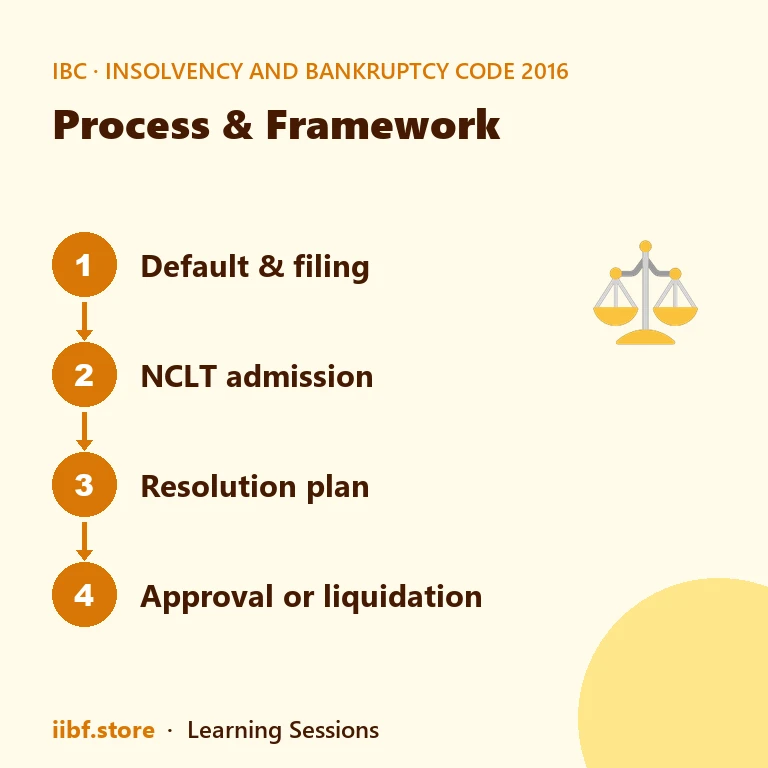
🔁 Base Resolution Plan, Swiss Challenge & NCLT Approval
The base resolution plan is prepared by the promoters or debtor before the tribunal application and submitted to the resolution professional once the process begins. If this base plan impairs the claims of operational creditors, or if it doesn't meet the committee's approval, the RP must invite competing resolution plans from the market through what practitioners call the Swiss challenge — third parties can submit rival plans, and the original base-plan proponent gets a chance to match or improve the winning bid. The committee of creditors must approve a final plan with 66% voting share, and the National Company Law Tribunal is required under Section 54D to approve or reject the plan within 30 days of receipt. This mirrors the resolution-plan approval discipline covered in Chapter 8 - Catalysing Successful Resolution Plan. If the CoC doesn't approve any plan within 90 days, the RP must file an application either to terminate the pre-pack or to convert it into a regular case.
📌 Remember: Two clocks run in parallel — 90 days for CoC approval of a resolution plan, and 120 days as the absolute outer limit for the entire pre-pack process, NCLT approval included.
🎯 Exam Angles: Pre-Pack Questions in JAIIB/CAIIB
Question setters like to test how pre-pack interacts with the rest of the Code. The moratorium under Section 14 IBC still applies once a pre-pack is admitted, freezing suits and asset transfers just as it would in a full case. Look-back periods for avoidance transactions under IBC continue to apply, so preferential or undervalued transfers made before the pre-pack filing can still be clawed back. The disqualifications under Section 29A eligibility for resolution applicants apply equally to anyone submitting a competing plan in the Swiss challenge. And if a pre-pack fails and converts to liquidation, the payout still follows the same order set out under Section 53 liquidation waterfall. For the regulatory backbone of all this, the IBBI's pre-pack regulations are worth a direct read at ibbi.gov.in, and the broader compliance framework is covered in our chapter on Regulatory & Miscellaneous Aspects.
Browse more IBC 2016 exam guides on the blog, check the latest RBI rates and IIBF news for updates, or browse the full exam prep blog.
🧠 Practice MCQs: Pre-Packaged Insolvency Resolution Process
Q1. Who can file an application to initiate the pre-packaged insolvency resolution process? (a) Any financial creditor (b) Any operational creditor (c) Only the corporate debtor (d) The IBBI
Answer: (c) — Unlike regular CIRP, only the corporate debtor itself can initiate a pre-pack application.
Q2. What is the outer time limit for completing the pre-packaged insolvency resolution process? (a) 90 days (b) 120 days (c) 180 days (d) 330 days
Answer: (b) — Section 54D caps the entire pre-pack process, including NCLT approval, at 120 days.
Q3. Under pre-pack, who remains in control of the corporate debtor's management? (a) The resolution professional (b) The committee of creditors (c) The existing board/promoters (d) The NCLT
Answer: (c) — Pre-pack is a debtor-in-possession model, so existing management continues to run operations.
Q4. What percentage of unrelated financial creditors must approve before a pre-pack application is filed? (a) 51% (b) 66% (c) 75% (d) 90%
Answer: (b) — At least 66% of unrelated financial creditors by value must approve before filing.
Q5. The "Swiss challenge" mechanism in a pre-pack is used to: (a) Appoint the resolution professional (b) Invite competing plans against an inadequate base resolution plan (c) Extend the moratorium period (d) Convert the case to liquidation
Answer: (b) — If the base resolution plan doesn't satisfy the CoC or impairs operational creditors, competing plans are invited via Swiss challenge.
Want chapter-wise mock tests with 100+ MCQs? Start practising free →
❓ Frequently Asked Questions
Which entities are eligible to use the pre-packaged insolvency resolution process?
Only corporate debtors classified as micro, small or medium enterprises under the MSMED Act, 2006 can apply, subject to the minimum default threshold and no CIRP/pre-pack history in the preceding three years.
Can a pre-pack convert into a regular CIRP?
Yes. If the committee of creditors doesn't approve a resolution plan within the internal timeline, the resolution professional must apply to either terminate the pre-pack or convert it into a full corporate insolvency resolution process.
Does the moratorium apply during a pre-pack?
Yes, once admitted, the same protective moratorium that freezes suits, asset transfers and recovery actions applies during a pre-pack, just as it does in a regular case.
Which section of the IBC governs pre-packaged insolvency?
Chapter III-A, comprising Sections 54A to 54P, inserted by the Insolvency and Bankruptcy Code (Amendment) Act, 2021, governs the pre-packaged insolvency resolution process.
Mastering the pre-packaged insolvency resolution process means knowing exactly where it borrows from — and departs from — the regular CIRP playbook. Lock in the thresholds and timelines with a full CAIIB or JAIIB course, then test yourself on iibf.store/tests before exam day.
Prefer revising from a printed book?
Chapter-wise books with MCQs after every chapter — minimal pages, complete coverage, delivered anywhere in India. Every book has a free sample to read first.
132 pages · 225 MCQs
Learning Sessions · Ashish Sir
188 pages · 435 MCQs
Learning Sessions · Ashish Sir
117 pages · 236 MCQs
Learning Sessions · Ashish Sir
Learning Sessions · Ashish Sir
118 pages · 299 MCQs
Learning Sessions · Ashish Sir
Learning Sessions · Ashish Sir
Learning Sessions · Ashish Sir
Learning Sessions · Ashish Sir
115 pages · 255 MCQs
Learning Sessions · Ashish Sir
Learning Sessions · Ashish Sir
334 pages · 936 MCQs
Learning Sessions · Ashish Sir
Learning Sessions · Ashish Sir
115 pages · 344 MCQs
Learning Sessions · Ashish Sir
107 pages · 240 MCQs
Learning Sessions · Ashish Sir
90 pages · 150 MCQs
Learning Sessions · Ashish Sir
Learning Sessions · Ashish Sir
131 pages · 672 MCQs
Learning Sessions · Ashish Sir
221 pages · 831 MCQs
Learning Sessions · Ashish Sir
128 pages · 524 MCQs
Learning Sessions · Ashish Sir
107 pages · 445 MCQs
Learning Sessions · Ashish Sir
148 pages · 478 MCQs
Learning Sessions · Ashish Sir
151 pages · 465 MCQs
Learning Sessions · Ashish Sir
148 pages · 375 MCQs
Learning Sessions · Ashish Sir
216 pages · 895 MCQs
Learning Sessions · Ashish Sir
109 pages · 300 MCQs
Learning Sessions · Ashish Sir
104 pages · 360 MCQs
Learning Sessions · Ashish Sir
82 pages · 297 MCQs
Learning Sessions · Ashish Sir
151 pages · 600 MCQs
Learning Sessions · Ashish Sir
98 pages · 282 MCQs
Learning Sessions · Ashish Sir
Quick quiz on this topic
5 exam-style questions from our free test bank — check yourself before you move on.
Practice this topic
Take a free mock test, download chapter PDFs, or watch a video class — all included on iibf.store.