Technology Risk Management in Banks: IIBF RM Guide 2026
For the IIBF Risk Management certificate exam, technology risk management in banks is one of the fastest-growing focus areas — and one candidates most often underestimate. As Indian banks push deeper into core banking systems, UPI rails, cloud hosting, and API-driven fintech partnerships, technology has become both a growth engine and a risk vector in its own right. This guide breaks down what technology risk means in the banking context, how RBI expects banks to govern it, and the exact points examiners look for when this module comes up in the paper.
📱 What Is Technology Risk in Banking?
Technology risk refers to the possibility of loss arising from inadequate or failed IT systems, infrastructure, applications, or third-party technology services used by a bank. It sits inside the broader family of risks that examine failures of people, processes, and systems rather than failures of a borrower or a market movement. Typical triggers include core banking system outages, data centre failures, software bugs in loan or payment processing, obsolete hardware that can no longer be patched, and disruption caused by a cyber-attack.
What makes this category distinct in 2026 is scale: a single technology failure at a large bank can simultaneously disrupt ATMs, UPI, mobile banking, and NEFT/RTGS processing for millions of customers within minutes — something a purely process-based failure rarely does. Examiners expect candidates to recognise that technology risk is not "just an IT department problem." It has direct capital, reputational, customer-trust, and regulatory-reporting consequences, which is exactly why the IIBF Risk Management syllabus treats it as an examinable topic in its own right rather than a footnote.
🔐 Key Sources of Technology Risk in Indian Banks
Candidates should be able to list and explain the main sources examiners test. First is cyber risk — phishing, ransomware, DDoS attacks, and unauthorised access attempts targeting core banking and payment systems. Second is legacy system risk, where old, poorly documented software increases the chance of an undetected failure during upgrades. Third is third-party or vendor risk, since most banks now outsource data centres, cloud hosting, and even parts of loan origination to fintech partners — a failure anywhere in that chain becomes the bank's risk. Fourth is data privacy risk, sharpened considerably by the Digital Personal Data Protection (DPDP) Act, 2023, which raises the compliance stakes around customer data handling. Fifth is concentration risk within technology itself — over-reliance on a single cloud provider or a single payment switch.
💡 Exam Tip: If a question describes a bank outsourcing IT infrastructure to a third party, the correct risk lens is usually "vendor/technology risk," even if the scenario also mentions cost savings — examiners are testing whether you can separate the business decision from the risk exposure it creates.
🏦 RBI's Framework for IT Governance and Cyber Security
RBI has issued specific, examinable guidance in this space. The Master Direction on IT Governance, Risk, Controls and Assurance Practices requires banks to have a Board-approved IT strategy, a dedicated IT Steering Committee, and clearly assigned accountability for cyber resilience — usually anchored around a Chief Information Security Officer (CISO). Separately, RBI's Cyber Security Framework for banks mandates a Board-approved cyber security policy distinct from the general IT policy, continuous system monitoring, and defined incident-reporting timelines. Major cyber incidents must be reported to CERT-In (the Indian Computer Emergency Response Team) within the prescribed window, alongside RBI notification. You can read the source guidance directly on the Reserve Bank of India's official website, which is worth bookmarking for the latest circulars on this theme.
⚠️ Common Mistake: Candidates often assume technology risk questions are only about hacking. In practice, IIBF papers test governance points just as heavily — Board oversight, CISO accountability, and audit trail requirements are asked about at least as often as cyber-attack scenarios.
📈 Managing and Mitigating Technology Risk
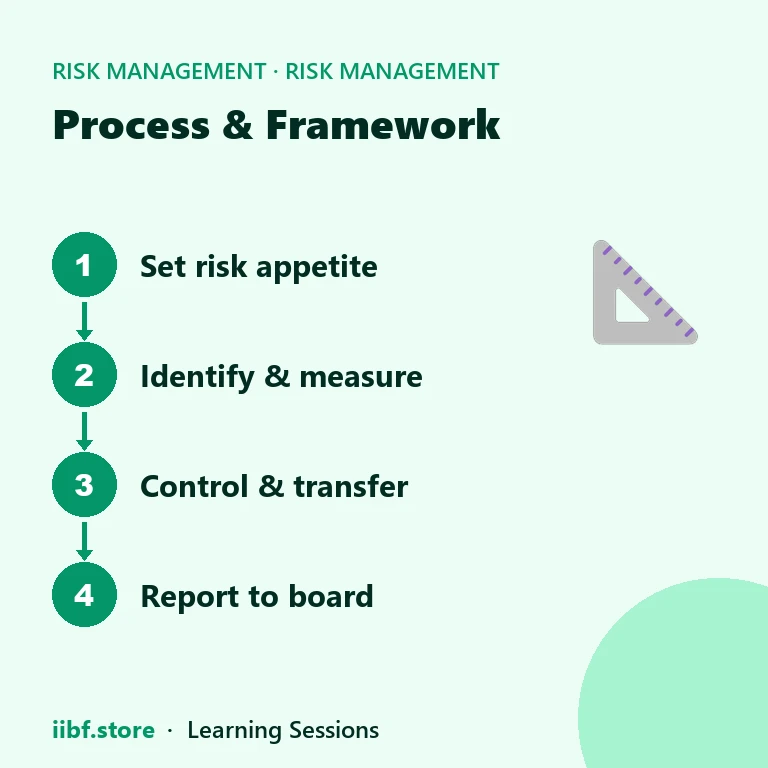
A sound technology risk management framework follows the same identify–assess–mitigate–monitor lifecycle used elsewhere in risk management, applied to IT-specific controls. Identification relies on asset inventories and threat modelling; assessment draws on incident history, which is why disciplined loss data collection practices matter even for technology events, not just credit or market losses. Mitigation tools include redundant data centres, tested Business Continuity Plans (BCP) and Disaster Recovery (DR) sites, regular penetration testing, and contractual SLAs with technology vendors. Monitoring is continuous — security operations centres (SOC), real-time transaction monitoring, and periodic cyber-drills.
Capital-wise, technology risk losses are captured within a bank's overall operational risk capital charge rather than as a separate Pillar 1 requirement — candidates should read this alongside the dedicated operational risk and management framework chapter. Ultimate accountability, however, sits with the Board and senior management — a theme covered in depth in the corporate governance chapter, which examiners frequently cross-link with technology risk case studies.
📌 Remember: Technology risk is managed, not eliminated — the exam rewards answers that talk about resilience (recovery time, backup systems, tested BCP) rather than answers that promise a "zero failure" system, which does not exist in practice.
Here's a quick reference on where common failure triggers sit, and whether RBI's dedicated IT/cyber framework applies directly:
| Risk Trigger | Example | RBI IT/Cyber Framework Applies Directly |
|---|---|---|
| Core banking system outage | Server or database failure disrupting transactions | ✅ |
| Cyber-attack | Ransomware, phishing, unauthorised access | ✅ |
| Vendor/third-party outage | Cloud host or payment switch downtime | ✅ |
| Adverse currency movement | Unhedged FX exposure on a trading book | ❌ |
For deeper context, pair this chapter with related IIBF Risk Management reads: reverse stress testing in banks, economic capital allocation, and ICAAP in banks. If you're studying across certificates, the wider IIBF exam-prep blog is a good place to browse other subjects, and you can find every article on this theme on the Risk Management articles hub.
🧠 Practice MCQs: Technology Risk Management
Q1. Under the Basel framework, technology risk is generally classified as a sub-category of which broader risk type? (a) Market risk (b) Credit risk (c) Operational risk (d) Liquidity risk
Answer: (c) — Technology risk arises from failed systems and processes, the defining feature of operational risk.
Q2. Which RBI instrument primarily governs IT governance, risk, controls and assurance practices at banks? (a) Basel III Framework (b) RBI Master Direction on IT Governance (c) SARFAESI Act (d) Companies Act, 2013
Answer: (b) — This Master Direction sets out Board-level IT governance and CISO accountability requirements.
Q3. A bank's core banking system suffers extended downtime due to a server failure. This is best classified as: (a) Credit risk (b) Technology/operational risk (c) Market risk (d) Reputational risk only
Answer: (b) — The root cause is a system failure; reputational damage may follow but is a consequence, not the primary category.
Q4. Which of the following is NOT a typical component of a bank's technology risk management framework? (a) Business Continuity Plan (BCP) (b) Vendor/third-party risk assessment (c) Fixed exchange rate hedging (d) Cyber incident response plan
Answer: (c) — Fixed exchange rate hedging is a market risk tool and unrelated to technology risk management.
Q5. As per RBI's cyber security guidelines, banks must report major cyber incidents to which agency? (a) SEBI (b) CERT-In (c) IRDAI (d) NPCI
Answer: (b) — Major cyber incidents must be reported to CERT-In within the prescribed timeline, alongside RBI.
Want chapter-wise mock tests with 100+ MCQs? Start practising free →
Frequently Asked Questions
Is technology risk part of the IIBF Risk Management syllabus?
Yes. It is examined as part of the operational risk module, with additional emphasis on RBI's IT governance and cyber security guidelines.
How is technology risk different from cyber risk?
Cyber risk is a subset of technology risk focused specifically on malicious attacks; technology risk also covers system outages, obsolete infrastructure, and vendor failures unrelated to any attack.
Which RBI guideline should candidates focus on for technology risk questions?
Focus on the Master Direction on IT Governance, Risk, Controls and Assurance Practices, and RBI's Cyber Security Framework for banks, including CERT-In reporting timelines.
Does technology risk carry a separate Basel capital charge?
No. Technology risk losses are captured within a bank's overall operational risk capital charge rather than as a distinct Pillar 1 requirement.
Technology risk management in banks is now a core, standalone examinable theme rather than a side note under operational risk — expect scenario-based questions on governance, RBI reporting timelines, and BCP/DR concepts. Lock in the concepts with a full-length mock and see exactly where you stand: take a free Risk Management practice test →
Prefer revising from a printed book?
Chapter-wise books with MCQs after every chapter — minimal pages, complete coverage, delivered anywhere in India. Every book has a free sample to read first.
Learning Sessions · Ashish Sir
132 pages · 225 MCQs
Learning Sessions · Ashish Sir
188 pages · 435 MCQs
Learning Sessions · Ashish Sir
117 pages · 236 MCQs
Learning Sessions · Ashish Sir
Learning Sessions · Ashish Sir
118 pages · 299 MCQs
Learning Sessions · Ashish Sir
Learning Sessions · Ashish Sir
Learning Sessions · Ashish Sir
Learning Sessions · Ashish Sir
115 pages · 255 MCQs
Learning Sessions · Ashish Sir
Learning Sessions · Ashish Sir
334 pages · 936 MCQs
Learning Sessions · Ashish Sir
115 pages · 344 MCQs
Learning Sessions · Ashish Sir
107 pages · 240 MCQs
Learning Sessions · Ashish Sir
90 pages · 150 MCQs
Learning Sessions · Ashish Sir
Learning Sessions · Ashish Sir
131 pages · 672 MCQs
Learning Sessions · Ashish Sir
221 pages · 831 MCQs
Learning Sessions · Ashish Sir
128 pages · 524 MCQs
Learning Sessions · Ashish Sir
107 pages · 445 MCQs
Learning Sessions · Ashish Sir
148 pages · 478 MCQs
Learning Sessions · Ashish Sir
151 pages · 465 MCQs
Learning Sessions · Ashish Sir
148 pages · 375 MCQs
Learning Sessions · Ashish Sir
216 pages · 895 MCQs
Learning Sessions · Ashish Sir
109 pages · 300 MCQs
Learning Sessions · Ashish Sir
104 pages · 360 MCQs
Learning Sessions · Ashish Sir
82 pages · 297 MCQs
Learning Sessions · Ashish Sir
151 pages · 600 MCQs
Learning Sessions · Ashish Sir
98 pages · 282 MCQs
Learning Sessions · Ashish Sir
Practice this topic
Take a free mock test, download chapter PDFs, or watch a video class — all included on iibf.store.
Keep reading