Organisational Change Management in Banks: CAIIB HRM Guide (2026)
Organisational change management in banks has moved from a boardroom buzzword to a survival skill. Mergers, core banking upgrades, fintech partnerships, and shifting regulatory expectations mean every public and private sector bank in India is mid-transformation somewhere in its structure. For a CAIIB HRM candidate, this topic tests whether you can connect classical change models — Lewin, Kotter, action research — to the messy reality of resistance on the branch floor. Examiners frame questions around why change initiatives stall, which OD intervention fits which symptom, and how HR functions as the change agent rather than a bystander. This guide walks through the models, the resistance patterns, and the OD toolkit you need for the exam and for the desk.
🔄 Why Change Is Constant in Banking Today
Banks rarely change for the sake of it. Four forces keep organisational change management in banks on the HR agenda: consolidation (PSB mergers and portfolio restructuring), digitisation of the core banking stack, tightening supervisory and governance expectations, and competition from NBFCs and fintech players eating into fee-based income. Each driver forces a different kind of change — structural, technological, cultural, or all three together.
Technology-led change deserves special attention because it rarely stays inside the IT department. When a bank re-platforms its middleware or wires a new enterprise service bus in banking to integrate core banking with payment rails and CRM, HR has to redesign roles, retrain staff, and manage the anxiety that comes with any system cutover. Understanding this link between IT-driven transformation and people-side change is exactly what separates a rote HRM answer from an integrated one. Candidates should also revisit how HRM in banks positions HR as a strategic partner during such transitions, not just a compliance function that reacts after the fact.
🧭 Classical Change Models Every Candidate Must Know
Three models dominate CAIIB HRM papers. Kurt Lewin's three-step model — unfreeze, change, refreeze — remains the base case: you loosen old habits, introduce the new state, then lock it in through reinforcement. Kotter's eight-step model expands this into a leadership playbook for large transformations: build urgency, form a guiding coalition, craft a vision, communicate it, empower broad-based action, generate short-term wins, consolidate gains, and anchor the change in culture. The action research model treats change as a repeating cycle of diagnosis, data feedback, joint action planning, intervention, and evaluation — useful when a bank wants employees co-designing the solution rather than having it imposed.
Force field analysis, borrowed from Lewin, is the diagnostic tool that usually precedes any of the above: it maps the driving forces pushing for change against the restraining forces resisting it, so an OD practitioner knows where to apply pressure. The Organisational Change chapter in your syllabus covers all four in sequence, and the Fundamentals of Human Resource Management chapter gives the underlying HR theory these models sit on.
💡 Exam Tip: If a question describes a sequential, one-time change with a clear "before and after" state, think Lewin. If it describes a large, multi-year transformation programme with visible leadership sponsorship, think Kotter.
| Change Model | Core Stages | Primary Focus | Fits Fast, Crisis-Driven Change? |
|---|---|---|---|
| Lewin's 3-Step Model | Unfreeze → Change → Refreeze | Stabilising the new behaviour | ❌ Sequential, slower |
| Kotter's 8-Step Model | Urgency → Coalition → Vision → Wins → Anchor | Leading large-scale transformation | ✅ Built for urgency |
| Action Research Model | Diagnosis → Feedback → Action → Evaluation (cyclical) | Participative, data-driven change | ❌ Iterative, not rapid |
| Force Field Analysis | Map driving vs restraining forces | Diagnosing resistance before acting | ✅ Fast diagnostic use |
🛡️ Resistance to Change: Sources and Symptoms
Resistance is not irrational — it is usually a rational response to a real or perceived threat. Individual-level resistance in a bank typically stems from fear of job loss during branch mergers or automation, loss of familiar routines, economic insecurity around incentive structures, or simple habit. Organisational-level resistance shows up as structural inertia (rigid reporting lines that were never redesigned), sunk-cost thinking ("we've already invested in the old system"), threatened power centres (a department losing headcount or budget), and group norms that punish early adopters who break from the pack.
In practice, resistance rarely announces itself as resistance. It surfaces as a spike in transfer requests, a slowdown in adopting a new CRM screen, or a cluster of formal complaints. This is one reason the employee grievance redressal in banks mechanism and change management are so closely linked in practice — an unresolved change grievance is often resistance wearing a different label. The Organisational Behaviour chapter gives the theoretical grounding for why individuals and groups react the way they do under uncertainty.
⚠️ Common Mistake: Candidates often assume resistance means employees are simply "against progress." Exam-correct answers treat resistance as diagnostic information about unmet needs, unclear communication, or genuine risk — not as a discipline problem.
🌱 OD Interventions Banks Use to Manage Change
Organisation Development gives HR a structured toolkit rather than ad-hoc firefighting. Survey feedback collects structured data on employee sentiment before and after a change, then routes it back to teams for joint discussion. Process consultation brings in a facilitator who helps a team diagnose its own dysfunction rather than prescribing a fix. Team-building interventions rebuild trust and role clarity after a restructuring. Sensitivity training (T-groups) and role analysis technique work at the interpersonal and role-definition level respectively, useful when a merger blends two distinct work cultures into one branch or department.
None of this works without an organisational memory that captures what was learned from the last change cycle — which is why change management, knowledge management in banks, and structured leadership development in banks are usually discussed as a connected cluster in HRM papers: leaders sponsor the change, knowledge systems retain the lessons, and OD interventions do the on-the-ground work. For deeper background on how banks structure this HR-driven transformation capability, see HRM in Indian banks. Browse more coverage on the Human Resources Management (Elective) tag hub.
📌 Remember: An OD intervention is only as good as the diagnosis before it — always match the tool (survey feedback, process consultation, sensitivity training, structural redesign) to the actual source of resistance, not the source you assume.
📈 Conclusion: Turning Change Theory into Exam Marks
Banking regulators, including RBI, increasingly expect regulated entities to demonstrate governance maturity around large transformation programmes — a signal that RBI's supervisory framework now treats change-readiness as part of sound institutional practice, not just an HR nicety. For your CAIIB HRM paper, be ready to name the model, identify the type of resistance in a case, and prescribe the matching OD intervention — that three-step logic covers most exam scenarios on this topic. Build speed on this pattern with structured practice on the CAIIB course before test day.
🧠 Practice MCQs: Organisational Change Management in Banks
Q1. Lewin's three-stage model of change is best described as: (a) Diagnosis-Feedback-Action-Evaluation (b) Unfreezing-Changing-Refreezing (c) Urgency-Coalition-Vision (d) Plan-Do-Check-Act
Answer: (b) — Lewin's model is Unfreeze, Change, Refreeze; the other options describe action research or Kotter-style sequences.
Q2. Which OD intervention most directly aims to build awareness of interpersonal style and group behaviour? (a) Survey feedback (b) Process consultation (c) T-group / sensitivity training (d) Role analysis technique
Answer: (c) — Sensitivity training (T-groups) targets interpersonal awareness and behavioural sensitivity directly.
Q3. In Kotter's eight-step model, "creating a guiding coalition" comes: (a) Early, right after establishing urgency (b) As the final anchoring stage (c) Only after short-term wins are generated (d) It is not part of Kotter's model
Answer: (a) — Kotter places coalition-building as the second step, immediately after creating a sense of urgency.
Q4. Resistance rooted in fear of job loss during a branch merger is best classified as: (a) Structural inertia (b) Individual/economic resistance (c) Group norm resistance (d) Technological resistance
Answer: (b) — Fear of job or income loss is an individual, economically-driven source of resistance, distinct from structural or group-level causes.
Q5. Force field analysis is primarily used to: (a) Anchor new behaviour in culture (b) Map driving and restraining forces before intervening (c) Measure employee engagement scores (d) Design compensation structures
Answer: (b) — It is a diagnostic tool used before intervention, mapping forces that support versus resist the proposed change.
Want chapter-wise mock tests with 100+ MCQs? Start practising free →
❓ Frequently Asked Questions
What is organisational change management in banks?
It is the structured process banks use to plan, implement, and stabilise shifts in structure, technology, or culture — using models like Lewin's and Kotter's alongside OD interventions to manage employee resistance and sustain the new state.
Which change model is most tested in CAIIB HRM for banks?
Lewin's three-step model and Kotter's eight-step model are the most frequently tested, along with force field analysis as the diagnostic step before either is applied.
How do banks typically overcome employee resistance to change?
Through early communication, employee participation in planning, addressing genuine economic or role-security concerns, and targeted OD interventions rather than mandates alone.
What OD interventions are common during bank mergers or technology rollouts?
Survey feedback, process consultation, team-building, sensitivity training, and role analysis technique are the interventions most often used to manage mergers and system rollouts.
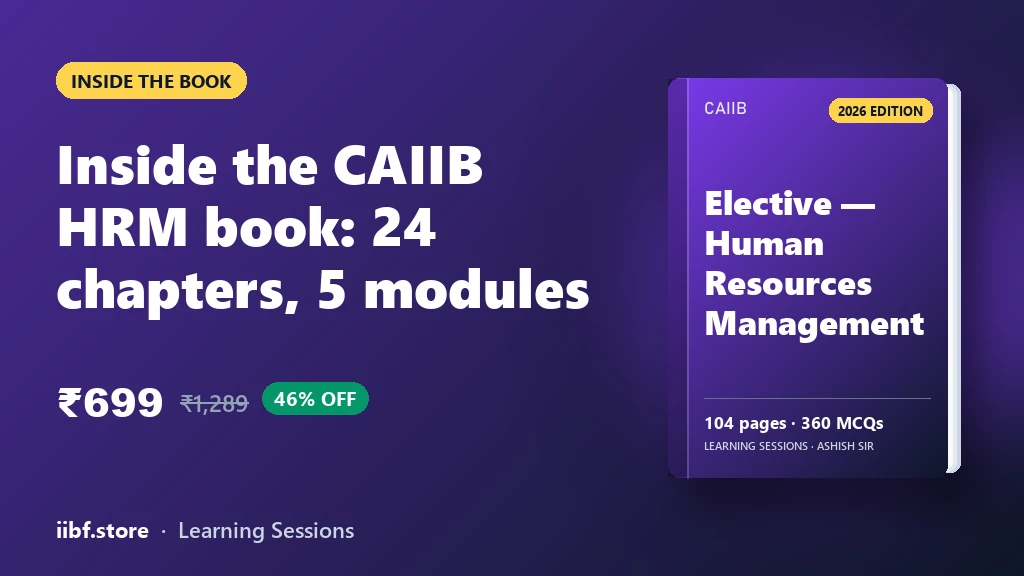
Prefer revising from a printed book?
Chapter-wise books with MCQs after every chapter — minimal pages, complete coverage, delivered anywhere in India. Every book has a free sample to read first.









Quick quiz on this topic
5 exam-style questions from our free test bank — check yourself before you move on.
Practice this topic
Take a free mock test, download chapter PDFs, or watch a video class — all included on iibf.store.