
Outdated Study Material Is Costing You Marks in 2026
Open any of the PDFs sitting in your downloads folder right now. The cover almost certainly says "Latest Updated". Scroll to the ombudsman chapter and see whether it still gives you one year to file a complaint. If it does, you are revising a rule that stopped being true on 1 July 2026 — and that is the quiet problem with outdated study material: it never announces itself. It looks exactly like good material, right up to the moment it costs you a mark. Ashish Jain opens the short below with an apology and a fix, because the good notes are now free. This article is the audit you should run before you trust any file, plus the specific 2026 changes that have turned a lot of circulating PDFs into outdated study material.
Quality study material, free of cost · Learning Sessions · Watch on YouTube
Why free notes go stale without anyone noticing
The failure mode is not laziness. It is copying. One person makes a genuinely good set of notes in, say, 2023. It gets forwarded into a Telegram group. Someone else re-exports it with a new cover page and a new year on it. Three hops later there are fifty files in circulation, all titled "latest", none of them dated, and nobody in the chain has read the master direction that changed in the meantime. You end up with a folder that is impossible to prioritise and impossible to trust.
Banking is a bad subject to be careless about here. A physics constant does not move. A compensation ceiling, a filing window, a capital charge, a loan cap and a benchmark rate all move, and IIBF writes fresh questions off exactly those movements because they separate the candidate who has read this year's circular from the candidate who has memorised a friend's notes.
The three-question audit
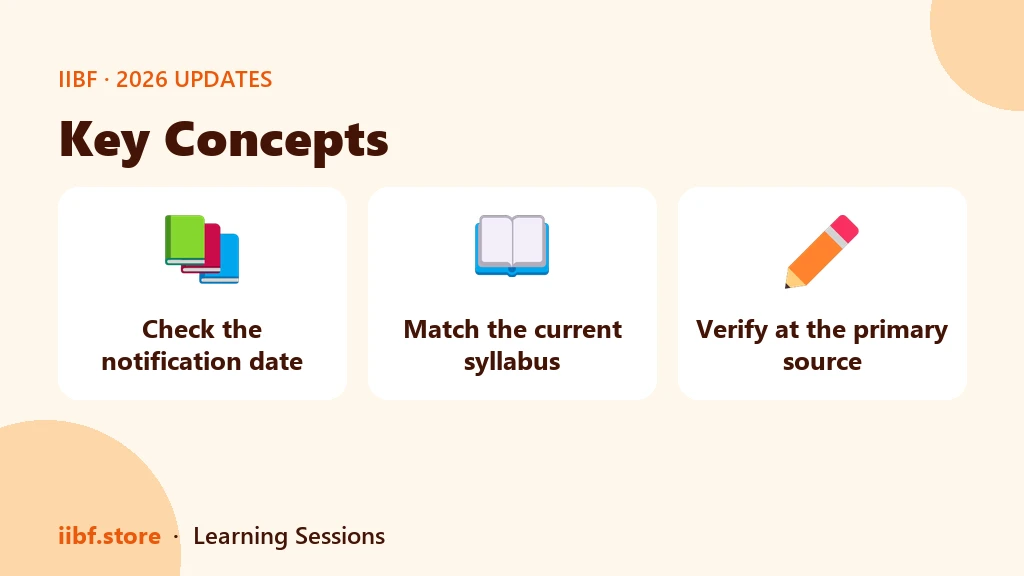
One: does it carry a date? Not a year on the cover — a date against the fact. Good notes say "with effect from 1 April 2024" next to the rule. If a page states a limit with no effective date anywhere near it, treat that page as unverified until you check it. This single test eliminates most outdated study material in one pass.
Two: does it match the current syllabus structure? If a JAIIB file still talks about the old four-paper split under the pre-revision names, or a CAIIB file has no idea that Advanced Business and Financial Management and Banking Regulations and Business Laws are compulsory papers, the author has not revisited it since the syllabus was reworked. Structure drift is a reliable proxy for content drift.
Three: can you land the fact at a primary source in under two minutes? Master directions and press releases live on rbi.org.in; exam rules, eligibility and syllabus live on iibf.org.in. If a claim cannot be traced to either, it does not go into your answer sheet.
The 2026 changes that broke a lot of old notes
Below is the short list of items where a pre-2026 file will actively mislead you. If your notes disagree with the right-hand column, you are holding outdated study material and it needs replacing rather than patching.
| Topic | What old notes usually say | Position in 2026 |
|---|---|---|
| Ombudsman scheme | RB-IOS 2021; one year to file; up to ₹20 lakh compensation | RB-IOS 2026 in force from 1 July 2026; 90-day window; up to ₹30 lakh, and ₹3 lakh for loss of time and harassment |
| PM SVANidhi | ₹10,000 / ₹20,000 / ₹50,000 ladder, scheme winding down | Restructured and extended to March 2030, with a UPI-linked RuPay credit card of up to ₹30,000 |
| UPI and MDR | Zero-MDR is absolute under Section 10A of the PSS Act, 2007 | The Taxation and Other Laws (Amendment) Bill, 2026 replaces the blanket bar with a notification-based exemption; passed by Lok Sabha on 6 August 2026 |
| Bank investment portfolio | HTM, AFS and HFT | HTM, AFS and FVTPL, under the RBI investment-classification directions effective 1 April 2024 |
| Loan pricing benchmark | MCLR treated as the current benchmark | EBLR for new floating-rate retail and MSME loans since October 2019; MCLR still runs the older book |
Notice the pattern. None of these are obscure corners. They are ombudsman, priority-sector-adjacent credit, payment systems, treasury and loan pricing — the highest-frequency chapters in the papers. That is precisely why outdated study material hurts more than its page count suggests: staleness clusters in the topics that get examined most, because those are the topics regulators keep touching.
How to clean up in one evening
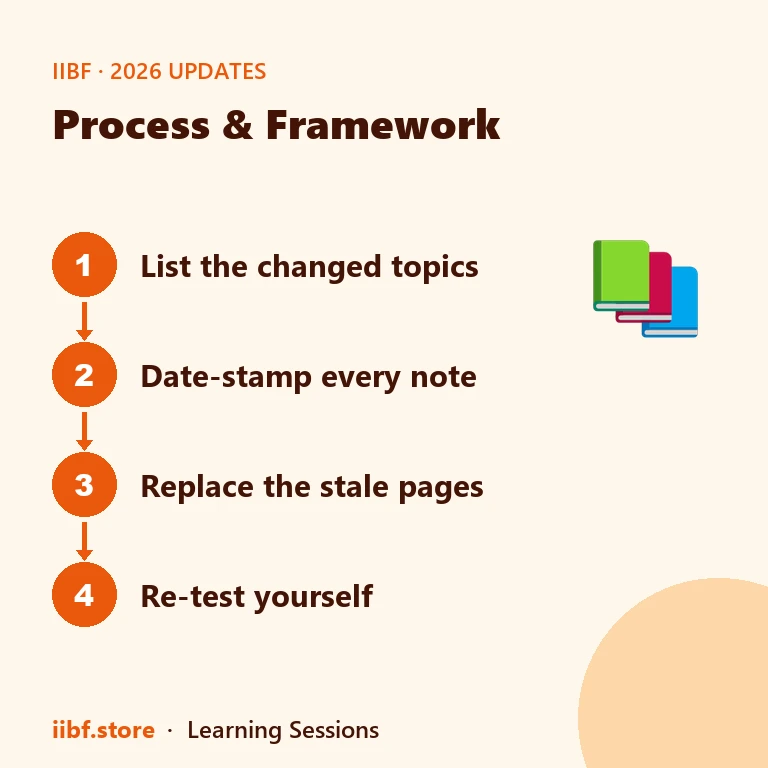
Do not try to re-read everything. Work the changed topics only. List the five or six areas above, open your existing notes at exactly those pages, and either correct them in place with the effective date written next to the number, or delete the page and pull a current one. Then re-test yourself on those chapters specifically — correcting a note you never revisit again is wasted work, and a wrong fact you have already rehearsed needs overwriting, not just editing.
The second half of the fix is supply. The material referenced in the video — one-liner PDFs, question banks and study notes across JAIIB, CAIIB, promotions and certifications — is now available free of cost, arranged subject-wise and chapter-wise rather than dumped as a pile of files. That ordering matters more than people expect: when the material is chaptered, you can see what you have not opened yet, which is the single thing a Telegram folder can never tell you. You can browse it on the free study material page, and pair it with the structured syllabus in the CAIIB course or the JAIIB course.
Build the habit, not just the folder
The candidates who never get caught by a changed rule all do the same small thing: they date-stamp. Every figure in their notes carries the day it became effective, so a stale entry is visible at a glance instead of hiding behind a confident font. Put a fifteen-minute updates check into your weekly plan on the study planner, keep the current numbers handy on the RBI rates page, and finish each week with a quick set on tests so the corrections actually stick. New write-ups on each change go up on the blog as they happen.
Free is not the problem. Free and undated is. Fix the dating and the free material will carry you further than the paid folder you never finished.
How do I know if a PDF is out of date?
Check whether facts carry effective dates, whether the syllabus structure matches the current papers, and whether you can trace one or two claims to rbi.org.in or iibf.org.in. A file that fails any of the three should not be trusted for revision.
Which 2026 changes matter most for JAIIB and CAIIB?
The Reserve Bank – Integrated Ombudsman Scheme, 2026 effective 1 July 2026, the restructured PM SVANidhi with a ₹30,000 RuPay credit card, the amendment to Section 10A of the Payment and Settlement Systems Act, 2007, and the HTM/AFS/FVTPL investment classification effective 1 April 2024.
Is free material good enough to pass?
Yes, if it is current and organised. What sinks candidates is not the price of the notes but stale figures and an unstructured pile of files. Chaptered, dated notes plus regular question practice is enough for the written papers.
Should I fix my old notes or start again?
Fix them, but only on the changed topics, and write the effective date next to every number you correct. Starting from zero wastes the recall you have already built; leaving a wrong figure untouched is worse than having no note at all.
Quick quiz on this topic
5 exam-style questions from our free test bank — check yourself before you move on.
Practice this topic
Take a free mock test, download chapter PDFs, or watch a video class — all included on iibf.store.
Keep reading



