Priority Sector Lending Targets: A CAIIB Rural Banking Guide
Every CAIIB Rural Banking candidate eventually meets the same acronym-heavy topic: Priority Sector Lending targets. It sounds like dry compliance detail, but it is really the rulebook that decides how much credit reaches farmers, small businesses and weaker sections through the banking system. Get the numbers wrong in the exam — or on the job — and you either misjudge a bank's regulatory exposure or misread a case study question completely.
This article walks through what the PSL targets are, how they are computed, how Regional Rural Banks and Small Finance Banks differ from mainstream commercial banks, and what happens when a bank falls short. We will also connect PSL to the broader rural economy you studied in Agriculture Economy and Rural Development Policies, because PSL is the financing arm that makes those policies real on the ground.
🌾 What Is Priority Sector Lending and Why Rural Banking Cares
Priority Sector Lending is RBI's mechanism to direct a defined share of bank credit toward sectors that are economically important but may not attract adequate financing on commercial terms alone: agriculture, micro and small enterprises, export credit, education, housing, social infrastructure, renewable energy and weaker sections. For a Rural Banking elective candidate, PSL matters because agriculture and allied activities sit at the very centre of the priority sector framework.
The categories are not static labels — each carries its own sub-target, and banks are assessed every year on whether they met each one, not just the overall number. A bank can hit its overall 40% PSL target and still be non-compliant on a specific sub-target, such as lending to small and marginal farmers or to weaker sections. That distinction is exactly the kind of nuance CAIIB examiners like to test with a case-study twist.
The framework also links back to rural development policy. When you studied the Economic Features of rural India, you saw how dependent rural households are on formal credit access. PSL targets exist precisely because market forces alone would under-serve that segment; regulation nudges banks to lend where the social return is high even if the private return looks thinner on paper.
💡 Exam Tip: Always separate the overall PSL target from its sub-targets in your answer. Examiners frequently ask "is the bank PSL-compliant overall?" versus "is the bank compliant on the agriculture sub-target?" — these can have different answers for the same bank.
📊 PSL Targets and Sub-Targets Explained
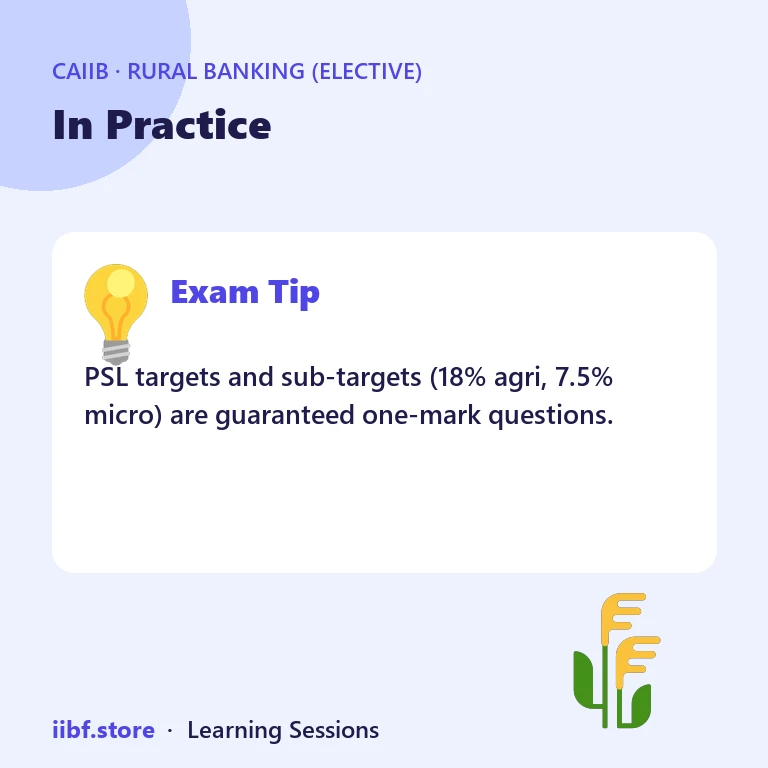
Under RBI's Master Direction on Priority Sector Lending, the overall target for domestic scheduled commercial banks (and foreign banks with 20 or more branches) is 40% of Adjusted Net Bank Credit (ANBC) or Credit Equivalent of Off-Balance Sheet Exposure (CEOBE), whichever is higher. Within that 40%, agriculture carries an 18% sub-target, and within agriculture, small and marginal farmers carry a further 10% sub-target. Weaker sections carry a 12% sub-target, and micro enterprises carry a 7.5% sub-target.
Regional Rural Banks and cooperative banks operate under adapted versions of this framework because their loan books are already agriculture-heavy by design. Small Finance Banks face a steeper overall target reflecting their financial-inclusion mandate. Foreign banks with fewer than 20 branches have a lower overall target and no mandatory agriculture sub-target, but they carry an export credit component instead.
| Bank category | Overall PSL target (of ANBC/CEOBE) | Agriculture sub-target | Mandatory agriculture sub-target? |
|---|---|---|---|
| Domestic commercial banks | 40% | 18% | ✅ |
| RRBs / Small Finance Banks | 75% | Adapted, agriculture-heavy | ✅ |
| Foreign banks (20+ branches) | 40% | 18% | ✅ |
| Foreign banks (<20 branches) | 40% | Export credit substitutes | ❌ |
Within the small and marginal farmers sub-target, banks track disbursement separately from outstanding, because a single crop-season loan cycle can otherwise distort the picture. This is where the scale of finance and crop loan assessment methodology becomes relevant — the district-level scale of finance feeds directly into how much of a farmer's loan counts toward the agriculture sub-target.
🏦 How RRBs and Small Finance Banks Meet PSL Norms
Regional Rural Banks were created specifically to serve rural credit needs, so a 75% overall PSL target is a natural extension of their mandate rather than a stretch goal. Most of their loan portfolio is already agriculture and allied-activity lending, kisan credit facilities, and small-ticket rural enterprise finance. The Kisan Credit Card scheme alone accounts for a large share of PSL-eligible agriculture credit at many RRBs.
Small Finance Banks face the same 75% threshold but arrived at it from a different starting point — many began as microfinance institutions or NBFCs before conversion, so meeting the target means actively building agriculture and MSME books rather than simply continuing an existing lending pattern. This is one reason SFBs lean heavily on co-lending and business correspondent partnerships to originate PSL-eligible rural loans quickly.
Both bank types coordinate closely with the district-level credit planning machinery. The annual credit plan drawn up under the Lead Bank Scheme and district credit plan effectively allocates PSL-eligible lending targets across banks operating in a district, so PSL compliance is not just a head-office exercise — it is negotiated block by block, branch by branch.
Infrastructure quality also shapes how easily a bank can originate priority-sector loans in a given area. Poor rural connectivity or weak market linkages — the kind of gaps discussed under Infrastructure — raise the cost of originating and servicing small PSL loans, which is why business correspondents and digital onboarding have become essential tools for RRBs and SFBs alike.
⚠️ Common Mistake: Students often assume every bank has the same 40% PSL target. Remember that RRBs and Small Finance Banks are held to a higher 75% target — this distinction shows up often in CAIIB objective questions.
📜 PSL Certificates, Shortfalls and RIDF Contribution
Not every bank can originate enough priority-sector loans organically, and not every bank wants to over-shoot its target either. RBI addresses this with Priority Sector Lending Certificates (PSLCs) — tradable instruments that let a bank with a PSL surplus in one category sell that surplus to a bank running short, without transferring the underlying loan or its risk. The seller earns fee income; the buyer closes its compliance gap.
PSLCs are traded in four categories — general, small and marginal farmers, micro enterprises, and agriculture — through RBI's e-Kuber platform. This gives banks a market-based way to meet sub-targets rather than being forced to originate loans in a category where they have no natural presence or expertise.
When a bank still falls short after using PSLCs, it must contribute the shortfall amount to the Rural Infrastructure Development Fund (RIDF) maintained with NABARD, or to other specified funds depending on the category of shortfall. RIDF deposits earn a lower return than the bank's normal lending yield, which is exactly the point — it creates a real financial incentive to meet PSL targets through actual lending rather than treating the shortfall as a routine cost of doing business.
This shortfall mechanism connects back to Issues Concerning Rural Areas — RIDF funding, ironically, ends up financing exactly the kind of rural infrastructure gaps that make PSL lending harder to originate in the first place, creating a slow feedback loop rather than an instant fix.
PSLC trading transfers only the PSL classification benefit, never the loan asset, the credit risk, or the borrower relationship — the originating bank keeps the loan on its own books throughout.
🧠 Practice MCQs: Priority Sector Lending Targets
Q1. What is the overall PSL target for domestic scheduled commercial banks as a percentage of ANBC/CEOBE? (a) 30% (b) 40% (c) 50% (d) 18%
Answer: (b) — Domestic scheduled commercial banks must lend 40% of ANBC or CEOBE, whichever is higher, to the priority sector.
Q2. Within the overall PSL target for domestic commercial banks, what is the sub-target for agriculture? (a) 10% (b) 12% (c) 18% (d) 25%
Answer: (c) — Agriculture carries an 18% sub-target within the 40% overall PSL target.
Q3. What is the sub-target within agriculture earmarked specifically for small and marginal farmers? (a) 8% (b) 10% (c) 12% (d) 15%
Answer: (b) — Small and marginal farmers carry a 10% sub-target, nested within the wider 18% agriculture sub-target.
Q4. A Priority Sector Lending Certificate (PSLC) allows a bank with a PSL shortfall to: (a) merge with another bank (b) buy PSL classification from a bank with a surplus, without transferring the loan (c) get an automatic RBI penalty waiver (d) convert PSL loans into NPAs
Answer: (b) — PSLCs let a bank buy PSL achievement from a surplus bank while the underlying loan stays on the originating bank's books.
Q5. A bank that persistently misses its PSL targets is required to contribute the shortfall amount to a fund maintained with which institution? (a) SEBI (b) NABARD (via RIDF) (c) DICGC (d) IBBI
Answer: (b) — Shortfall contributions typically flow into the Rural Infrastructure Development Fund maintained with NABARD.
Want chapter-wise mock tests with 100+ MCQs? Start practising free →
Frequently Asked Questions
What is ANBC and why does it matter for PSL?
Adjusted Net Bank Credit is net bank credit adjusted for specific eligible deductions such as RIDF and certain bonds. It is the base figure — alongside CEOBE — against which every PSL target and sub-target percentage is calculated, so an error in computing ANBC throws off the entire compliance picture.
Do Regional Rural Banks follow the same PSL target as commercial banks?
No. RRBs and Small Finance Banks are held to a higher 75% overall PSL target because of their rural and financial-inclusion mandate, compared with 40% for most domestic commercial banks.
What happens if a bank exceeds its PSL target?
A bank with a PSL surplus in a given category can sell Priority Sector Lending Certificates to banks that are short, earning fee income while helping the buying bank close its compliance gap for that category.
Is export credit treated as priority sector lending for all banks?
Export credit is a PSL category mainly for foreign banks, particularly those with fewer than 20 branches, rather than a standard component for domestic commercial banks. Always verify category-wise treatment against the current RBI Master Direction before applying it to a case study.
Why This Topic Keeps Showing Up in CAIIB Case Studies
PSL targets are a favourite CAIIB case-study anchor because they combine a hard number (the percentage) with a judgment call (which category a loan falls into, and how it is computed). A case study might describe a bank's loan book and ask you to compute whether it met its agriculture sub-target, or whether buying a specific category of PSLC is the cheaper compliance route compared with an RIDF deposit.
To answer these confidently, keep the four numbers straight: 40% overall for most banks, 75% for RRBs and Small Finance Banks, 18% for agriculture, and 10% within that for small and marginal farmers. Then layer in the weaker sections figure of 12% and the micro enterprises figure of 7.5%. Everything else in the topic — PSLC trading, RIDF shortfall contributions, category-wise treatment for foreign banks — builds on that base.
It is also worth connecting PSL compliance to how banks manage internal talent and oversight around specialised lending functions. Just as a bank needs strong succession planning in banks to keep specialised credit teams staffed through leadership transitions, PSL compliance needs institutional memory — a rotating loan officer should not have to relearn sub-target rules from scratch every posting cycle.
For the latest confirmed figures before your exam, always cross-check against RBI's official Master Direction on Priority Sector Lending at rbi.org.in, since sub-target percentages and eligible activity lists are reviewed periodically and any exam question will assume the current regulatory position rather than an outdated one.
If you want a wider view of how PSL fits into the rural credit ecosystem — repo-linked lending rates, refinance windows, and the latest RBI notifications — browse RBI rates and resources alongside your chapter notes.
Conclusion: Lock In the PSL Numbers Before Exam Day
Priority Sector Lending targets are one of the more numbers-heavy parts of the CAIIB Rural Banking elective, but they reward candidates who memorise the structure rather than isolated digits: overall target, agriculture sub-target, small-and-marginal-farmers sub-target, weaker sections sub-target, and the PSLC/RIDF compliance mechanisms that sit around them. Once that structure is clear, case-study variations become easy to solve rather than intimidating.
Explore more Rural Banking elective coverage in the Rural Banking Elective article hub, and when you are ready to test yourself under exam conditions, head to the CAIIB course page for full chapter-wise mocks and structured practice sets.
Quick quiz on this topic
5 exam-style questions from our free test bank — check yourself before you move on.
Practice this topic
Take a free mock test, download chapter PDFs, or watch a video class — all included on iibf.store.
Keep reading