Reputational Risk Management in Banks: CAIIB Risk Guide
Reputational risk management in banks protects the one asset a bank cannot rebuild quickly — the willingness of depositors, borrowers, investors and regulators to keep dealing with it. Unlike credit or market risk, it carries no position to close and no direct Pillar 1 capital charge; the damage shows up instead as deposits that leave, applications that stop arriving, wholesale funding that reprices and frontline staff who resign. That is why reputational risk management in banks is examined as a governance subject in the CAIIB Risk Management elective rather than a numerical one, and why a well-drafted answer must move from definition to drivers to measurement to board oversight without inventing formulas that do not exist.
🏦 What Reputational Risk Actually Means in a Bank
Reputational risk is the risk that adverse perception of the bank — among customers, counterparties, shareholders, employees, the media or the supervisor — reduces its ability to maintain existing business relationships, establish new ones, or continue to access funding on normal terms. Two features make it different from the risks you have already studied in the risk management framework chapter.
First, it is almost always a second-order risk. Reputational damage rarely originates on its own; it is the amplification of some other failure — a mis-sold product, a data breach, an outage on salary day, a large NPA disclosure, an adverse regulatory order, or a viral video of rude branch behaviour. The primary event may be small in rupee terms while the reputational consequence is disproportionate.
Second, it is asymmetric and non-linear. Goodwill accumulates over decades and erodes in days. A bank can absorb a crore of operational loss silently, yet a single trending complaint thread can trigger deposit withdrawal requests running into hundreds of crores, which is exactly how a reputational event converts into the funding problem discussed under liquidity risk management.
The standard drivers examiners expect you to list are: conduct and mis-selling, poor grievance redressal, technology outages and cyber incidents, data privacy failures, aggressive or coercive recovery practices, KYC/AML lapses and regulatory penalties, association risk from outsourced partners and co-lending tie-ups, governance and audit-quality concerns, and — increasingly — environmental and social controversies attached to financed projects.
💡 Exam Tip: If a question asks you to "classify" reputational risk, the safest answer is that it is a consequential or second-order risk arising from other risk events, assessed under the supervisory review process rather than charged under Pillar 1.
🔗 Conduct and Operational Failures: The Usual Entry Points
Basel's standard definition of operational risk — loss from inadequate or failed internal processes, people and systems, or from external events — explicitly includes legal risk but excludes strategic and reputational risk. Candidates routinely get this backwards. The exclusion is not a statement that reputational risk is unimportant; it is a statement that it cannot be modelled in the same loss-data way, so it is handled through governance and the Pillar 2 supervisory review process instead.
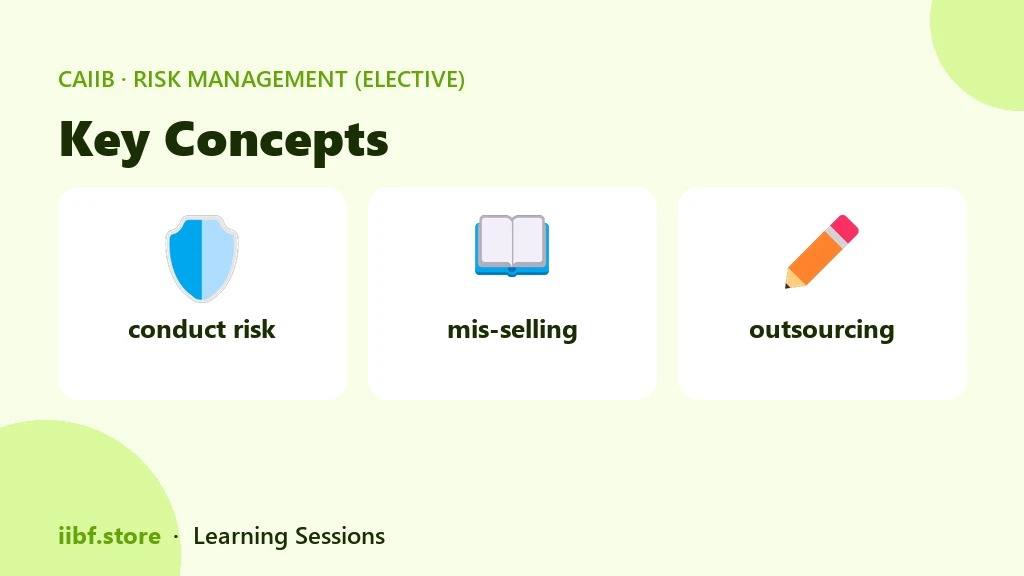
Conduct risk is the most reliable feeder. Selling a long-tenor insurance policy to a pensioner as a "deposit scheme", bundling products with a loan sanction, opening accounts or issuing cards without informed consent, unfair charging, or opaque pricing all create a customer-detriment event first, a complaint second, a penalty or ombudsman award third, and adverse coverage fourth. The same chain runs through digital lending and partnership models: when a sourcing agent or a recovery agent of an outsourced partner behaves badly, the reputational hit lands on the bank's brand, not the vendor's. This association exposure also applies to newer transaction-banking products, so the operating discipline described in supply chain finance for banks matters reputationally as much as it does commercially.
Operational and technology failures form the second feeder. Payment outages, failed ATM or UPI transactions with delayed reversal, mis-posted interest, and data leakage all become public within minutes. Environmental and social controversies form a third and fast-growing feeder, which is why disclosure discipline of the kind covered in climate stress testing for banks increasingly doubles as reputational protection. Model failure is a fourth: if a scoring or provisioning model is later found to be biased or poorly validated, the story is rarely "a technical error" — it is reported as unfairness, so the validation standards in credit risk models in banks carry a reputational dimension too.
📱 The Complaint and Social-Media Escalation Ladder
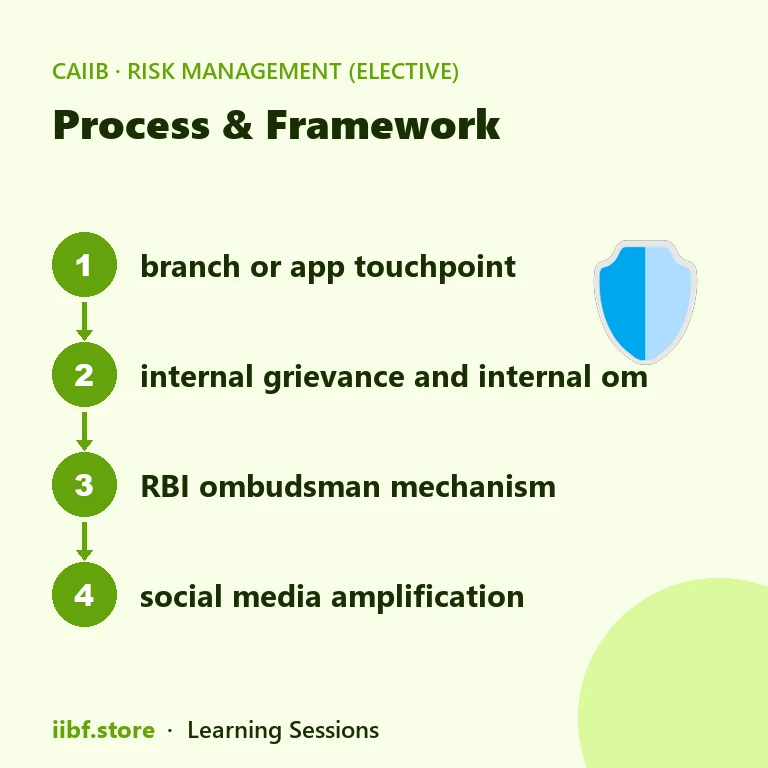
Reputational events in Indian banking follow a fairly predictable escalation ladder, and being able to describe it earns marks because it demonstrates process understanding rather than rote definition.
The ladder starts at the branch or app touchpoint, where a service failure is either resolved at first contact or not. Unresolved, it moves to the bank's internal grievance redressal machinery — the customer service department, the nodal officer, and the internal ombudsman mechanism that banks are required to maintain for complaints they propose to reject wholly or partly. Beyond that sits the Reserve Bank's integrated ombudsman mechanism, whose scheme provisions, eligibility windows and compensation ceilings have been revised more than once; quote the structure, and check the version currently in force on the RBI website before quoting any limit or time window in an answer.
Running parallel to this formal ladder is the informal one: social media, consumer forums, WhatsApp groups of customers, and news aggregators. The informal ladder is faster than the formal one and has no adjudication step, which is the practical problem. A complaint that would have taken 30 days to reach the ombudsman reaches ten thousand screens in an hour, and the bank's silence is read as confirmation.
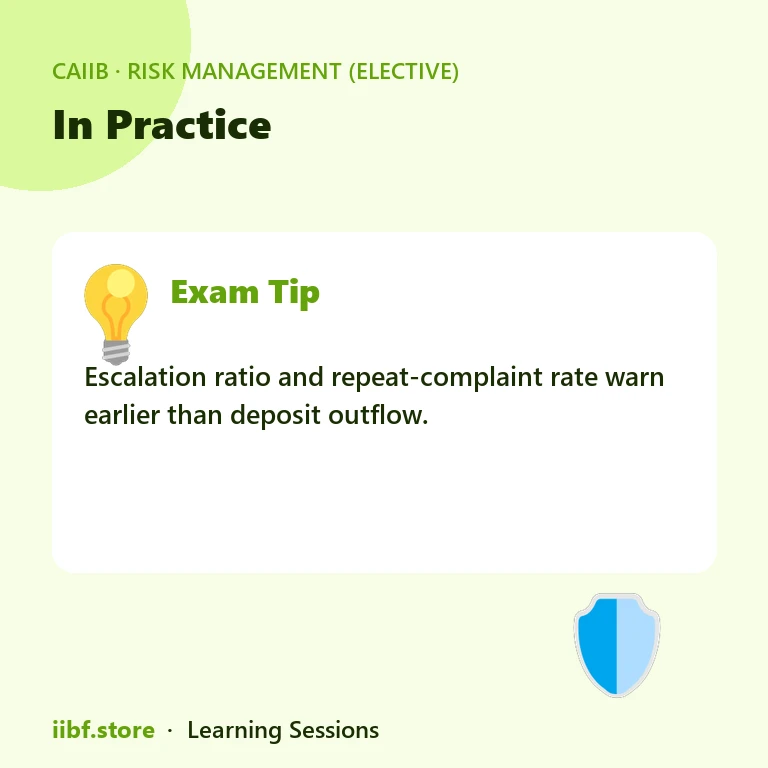
Three control ideas follow directly. One, social listening must be a first line of defence tool feeding the operational risk function, not merely a marketing dashboard. Two, root-cause analytics on complaints matter more than closure statistics — a falling complaint count with a rising repeat-complaint ratio is a deteriorating position. Three, service-recovery authority must sit low enough in the hierarchy that a branch manager can settle a small grievance immediately instead of escalating it into a public dispute.
⚠️ Common Mistake: Treating complaint volume alone as the reputational metric. Volume rises when a bank makes complaining easier, which is a good outcome. The reputational signals are the escalation ratio, the repeat rate, the ageing of open complaints and the proportion decided against the bank.
📊 Measuring Reputational Risk: Proxies and Early Warnings
There is no accepted single-number measure of reputational risk. What supervisors and boards expect instead is a dashboard of proxies, split between leading indicators that warn before the event and lagging indicators that confirm the damage. The table below is the shape such a dashboard usually takes and is a compact answer to any "how do you measure reputational risk" question.
| Indicator | What it signals | Leading or lagging | Board-level reporting? |
|---|---|---|---|
| Complaints per 1,000 accounts and repeat-complaint ratio | Service quality and conduct drift at the frontline | Leading | ✅ |
| Escalation ratio to internal / RBI ombudsman and awards against the bank | Failure of internal redressal; regulatory visibility | Leading | ✅ |
| Negative social-media mention volume and sentiment score | Public perception forming ahead of formal complaints | Leading | ❌ (management dashboard, escalated on breach) |
| Frontline and key-personnel attrition | Internal confidence and culture stress | Leading | ❌ (people committee) |
| Retail deposit outflow and CASA attrition after an incident | Depositor confidence actually breaking | Lagging | ✅ |
| Widening of wholesale funding spreads, CD rates or CDS levels | Market repricing of the bank's franchise | Lagging | ✅ |
| Regulatory penalties, adverse orders and business restrictions | Crystallised conduct and compliance failure | Lagging | ✅ |
Because the lagging indicators are funding indicators, reputational risk is usually stressed through the liquidity framework rather than separately: a "name-specific stress" scenario assumes accelerated retail withdrawal, loss of unsecured wholesale funding and non-renewal of bulk deposits, and tests survival horizons. That is the same machinery you use in asset liability management in banks, and the behavioural assumptions come from the bucketing discipline in the asset liability management chapter. Some banks additionally track a reputational risk appetite statement with qualitative red lines — no product may be sold without a suitability record, no recovery contact outside prescribed hours — because a limit that cannot be numerically calibrated can still be stated as a prohibition.
🛡️ Board Oversight, Pillar 2 and the Crisis Playbook
Under the Basel framework, reputational risk sits in Pillar 2. The supervisory review process expects a bank to identify it, consider it in internal capital adequacy assessment, and address it through governance, culture and contingency planning; supervisors then review the adequacy of that assessment. No standardised risk weight or capital multiplier applies to it — writing that reputational risk attracts a specific Pillar 1 charge is a straightforward error. In practice, the capital link is indirect: reputational stress can force a bank to support off-balance-sheet vehicles, sponsored funds or securitisation structures it is not contractually obliged to support, purely to avoid the damage of letting them fail. Basel calls this step-in risk, and it is the cleanest example of reputational risk consuming real capital and liquidity.
Board-level ownership is expected to be explicit. The risk management committee of the board approves the reputational risk appetite and reviews the dashboard; the customer service committee owns grievance outcomes; the audit committee sees regulatory correspondence and penalties; and the chief risk officer aggregates the picture. Product approval committees are the practical control point, because most conduct damage is designed in at product stage rather than caused at branch stage — the same discipline that governs complex products such as options and structured derivative sales to corporate clients, where suitability and appropriateness documentation is the reputational firewall.
The crisis communication playbook is the operational half of the answer, and the sequence is worth memorising: detect through social listening, complaint spikes and incident alerts; convene a pre-named crisis team with a single accountable spokesperson; issue a holding statement quickly that acknowledges the issue with only verified facts and states what is being done; notify the regulator within prescribed incident-reporting timelines; script the channels so branches, the call centre and social handles say the same thing; remediate affected customers, including compensation where due; and conduct a post-incident review that feeds root causes back into product design and controls. Rehearsal matters more than documentation — a playbook first opened during the crisis is a document, not a control.
📌 Remember: Speed plus verified facts beats a perfect statement issued late. The two classic failures are silence while facts are gathered, and an early denial that later has to be withdrawn — the second is far more damaging than the original incident.
For revision across the elective, work through the related topics on the risk management elective blog hub and the derivatives-side chapters such as derivatives and risk management, where suitability and disclosure obligations create the same reputational exposure in a wholesale setting.
🧠 Practice MCQs: Reputational Risk in Banks
Q1. Under the Basel framework, reputational risk is best described as: (a) a component of the Pillar 1 operational risk capital charge (b) a risk assessed under the Pillar 2 supervisory review process (c) a market risk captured in the trading book (d) a recognised credit risk mitigant giving RWA relief
Answer: (b) — Reputational risk carries no Pillar 1 charge; it is identified, assessed and governed under the Pillar 2 supervisory review process.
Q2. Which of the following is the most useful leading indicator of building reputational risk? (a) Fall in the share price after a penalty order (b) Widening of wholesale funding spreads (c) Retail deposit outflow in the month after an outage (d) Rising complaints per 1,000 accounts with a higher repeat-complaint ratio
Answer: (d) — Complaint intensity and repeat rates move before confidence breaks; price, spread and outflow measures only confirm damage that has already occurred.
Q3. The Basel definition of operational risk: (a) includes legal risk but excludes strategic and reputational risk (b) includes reputational risk but excludes legal risk (c) includes both strategic and reputational risk (d) excludes legal, strategic and reputational risk
Answer: (a) — Legal risk is inside the definition; strategic and reputational risk are explicitly outside it and are handled under Pillar 2.
Q4. In a crisis communication playbook, the purpose of the holding statement is to: (a) confirm the final root cause and quantified loss (b) substitute for the regulatory incident report (c) acknowledge the issue quickly using only verified facts while the investigation continues (d) transfer accountability to the outsourcing partner
Answer: (c) — A holding statement buys credibility early without committing to unverified conclusions; the regulatory report and root-cause findings follow separately.
Q5. A bank voluntarily supports a sponsored fund it has no contractual obligation to support, in order to avoid damage to its franchise. This is best described as: (a) settlement risk (b) step-in risk (c) basis risk (d) residual credit risk
Answer: (b) — Step-in risk is the Basel term for reputation-driven support of entities beyond contractual obligation, and it consumes real capital and liquidity.
Want chapter-wise mock tests with 100+ MCQs? Start practising free →
❓ Frequently Asked Questions
Is reputational risk given a separate capital charge in Basel III?
No. It is not a Pillar 1 risk and has no prescribed risk weight or capital multiplier. It is assessed under the Pillar 2 supervisory review process, including in the bank's internal capital adequacy assessment, and can consume capital indirectly through step-in risk and liquidity stress.
How is reputational risk different from operational risk?
Operational risk is loss from failed internal processes, people, systems or external events, and its Basel definition includes legal risk but excludes strategic and reputational risk. Reputational risk is the consequential loss of stakeholder confidence that often follows an operational or conduct failure.
Which metrics should a board dashboard for reputational risk contain?
A mix of leading indicators — complaints per 1,000 accounts, repeat-complaint ratio, escalation ratio to the internal and RBI ombudsman mechanisms, negative social-media sentiment, frontline attrition — and lagging indicators such as deposit or CASA outflow, funding spread movements and regulatory penalties.
What is the first step when a reputational incident goes viral?
Convene the pre-named crisis team, appoint a single spokesperson and issue a holding statement containing only verified facts and the action being taken, while notifying the regulator within the prescribed incident-reporting timelines. Silence and premature denials both make the outcome worse.
To summarise: treat reputational risk as a consequential risk with real funding consequences, feed it from conduct and operational data, measure it through a leading-and-lagging proxy dashboard, own it at board level under Pillar 2, and rehearse the crisis playbook before you need it. That five-part structure will answer almost any descriptive question the examiner sets on this topic. Ready to test yourself under exam conditions? Take a full chapter-wise mock on the CAIIB course page and track the topics where your accuracy drops below 70%.
Source and further reading: Bank for International Settlements and the Indian Institute of Banking & Finance.
Practice this topic
Take a free mock test, download chapter PDFs, or watch a video class — all included on iibf.store.
Keep reading