Risk Appetite Framework in Banks: RBI Guidelines (2026)
A risk appetite framework is the board-approved boundary that tells a bank how much risk it is willing to accept while pursuing its business objectives, and IIBF Risk Management examiners test this concept in nearly every scenario-based question. For working bankers, understanding how a risk appetite framework translates into limits, dashboards and escalation triggers is not academic — it is the language your ALCO, credit committee and internal audit desk speak every single day. This article walks through the structure, RBI expectations and practical application of a risk appetite framework so you can answer exam questions and real-world queries with equal confidence.
🎯 What Is a Risk Appetite Framework in Banks
A risk appetite framework (RAF) is the overarching set of policies, processes, controls and systems through which a bank's risk appetite is established, communicated and monitored. It sits above individual risk policies and ties together credit, market, liquidity, operational and reputational risk into one coherent board-level view. The RAF is distinct from — but closely related to — four concepts that examiners love to mix up: risk capacity (the maximum risk the bank can absorb before breaching capital or regulatory constraints), risk appetite (the risk the board chooses to take in pursuit of strategy, always below capacity), risk tolerance (the acceptable variation around appetite for a specific risk category) and risk limits (the granular, desk- or business-line-level caps that operationalise tolerance day to day). Getting this hierarchy right is the single most tested distinction in this topic.
Every RAF rests on a foundational understanding of the risks a bank actually runs — credit, market, liquidity, operational, strategic and reputational — and how they interact under stress. For a refresher on how these categories are classified and managed at the institutional level, see this chapter on risks and risk management in banks, which lays the groundwork the RAF builds on. A well-designed risk appetite framework is forward-looking: it does not merely record last quarter's numbers, it sets the boundaries within which next year's growth, lending and treasury decisions must be made.
📐 Building Blocks: Appetite Statement, Metrics and Limits
The centrepiece of any risk appetite framework is the Risk Appetite Statement (RAS) — a board-approved document that expresses appetite both qualitatively ("the bank will not compromise its reputation for short-term profit") and quantitatively, through a dashboard of metrics with green-amber-red thresholds. Typical quantitative metrics include the CRAR/CET1 buffer over regulatory minimums, gross and net NPA ratios, single-borrower and group exposure caps, liquidity coverage bands, and market-risk measures such as Value at Risk limits for the trading book.
Capital-related metrics deserve special attention because they anchor the whole framework: a bank that has already worked through CRAR calculation for banks will recognise that the appetite statement's capital buffer is simply CRAR expressed as a management action trigger rather than a bare regulatory ratio. Similarly, leverage is capped not only by the regulatory minimum but by an internal appetite band — a concept explored further in the guide on leverage ratio framework Basel III. On the market-risk side, VaR limits set at the trading-desk level only mean something if they are validated regularly; banks that skip this step routinely fail internal audit, which is why VaR backtesting techniques for banks is treated as a companion discipline to appetite-setting, not an optional extra. Limits then cascade from the board-approved RAS down to business-unit and desk-level operating limits, each one narrower than the tier above it.
💡 Exam Tip: If a question asks you to rank risk capacity, risk appetite, risk tolerance and risk limits from widest to narrowest, the order is always: capacity > appetite > tolerance > limits. Capacity is a hard constraint set by capital and regulation; limits are the tightest, most granular controls.
🏦 RBI Governance Expectations for the RAF
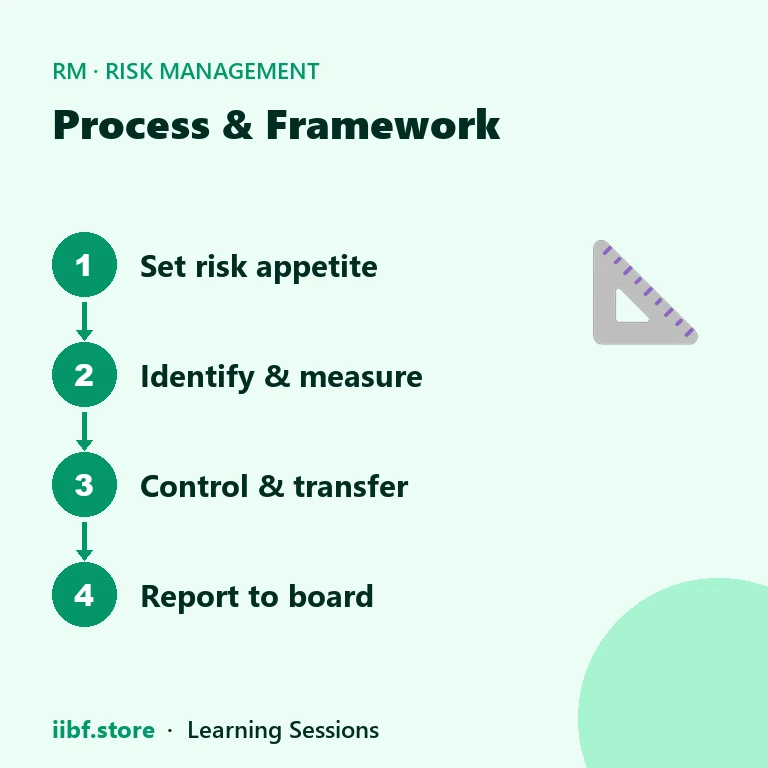
The Reserve Bank of India expects every bank's board to own its risk appetite framework, not delegate it to management. In practice this means the Board Risk Management Committee (or equivalent) approves the RAS at least annually, reviews it whenever the business model or macro environment changes materially, and receives regular breach and trend reports. The Chief Risk Officer (CRO) is expected to have a functional reporting line to the board or the risk committee — independent of business-line pressure — so that appetite is enforced rather than negotiated away during a growth push.
This governance structure rests on the classic three-lines-of-defence model: business units own and manage risk within their limits (first line), risk management and compliance functions independently monitor and challenge that risk-taking (second line), and internal audit provides assurance that the whole framework actually works as designed (third line). RBI's supervisory reviews — including the Risk Based Supervision (RBS) process — specifically test whether a bank's stated appetite is consistent with its actual portfolio behaviour, and whether breaches trigger real management action rather than paperwork. You can review RBI's supervisory and governance guidance directly at rbi.org.in.
⚠️ Common Mistake: Candidates often assume the CRO "sets" the risk appetite. The CRO designs, monitors and reports against the framework — the board approves and owns it. Attributing ownership to the CRO is a frequent wrong-option trap in IIBF papers.
Risk Appetite Tiering — At a Glance
| Tier | Set/Owned By | Example Metric | Board Approval Required |
|---|---|---|---|
| Risk Capacity | Board (regulatory-anchored) | CET1 floor + capital conservation buffer | ✅ |
| Risk Appetite | Board / Risk Committee | CRAR target, gross NPA ceiling, VaR cap | ✅ |
| Risk Tolerance | Senior Management / ALCO | Sector exposure band, LCR range | ❌ |
| Operating Limits | Business Unit / Desk Heads | Daily dealer VaR, single-borrower cap | ❌ |
💰 Linking Risk Appetite to Capital Planning
A risk appetite framework is only credible if it is wired into capital planning, not treated as a standalone document. Capital planning translates the board's appetite into a forward multi-year capital trajectory: projected CRAR under the base case, under an adverse stress scenario, and under a severe-but-plausible tail scenario. If projected capital breaches the appetite-tier buffer even in the base case, the plan has to change — either by slowing risk-weighted-asset growth, raising fresh capital, or tightening underwriting. This is precisely where the ICAAP process and the RAF converge: appetite sets the boundary, ICAAP stress-tests whether the bank stays inside it. Readers building capital-planning intuition should also work through regulatory capital and capital adequacy, which covers how minimum ratios interact with the buffers that sit above them.
Interest-rate risk in the banking book is another area where appetite and capital planning must stay aligned — a bank can be well capitalised on a point-in-time basis and still face a material earnings hit if duration mismatches are outside tolerance. The chapter on measurement of interest rate risk is a useful companion here. It is also worth noting that appetite frameworks are not exclusive to banks: under RBI's scale-based regulation, larger NBFCs are now expected to run comparable board-approved risk frameworks, a parallel worth knowing about when you study non-banking financial companies in India for the broader IEIFS syllabus.
📌 Remember: Risk appetite is a board input to capital planning, not an output of it. Capital adequacy tells you where you stand today; the RAF tells you the boundary you have chosen never to cross.
🧠 Practice MCQs: Risk Appetite Framework
Q1. In the standard risk hierarchy used in a bank's RAF, which of the following is the WIDEST boundary? (a) Risk tolerance (b) Risk limits (c) Risk capacity (d) Risk appetite
Answer: (c) — Risk capacity is the maximum risk a bank can absorb before breaching capital or regulatory constraints; appetite, tolerance and limits are all progressively narrower bands within it.
Q2. Who is primarily responsible for APPROVING a bank's Risk Appetite Statement? (a) Chief Risk Officer (b) Statutory auditor (c) Board of Directors / Board Risk Committee (d) Business unit head
Answer: (c) — The board (or its risk committee) owns and approves the RAS; the CRO designs, monitors and reports on it but does not approve it unilaterally.
Q3. In the three-lines-of-defence model underpinning RAF governance, which line is responsible for independent monitoring and challenge of risk-taking? (a) First line (business units) (b) Second line (risk management/compliance) (c) Third line (internal audit) (d) External regulator
Answer: (b) — The second line — risk management and compliance — independently monitors and challenges risk-taking by the first line; internal audit (third line) then assures that the whole framework functions correctly.
Q4. A bank's risk appetite framework should be linked to which planning process to test whether projected capital stays within approved appetite under stress? (a) Marketing plan (b) ICAAP / capital planning (c) Branch expansion plan (d) HR succession plan
Answer: (b) — ICAAP and multi-year capital planning stress-test whether the bank's projected capital trajectory remains within the boundaries set by the risk appetite framework.
Q5. Which of these is an example of an OPERATING LIMIT rather than a board-level risk appetite metric? (a) CET1 floor (b) Gross NPA ceiling approved by the board (c) A single dealer's daily VaR cap (d) Bank-wide CRAR target
Answer: (c) — A dealer's daily VaR cap is a granular operating limit cascaded down from board-level appetite metrics such as CRAR, NPA ceilings and the CET1 floor.
Want chapter-wise mock tests with 100+ MCQs? Start practising free →
What is the difference between risk appetite and risk tolerance?
Risk appetite is the board-approved level of risk the bank chooses to take in pursuit of its strategy; risk tolerance is the acceptable range of variation around that appetite for a specific risk category, usually set by senior management or ALCO.
Who owns the risk appetite framework in a bank?
The Board of Directors, typically acting through the Board Risk Management Committee, owns and approves the risk appetite framework. The Chief Risk Officer designs, monitors and reports against it but does not own it.
How often should a bank review its Risk Appetite Statement?
At minimum annually, and additionally whenever there is a material change in the bank's business model, risk profile, or the macroeconomic and regulatory environment.
Does the risk appetite framework apply only to large banks?
No. While RBI's expectations scale with size and complexity, even smaller banks and, under scale-based regulation, larger NBFCs are expected to maintain a board-approved risk appetite framework appropriate to their risk profile.
🚀 Master the Risk Appetite Framework for Your IIBF Exam
The risk appetite framework connects everything you study in the Risk Management paper — capital adequacy, credit limits, market-risk controls and governance — into one board-owned discipline. The fastest way to lock in the appetite-versus-tolerance-versus-limits hierarchy, RBI's governance expectations, and how RAF feeds capital planning is to drill it with exam-style questions. Practise chapter-wise Risk Management mock tests now → and explore more topics on the Risk Management blog hub.
Prefer revising from a printed book?
Chapter-wise books with MCQs after every chapter — minimal pages, complete coverage, delivered anywhere in India. Every book has a free sample to read first.
























Practice this topic
Take a free mock test, download chapter PDFs, or watch a video class — all included on iibf.store.
Keep reading