Variable Rate Repo Auctions: A CAIIB Central Banking Guide (2026)
Every CAIIB Central Banking candidate memorises the LAF corridor, but few can explain how RBI actually decides the rate at which banks borrow overnight. That's where variable rate repo auctions come in — the workhorse tool RBI uses almost daily to fine-tune banking-system liquidity between full policy reviews. Unlike the fixed overnight repo rate announced by the Monetary Policy Committee, variable rate repo auctions let the market discover the actual borrowing cost through competitive bidding, subject to a floor and ceiling set by the corridor. This article walks through the mechanics, the auction process, and the exam angles you need for CAIIB Central Banking.
📊 What Are Variable Rate Repo Auctions
A variable rate repo (VRR) auction is a liquidity-injecting operation where RBI invites banks to bid for funds against approved collateral (mostly government securities) for a specified tenor — usually 7, 14, or 28 days, though overnight VRRs are also conducted when durable liquidity deficit is expected. Instead of fixing the rate in advance, RBI announces the notified amount and tenor, and eligible participants submit bids specifying both the amount and the rate they are willing to pay. The Reserve Bank then accepts bids starting from the lowest rate upward (in a uniform-price or multiple-price format, as notified) until the full notified amount is allotted, or it may reject bids entirely if rates deviate too far from its comfort zone. The weighted average rate that emerges becomes the effective cost of funds for that auction, and it typically settles somewhere between the repo rate and the MSF rate. This mechanism gives RBI a market-based signal of the true liquidity stress in the banking system, rather than a rate it has to guess and fix administratively for every operation. For students revising the monetary policy chapter, remember that VRR auctions are the operational arm that keeps the weighted average call rate (WACR) anchored close to the repo rate — the RBI's primary operating target.
💡 Exam Tip: If a question asks "which instrument allows the market to discover the rate rather than RBI fixing it," the answer is almost always variable rate repo/reverse repo auctions, not the fixed-rate LAF window.
🏦 VRR vs VRRR: Absorption and Injection
Variable rate operations run in both directions. A VRR auction injects liquidity — RBI lends money to banks against collateral when the system faces a deficit. A Variable Rate Reverse Repo (VRRR) auction does the opposite: RBI borrows surplus funds from banks, again at a rate discovered through competitive bidding, when the banking system is flush with cash. Which one RBI conducts on a given day depends entirely on the prevailing liquidity condition, tracked through the daily net liquidity position published by RBI's Financial Markets Operations department. During demonetisation-era surpluses or heavy government spending phases, VRRR auctions dominate; during festival-season currency leakage or advance tax outflows, VRR auctions take over. Both instruments sit "outside" the standing fixed-rate LAF corridor (repo/reverse repo) as supplementary, discretionary tools — they are announced separately and are not available to banks on tap the way the fixed-rate window is. A useful way to remember the distinction taught in the Reserve Bank of India chapter is: fixed-rate LAF = standing, always-available, rate pre-announced; variable-rate auctions = discretionary, amount pre-announced, rate market-discovered.
| Feature | Fixed Rate Repo (LAF) | Variable Rate Repo Auction |
|---|---|---|
| Rate | Pre-announced by RBI | Discovered via competitive bidding |
| Availability | On tap, daily, fixed window | Announced separately, as needed |
| Tenor | Overnight | Overnight to 28+ days |
| Amount | Uncapped (subject to eligible collateral) | Notified amount, capped |
| Reflects market stress | ❌ No — rate is fixed regardless of demand | ✅ Yes — cut-off rate reveals actual liquidity tightness |
⏱️ Auction Mechanics and Bidding Process
The auction cycle begins with RBI notifying the amount, tenor, and auction timing through a press release, usually issued the previous evening or the same morning. Eligible participants — scheduled commercial banks and primary dealers with access to the LAF/MSF window — submit bids through the Core Banking Solution (E-Kuber) platform within the specified window, quoting the rate and quantum they want. RBI's Financial Markets Operations department then aggregates bids and determines the cut-off rate: the highest accepted rate in a VRR auction (lowest in a VRRR), such that the notified amount is fully allotted. Successful bidders below the cut-off (for VRR) get funds at their own bid rate under a multiple-price auction, or at the uniform cut-off rate under a uniform-price format — RBI has used both formats at different points, and the auction notification specifies which applies. Settlement happens on a T+0 or T+1 basis against pledged government securities held in the participant's SGL account. If the auction is undersubscribed, RBI may allot only the bids received; if oversubscribed at attractive rates, RBI may accept more than the notified amount at its discretion — a nuance examiners like to test. Banks unfamiliar with the collateral eligibility rules should revisit the constituents of Indian financial system structure chapter, which maps out which institutions can access which RBI liquidity windows.
⚠️ Common Mistake: Students often assume VRR auctions have a fixed periodicity like a weekly MPC meeting. In reality, RBI conducts them purely need-based — sometimes daily during stress, sometimes not for weeks when liquidity is balanced.
📈 Why RBI Prefers Variable Rate Auctions for Fine-Tuning
The core rationale is precision. A fixed-rate window forces RBI to guess in advance exactly how much liquidity the system needs at a given price — get it wrong, and either the window is flooded (signalling the rate is too attractive) or goes unused (signalling it is priced wrong for prevailing conditions). Variable rate auctions instead let RBI control the quantity precisely (via the notified amount) while letting the market reveal the price. This is especially valuable for fine-tuning operations between full bi-monthly policy reviews, where durable liquidity mismatches — from GST outflows, forex intervention, or currency-in-circulation swings — need addressing without changing the headline repo rate itself. It also gives RBI a cleaner read on transmission: when VRR cut-off rates track close to the repo rate, transmission to the money market is working well; a persistent wide gap flags stress that may need a CRR cut or additional durable liquidity infusion through open market purchases. For students linking this to fiscal-monetary coordination, the fiscal-monetary relations chapter explains how government cash balances with RBI are one of the biggest drivers of the durable liquidity swings that trigger these auctions in the first place.
📌 Remember: VRR/VRRR auctions are discretionary and supplementary; the fixed-rate overnight repo and reverse repo remain the standing, always-on instruments of the LAF.
🌐 Where This Fits in the Broader Liquidity Toolkit
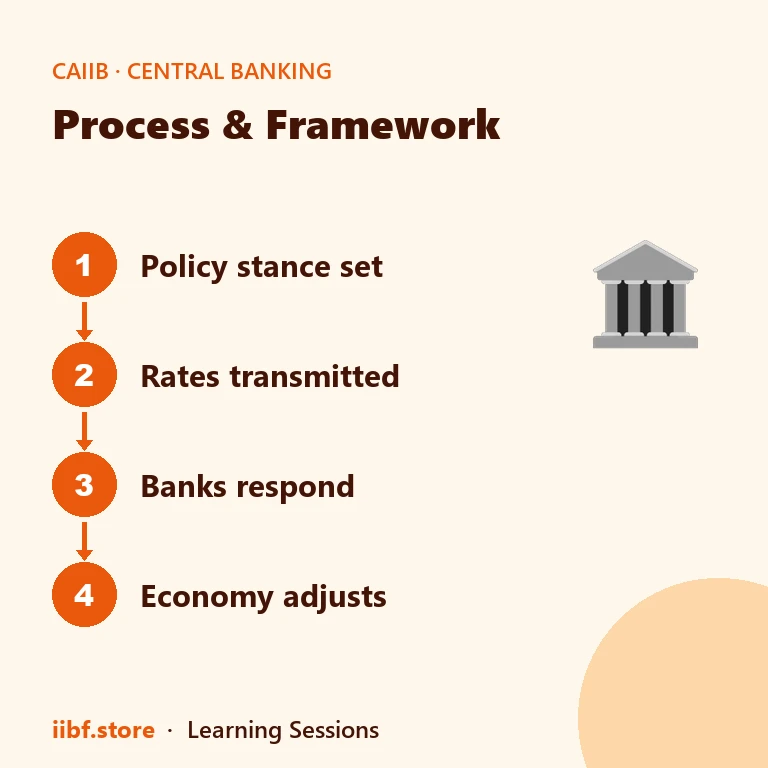
Variable rate auctions don't operate in isolation — they sit alongside a suite of RBI liquidity tools that CAIIB candidates must be able to distinguish clearly. The Marginal Standing Facility serves as the emergency ceiling banks tap when they've exhausted other options, while the Standing Deposit Facility absorbs surplus liquidity without needing collateral — a key difference from VRRR, which does require collateral from RBI's side. On the fiscal side, the Ways and Means Advances facility smooths the government's own temporary cash mismatches, which is a major source of the very liquidity swings that VRR/VRRR auctions are designed to absorb or inject against. And because all of this liquidity management ultimately serves RBI's broader mandate, it's worth revisiting the inflation targeting framework guide to see how short-term liquidity operations connect to the medium-term inflation goal. On the regulatory side, similar risk-based, tiered thinking shows up in how RBI treats shadow-banking entities — see how the NBFC scale based regulation framework applies graded rules to bigger institutions, a theme CAIIB examiners frequently connect across ABM and Central Banking papers. For the primary source, RBI's own liquidity management framework and periodic notifications are published on rbi.org.in, and are worth skimming before your exam for the latest tenor and auction-format tweaks.
For a wider map of Central Banking topics, browse the Central Banking tag hub, revisit the contemporary issues in central banking chapter for how these tools have evolved post-pandemic, and check current RBI rates for the latest repo/reverse repo/MSF levels before attempting mock tests.
🧠 Practice MCQs: Variable Rate Repo Auctions
Q1. In a variable rate repo auction, how is the rate determined? (a) Pre-announced by the Monetary Policy Committee (b) Discovered through competitive bidding by participants (c) Fixed at the MSF rate (d) Set equal to the previous day's WACR
Answer: (b) — Unlike the fixed-rate LAF window, VRR auctions let banks bid their own rates, and RBI determines a cut-off based on the notified amount.
Q2. A Variable Rate Reverse Repo (VRRR) auction is used by RBI to: (a) Inject liquidity during a deficit (b) Absorb surplus liquidity from banks (c) Set the bi-monthly policy repo rate (d) Provide emergency overnight funds above the corridor
Answer: (b) — VRRR is an absorption tool: RBI borrows surplus funds from banks at a rate discovered through bidding, used when the system is flush with cash.
Q3. Which platform do banks use to submit bids in RBI's variable rate auctions? (a) NEFT portal (b) E-Kuber (c) CIBIL dashboard (d) SGL physical ledger only
Answer: (b) — Bids are submitted electronically through the Core Banking Solution platform, E-Kuber, within the notified auction window.
Q4. Compared to the fixed-rate overnight repo, variable rate repo auctions primarily give RBI better control over: (a) The exact quantity of liquidity injected (b) The bank's capital adequacy ratio (c) The inflation target band (d) The exchange rate
Answer: (a) — By pre-announcing the notified amount and letting the rate float, RBI fixes the quantity precisely while the market discovers the price.
Q5. VRR/VRRR auctions are best described as: (a) Standing, always-on facilities available on tap daily (b) Discretionary, need-based operations announced separately from the fixed LAF window (c) Instruments used only during MPC policy announcements (d) A replacement for the Marginal Standing Facility
Answer: (b) — They are supplementary, discretionary tools RBI deploys based on assessed liquidity conditions, distinct from the standing fixed-rate LAF window.
Want chapter-wise mock tests with 100+ MCQs? Start practising free →
❓ Frequently Asked Questions
What is the difference between VRR and the fixed-rate repo under LAF?
The fixed-rate repo has a rate pre-announced by RBI and is available on tap every day, while a variable rate repo (VRR) auction has the amount pre-announced and the rate discovered through competitive bidding among participants.
How often does RBI conduct variable rate repo auctions?
There is no fixed schedule — RBI conducts VRR or VRRR auctions on a need-based, discretionary basis depending on the prevailing banking-system liquidity position, which can mean daily during stress or none for extended periods when liquidity is balanced.
What collateral is required for a variable rate repo auction?
Participants pledge eligible government securities held in their SGL (Subsidiary General Ledger) account, similar to the collateral required under the standard LAF repo window.
Why is the VRR cut-off rate important for CAIIB candidates to understand?
The VRR cut-off rate shows how closely the money market rate is tracking the policy repo rate — a persistent gap signals transmission stress, a concept frequently tested alongside monetary policy transmission topics in Central Banking papers.
Mastering variable rate repo auctions rounds out your understanding of RBI's full liquidity toolkit beyond the textbook LAF corridor. Reinforce it with a timed mock — head to CAIIB Central Banking course or attempt a practice test now, and browse the blog for more exam-focused explainers.
Prefer revising from a printed book?
Chapter-wise books with MCQs after every chapter — minimal pages, complete coverage, delivered anywhere in India. Every book has a free sample to read first.
98 pages · 282 MCQs
Learning Sessions · Ashish Sir
148 pages · 478 MCQs
Learning Sessions · Ashish Sir
151 pages · 465 MCQs
Learning Sessions · Ashish Sir
148 pages · 375 MCQs
Learning Sessions · Ashish Sir
216 pages · 895 MCQs
Learning Sessions · Ashish Sir
109 pages · 300 MCQs
Learning Sessions · Ashish Sir
104 pages · 360 MCQs
Learning Sessions · Ashish Sir
82 pages · 297 MCQs
Learning Sessions · Ashish Sir
151 pages · 600 MCQs
Learning Sessions · Ashish Sir
131 pages · 672 MCQs
Learning Sessions · Ashish Sir
221 pages · 831 MCQs
Learning Sessions · Ashish Sir
128 pages · 524 MCQs
Learning Sessions · Ashish Sir
107 pages · 445 MCQs
Learning Sessions · Ashish Sir
132 pages · 225 MCQs
Learning Sessions · Ashish Sir
188 pages · 435 MCQs
Learning Sessions · Ashish Sir
117 pages · 236 MCQs
Learning Sessions · Ashish Sir
Learning Sessions · Ashish Sir
118 pages · 299 MCQs
Learning Sessions · Ashish Sir
Learning Sessions · Ashish Sir
Learning Sessions · Ashish Sir
Learning Sessions · Ashish Sir
115 pages · 255 MCQs
Learning Sessions · Ashish Sir
Learning Sessions · Ashish Sir
334 pages · 936 MCQs
Learning Sessions · Ashish Sir
Learning Sessions · Ashish Sir
115 pages · 344 MCQs
Learning Sessions · Ashish Sir
107 pages · 240 MCQs
Learning Sessions · Ashish Sir
90 pages · 150 MCQs
Learning Sessions · Ashish Sir
Learning Sessions · Ashish Sir
Quick quiz on this topic
5 exam-style questions from our free test bank — check yourself before you move on.
Practice this topic
Take a free mock test, download chapter PDFs, or watch a video class — all included on iibf.store.