Indian Ethos and Values in Banking Explained (IIBF Ethics)
Indian ethos and values in banking is the very first thing the IIBF Ethics in Banking syllabus puts in front of you, and that placement is deliberate. An "ethos" is the characteristic spirit and settled moral outlook of a culture — not a decorative preface bolted on before the "real" compliance chapters. The paper expects you to take an inherited moral vocabulary — dharma, nishkama karma, trusteeship, shreya and preya — and apply it to a live loan file, a mis-sold insurance policy, or a gift offered by a borrower. This guide walks you through each idea, its precise banking translation, and the way examiners actually test it.
🪔 What an Ethos Is, and Why IIBF Starts Here
An ethos is not a rulebook. It is the shared disposition that decides what people in a community treat as obviously right, obviously shameful, or simply not done — the layer of judgement that operates before any rule is consulted. Compliance tells you what is prohibited; an ethos tells you what you would not do even if it were permitted.
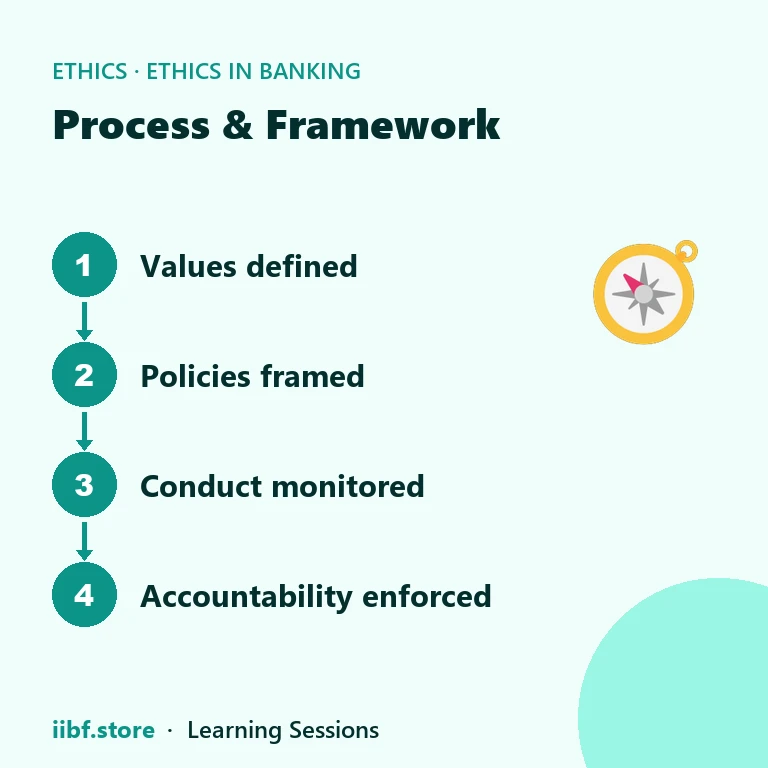
The syllabus opens with Indian ethos and values in banking because Indian banking is staffed and supervised by people formed by a specific moral inheritance. A code of conduct written in Basel language still has to be obeyed at 4 p.m. on the last day of a quarter by a branch officer under target pressure. What holds at that moment is disposition, not documentation.
There is a second, more practical reason. Indian ethical thought is unusually strong on duty and unusually weak on entitlement, which is exactly the emphasis a fiduciary industry needs. Western business ethics tends to reason from rights, contracts and consequences; the Indian tradition reasons from obligation attached to a role. Both arrive at "do not mis-sell", but the Indian route gets there faster in an ambiguous case.
The chapter on ethics as a holistic approach makes this point directly: values, systems and conduct are one continuous fabric, not three separate audit heads. Read the module knowing that every abstract term in it has a branch-level counterpart.
⚖️ Dharma: Duty Appropriate to Role and Station
Dharma, in the sense the syllabus uses it, is duty appropriate to a person's role, station and situation. It is deliberately not a single universal command. A soldier's dharma, a teacher's dharma and a banker's dharma differ because their positions differ, yet each is binding on the person occupying that position.
Translate that into your job and the four duties fall out cleanly. Towards the depositor, whose money you hold and who has no bargaining power, the duty is safety and honest advice. Towards the borrower, the duty is fair appraisal, transparent pricing and recovery conducted without harassment. Towards the institution, the duty is protection of its capital and reputation. Towards society, the duty is credit allocated productively rather than to whoever shouts loudest.
Notice the ordering problem the exam loves. These four duties conflict. The classic case study gives you a profitable proposal that is bad for the depositor, or a recovery route that is legal but degrading. Dharma reasoning resolves it by asking which duty is constitutive of your role: a bank exists because depositors trust it, so depositor protection is not one interest among four, it is the ground of the rest.
This is where Indian ethos and values in banking connects to the modern law of the banker-customer relationship. The fiduciary duty of bankers is, in effect, dharma written in enforceable language — trust, care and disclosure owed because of the position held, not because of a bargain struck.
💡 Exam Tip: When a case study asks "what should the officer do?", first name the role, then name the duty attached to that role. Answers that begin with the role score higher than answers that begin with the regulation.
🎯 Nishkama Karma, Shreya and Preya on the Sales Floor
Nishkama karma — the teaching of the Bhagavad Gita's second chapter that one has a claim on the action but not on its fruit — is the single most misread idea in this module. It does not say targets are immoral, and it does not ask you to refuse variable pay. It says the reward must not become the governing motive of the work; the work is to be done to its proper standard because that is what the work demands.
The banking application is immediate. A relationship manager who assesses suitability first and books whatever product genuinely fits is practising nishkama karma even while earning incentive. One who reverse-engineers the recommendation from the commission grid has inverted the order, and every mis-selling case in the syllabus traces back to that inversion.
The Katha Upanishad's contrast between shreya (the good) and preya (the pleasant) sharpens it further. The two rarely announce themselves; the pleasant option is the one that closes today. A single-premium market-linked policy sold to a seventy-four-year-old seeking capital safety is preya for the seller and disaster for the buyer. Choosing shreya means choosing the customer's long-term interest over your short-term commission, knowingly and repeatedly.
Distorted incentives are also why moral hazard in banking sits so close to this chapter: when the person taking the risk does not bear its consequence, only an internalised standard restrains them until the regulator catches up.
⚠️ Common Mistake: Writing that nishkama karma means "work without expecting salary". It means work whose quality is not dictated by the reward. Say that, and you keep the mark.
🤝 Trusteeship, Aparigraha and Satya in Practice
Gandhi's doctrine of trusteeship holds that wealth and position are held in trust for society rather than owned outright. The holder is a custodian with a duty to use what is held for the common benefit. In a bank this is not metaphor: every rupee on the liability side belongs to somebody else, and every discretionary power you exercise was delegated, not earned. Modern stewardship language — boards as stewards, institutional investors as stewards of client capital — is trusteeship in contemporary dress.
Two further virtues close the loop. Aparigraha, non-possessiveness or non-grasping, is why gifts, hospitality and "small favours" from borrowers are treated as corrosive even when no quid pro quo is proved — accumulation of obligation is itself the harm. Satya, truthfulness, is broader than not lying: it forbids suppression of a material fact, which is precisely what a lock-in period or an exit load buried in a brochure amounts to.
The table below maps each concept to its banking application and to the policy instrument that carries it today. Use it as your revision anchor for Indian ethos and values in banking, and note the last column carefully — some values have a hard compliance hook, others survive only as judgement.
| Concept | Core idea | Banking application | Hard policy hook? |
|---|---|---|---|
| Dharma | Duty by role and station | Depositor safety ranks first among competing duties | ✅ Fiduciary and duty-of-care obligations |
| Nishkama karma | Excellence of the act over its fruit | Suitability decided before the incentive is looked at | ❌ Attitudinal; only indirectly via pay design |
| Trusteeship | Wealth and position held for society | Custody of public deposits; stewardship by the board | ✅ Board stewardship and CSR frameworks |
| Shreya over preya | The good over the merely pleasant | Long-term customer interest over quarter-end closure | ❌ Judgement-based; tested through suitability norms |
| Aparigraha | Non-possessiveness, non-grasping | Refusal of gifts, hospitality and favours from clients | ✅ Gifts and hospitality clauses in staff codes |
| Satya | Truthfulness, non-suppression | Full disclosure of charges, risks, lock-ins and exit loads | ✅ Transparency and disclosure requirements |
🕉️ Plural Traditions and the "Too Vague to Enforce" Objection
The Indian inheritance is plural, and the exam expects you to know the parallel strands. Buddhist samma ajiva, right livelihood in the Noble Eightfold Path, rules out earning a living through deceit or through trades that injure others — a direct ancestor of exclusion lists. Jain ahimsa extended into commerce produced an unusually scrupulous mercantile ethic, cautious about leverage and about harm done at a distance. Sikh teaching pairs kirat karo, honest earning, with vand chhako, sharing what is earned, which is redistribution built into the definition of legitimate income. Islamic ethics prohibits riba (interest) and gharar (excessive uncertainty or speculation), and inspired participatory, asset-backed and profit-and-loss-sharing structures; note for accuracy that India's present statutory framework does not permit interest-free deposit banking, so treat this as an ethical influence rather than an available product line.
Alongside these ran the traditional mercantile community codes — the hundi, the word of honour, the community reputation that functioned as a credit bureau long before one existed. Default was social death, so enforcement cost almost nothing.
The standard criticism is that all this is too soft to operationalise. The syllabus answer is that institutions are the operational form of these values: written codes of conduct, protected whistle-blower and vigil mechanisms, board-level oversight and, above all, tone at the top. Chapter 11 on building an ethical organization and Chapter 10 on work ethics and the workplace are where Indian ethos and values in banking stops being philosophy and becomes an org chart. The same logic drives the three lines of defence in bank compliance, and it is what an ethical audit in banks is designed to measure. Self-management comes first in the sequence: the tradition insists you cannot govern others before you have disciplined yourself, which is why character-building is treated as a managerial competence, not a private hobby. For the institute's own syllabus and study material, see the Indian Institute of Banking & Finance, and browse the full Ethics in Banking article hub for the rest of this series.
📌 Remember: Examiners test application, not recitation. Naming five Sanskrit terms earns little; resolving a case study by naming the duty, the conflict and the value that breaks the tie earns the mark.
🧠 Practice MCQs: Indian Ethos and Values in Banking
Q1. In Indian ethical thought as used in the IIBF syllabus, "dharma" applied to a banker is best described as — (a) the pursuit of profit within the limits of law (b) duty appropriate to one's role, station and situation (c) a purely ritual obligation with no secular content (d) charitable giving out of surplus income
Answer: (b) — Dharma is role-specific duty; it is not universal charity, ritual, or lawful profit-seeking.
Q2. A branch head declines to book a single-premium market-linked policy for a 74-year-old depositor seeking capital safety, though it would complete her quarterly target. Which distinction does this best illustrate? — (a) satya over asatya (b) aparigraha over parigraha (c) shreya over preya (d) ahimsa over himsa
Answer: (c) — She chooses the customer's long-term good (shreya) over the immediately pleasant target closure (preya).
Q3. Nishkama karma, applied to a target-driven sales culture, most nearly means — (a) sales targets are inherently unethical and should be abolished (b) the work must be done to its proper standard, with the reward not governing the motive (c) employees should decline all variable pay (d) results matter more than the process that produced them
Answer: (b) — It regulates the motive, not the existence of incentives; quality of the act must not be dictated by its fruit.
Q4. The doctrine of trusteeship, as used in the Ethics in Banking syllabus, is closest to which modern idea? — (a) a trust created under the Indian Trusts Act, 1882 (b) stewardship, where wealth and position are held for the benefit of society (c) the debtor-creditor character of the banker-customer relationship (d) an escrow account operated for a third party
Answer: (b) — Trusteeship is an ethical doctrine of custodianship, mirrored today in board and investor stewardship, not a legal trust instrument.
Q5. A candidate argues that Indian ethical values are too vague to enforce in a bank. The best syllabus response is that they are institutionally expressed through — (a) higher capital adequacy ratios (b) codes of conduct, whistle-blower or vigil mechanisms and tone at the top (c) the deposit insurance scheme (d) statutory liquidity requirements
Answer: (b) — Codes, protected disclosure channels and leadership example are the institutional form these values take; prudential ratios address solvency, not conduct.
Want chapter-wise mock tests with 100+ MCQs? Start practising free →
❓ Frequently Asked Questions
Is this topic asked directly in the IIBF Ethics in Banking paper?
Rarely as a definition question and often as a case study. You are typically given a branch-level dilemma and asked to justify a course of action, so prepare the concepts as decision tools rather than as vocabulary.
Do I need to quote Sanskrit terms in my answer?
Use them once, with the English meaning in brackets, then argue in plain English. Examiners reward the reasoning that follows the term, not the term itself.
How is trusteeship different from corporate social responsibility?
CSR is a defined activity funded out of profit. Trusteeship is a prior attitude to the profit itself — that the wealth and the position are held on behalf of society. A bank can comply fully with CSR obligations and still fail the trusteeship test in how it treats depositors.
Is the Islamic prohibition on interest examinable as an Indian banking practice?
Treat it as an ethical influence on thinking about speculation, risk-sharing and asset backing. India's current statutory framework for banking does not permit interest-free deposit banking, so do not present it as an available Indian product line.
🎓 Conclusion: Turn the Ethos Into an Exam Method
Reduce the whole module to one habit. In any case study, name the role, name the duty that role creates, identify which duty is in conflict, and let the value break the tie — shreya over preya, satya over silence, aparigraha over the accepted favour, trusteeship over ownership. That method converts Indian ethos and values in banking from a reading assignment into marks.
Now test it under time pressure. Work through the Ethics in Banking chapter set, then attempt a full mock at iibf.store mock tests, and if Ethics is part of your CAIIB plan, line it up with the rest of your syllabus on the CAIIB course page. Ten case studies solved this way will do more for your score than a second reading of the chapter.
Quick quiz on this topic
5 exam-style questions from our free test bank — check yourself before you move on.
Practice this topic
Take a free mock test, download chapter PDFs, or watch a video class — all included on iibf.store.